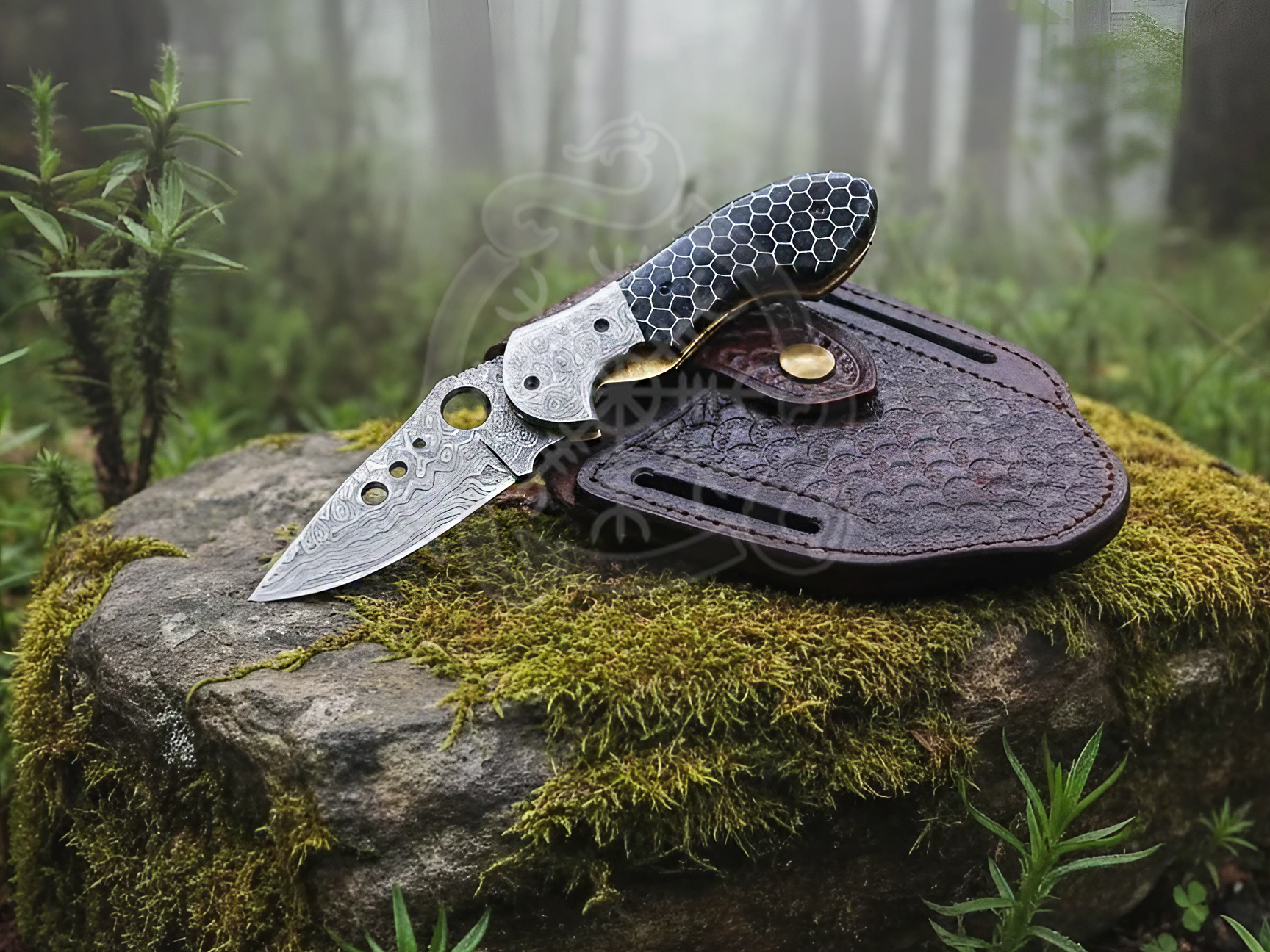
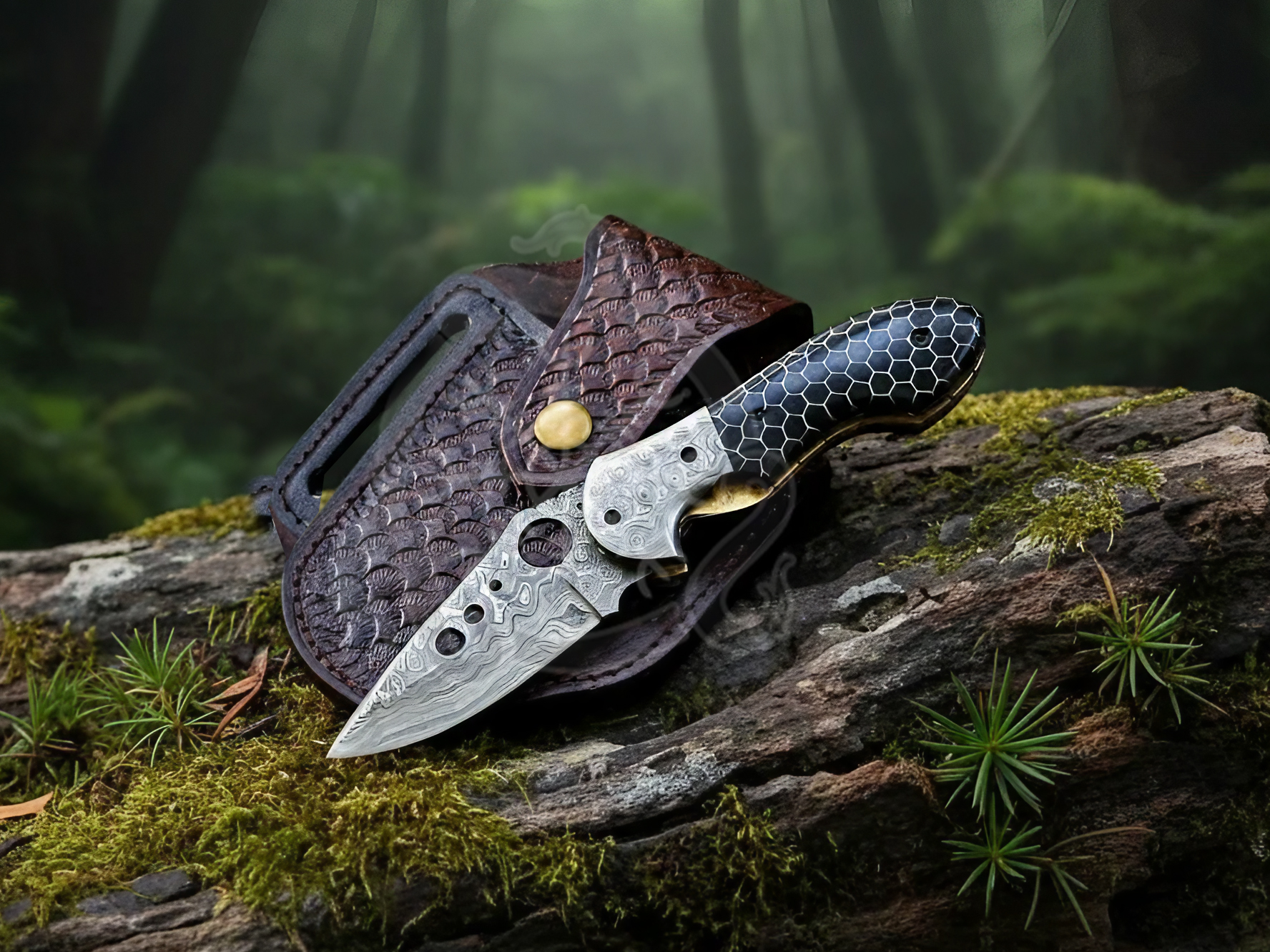
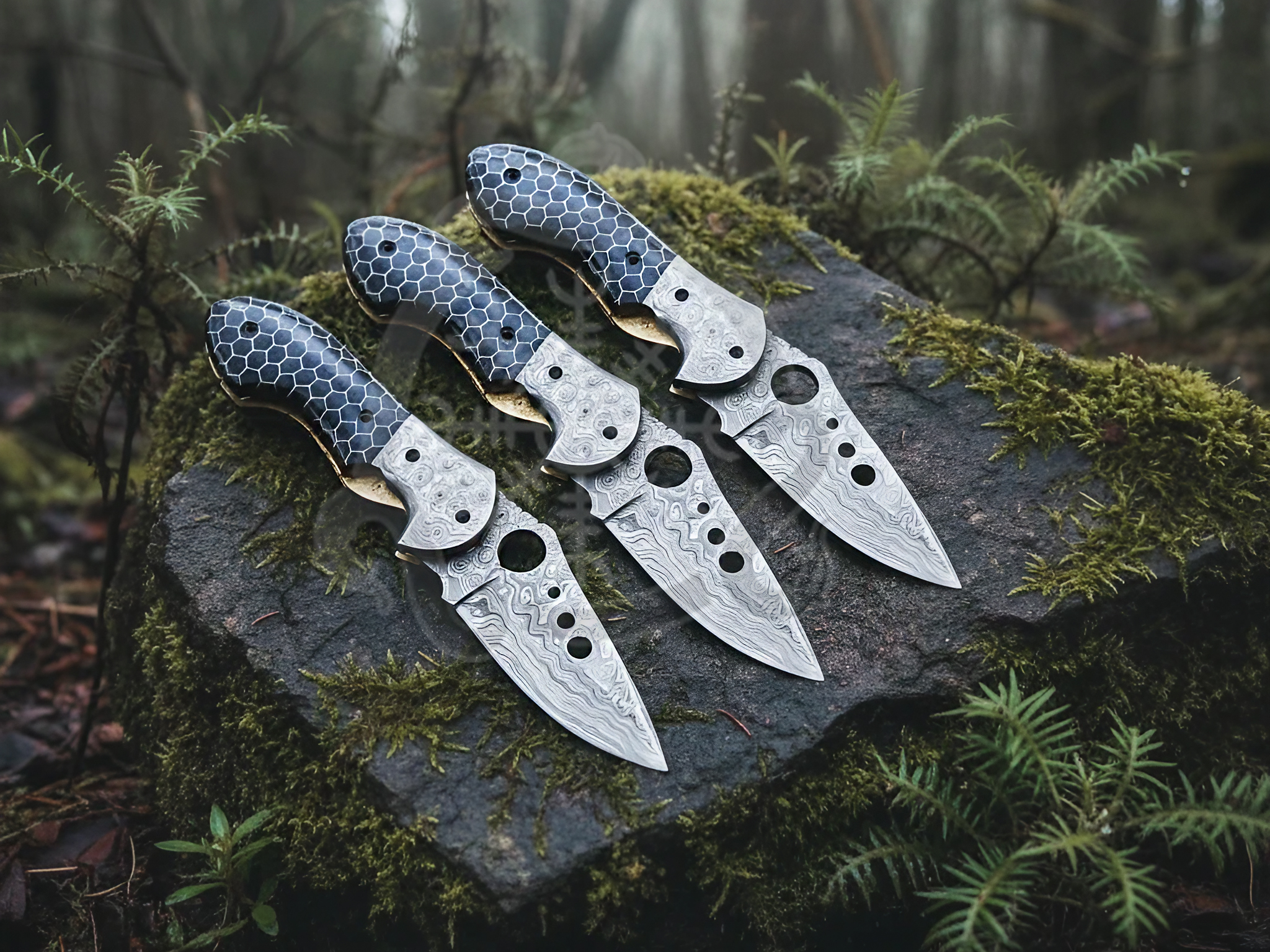
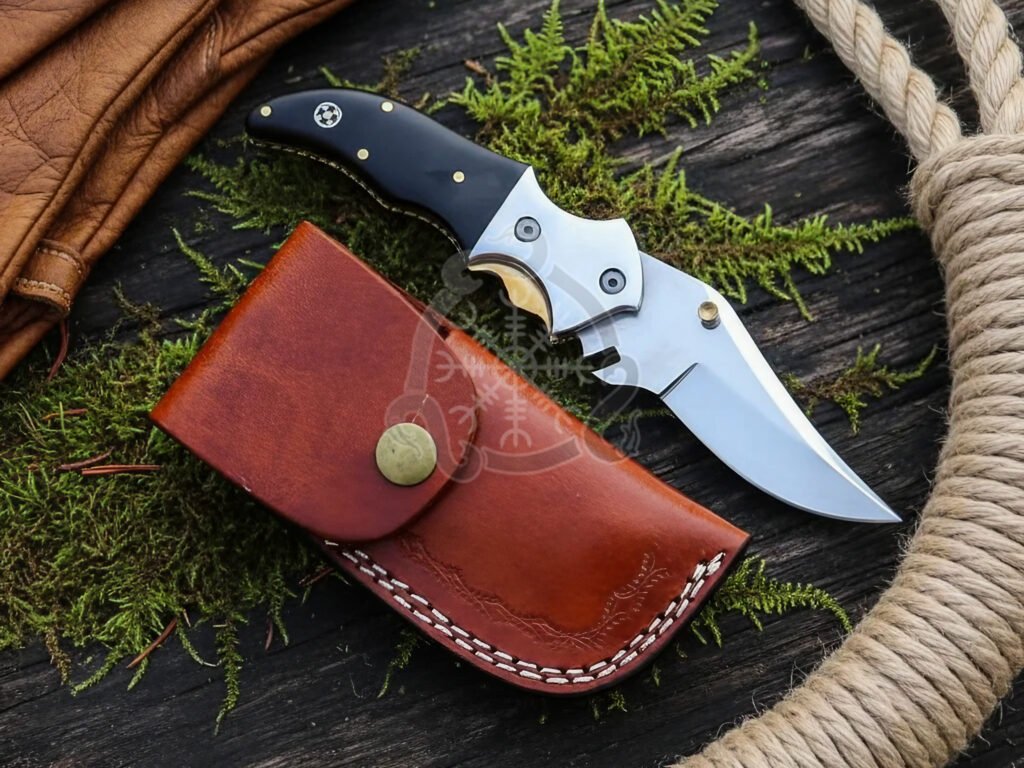
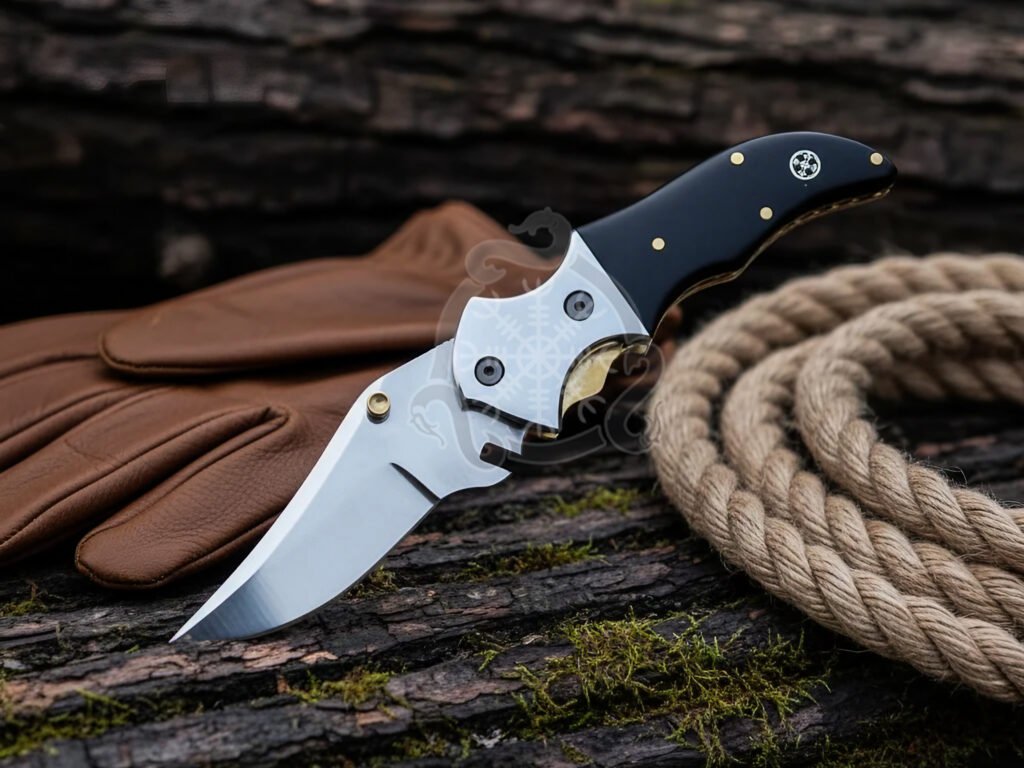
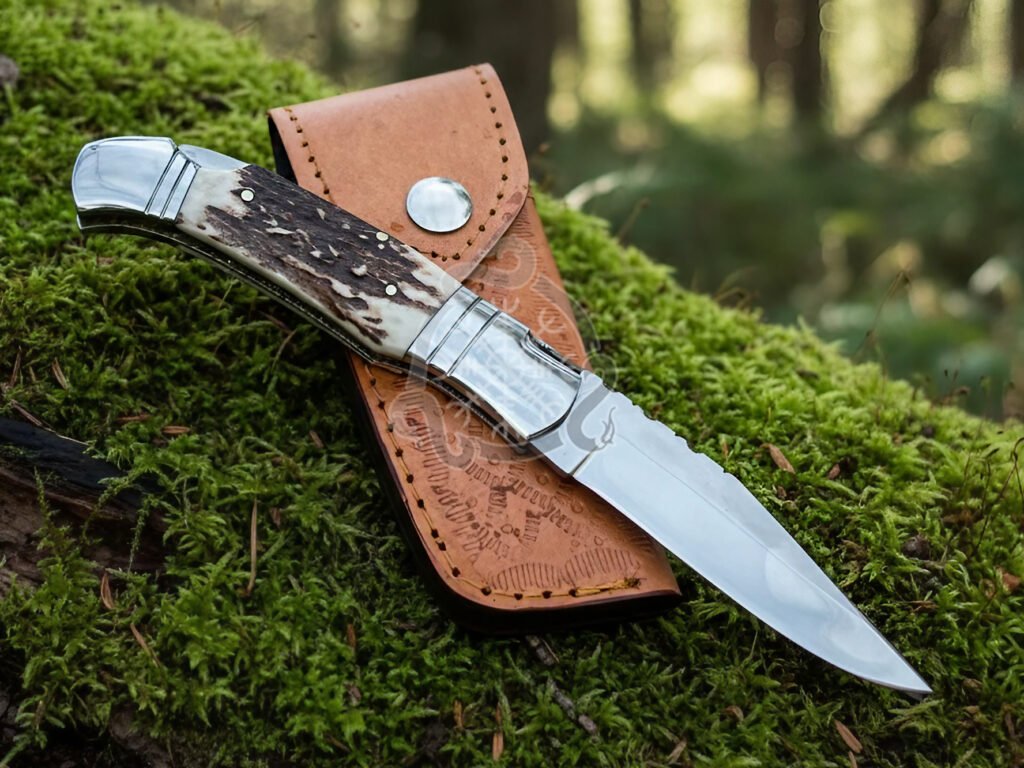
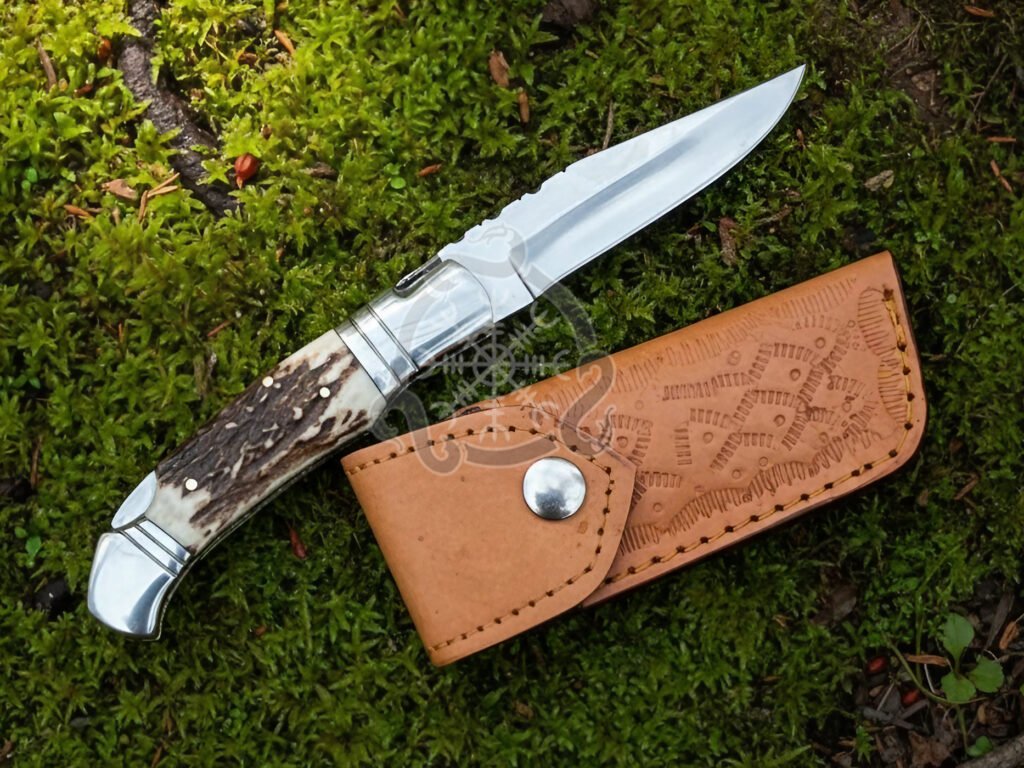
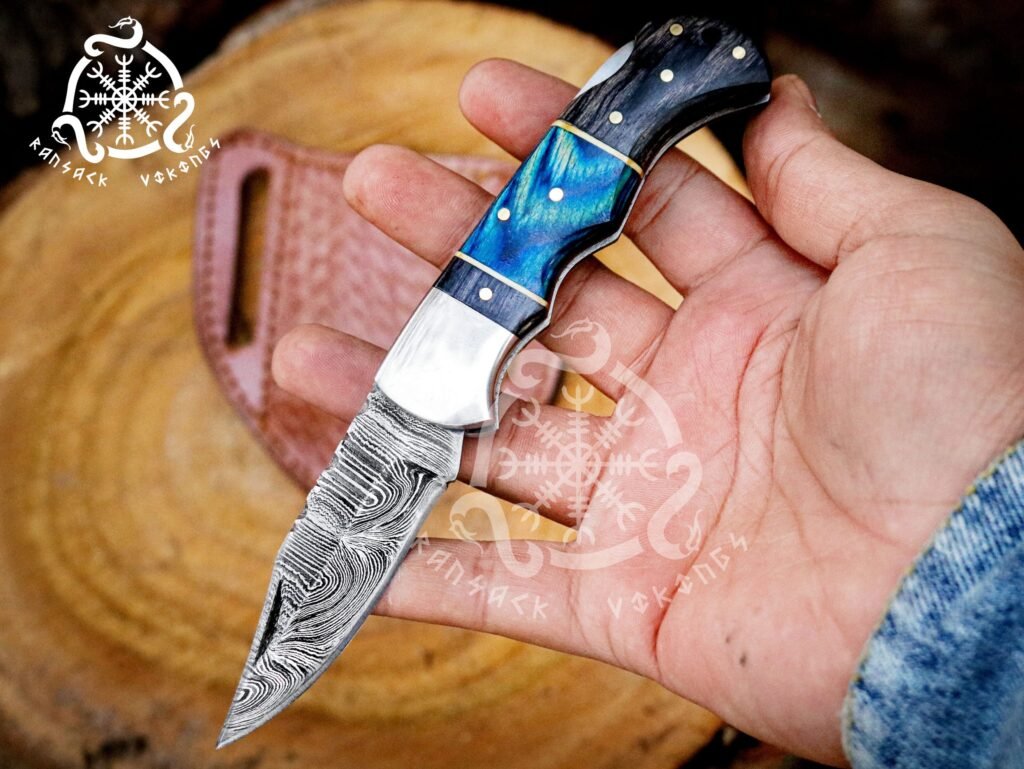
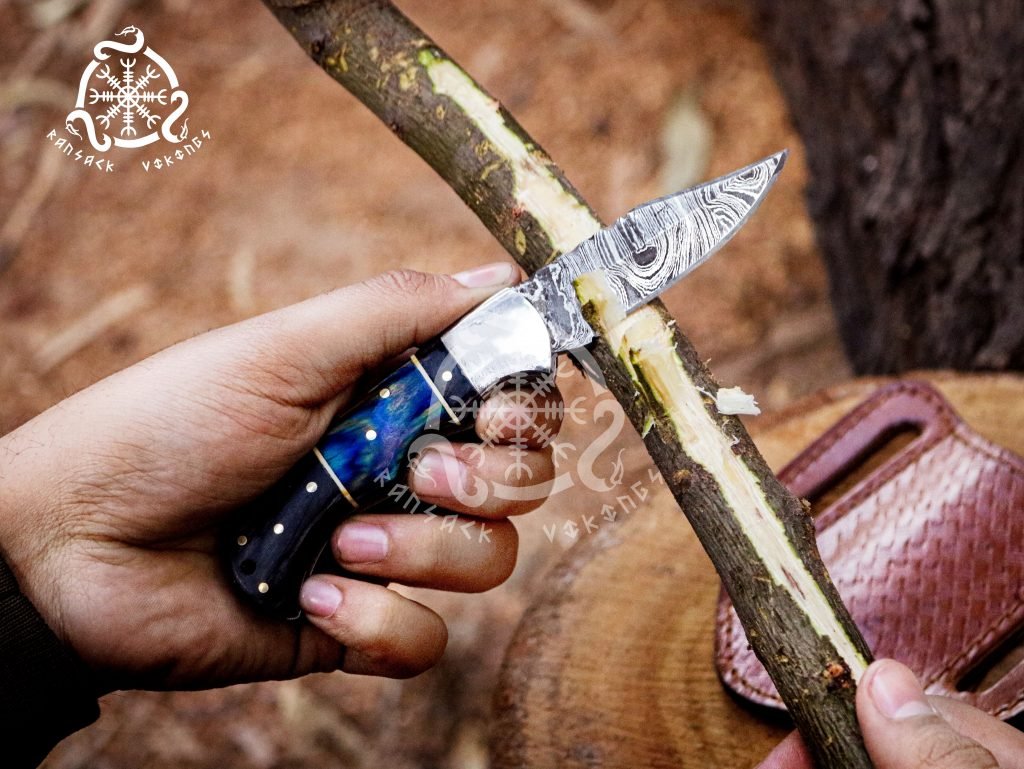
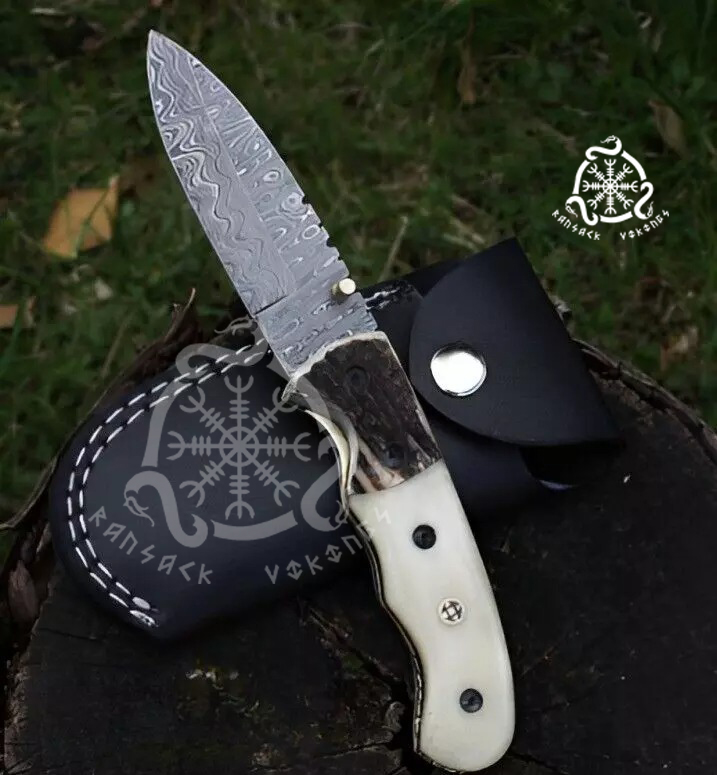
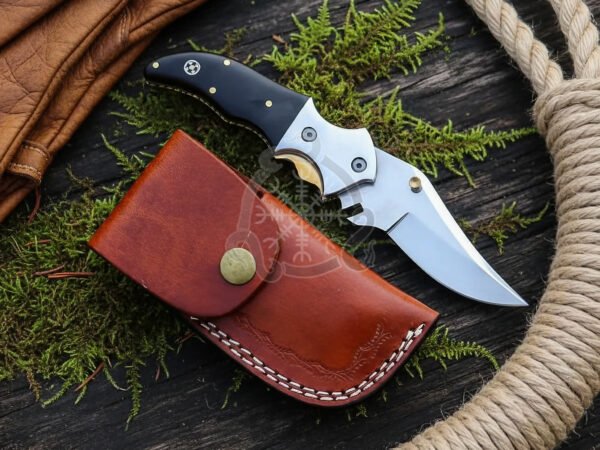
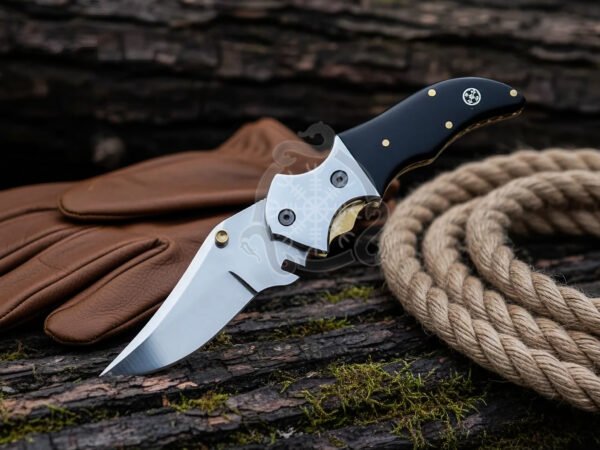
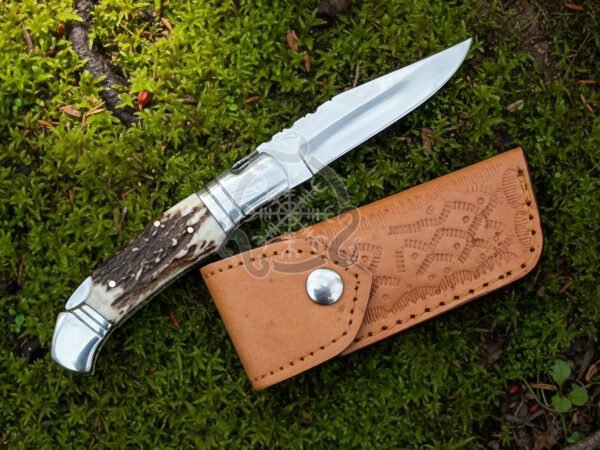
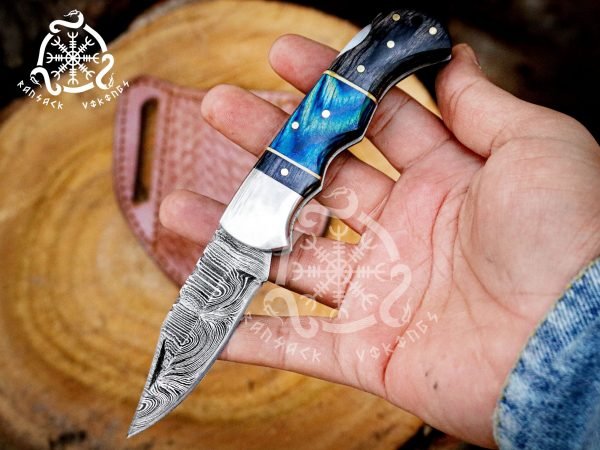
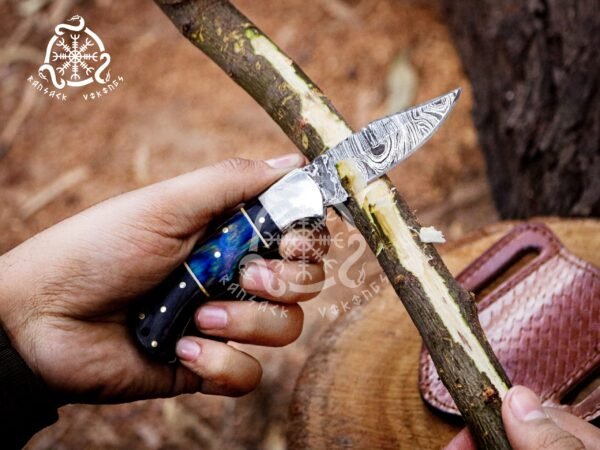
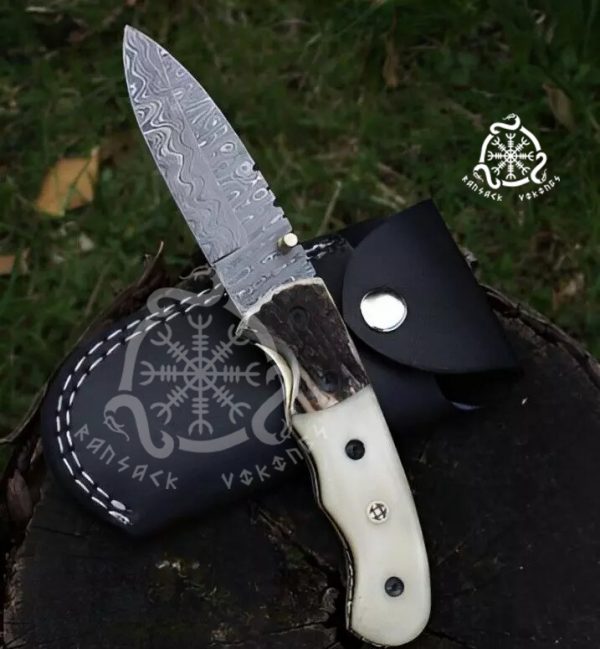
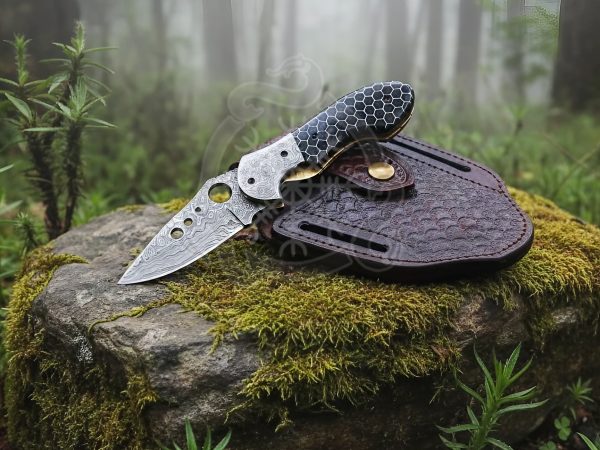
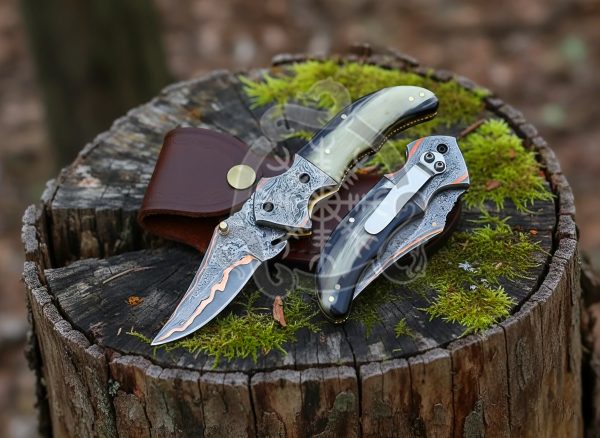
The Ramfold is what happens when a folding pocket knife is made by hand instead of stamped out. A 512 layer Damascus blade of three and a half inches, five millimetres thick at the spine, ram horn at the grip over a bone and honeycomb build, a liner lock to hold it open and a premium cowhide pancake sheath to carry it in. Six and a half inches open, and a fit you can feel the moment you pick it up. How this compares with the rest of the folding range is covered in the folding knives compared.
The lock is the part worth understanding. A liner lock is one leaf of the metal liner inside the handle, cut free along most of its length and bent inward so it is always under spring tension. Closed, the blade holds the leaf out of the way. Open the blade fully and the leaf snaps across behind the tang, wedging against a matched angle so the blade cannot fold back onto your fingers. To close it you push the leaf aside with a thumb and fold the blade down. The idea appeared in various forms early in the twentieth century, but it was the American maker Michael Walker who refined it in the early 1980s into the geometry the whole industry now uses. What makes it good is that it is simple, it is operated one handed, and the harder the blade is loaded the more firmly the leaf is driven into the lock face.
This knife is forged and finished in the Czech Republic, from billet welding through heat treat, grinding, handle fitting, sheath making and final sharpening.
Specifications
| Steel | Hand forged Damascus, 1095 and 15N20, approximately 512 layers |
|---|
| Hardness | 58 to 60 HRC |
|---|
| Overall length | 6.5 inches open |
|---|
| Blade length | 3.5 inches |
|---|
| Handle length | 3.5 inches |
|---|
| Blade thickness | Approximately 5 mm |
|---|
| Handle | Ram horn with bone and honeycomb |
|---|
| Lock | Liner lock |
|---|
| Finish | Handmade forged pattern Damascus |
|---|
| Sheath | Premium cowhide leather, pancake style |
|---|
| SKU | RK-1017 |
|---|
512 layers, five millimetres, and what those numbers mean
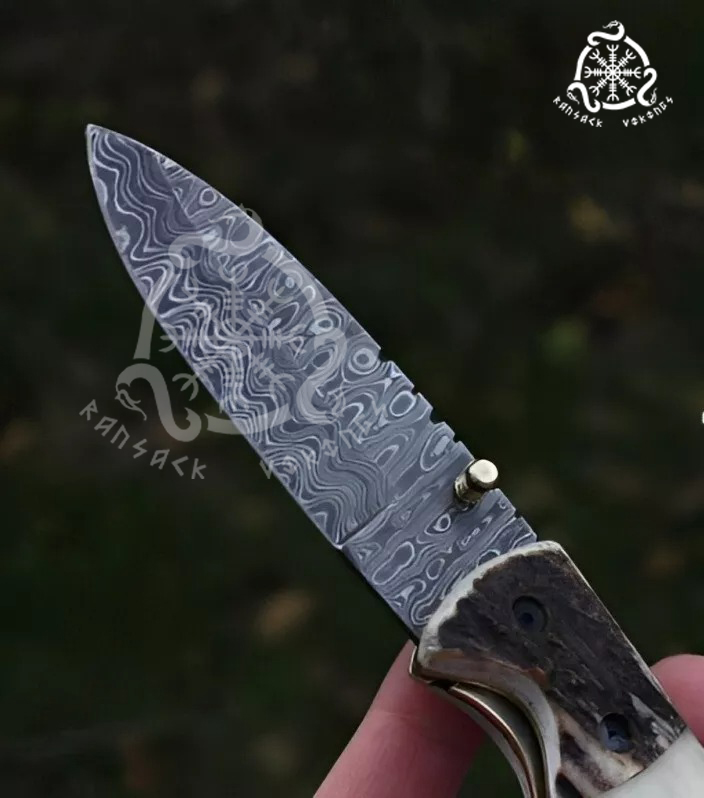
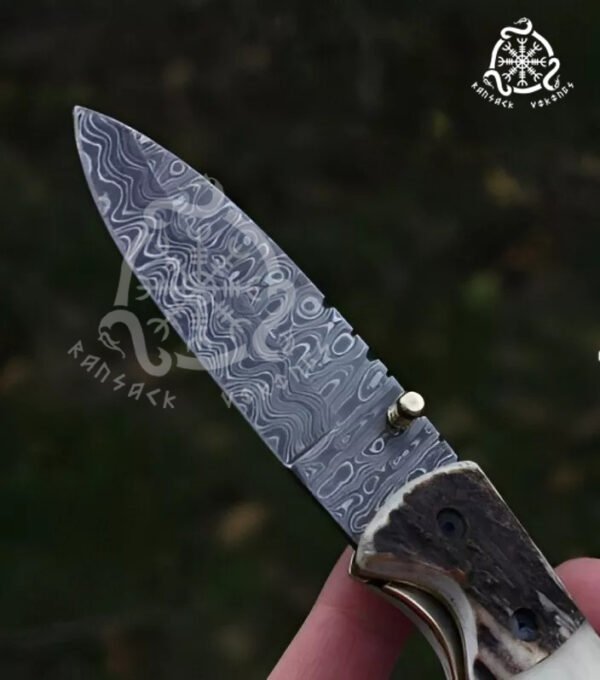
Layer counts get thrown around in Damascus listings without much explanation, so here is the plain version. A billet starts as a stack of alternating sheets, say ten or twenty. Forge weld it, cut it, fold it and weld it again and the count doubles each time. Nine folds from a stack of two gives you 512. What a higher count actually changes is the fineness of the pattern: more layers means thinner individual layers, so the light and dark bands sit closer together and the finished blade reads as a tight, busy pattern rather than a few broad stripes. Past a point it stops improving performance and becomes purely visual, and 512 sits right at the top of the useful visual range.
The five millimetre spine is the more unusual number. Most folding knives are ground from stock half that thickness, because a folder does not need the strength and every extra millimetre is weight in a pocket and a thicker wedge behind the edge. This one is built deliberately stout, which gives it a heft in the hand that thin folders do not have and makes the blade unusually rigid for its length. It is a knife with mass. The trade off is honest: it is heavier to carry than a slim gentleman’s folder, and a thicker blade takes more effort to push through a deep cut in dense material. The stated hardness on this piece is 58 to 60 HRC, a little softer than our fixed blades, which makes the edge tougher and more forgiving against chipping and means it takes very little work to bring back on a stone.
Why Damascus and not stainless
The billet is built from alternating layers of 1095 and 15N20, forge welded, folded and drawn down before the blade is cut from it. That is why the pattern follows the grind instead of running flat across it, and it is the reason you cannot sand or wear the pattern off: it goes through the steel. More on whether the steel earns its reputation is in is Damascus steel good.
The case for stainless is a real one on a folder, and we will state it rather than skip past it. Folders live in pockets, absorb sweat, and get closed while damp with moisture sitting in the pivot slot where no cloth reaches. Stainless is indifferent to all of that. What it will not give you is this pattern, because there is nothing in a stainless alloy for an acid etch to differentiate, and it will not take the same fine edge. The trade is a distinctive, harder working carbon blade in exchange for drying it and oiling it. The comparison is in Damascus versus stainless.
The ram horn handle
Ram horn is keratin, layered and translucent, and it is a natural material, so the colour, the streaking and the depth of the translucency change from piece to piece. Yours will not match the photograph exactly, and that is the point of buying handmade. Held up to a light, the thinner sections glow amber where a bone or wood scale would stay opaque.
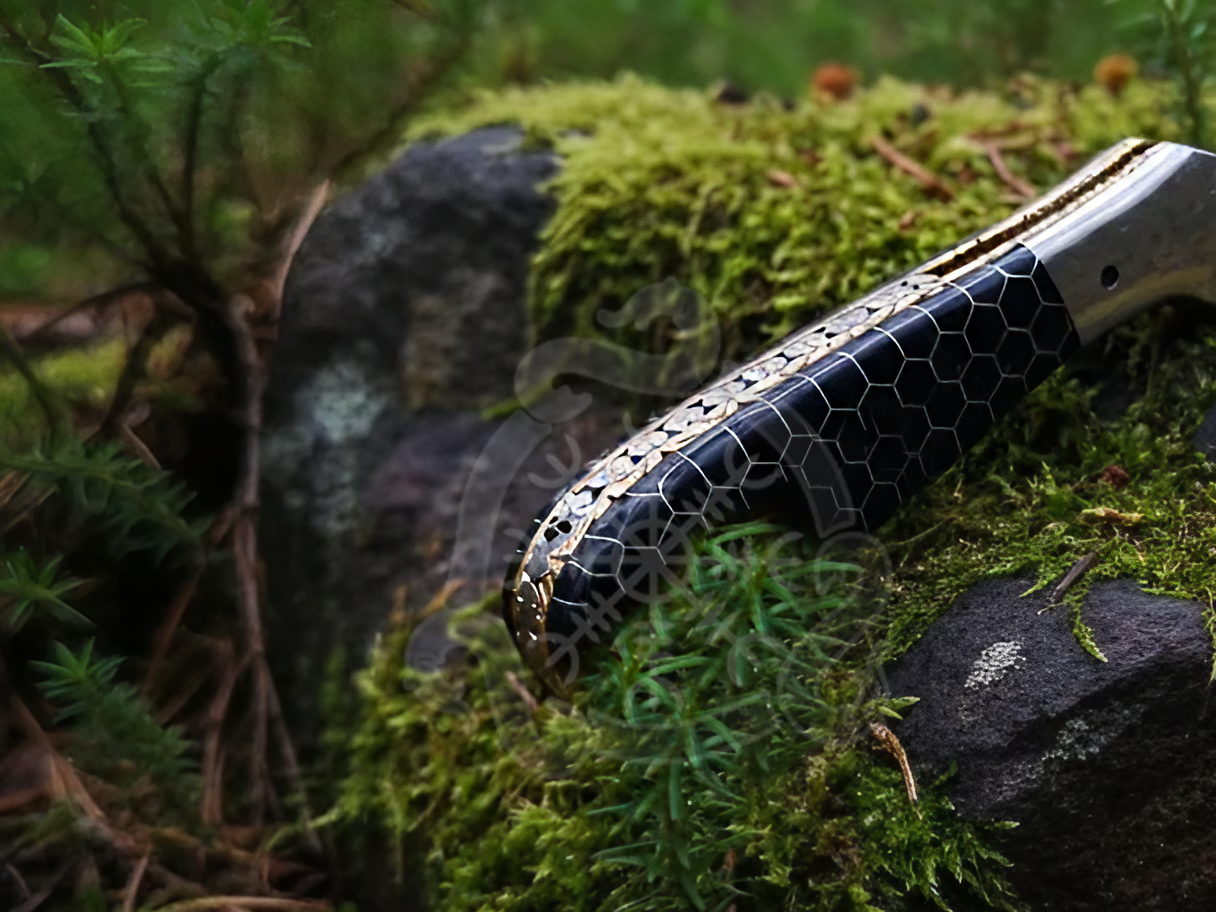
The handle is built as an assembly rather than a pair of plain scales, with bone and a honeycomb layer working with the horn, and the liner lock mechanism running inside it. Keep it away from prolonged soaking and away from sustained dry heat and it will stay stable for decades. That means no dishwasher, no radiator, no summer afternoons on a dashboard. Wash by hand, dry the handle with the blade, and leave the knife open until the pivot has dried. A light wipe of oil once or twice a year stops horn looking chalky, exactly as it would a wooden grip, and the routine is in wooden handle care.
Engraving, runes and your own design
Use the rune converter on this page to turn a name, a date or a short phrase into Elder Futhark and we will cut it into the steel or the handle. If you would rather have a Viking pattern than a rune line, choose your own design in the engraving option above the add to cart button and tell us whether it goes on the blade or the handle. Where a piece already carries an engraved design, your chosen engraving replaces it rather than sitting alongside it. On this knife a dense 512 layer pattern competes with lettering on the blade, so short lines or initials read best there, while the horn takes a cut line with strong contrast. Layout and lettering examples are on the engraving page.
Care and sharpening
Damascus is carbon steel underneath the pattern, so treat it like carbon steel. Dry after use, a thin film of oil before storage, and out of the sheath for long spells, because leather is tanned with salts and holds moisture against a blade. A single drop of oil at the pivot once or twice a year, spread by working the action, keeps the lock and the blade moving cleanly. Detail is in steel care, and sheath care is in leather sheath care.
At 58 to 60 HRC this edge is quick to sharpen. Match the existing bevel, work one side in overlapping passes until you feel a burr along the full length, turn the blade and match it, then strip the burr with light alternating strokes. A slightly softer blade rewards a slightly coarser finish, so stop at a medium stone for a working edge with bite. The method is in sharpening with a whetstone.
Made in the Czech Republic
Every piece we sell is made by hand in the Czech Republic. The smiths there work the way the trade has been worked for a long time, heating and hammering the steel, taking the bevels down by eye, and fitting the handle and the leather one at a time. There is no automated line anywhere in it, so small differences from one piece to the next are normal and expected.
Ransack Viking is a United States company based in Memphis, Tennessee. We bring the pieces in ourselves, inspect them on arrival and ship them from our own warehouse. If you add engraving, that is carried out here in the United States before your order goes out.
A note on handmade variation
The Ramfold is hand forged, not machine made and not bulk produced, so the knife that arrives will not be a pixel for pixel copy of the photograph on this page. The 512 layer pattern depends on how that individual billet folded and where in the bar the blade was cut. The ram horn brings its own colour, streaking and translucency, and the leather is cut to the individual knife. The dimensions, the steel and the build are the same every time. The character is not.
Frequently asked questions
How does the liner lock work?
One leaf of the metal liner inside the handle is cut free and sprung inward. When the blade is opened fully the leaf snaps across behind the tang and blocks it from folding back. To close, push the leaf aside with a thumb and fold the blade down. It is simple, strong and works one handed.
Does 512 layers make it a better knife?
It makes it a finer looking one. More layers means thinner individual layers and a tighter, busier pattern in the steel. Beyond a certain count the effect is visual rather than mechanical, and 512 sits at the top of the range where the pattern is at its most detailed.
Why is the blade so thick?
At around five millimetres it is roughly twice the stock of a typical folder, which is a deliberate choice. It gives the knife real mass in the hand and a very rigid blade. The honest cost is weight in a pocket and slightly more effort in a deep cut.
What is the sheath for on a folding knife?
Belt carry. The pancake style cowhide sheath sits flat against the body with the belt running through slots either side, so a folder this stout rides on a belt rather than dragging on a pocket. Store the knife outside the sheath for long periods.
Will my ram horn look like the photograph?
Not exactly. Ram horn varies enormously in colour, streaking and translucency, and every scale is cut from a different section. The shape, the size and the fit are consistent, the character is not.
Is it hard to sharpen?
No, and that is one of the advantages of the stated 58 to 60 HRC. A slightly softer edge is tougher against chipping and comes back on a stone with less work than a very hard blade. A few minutes on a medium stone restores it.
What is in the box
- One Ramfold hand forged Damascus folding pocket knife
- One premium cowhide leather pancake sheath
- Protective packaging
- Forged and finished in the Czech Republic
Explore the range
Nearby in the range: Folding Pocket Knives, Hunting Knives, Viking Knives and Engraved and Personalized. Everything else worth knowing is written up in the guides.









Reviews
There are no reviews yet