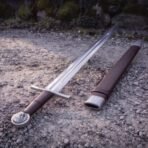
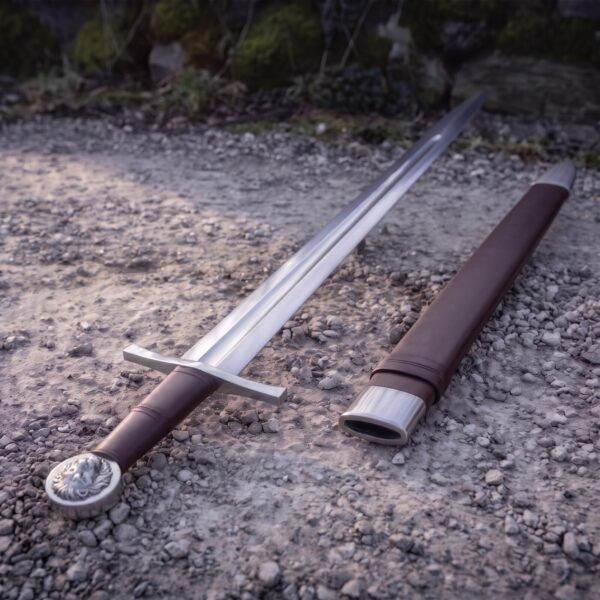
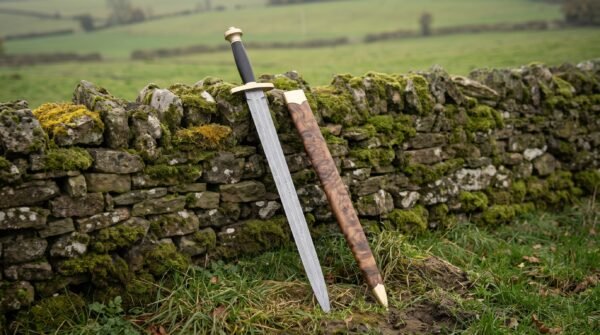
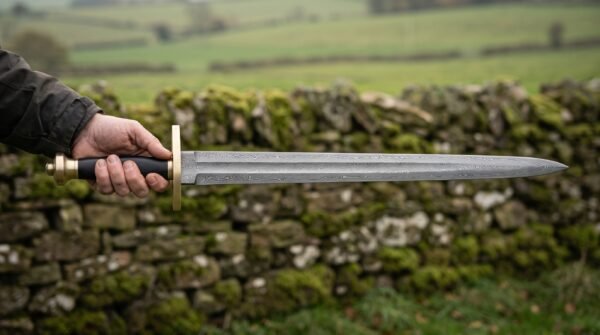
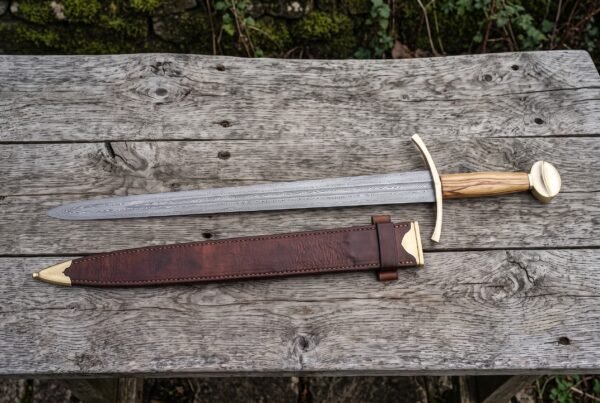
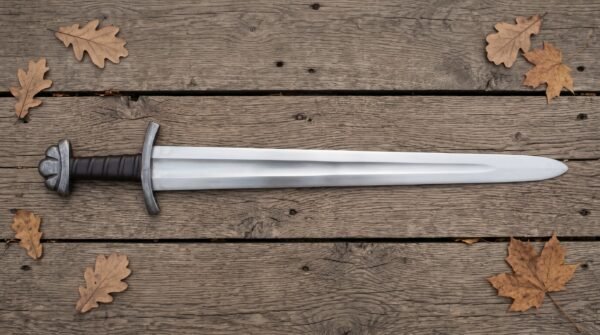
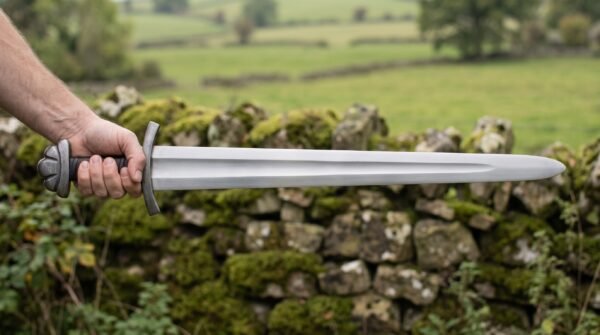
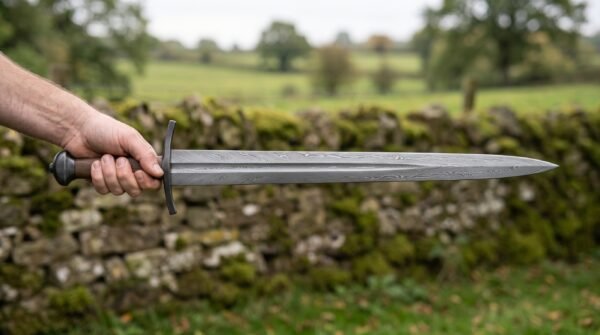
A forty inch knightly sword built in the style carried on the Third Crusade, with a round disc pommel that carries a lion’s head raised in relief. The blade is long, straight and double edged with a single fuller running down the centre. Above it sits a plain steel cross guard with squared ends, then a grip in dark brown leather, and the lion caps the whole thing where your palm closes. A dark brown leather scabbard with a steel chape comes with it.
We named it for Richard I of England, the king the chroniclers called Coeur de Lion, because the lion is the piece of heraldry most people tie to him and because a sword of this shape is what a king of the 1190s would have worn. The blade is 1095 high carbon steel, hand forged and hardened to 54 to 58 HRC. Nothing here is gilded or jewelled. The lion does the talking and the rest of the sword stays quiet, which is how a real sword of the period looked.
If you are building a crusader corner, the Pattecross Templar sword and the Crosswatch heater shield sit well beside it. The wider choice of single handed knightly swords is under arming swords, and display sword vs battle ready explains what the edge on a piece like this is for.
Specifications
| Blade steel | 1095 high carbon steel, hand forged |
|---|
| Hardness | 54 to 58 HRC |
|---|
| Overall length | Approximately 40 inches |
|---|
| Blade length | Approximately 33 inches |
|---|
| Blade | Straight, double edged, single central fuller, tapering point |
|---|
| Guard | Straight steel cross guard with squared ends |
|---|
| Grip | Dark brown leather over a wooden core, single hand |
|---|
| Pommel | Steel disc with a lion’s head raised in relief on the face |
|---|
| Scabbard | Dark brown leather with a steel chape, included |
|---|
| Edge | Finished edge, not honed to shaving sharpness |
|---|
| Type | Collector, display and reenactment display piece |
|---|
| SKU | RK-2381 |
|---|
Richard the Lionheart in brief
Richard was born in Oxford in 1157, the third son of Henry II and Eleanor of Aquitaine, and he spent remarkably little of his life in England. He was raised largely in his mother’s lands in the south of France, fought his own father more than once, and was crowned king in 1189. Within a year he had raised money by almost every means a medieval king could think of and set off on the Third Crusade.
The crusade is where the legend comes from. Richard took Acre in 1191 alongside Philip II of France, beat Saladin’s army at Arsuf the same year, and twice marched close enough to Jerusalem to see it without trying to take it. He judged that he could capture the city but could not hold it once the crusading armies went home, and he was probably right. In 1192 he agreed a truce with Saladin that left Jerusalem in Muslim hands but kept the coast for the crusaders and opened the city to Christian pilgrims.
The trip home went badly. He was shipwrecked, travelled overland in disguise, and was caught near Vienna by Duke Leopold of Austria, whom he had insulted at Acre. He spent more than a year as a prisoner of the Emperor Henry VI until England paid an enormous ransom. He died in 1199 from a crossbow wound taken at a minor siege in the Limousin, after only about six months in England across a ten year reign.
That record makes him a strange national hero, and historians have argued about him for eight hundred years. What nobody disputes is that he was a very good soldier who led from the front, and the name Lionheart was being used of him while he was still alive.
The lion on the pommel
Lions were already the badge of the English royal house in Richard’s time. His father and grandfather seem to have used them, and Richard’s second great seal, made in 1198, shows three lions passant guardant on his shield, the arrangement still used in the royal arms of England today. The nickname and the heraldry fed each other, and by the end of the Middle Ages a lion was simply what you put on anything meant to call Richard to mind.
On this sword the lion is a head rather than a full beast, raised from the face of the disc pommel so that the mane stands proud and catches light at its edges. A disc pommel is a good place for it. It is broad and flat, it faces outward when the sword hangs on a wall, and it is the one part of the hilt that anyone looking at the sword will see first. A full walking lion at that scale tends to turn into a lump; a head stays readable from across a room.
We will say plainly that there is no surviving sword of Richard’s with a lion on the pommel. Swords of his period were plain, and decoration, when there was any, usually went on the blade as an inlaid inscription or on the scabbard fittings. The lion head is our way of tying the sword to the man. The shape of everything below it is the period.
What a crusader sword of the 1190s was
A knight at Acre or Arsuf carried what collectors now call an arming sword, and what people at the time simply called a sword. It was a single handed weapon for use with a shield, about three feet in the blade or a little less, double edged and broad at the base. The cross guard was straight and fairly short, there mainly to stop an opponent’s blade sliding down onto the hand. The pommel was heavy, often a disc or a brazil nut shape, and it was there to balance the long blade so the sword felt lighter than it was.
That is the shape we have followed. The blade tapers from a wide base to a point, which lets it cut with authority and still give a reasonable thrust. Armour at the time was mostly mail over padding, and a sword that could cut hard and slip a point into a gap was what a knight wanted. The fuller down the centre removes steel where it does the least work, which keeps the blade stiff for its weight. It has nothing to do with blood, whatever you have been told.
At forty inches this sits at the long end for a one handed sword of the period, and it has the presence that suits a sword named for a king. The disc pommel pulls the balance back toward the guard so it does not feel nose heavy in the hand.
Steel and heat treat
The blade is 1095, a plain high carbon steel with about 0.95 percent carbon and very little else. It is one of the oldest and most honest blade steels in use. It hardens well, takes a good edge and is easy to bring back if it is ever neglected. It is not stainless, and that matters for care, which we cover below.
It is hardened and then tempered back to 54 to 58 HRC. That is softer than a kitchen knife, on purpose. A long sword blade needs to flex a little and come back true rather than stay hard and brittle, and this range is where a 1095 blade of this length behaves well. The steel glossary has more on what these numbers mean.
Engraving, runes and your own design
Use the rune converter on this page to turn a name, a date or a short phrase into Elder Futhark and we will cut it into the steel. On a crusader sword many buyers prefer a Latin motto or a plain English line instead of runes, and that is easy: choose your own design in the engraving option above the add to cart button and tell us the wording and where it goes. Where a piece already carries an engraved design, your chosen engraving replaces it rather than sitting alongside it. The fuller just below the guard is the traditional place for an inscription on a sword of this age, and it is where period swords carried theirs. More on the engraving page.
Handling and display
This is a collector and display sword, and a reenactment display piece for a costume, a stand or a wall. It arrives with a finished edge that is not honed to shaving sharpness. It is not built or sold for sparring, cutting practice or contact of any kind and should not be used for them.
On a wall, hang it with the pommel toward the room so the lion is what people see. Horizontal with the point to the left reads well over a fireplace; a diagonal behind a heater shield reads better in a corner. Use two fixings into a stud or a proper wall plug, one under the guard and one toward the point, so the weight never hangs off the hilt alone. How to display swords and axes covers brackets and heights.
If you would rather stand it, a floor or desk stand from the sword stands range works, and keeping the sword out of its scabbard on display is kinder to the blade in a damp house.
Care
Wipe the blade after it has been handled and keep a thin coat of light machine oil or mineral oil on it. Renew that every couple of months, more often in a humid room. Skin leaves salt on steel and 1095 will show a fingerprint as a rust spot within days if you let it.
Give the pommel the same treatment and pay attention to the recesses round the mane, where dust and moisture like to sit. A soft brush with a drop of oil on it gets into those better than a cloth.
Feed the grip leather and the scabbard once or twice a year with a proper leather conditioner. Do not store the sword sheathed for months in a damp room, because leather holds moisture against the steel. The care guide has the rest.
Made in the Czech Republic
This sword is made by hand in the Czech Republic, in a workshop that forges, grinds, hardens and fits its swords in small runs. Every one is checked before it is boxed for a tight hilt, a straight blade, a clean pommel casting and a scabbard that fits. It ships from our Chicago, Illinois warehouse. Processing takes one to two weeks, and engraved orders sit at the longer end because the layout is agreed with you first. Shipping inside the United States is free. Returns are accepted for seven days. The lifetime warranty against defects in forging, grind, heat treat and fittings has no end date and needs no receipt.
A note on handmade variation
This sword is made by hand, not machine made or bulk produced, so what arrives will not be a pixel for pixel copy of the photograph. The lion’s head is cast and then dressed by hand, so the depth of the mane and the crispness of the face vary slightly from sword to sword. The squared ends of the guard are filed by hand. Leather is a natural material and the brown of the grip runs a shade lighter or darker between batches. The length, the steel, the heat treat and the build are the same every time.
Frequently asked questions
Is this Richard the Lionheart’s actual sword design?
No sword that belonged to Richard survives, and nobody knows what his looked like in detail. This is a knightly sword of the right shape for the Third Crusade with a lion’s head pommel added to tie it to him. We would rather tell you that than pretend otherwise.
Is it sharp?
It arrives with a finished edge that is not honed to shaving sharpness. It is a display and collector piece, and it should still be handled with the care you would give any long blade.
Is it one handed?
Yes. The grip is sized for a single hand, as a sword of this period would be, with the disc pommel resting against the heel of the palm.
Is the scabbard included?
Yes, a dark brown leather scabbard with a steel chape.
Can I add a Latin motto?
Yes. Use the engraving option and give us the wording and the placement. Short mottos look best in the fuller just below the guard.
How is it shipped?
Free within the United States, from Chicago, Illinois, in a long box with the blade wrapped and the point capped. Tracking is sent when it is packed.
What is in the box
- One hand forged 1095 high carbon steel crusader sword with lion’s head pommel, approximately 40 inches overall
- Dark brown leather scabbard with a steel chape
- Engraving where ordered
- Care card for the steel and the leather
Explore the range
See the rest of the arming swords, the medieval helmets to go with it and the full sword collection. If you have an idea of your own, the custom sword page explains how a one off is made. How to buy your first sword is worth a read if this is your first.
Close to this one
For a sword of the military orders from the same century, see the Pattecross Templar sword with its cross pattee pommel. For something plainer and a touch shorter there is the Crimsonhilt knightly sword.







Reviews
There are no reviews yet