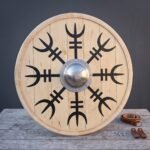
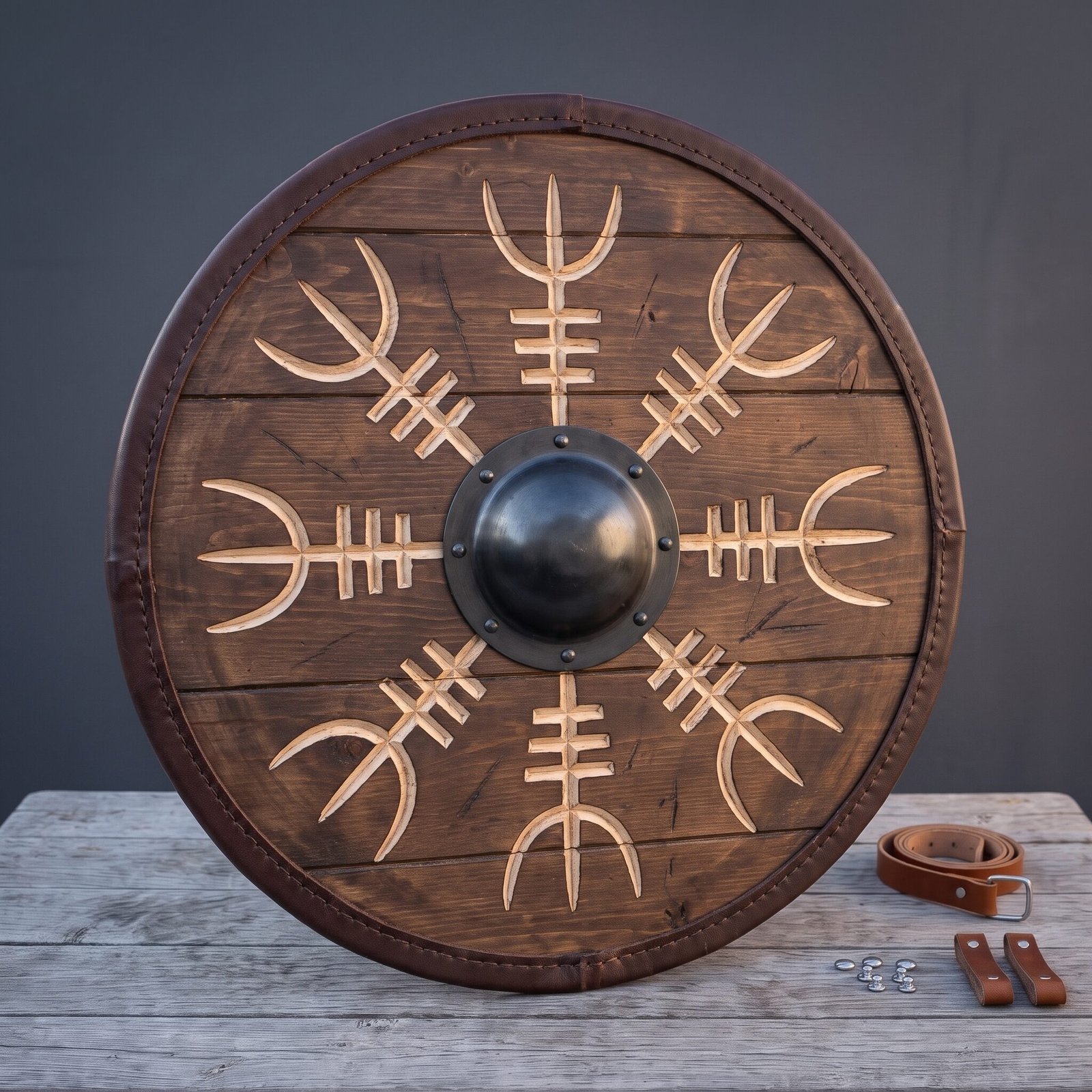
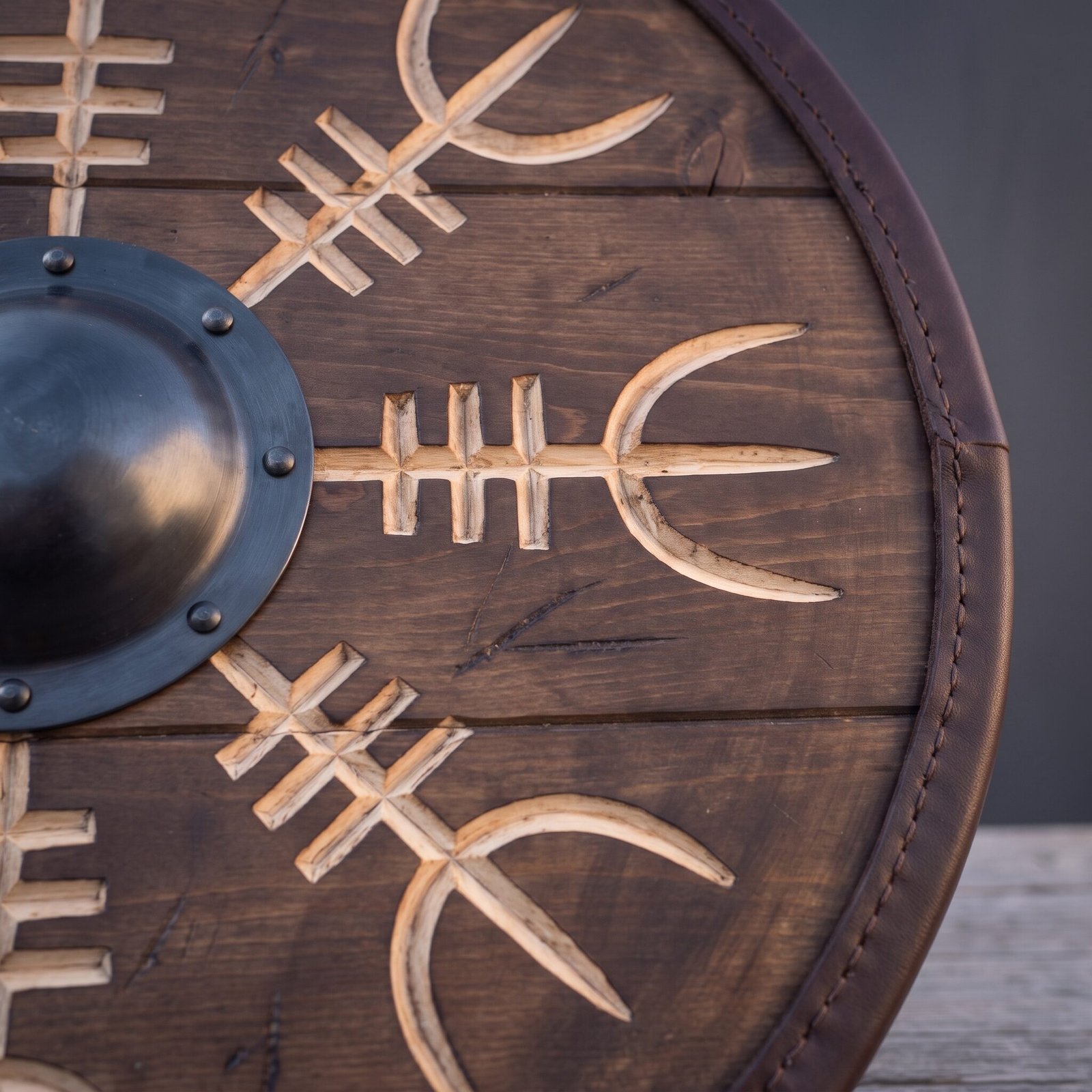
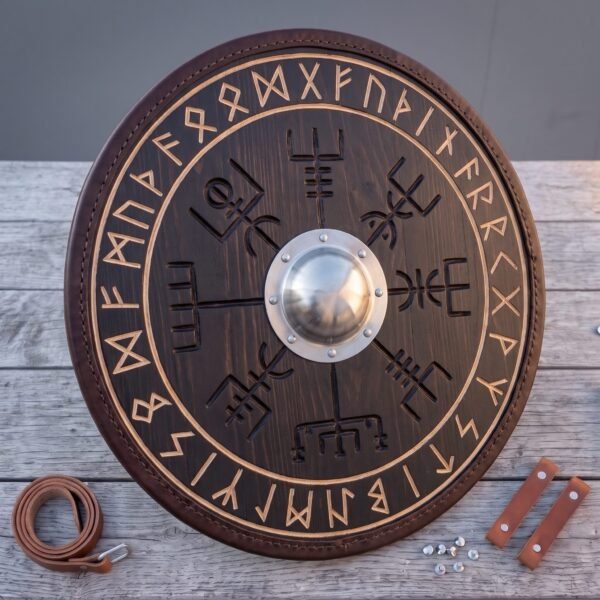
Stavecut is a hand made Viking round shield with the Aegishjalmur carved into it rather than painted on. The planks are stained a dark walnut brown, and the eight arms of the Helm of Awe are cut through that stain in clean V grooves, so every line of the symbol shows as pale fresh wood against the dark face. The boss is blackened steel and the edge is bound in dark brown stitched leather. It is 24 inches across and there is not a drop of paint on it.
Carving changes how a symbol behaves on a wall. Paint sits on the surface and looks the same from every angle. Grooves catch light. Walk past Stavecut in the evening with a lamp on one side and the arms seem to move, one side of each cut bright and the other in shadow. That was the whole idea.
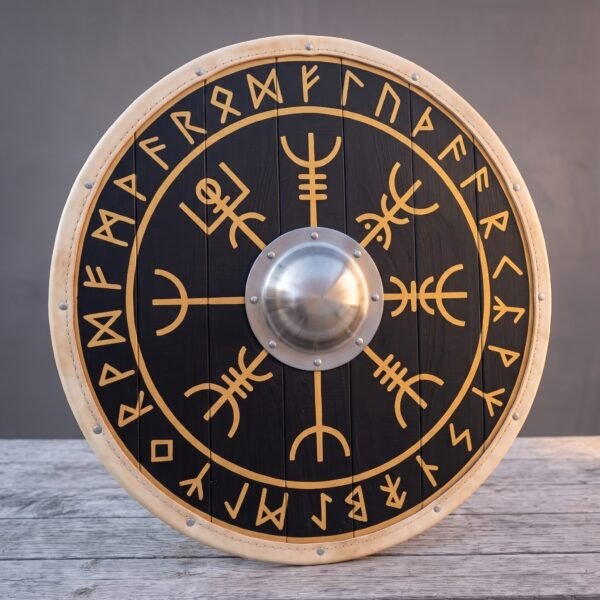
The shield is planked, stained, carved and bound by hand in a Czech Republic workshop and shipped from our Chicago, Illinois warehouse. The leather arm strap, hand grip and rivets come loose in the box. If you prefer the same symbol painted black on bare natural wood, see the Awemark Helm of Awe shield. For the history of shield building, there is our guide to Viking shields.
Specifications
| Material | Wooden planks butted and glued edge to edge, about 12 mm thick, dark walnut stain |
|---|
| Diameter | 24 inches |
|---|
| Design | Aegishjalmur, eight forked arms carved by hand in V grooves through the stain |
|---|
| Boss | Blackened steel dome, riveted through the flange over the centre hole |
|---|
| Rim | Dark brown leather edging, hand stitched around the circumference |
|---|
| Fittings supplied | Leather arm strap with steel buckle, leather hand grip, shield rivets |
|---|
| Grip type | Centre grip behind the boss, in the Viking age manner |
|---|
| Intended use | Display, wall mounting, costume and light reenactment |
|---|
| SKU | RK-2322 |
|---|
How the carving is done
The planks are glued, flattened and stained first. The symbol is then laid out from the centre with compass and rule so the eight arms sit at even angles, and each line is cut by hand with a knife and gouge, one wall of the groove at a time. Cutting through the stain is what gives the contrast. The dark brown stays on the face and the inside of each groove is clean pale wood.
A V groove is the oldest way of putting a line into wood and still one of the most forgiving to look at. The angle of the two walls means the line reads clearly from across a room and still has depth up close. On the forks at the end of each arm the cuts meet at small points, which is where you can see whether a carver knows what they are doing. They should be crisp, not torn.
Staves, carving and the Icelandic tradition
Aegishjalmur means the helm of terror, or helm of awe. The name turns up in Norse legend first: the dragon Fafnir wears it, and Sigurd takes it from his hoard after killing him. What it looked like is never described. The symbol with eight forked arms is recorded much later, in Icelandic books of galdrastafir, the magical staves copied by hand from the seventeenth century onward.
Stave is a good word for it. In Old Norse a stafr was a staff, a letter and a carved sign all at once, which tells you how closely writing, wood and knife were tied together. Runes were made to be cut, with straight strokes that work across the grain. A carved Aegishjalmur is a little closer to that habit than a painted one, which is a pleasing thought even if the Icelandic magicians mostly drew theirs in ink and, by some accounts, in lead on the forehead.
If you want to go further into the signs and what we can and cannot say about them, read Viking symbols and their meanings and our guide to the Elder Futhark.
Why the dark stain and the black boss
A pale shield with a polished boss is bright and friendly. This one is meant to be the opposite: dark, quiet and a bit serious, like a piece of old furniture that has seen things. The walnut stain, the blackened boss and the brown leather rim all sit in the same low range so the only light parts are the carved lines themselves.
Blackened steel is also easy to live with. It does not show fingerprints the way polished steel does, and small marks blend in rather than shine. It still wants a little wax now and then, covered below.
Hanging it on a wall
At 24 inches across, Stavecut fits over a fireplace, a sideboard, a bed or a desk without crowding the wall. Hang it so the boss sits roughly at standing eye level, or a little higher over furniture. Side light from a window or a lamp shows the surface far better than a ceiling light directly above, which flattens everything it touches.
Use two strong picture hooks or a pair of brackets that catch the rim at the left and right, so the weight is shared and the shield cannot rock. A French cleat screwed to the back also works if you are happy drilling into the planks. Please do not hang it from the arm strap. Leather stretches slowly for months and then gives up all at once, usually at night.
Keep it away from radiators, heating vents and the wall above a wood stove. Warm dry air blowing across planks year after year is the quickest way to open the joints. Carved work is worth lighting from the side. A single picture light or wall lamp aimed across the face, not straight at it, will do more for this shield than any amount of brightness. For sizes and placement across the range, read choosing a shield for display.
The planks, the boss and the rim
Under the finish this is the same build as a Viking age board shield. The face is several planks glued edge to edge rather than one sheet of board, which is why the joints show through. The middle is cut through for the hand and covered by the steel boss, riveted through its flange. The edge is bound in dark brown leather, stitched through and pulled tight, holding the plank ends together.
That build is why the shield can be carried as well as hung. With the strap and grip fitted it works on a centre grip, held in the fist behind the boss the old way. It suits costume events, photo shoots and light living history. It is not made for full contact combat, where groups set and inspect their own board, rim and boss standards, and we would rather say so now than after a weekend at a reenactment field. Our guide to Viking shields covers the history of the build.
Engraving, runes and your own design
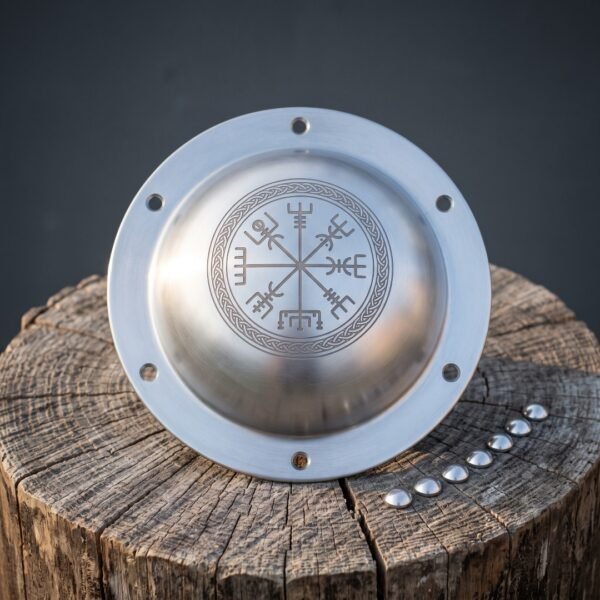
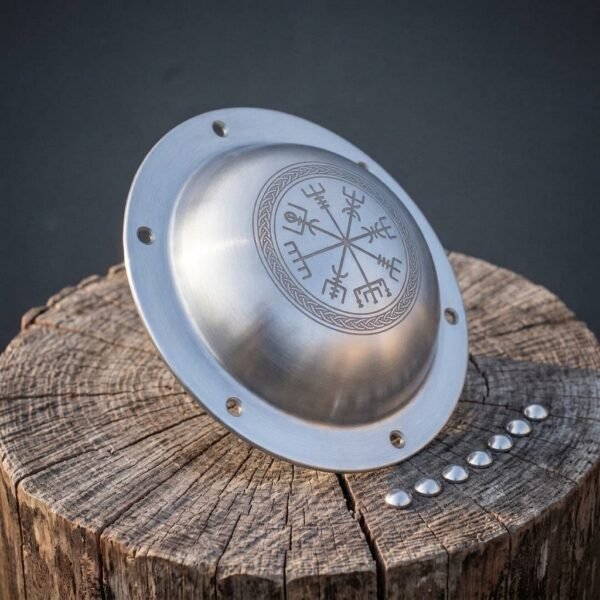
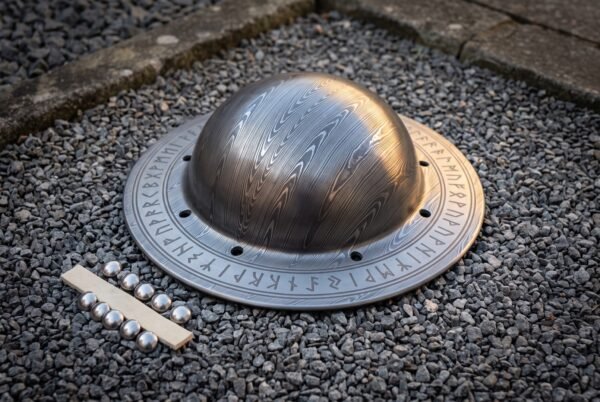
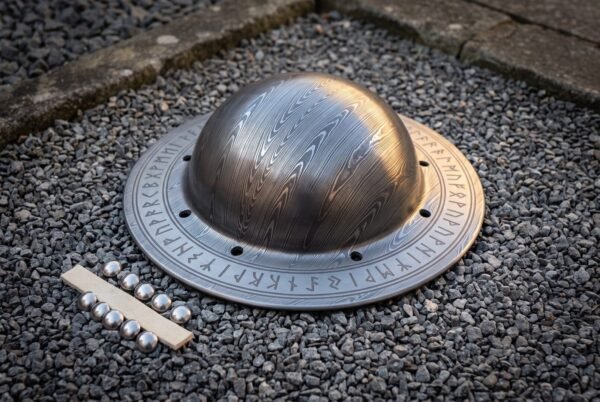
Use the rune converter on this page to turn a name, a date or a short phrase into Elder Futhark and we will cut it into the steel boss. If you would rather have a Viking pattern than a rune line, choose your own design in the engraving option above the add to cart button and tell us where it goes. Where a piece already carries an engraved design, your chosen engraving replaces it rather than sitting alongside it. The boss on Stavecut is blackened, so a rune line or design cut into it shows as bright steel against black, which matches the pale lines on the wood around it. See the engraving page for how it works.
Care
Dust the face and the grooves with a soft dry brush, such as a clean paintbrush, so dust does not settle in the cuts. A light wipe with furniture wax once a year keeps the stained face from drying out. Avoid water, sprays and solvent. Keep the shield indoors and dry, because wood, paint and rawhide all dislike long damp spells.
Give the steel boss a thin film of light oil or paste wax once or twice a year. If a rust spot appears, lift it with fine steel wool and a drop of oil, then wax again. The steel care page has the details.
Who it suits
Stavecut is a good choice for someone who likes Norse things but not bright colours, or for a room that already has a lot going on. It also makes sense in a study, a library corner or a bar, anywhere with wood and leather around it. People who carve or work wood themselves tend to look at the grooves before they look at anything else, which is a fair test.
As a gift it carries the same meaning as any Helm of Awe: protection and nerve. It just says it more quietly.
Made in the Czech Republic
Stavecut is made by hand in a Czech Republic workshop. The planks are cut, glued and stained, the symbol is laid out and carved by hand, the leather rim is stitched on, and the boss is fitted last. Ransack Viking is a United States company. We check each piece when it reaches us and ship it from our Chicago, Illinois warehouse.
A note on handmade variation
Every Stavecut is carved freehand from the same layout. The grooves will follow the photographs closely but the depth of each cut and the colour of the wood inside them will vary a little with the planks. The stain takes differently on each board, so the face can show light and dark streaks, which is the wood, not a fault.
Frequently asked questions
Is it the same shield as Awemark
No. Awemark has the symbol painted in black on bare natural wood with a polished boss and rawhide rim. Stavecut has it carved into dark stained wood with a blackened boss and a leather rim.
How deep are the carved lines
They are V grooves cut by hand, deep enough to cast a clear shadow in side light. Depth varies slightly from line to line, as hand carving does.
Can I carry it
Yes, for costume, photos and light reenactment. The strap and grip ship loose. It is not built for full contact fighting, and a carved face is better kept away from blows anyway.
Will the pale wood in the grooves darken
Slowly, over years, as any bare wood does. It stays much lighter than the stained face.
Can I put a name on it
Yes. The boss takes a rune line or a chosen design through the engraving option on this page.
How long does it take to ship
Processing is one to two weeks because each shield is built and finished to order, then shipping is free within the United States. Returns are accepted within seven days. Custom boss engraving adds a few days.
What is in the box
- One 24 inch planked Viking round shield in walnut stain with a hand carved Aegishjalmur
- Blackened steel dome boss, riveted in place
- Dark brown stitched leather rim
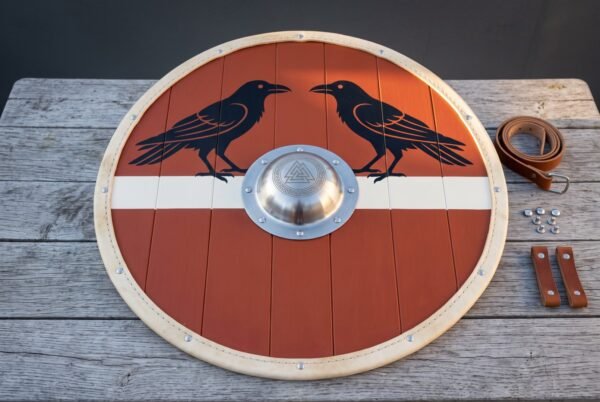
- Leather arm strap with buckle and leather hand grip, supplied loose, with shield rivets
- Made in the Czech Republic
Explore the range
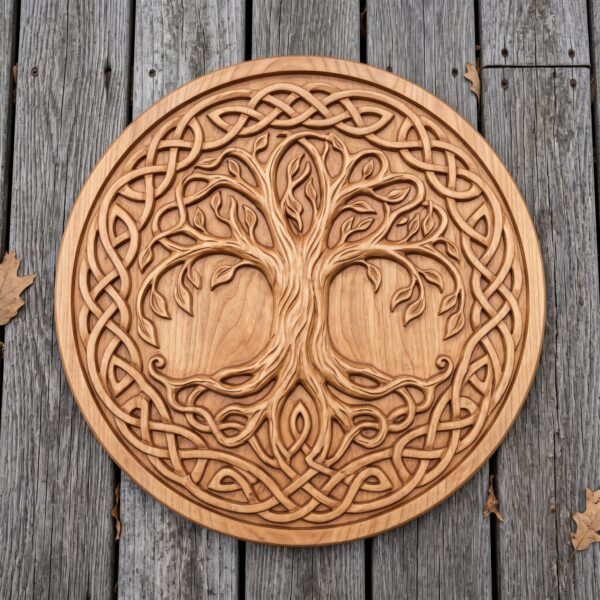
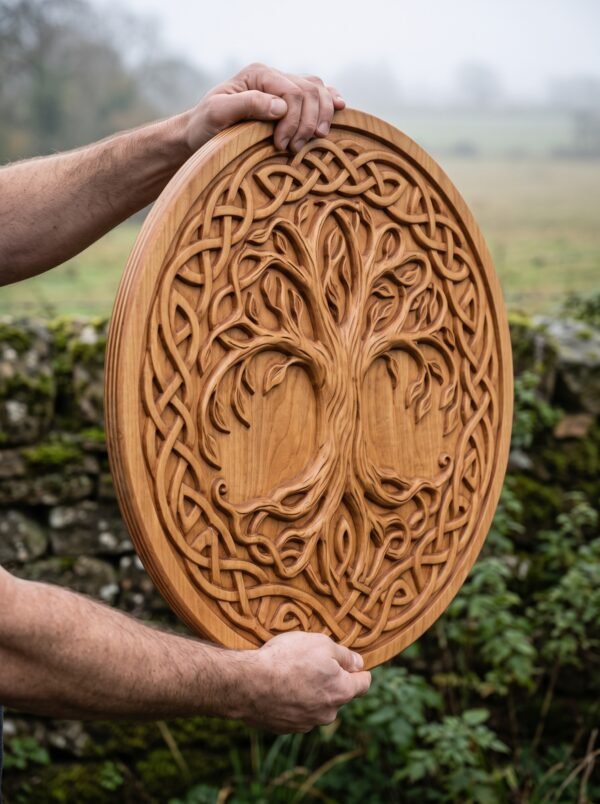
See more in round shields and viking shields. For another carved face, the Hammerhewn carved Mjolnir shield has Thor’s hammer standing in raised relief.




Reviews
There are no reviews yet