The bearded axe, the skeggox of the Norse sagas, takes its name from the long lower lug that hangs below the cutting edge like a beard. That shape was never decoration. It buys a long cutting edge on a very light head, and it leaves a hollow behind the beard where a hand can choke right up under the steel for fine carving work. The same profile turns up again and again in Scandinavian grave finds because it did two jobs well. It shaped timber all week and it went to war on the same haft. For the working logic behind the profile, see what the beard is for.
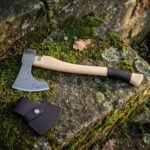
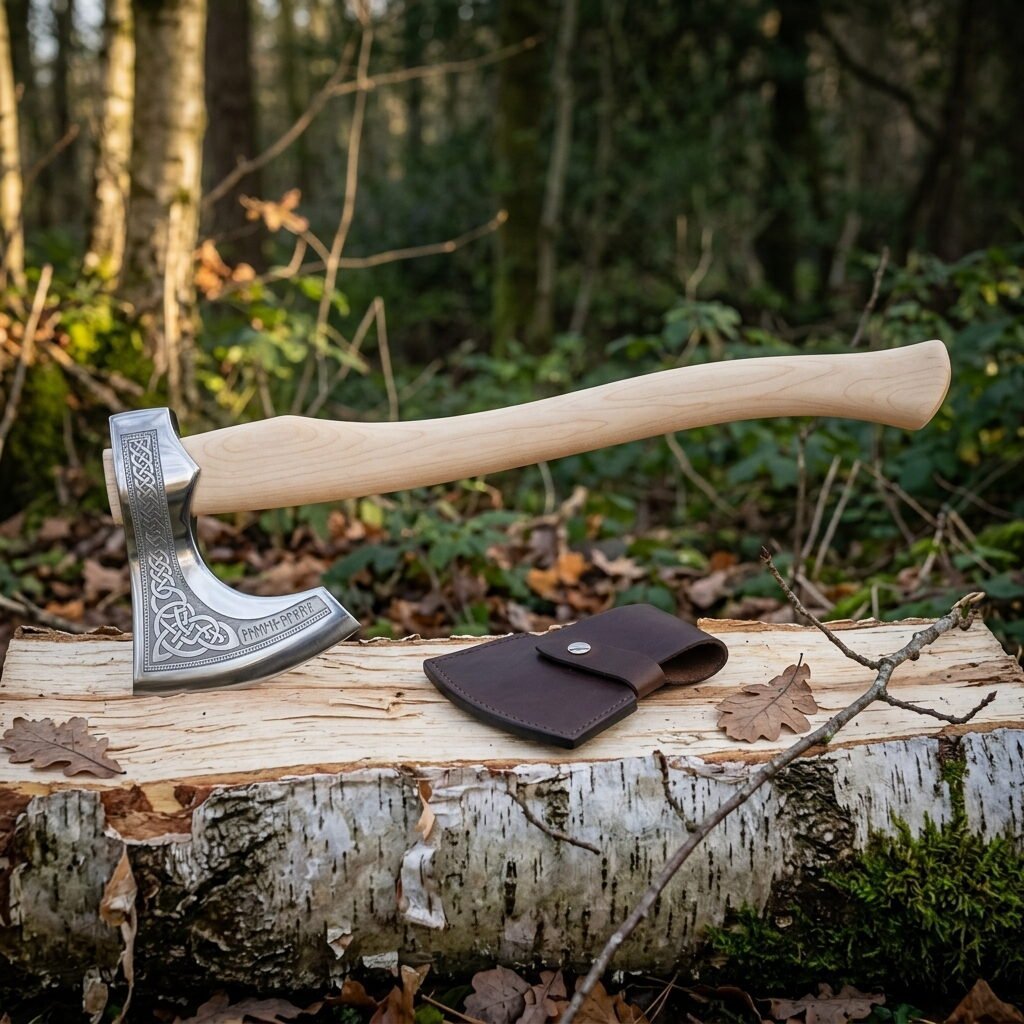
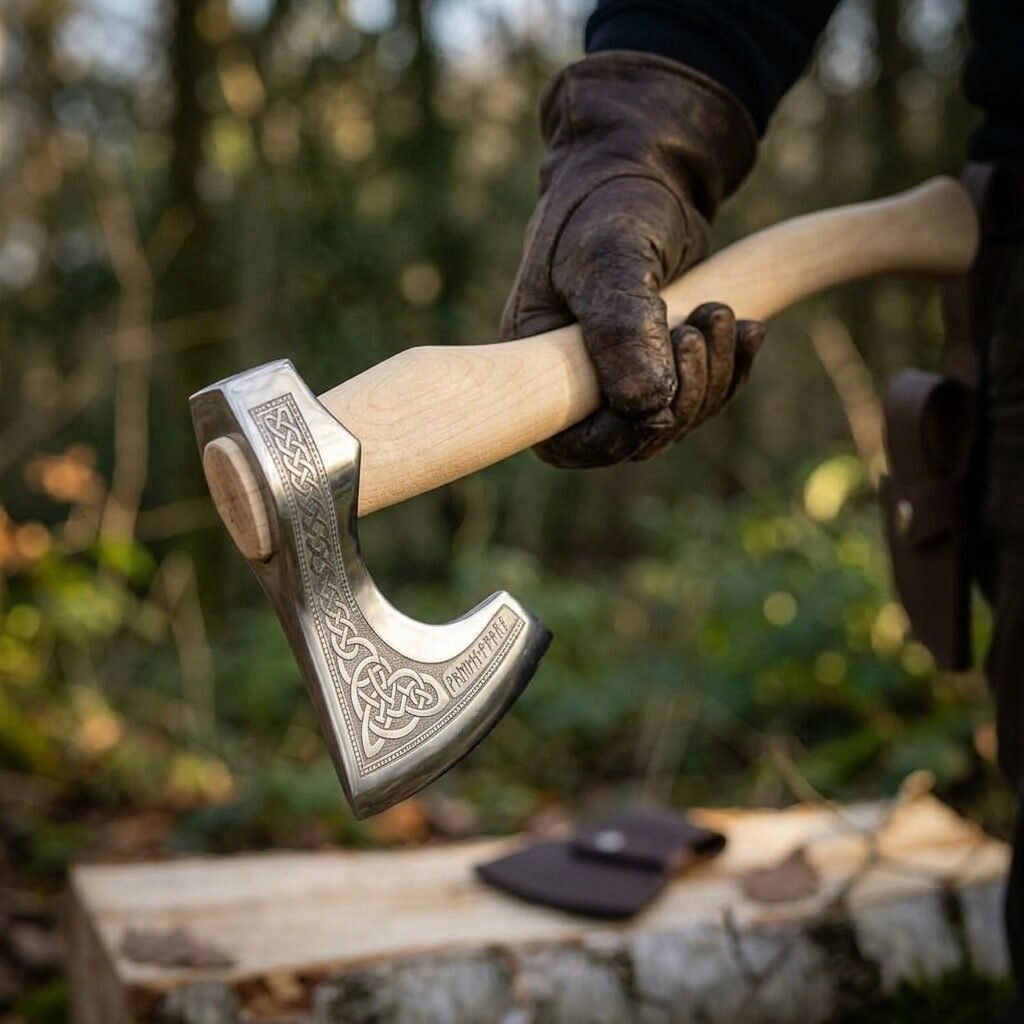
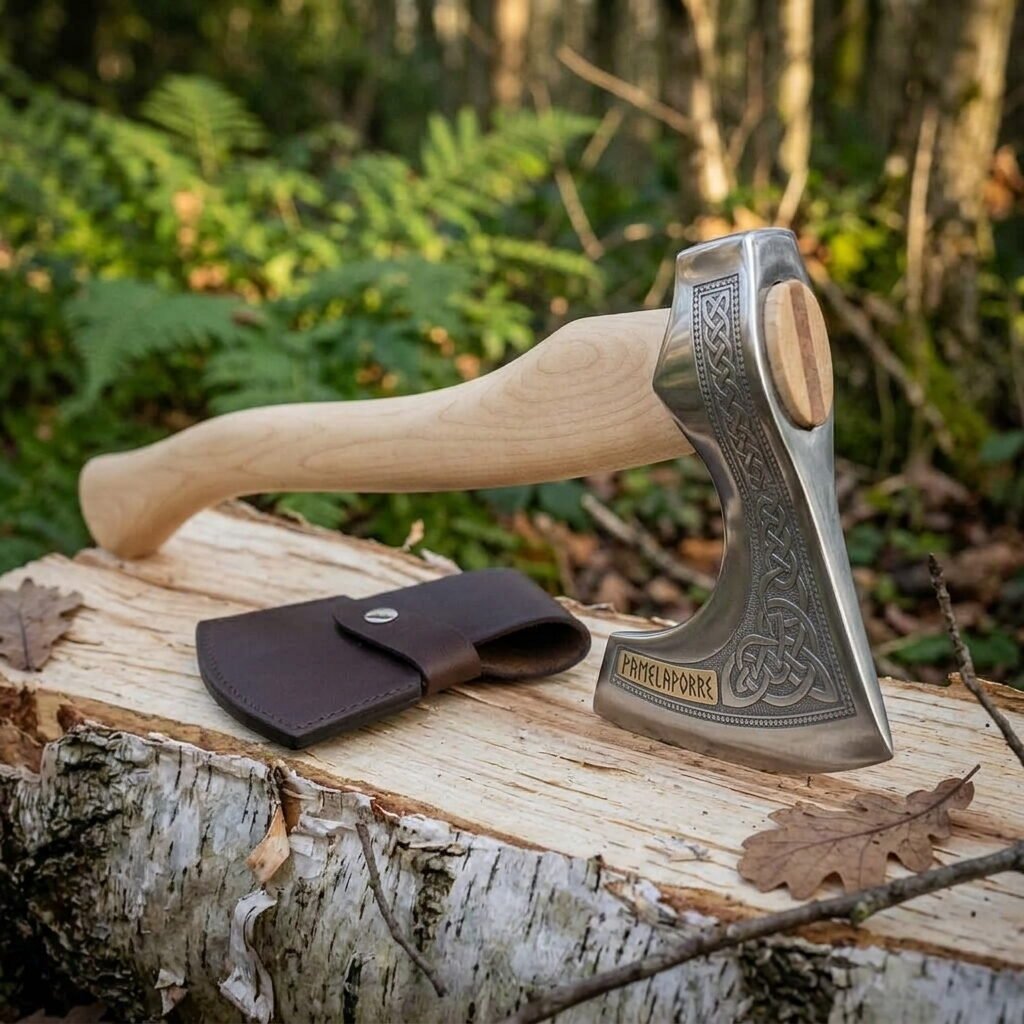
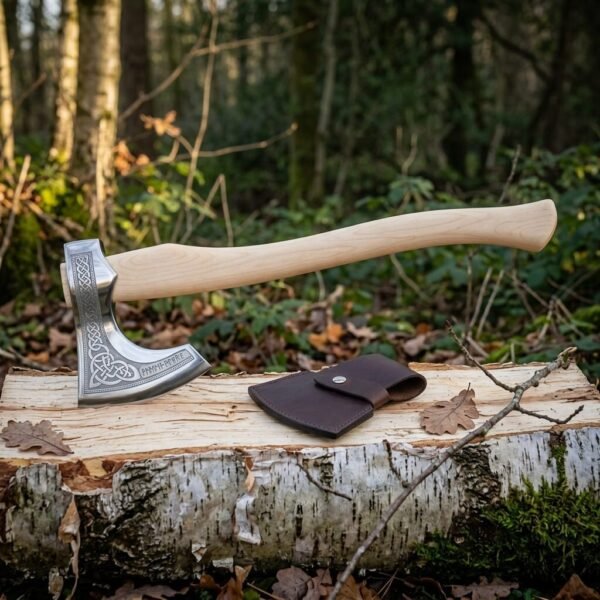
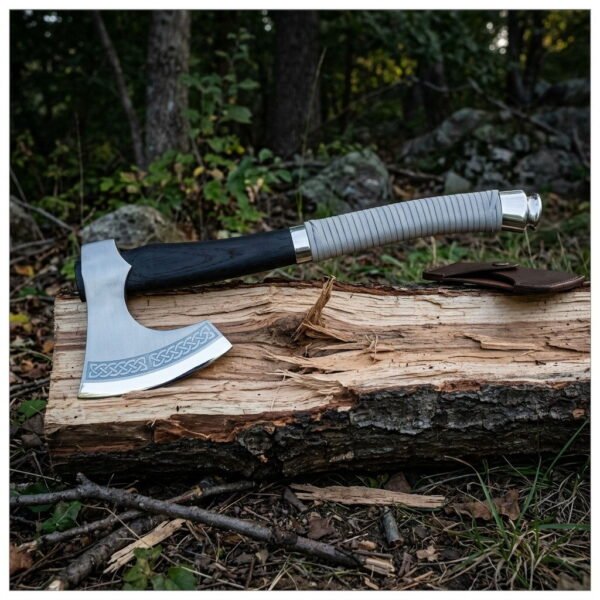
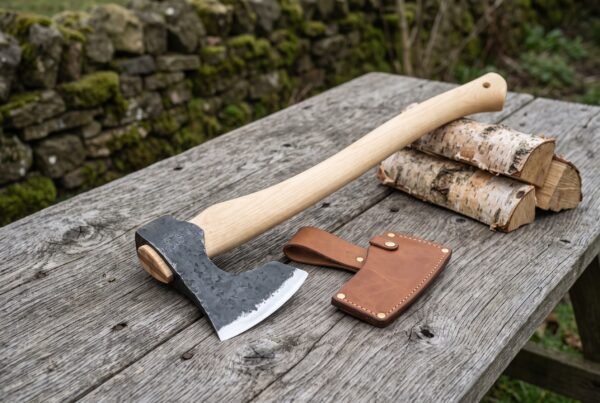
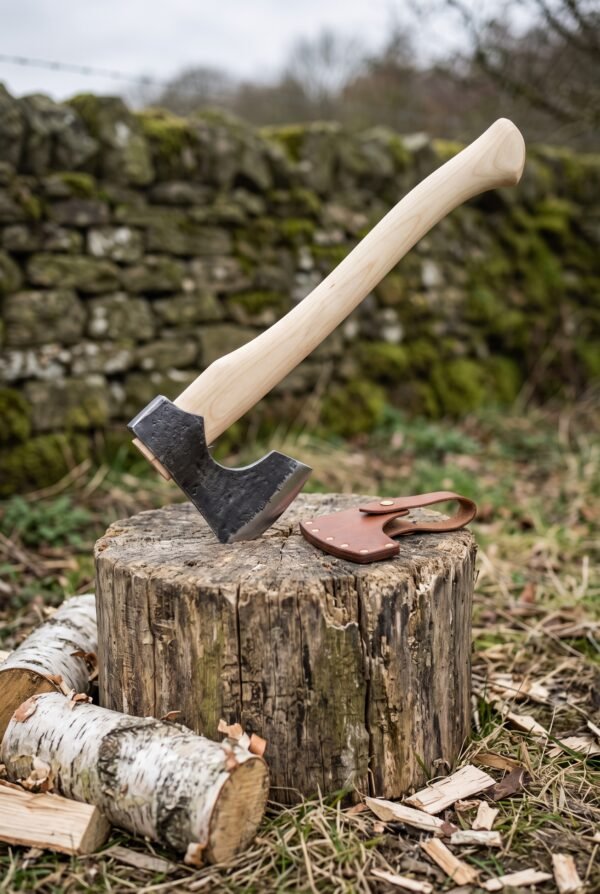
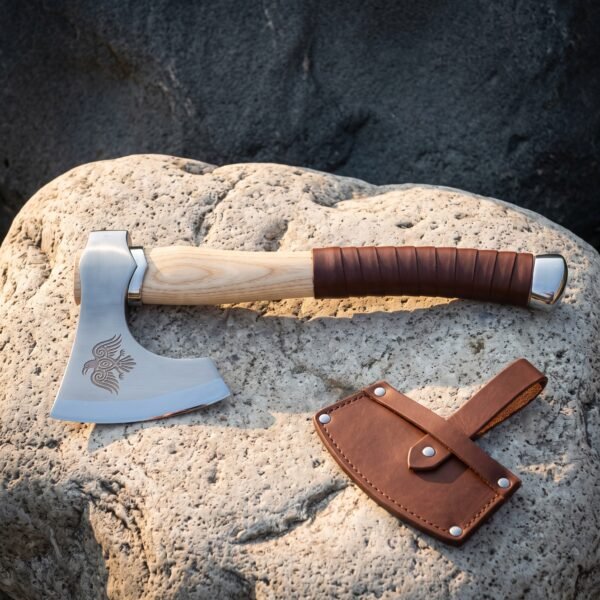
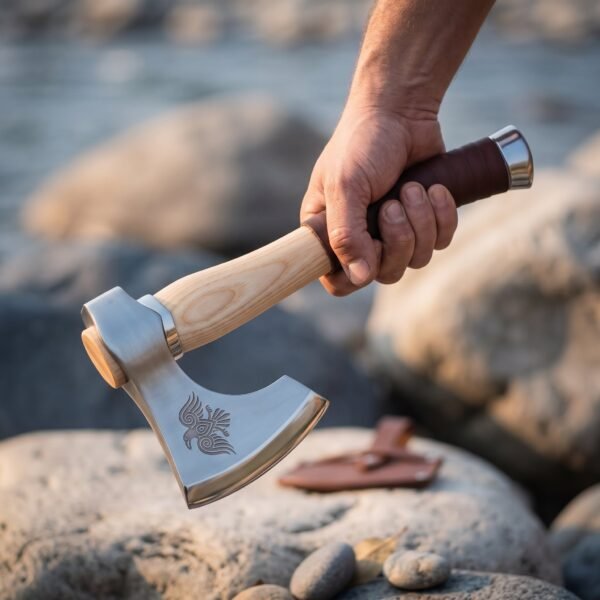
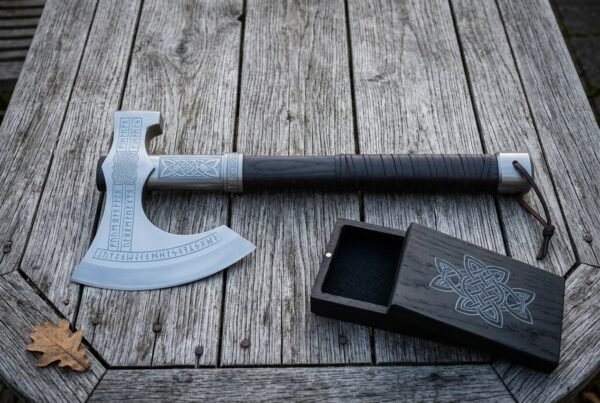
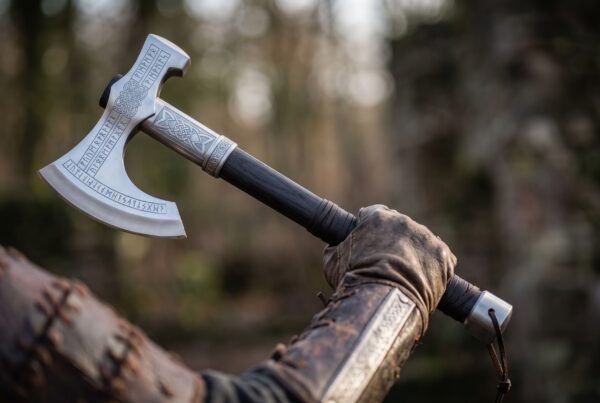
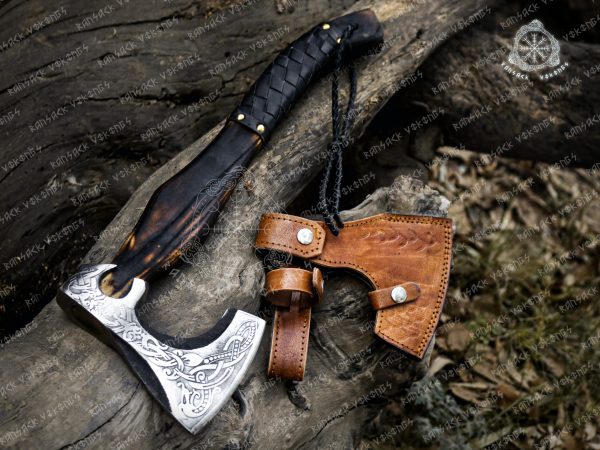
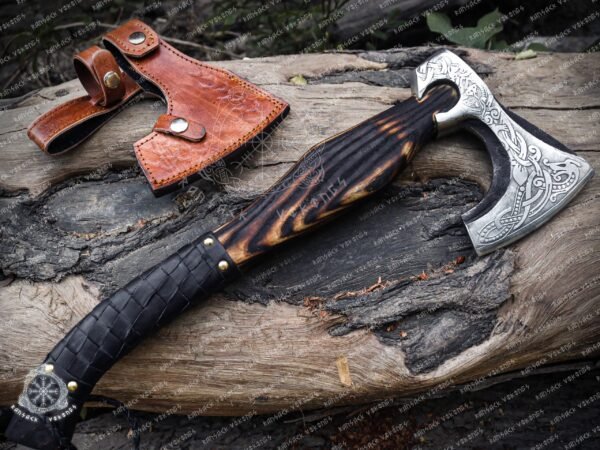
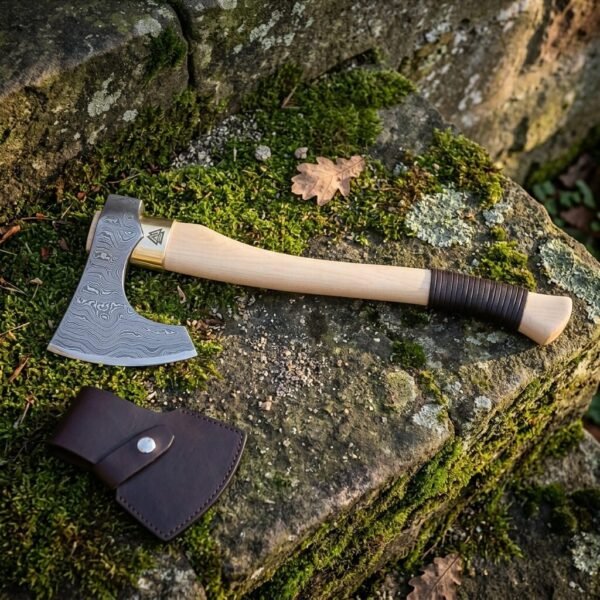
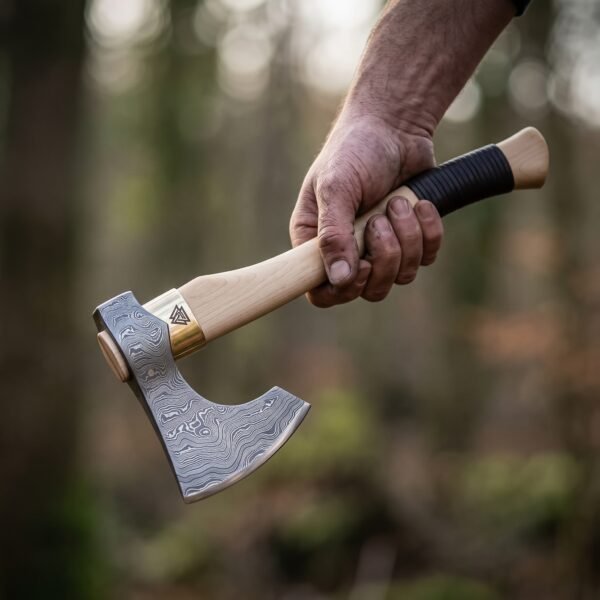
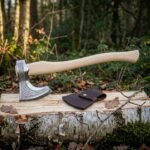
This axe is forged and finished in the Czech Republic. The head is high carbon steel, hand ground to a convex edge, then etched with a Norse interlace panel that runs across both cheeks and follows the curve of the beard. The haft is light birch, shaped by hand and finished with oil rather than lacquer so it stays warm and grippy instead of slick. It ships with the dark leather head sheath shown in the photographs, cut and stitched to this head rather than pulled off a shelf.
Specifications
| Steel | 1095 high carbon steel, hand forged |
|---|
| Hardness | 54 to 58 HRC at the edge, softer through the eye and poll |
|---|
| Head | Bearded profile with a long sweeping beard, polished bright finish |
|---|
| Overall length | 19 inches |
|---|
| Cutting edge | 4.5 inches from horn to beard |
|---|
| Head weight | Approximately 1.5 lb |
|---|
| Decoration | Etched Norse knotwork panel on the cheek with a rune band along the beard |
|---|
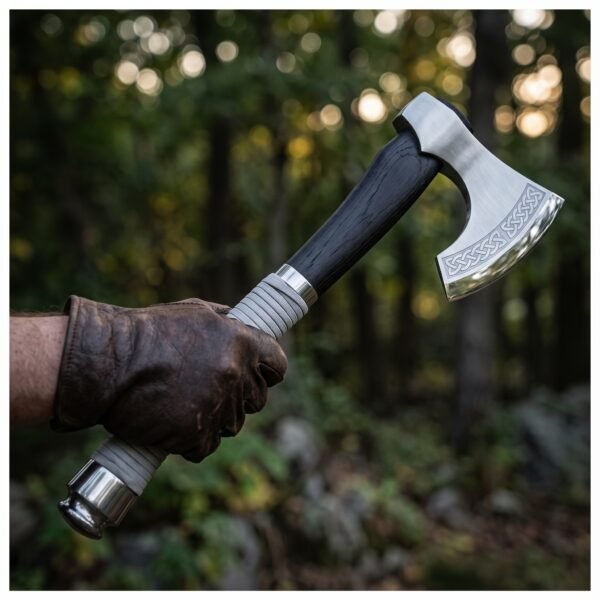
| Haft | Light birch, hand shaped with a curved grip and flared end knob, oil finished, wedged in the eye |
|---|
| Sheath | Dark brown leather head sheath with a flap and snap stud |
|---|
| Engraving | Existing etched panel can be replaced with your own design |
|---|
| SKU | RK-1210 |
|---|
What the beard on a bearded axe actually does
Look at the head side on and you can see the whole argument for the pattern. The edge sweeps down and back into a hook, so a head weighing about a pound and a half carries four and a half inches of cutting edge. A wedge shaped head of the same weight would give you barely three. More edge on less steel means the axe bites deeper for the same swing and tires the arm far less over an afternoon.
The hollow behind the beard matters just as much. Slide your hand up the haft until your fingers sit in that gap and the axe becomes a drawknife you can control an inch at a time, which is how Norse boatbuilders shaped strakes and how green woodworkers still use the pattern today. The upper horn is what catches, hooks and pulls, whether that is a shield rim in the reenactment line or a branch you want out of the way. None of that is styling. Every part of the outline is doing work.
Why high carbon steel and not stainless
Stainless steel earns its keep in a kitchen drawer and on a boat. It does not earn it in an axe head. The chromium that makes steel stainless also makes it more brittle at the hardness an axe needs, and an axe edge takes impact loads that a paring knife never sees. High carbon steel takes a heavy blow, rolls slightly rather than chipping out, and comes back true on a stone in a few minutes. It also takes heat treatment far more predictably, which is what lets us leave the eye and poll soft while the edge runs hard. If you want the longer version of that argument, we set it out on Damascus versus stainless.
The trade is rust. Carbon steel will spot if you leave it wet or put it away with fingerprints on it. A wipe of oil after handling settles the matter for good.
The birch haft and how to keep it
Birch is a traditional Northern European haft wood and it is the right choice for a light axe like this one. It is stiff, close grained, pale enough that the grain reads clearly, and it damps shock better than most people expect for its weight. The haft is hand shaped so the oval section sits in the palm with the long axis pointing where the edge points, which means you know your edge alignment without looking at the head.
It is oiled, not sealed under a plastic film. That means it will darken slowly with handling and will want feeding once or twice a year with a rag and a little oil. Full instructions are on our wooden handle care page. Never leave it soaking in water and never store it against a hot radiator, because a shrinking haft loosens in the eye.
Engraving, runes and your own design
Use the rune converter on this page to turn a name, a date or a short phrase into Elder Futhark and we will cut it into the steel or the handle. If you would rather have a Viking pattern than a rune line, choose your own design in the engraving option above the add to cart button and tell us whether it goes on the blade or the handle. Where a piece already carries an engraved design, your chosen engraving replaces it rather than sitting alongside it. This head already carries an interlace panel, so a custom order replaces that panel with your artwork or your rune line. Examples and pricing are on the engraving page.
Care and sharpening
Wipe the head dry after use and put a thin film of oil on it before it goes back in the sheath. Leather holds moisture, so an axe stored wet inside a sheath is the one reliable way to ruin a good head. Our steel care page covers rust removal if a spot does appear.
Sharpen with a puck or a coarse stone worked in small circles, following the existing convex bevel rather than trying to flatten it, then finish on a fine stone and strop on leather. The guide to sharpening with a whetstone applies directly, with the one change that an axe wants a slightly more open angle than a knife.
Made in the Czech Republic
This piece is made by hand in the Czech Republic, in a workshop that still works the old way. The steel is forged, ground, heat treated and finished by smiths who learned the trade from the people before them, and the wood, horn and leather are cut and fitted by hand rather than pressed out on a line. That is also why no two pieces come out exactly the same.
Ransack Viking is a United States company. We import these pieces ourselves, check every one when it lands and ship from our warehouse in Chicago, Illinois. Engraving is done here in the United States after the piece arrives, so your runes or your own design go on before it leaves for you.
A note on handmade variation
This piece is hand forged. It is not machine made and it is not bulk produced, so what arrives will not be a pixel for pixel copy of the photograph. Grain, tone, pattern and exact profile vary because every one is worked by hand from natural materials, and birch in particular runs from near white to warm honey from board to board. Hammer marks, small variations in the etch and the exact sweep of the beard are part of the object rather than faults in it. The dimensions, the steel and the build are the same every time. The character is not.
Frequently asked questions
Is it sharp when it arrives?
Yes. It ships with a working convex edge that will bite into seasoned wood straight out of the sheath. It is not shaved sharp, because a razor edge on an axe rolls on the first hard contact. Ten minutes on a stone will take it further if you want it there.
Can I actually use it, or is it a display piece?
You can use it. The head is properly heat treated and the haft is wedged for use, so it will split kindling, carve and take a session at a reenactment line. It is a light 19 inch axe rather than a felling axe, so treat it as a hand axe and not a splitting maul.
Can I have runes engraved on it?
Yes. Use the rune converter above to convert your text to Elder Futhark and pick whether it goes on the head or the haft. Your engraving replaces the interlace panel that is already on the cheeks rather than being added next to it.
Will mine look exactly like the photograph?
Close, but not identical. The profile, length and edge are consistent. The birch grain, the depth of the etch and the tone of the leather shift from piece to piece because each one is worked by hand.
What is the difference between this and a throwing axe?
A throwing axe has a lighter head, a plainer edge and a haft meant to be replaced when it gets chewed up on a miss. This is a working and collecting axe with an etched head and a fitted sheath, so we do not recommend throwing it at a target board.
How long does shipping take?
Shipping inside the United States is free and a stock axe leaves the shop in two to three business days, usually arriving within a week. Engraved orders add one to two weeks of shop time before they ship.
What is in the box
- One Birchskeg hand forged high carbon steel Viking bearded axe
- Fitted dark leather head sheath
- Care and sharpening card
- Certificate of hand forging with the SKU recorded on it
- Forged and finished in the Czech Republic
Explore the range
See the rest of the bearded axes, the wider Viking axes range, the heavier battle axes and the full Norse arms collection, or read the guides for steel, sharpening and haft care.
Other pieces in this group
For a straight comparison, see the Stormcleft bearded axe, 28 inches overall. Worth putting side by side with this is the Knotcleave bearded axe. In the same category sits the Braidhewn bearded axe, forged from 1095.
From the same corner of the shop, there is the Langhewer Medieval axe. Nothing here exactly right, build one to your own spec on the custom Viking axe page.


Does the job but I wasn’t blown away. Handle material felt a bit different than pictured. It’s fine but I expected a little more for the price. Wouldn’t say no to it but wouldn’t rave about it either.
Photos don’t do this axe justice at all. Will definitely order again for another gift.
My husband was speechless when he opened this. Leather sheath is thick and well stitched. Not the cheap stuff you usually get. Highly recommend this one.
Bought this on a whim and it turned out to be one of my favorite purchases this year. The wood handle feels amazing and the balance is perfect. This shop clearly takes pride in their work.
I collect stuff like this and this axe is on another level. Edge retention has been great even after regular use. Fit and finish is museum quality. You can tell real craftsmen made this by hand. Will definitely order again for another gift.
My whole family was impressed when I unboxed it. Love that this is Czech craftsmanship and shipping from the US meant it showed up in just a few days. Came in a nice gift box which made it feel even more special. Weight and balance make it feel like a real functional piece not some cheap replica. Already telling my friends to check this out.
My whole family was impressed when I unboxed it. High Carbon Steel blade holds a razor edge right out of the box. Leather sheath is thick and well stitched. Not the cheap stuff you usually get. If you’re on the fence just get it. You won’t regret it.
Middle of the road experience with this one. It’s fine but I expected a little more for the price. Not bad, not amazing either.
Absolutely blown away by this axe. Weight and balance make it feel like a real functional piece not some cheap replica. 10/10 would buy again.
My whole family was impressed when I unboxed it. High Carbon Steel blade holds a razor edge right out of the box. So worth it.