The double bit axe is one of the few axe patterns whose history we can date precisely, and it is not as old as most people assume. It appears in American logging camps in the middle of the nineteenth century, and it was a working solution to a practical problem. Fellers kept one edge ground thin and razor sharp for clean cutting into standing timber, and the other edge ground thicker and blunter for limbing, grubbing near the ground and anything likely to meet dirt or grit. One haft, two purposes, and no walking back to camp to swap tools. The symmetry also balances the head around the eye, which is why a double bit hangs dead straight and swings truer than a single bit for many people. Axe heads changed shape after the Viking age for good reasons, traced in Viking axe against medieval axe.
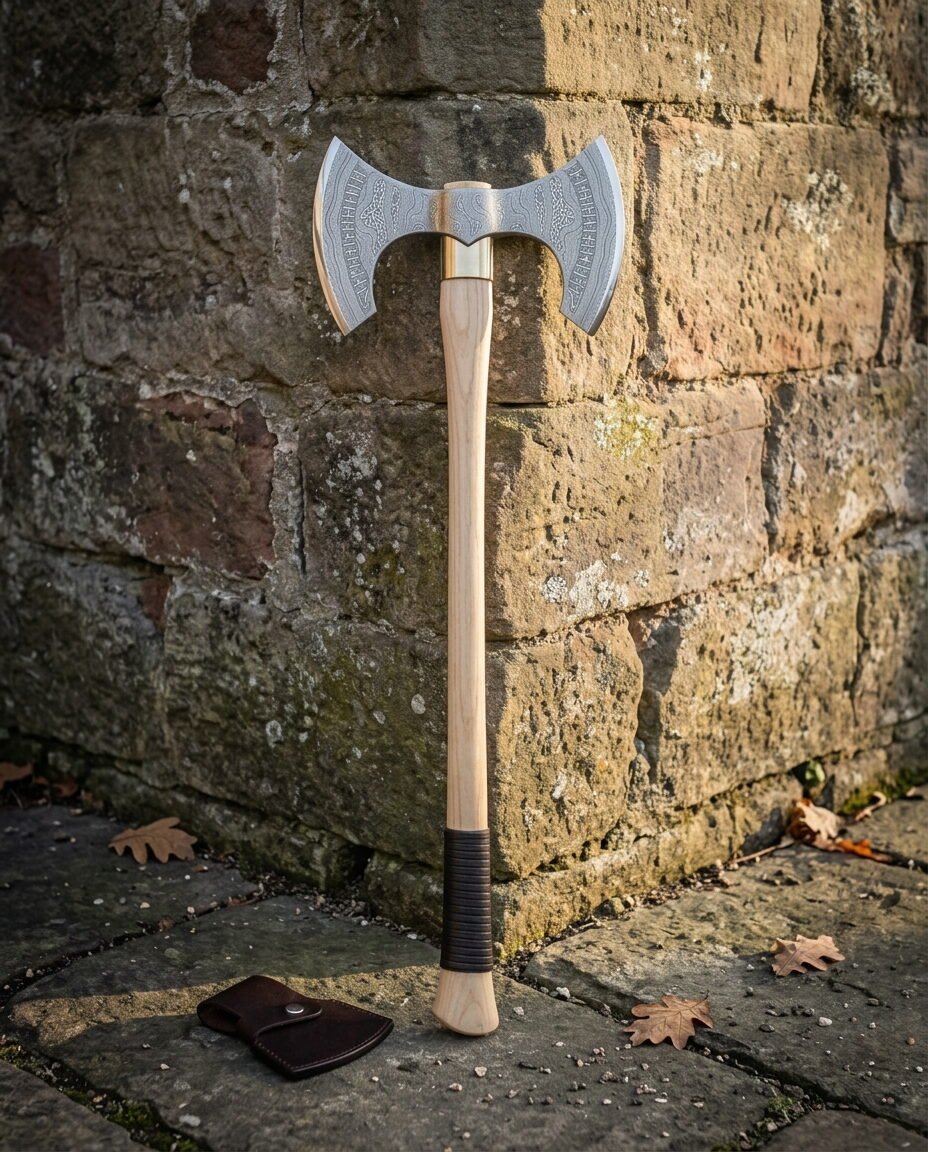
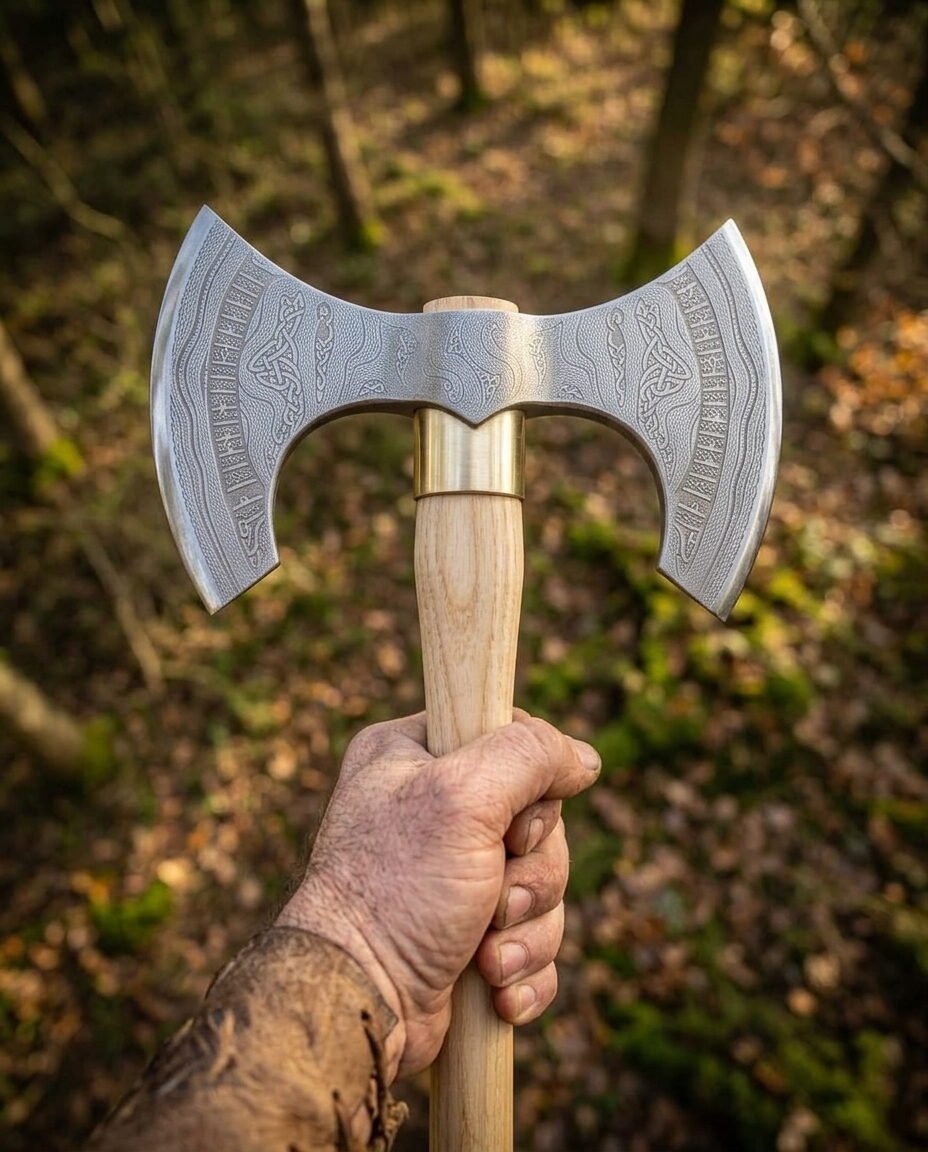
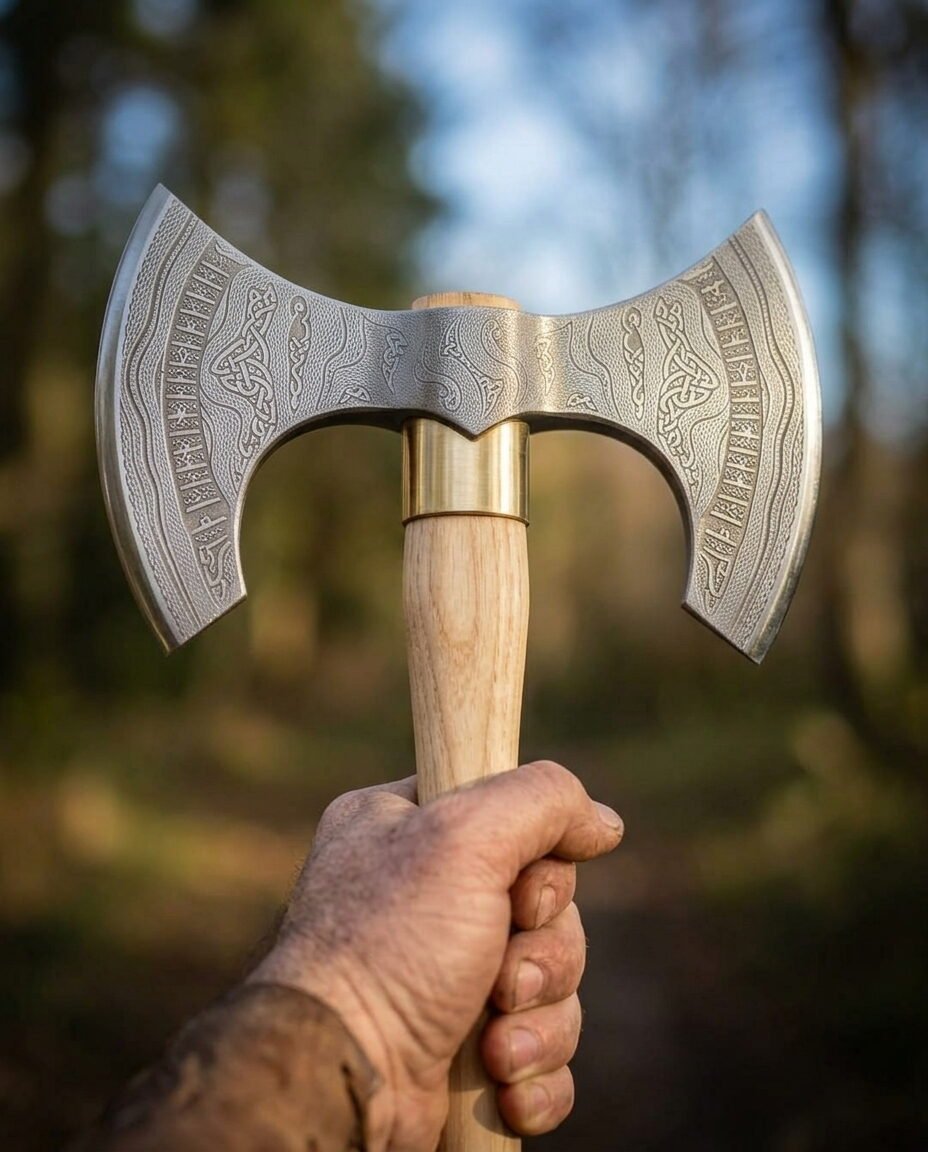
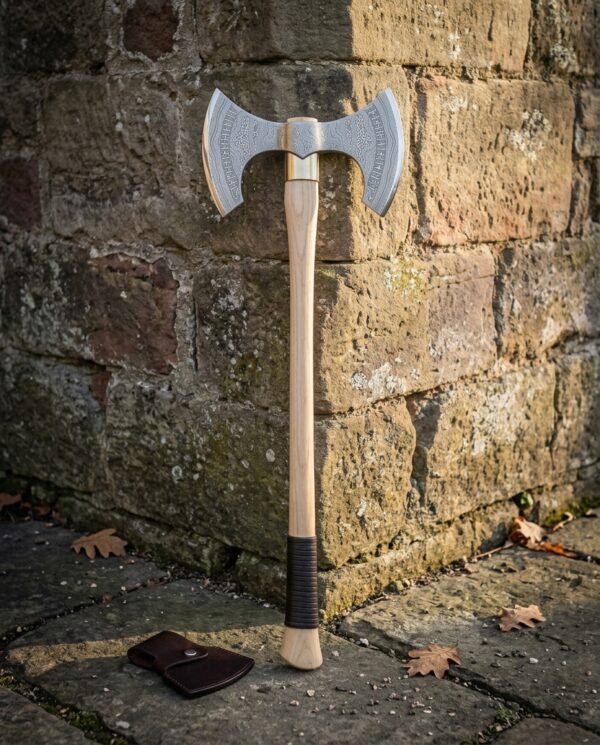
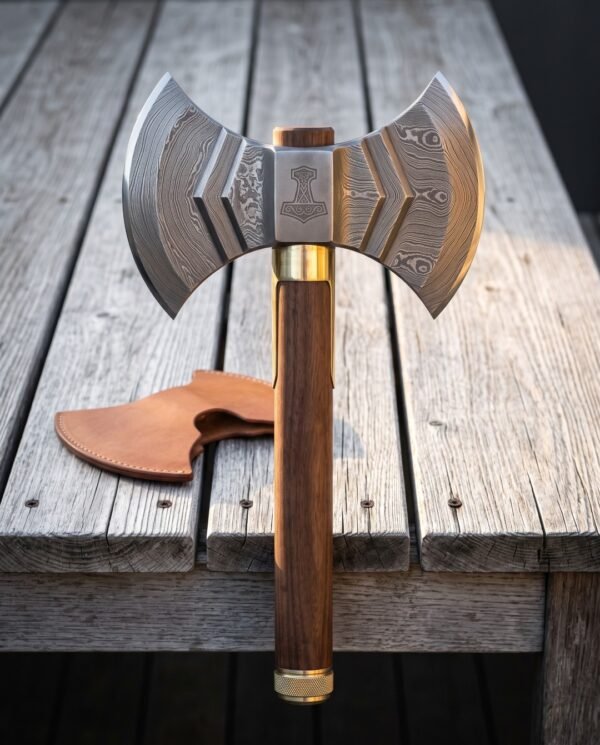
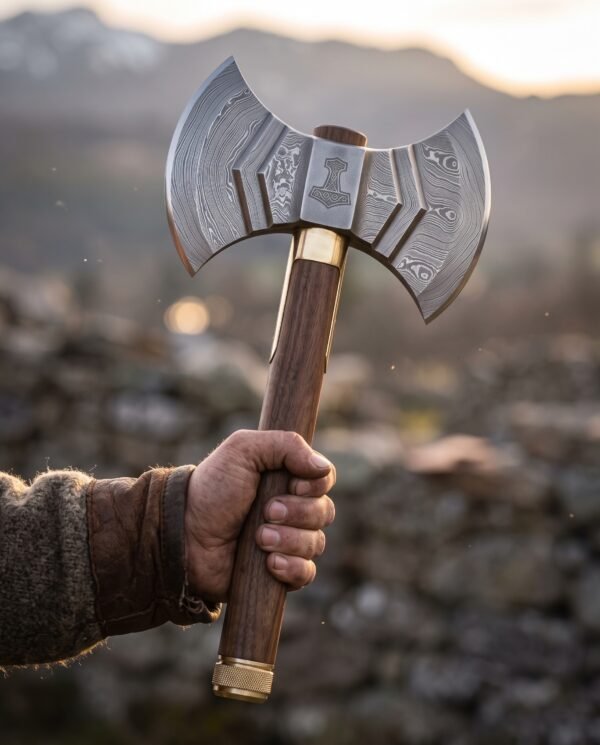
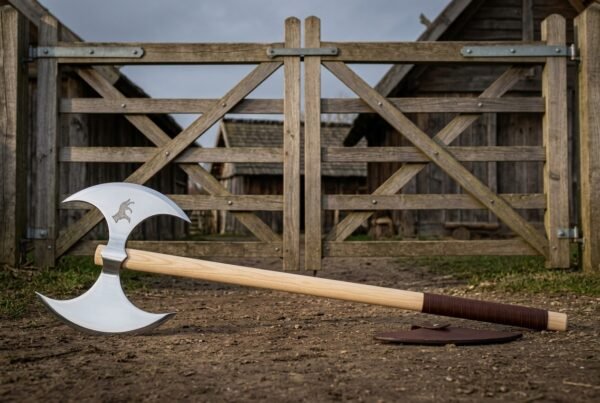
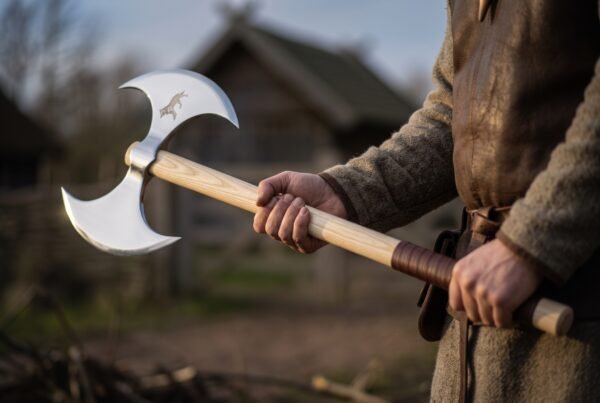
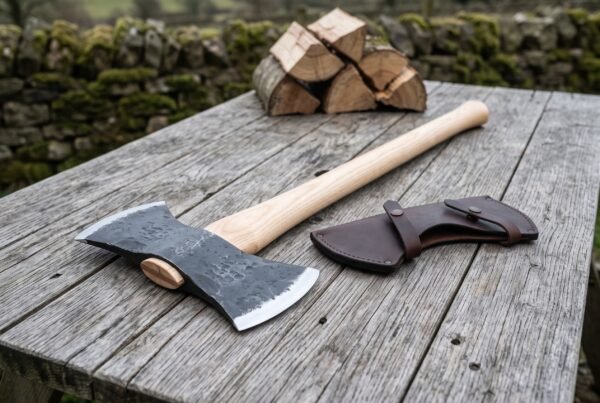
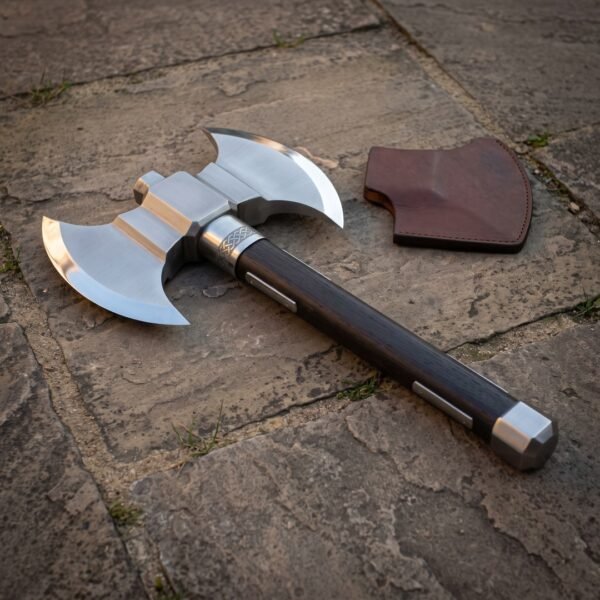
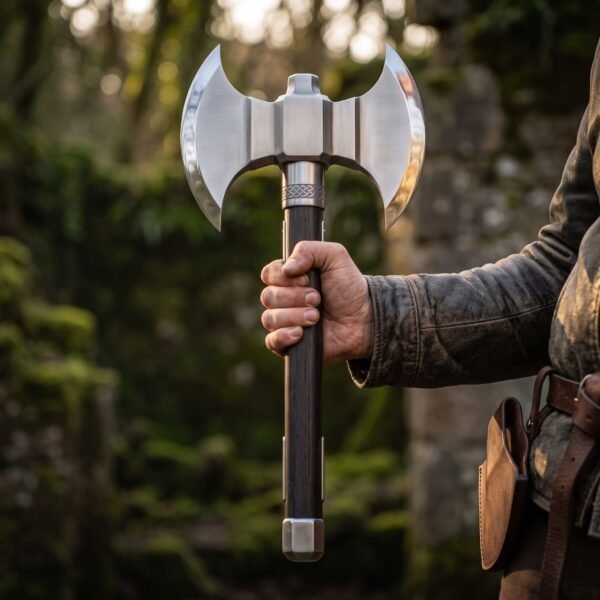
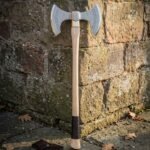
This one is forged and finished in the Czech Republic as a display and collector piece rather than a logging tool, with both bits taken to the same profile and etched with matching Norse panels. The head is high carbon steel, the haft is light straight grained wood, and the grip just above the butt is wrapped in dark leather for hold and for contrast against the pale timber. It ships with a pair of leather edge guards, one for each bit.
Specifications
| Steel | Hand forged 1095 high carbon steel |
|---|
| Hardness | 54 to 58 HRC at both edges, soft through the eye |
|---|
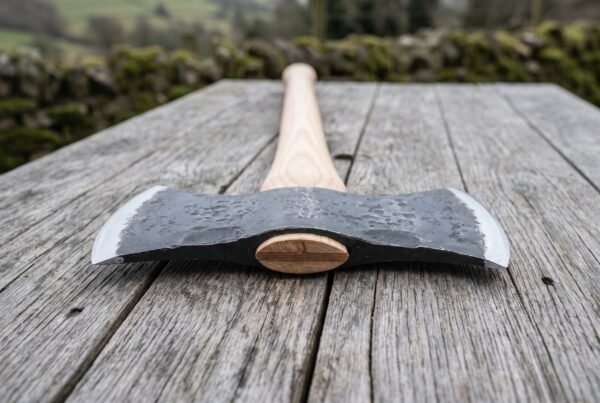
| Head | Double bit head with two symmetric crescent bits, etched with rune bands and Norse knotwork on both faces |
|---|
| Overall length | 28 inches |
|---|
| Cutting edges | About 6 inches each, twin symmetric bits |
|---|
| Collar | Brass collar below the head |
|---|
| Haft | Light straight grained wood with a flared knob at the butt |
|---|
| Grip | Dark leather wrap just above the butt |
|---|
| Edge protection | Two leather edge guards, one per bit |
|---|
| SKU | RK-1215 |
|---|
Why two bits instead of one
Balance is the argument that survives even when the logging camp use case does not. On a single bit axe all the cutting mass sits on one side of the eye, so the head wants to rotate in flight and the haft has to be gripped firmly enough to stop it. A double bit is symmetric about the eye, so it tracks straight with a much lighter grip and the edge lands where you were looking rather than a few degrees off. Throwers and cutters who move between the two patterns notice it immediately.
The second thing a double bit gives you is a spare edge. On a single bit the poll is dead weight, useful only as a hammer face. On a double bit that same weight is a second working edge, so when one bit dulls you turn the haft in your hand and carry on. On a display piece like this one the practical benefit is smaller, but the visual logic of the shape, two mirrored crescents balanced around a central eye, is exactly why the pattern reads so strongly on a wall.
Why high carbon steel and not stainless
A double bit head is a large piece of steel with two hardened edges and a soft centre, and getting that right depends entirely on the alloy responding predictably to heat treatment. High carbon steel does. It can be quenched hard at both edges while the body around the eye is left tough, which matters more here than on a single bit because there is no soft poll to absorb shock. Stainless steel resists corrosion by carrying chromium, which costs toughness at cutting hardness and makes an edge that chips rather than rolls. We lay the argument out on Damascus versus stainless.
The maintenance cost is a wipe of oil after handling, which is a fair trade for an edge that behaves.
The haft, the leather wrap and how to keep them
The haft is straight grained light wood, chosen so the growth rings run down the length rather than out through the side, and shaped by hand to an oval section. Because both bits are live, a double bit haft is deliberately straight rather than curved. A curved haft would put one edge out of line with the other, and the whole point of the pattern is that both edges sit on the same plane.
The dark leather wrap near the butt gives the rear hand something to hold on a two handed swing and stops the axe sliding when your hands are damp. Keep the wood oiled once or twice a year and the leather fed occasionally with a leather conditioner, and keep both away from radiators and standing water. Our wooden handle care page covers the wood side in full.
Engraving, runes and your own design
Use the rune converter on this page to turn a name, a date or a short phrase into Elder Futhark and we will cut it into the steel or the handle. If you would rather have a Viking pattern than a rune line, choose your own design in the engraving option above the add to cart button and tell us whether it goes on the blade or the handle. Where a piece already carries an engraved design, your chosen engraving replaces it rather than sitting alongside it. A double bit head gives you two mirrored faces to work with, so a common request is a rune line on one bit and a knotwork panel on the other. Say which you want in the order notes and see the engraving page for placement.
Care and sharpening
Dry and oil both bits before the guards go on. Leather traps moisture, so a damp head inside a guard is the one reliable way to spot a good axe. If rust appears, steel care explains how to take it back without flattening the etched panels.
Sharpen each bit separately on a coarse puck worked in small circles along the convex bevel, keeping the two edges symmetric so the head stays balanced, then refine on a fine stone. The method in sharpening with a whetstone applies at a more open angle than a knife would take. Sharpen with the axe secured and the far bit covered, because two live edges means one of them is always pointing at you.
Made in the Czech Republic
Every piece we sell is made by hand in the Czech Republic. The smiths there work the way the trade has been worked for a long time, heating and hammering the steel, taking the bevels down by eye, and fitting the handle and the leather one at a time. There is no automated line anywhere in it, so small differences from one piece to the next are normal and expected.
Ransack Viking is a United States company based in Chicago, Illinois. We bring the pieces in ourselves, inspect them on arrival and ship them from our own warehouse. If you add engraving, that is carried out here in the United States before your order goes out.
A note on handmade variation
This piece is hand forged. It is not machine made and it is not bulk produced, so what arrives will not be a pixel for pixel copy of the photograph. Grain, tone, pattern and exact profile vary because each is worked by hand from natural materials. The two bits are ground to match each other on the individual axe rather than to match a photograph, the wood tone shifts from board to board, and leather takes dye differently hide to hide. Dimensions, steel and build are the same every time. The character is not.
Frequently asked questions
Are both edges sharp?
Yes, both bits arrive with a working convex edge. If you want one bit left blunt for safer display or handling, ask in the order notes and we will grind it that way at no extra charge.
Is this a historical Viking pattern?
No, and we would rather say so. Double bit axes are a nineteenth century American logging pattern, not a Norse one. This piece takes that shape and finishes it with Norse etching, so it sits in the collection as a display and fantasy piece rather than a reenactment accurate one.
Can I have runes engraved on it?
Yes. There are two faces available, so you can have a rune line on one bit and a pattern on the other. Your engraving replaces the existing etched panel rather than sitting beside it.
Will mine look exactly like the photograph?
The dimensions and the symmetry will match. The wood tone, the leather colour and the exact cut of the etch will be particular to your axe.
What is the difference between this and a single bit battle axe?
Balance and edge count. A single bit carries its mass on one side of the eye and uses the poll as a hammer. This is symmetric about the eye, tracks straighter, weighs more and gives you two live edges instead of one.
How long does shipping take?
Free United States shipping, leaving the shop in three to five business days on a stock piece. Engraved orders add one to two weeks.
What is in the box
- One Twinbite hand forged high carbon steel double headed axe
- Two leather edge guards, one per bit
- Care and sharpening card
- Certificate of hand forging with the SKU recorded on it
- Forged and finished in the Czech Republic
Explore the range
Browse the rest of the double headed axes, the battle axes, the wider Viking axes range and the full Norse arms collection, or read the guides for sharpening and handle care.
Others in the same line
If this one is not quite right, there is the Twinbite battle axe, forged from 1095. Also in this group is the Twinbite felling axe, forged from 1095. Sitting beside it in the catalogue is the Twinfell double headed axe, forged from 1095.
From the same corner of the shop, there is the Moonpoll Medieval axe. You can have this made your way instead on the custom Viking axe page.


Did not expect this level of quality for the price. Fit and finish is museum quality. You can tell real craftsmen made this by hand. Already planning my next purchase from this shop.
This is exactly what I wanted and then some. Weight and balance make it feel like a real functional piece not some cheap replica. Even the small engravings are crisp and clean. Shipping was fast and everything arrived well packaged.
Been eyeing this axe for months and it did not disappoint. Even the small engravings are crisp and clean. Fit and finish is museum quality. You can tell real craftsmen made this by hand. Will definitely order again for another gift.
Got this as a birthday gift and the reaction was priceless. Came in a nice gift box which made it feel even more special. The wood handle feels amazing and the balance is perfect. This is going straight into my display case.
Was nervous ordering something like this online but so glad I did. Even the small engravings are crisp and clean. Made overseas in the Czech Republic yet shipped from a US location so no long customs wait. This shop clearly takes pride in their work.
Incredible craftsmanship on this one. Already planning my next purchase from this shop.
This axe is well made. Just a couple small things kept it from 5 stars. Sheath is nice. Wish it had more padding but it does the job. Good to know it ships domestically from the US despite being made overseas. Would still tell others to give this a try.
Been eyeing this axe for months and it did not disappoint. Fit and finish is museum quality. You can tell real craftsmen made this by hand. Great buy overall.
Perfect gift. Perfect quality. No complaints. Even the small engravings are crisp and clean. Leather sheath is thick and well stitched. Not the cheap stuff you usually get. You can tell it’s real Czech blacksmith work and shipping from the States made delivery painless. 10/10 would buy again.
Been eyeing this axe for months and it did not disappoint.