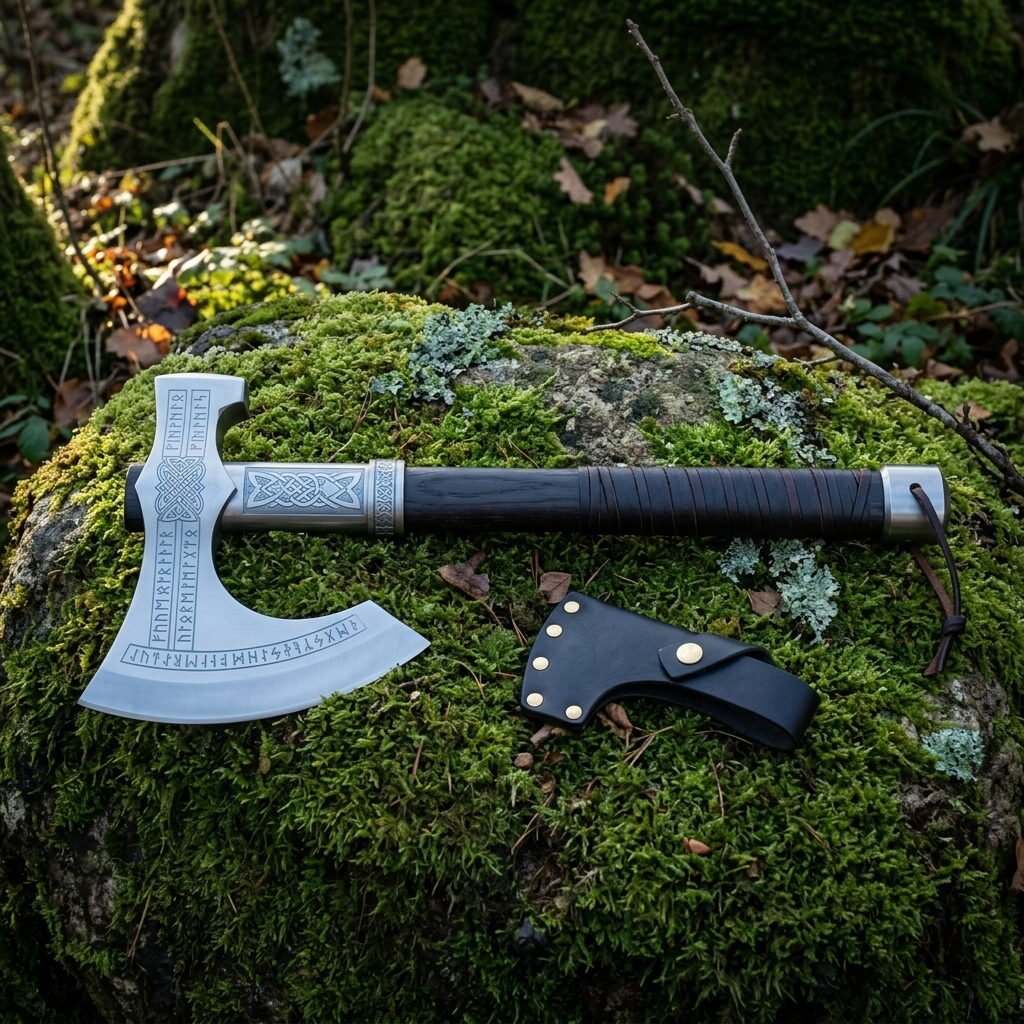
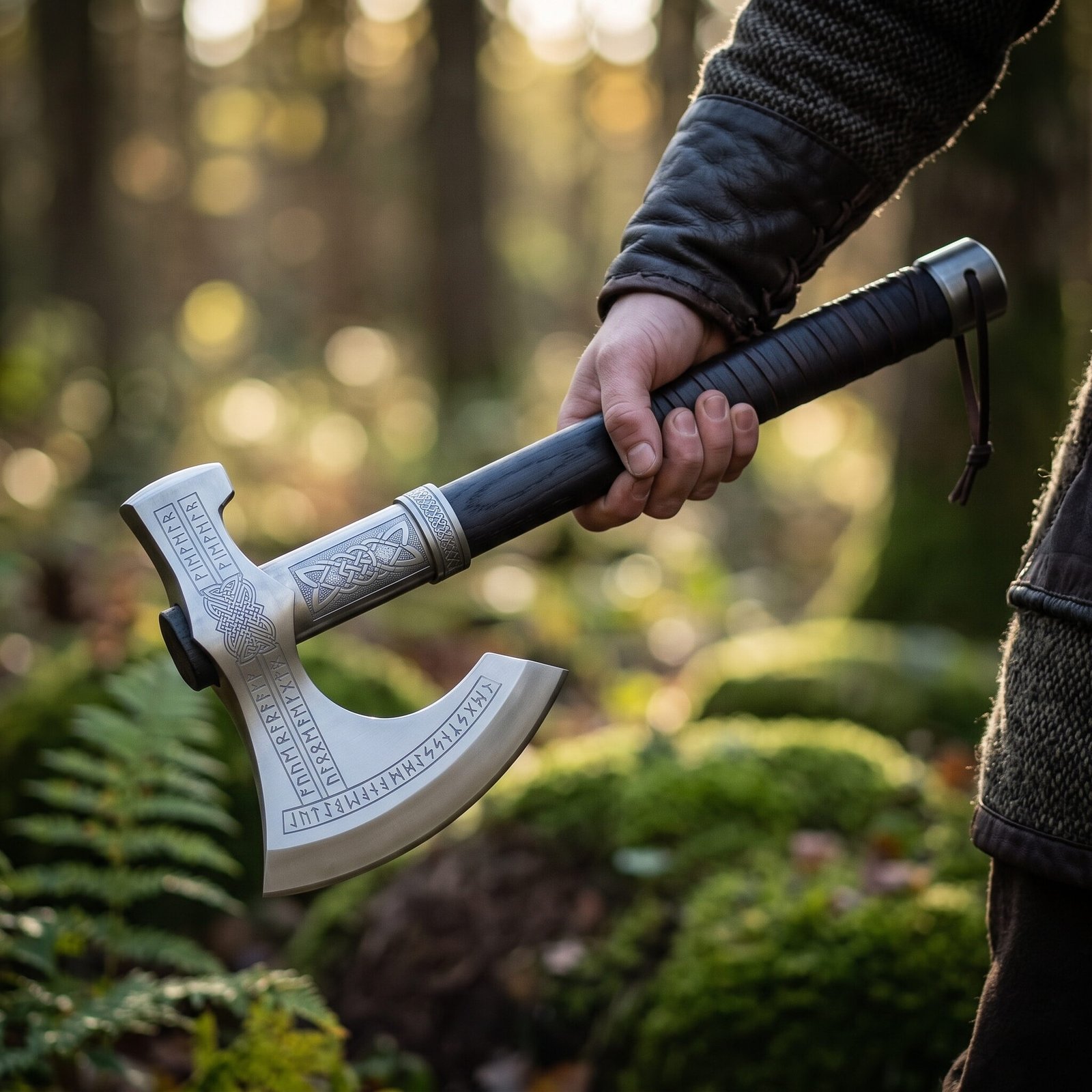
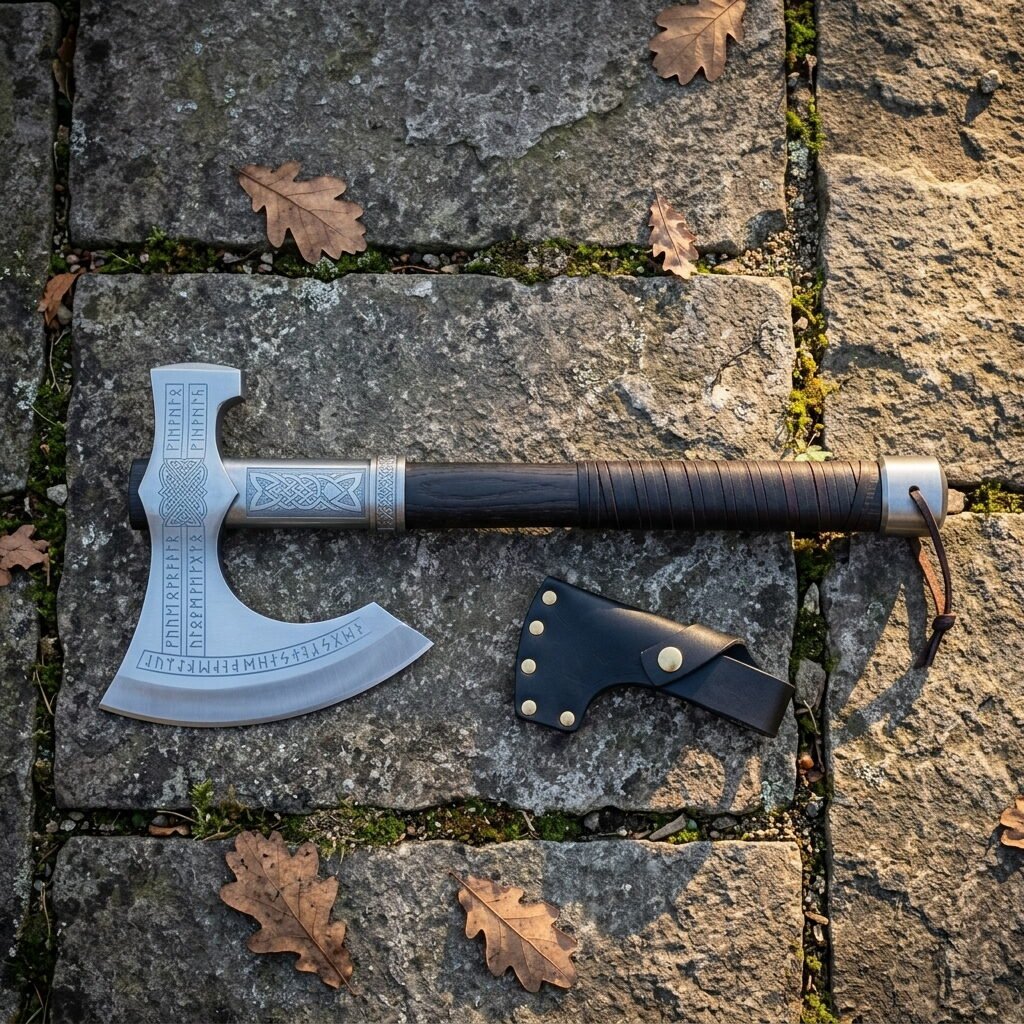
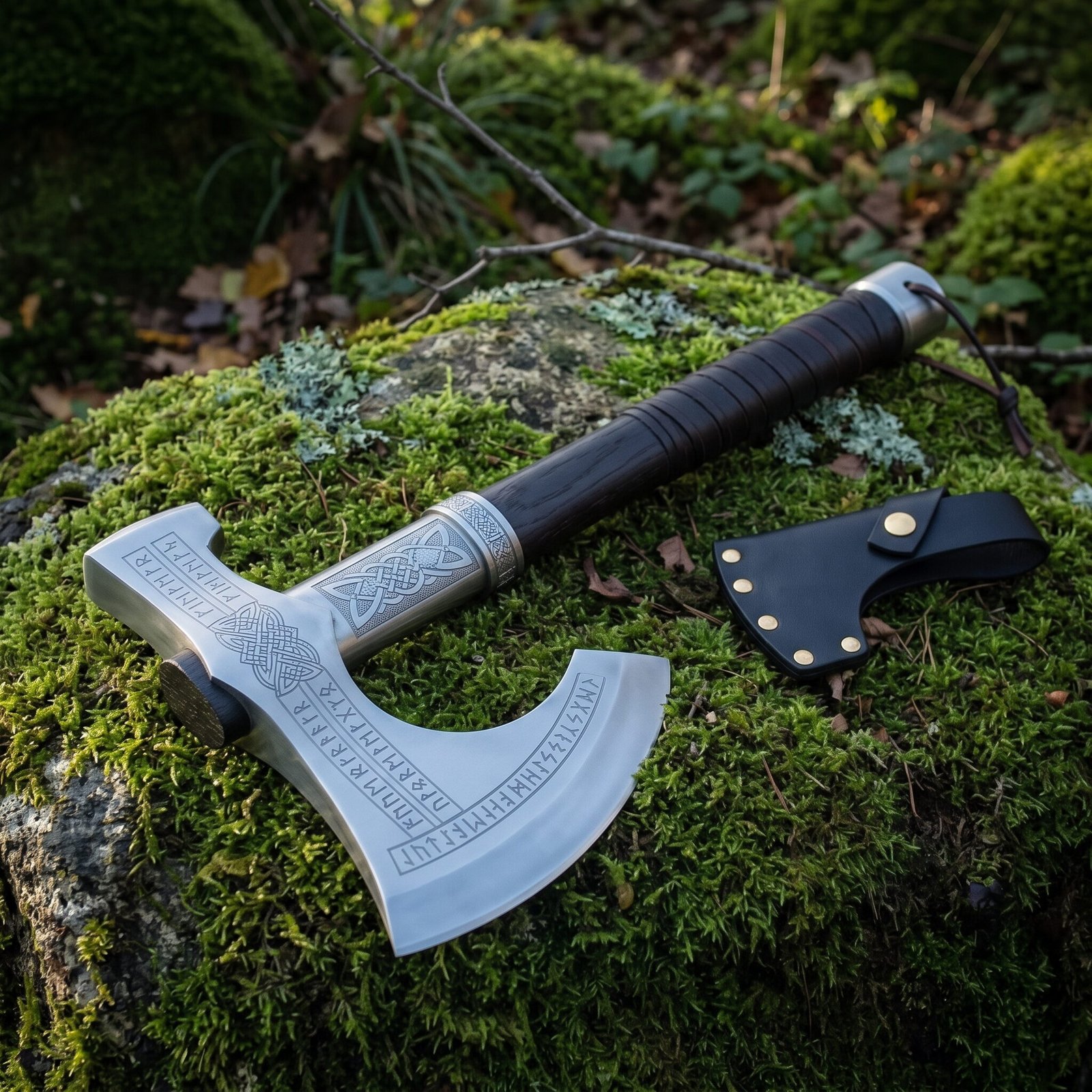
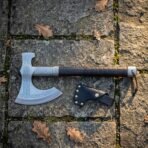
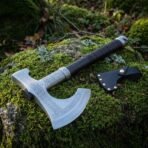
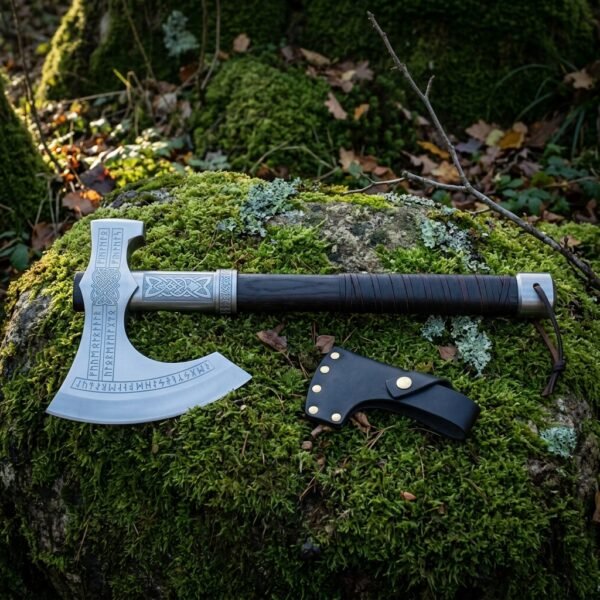
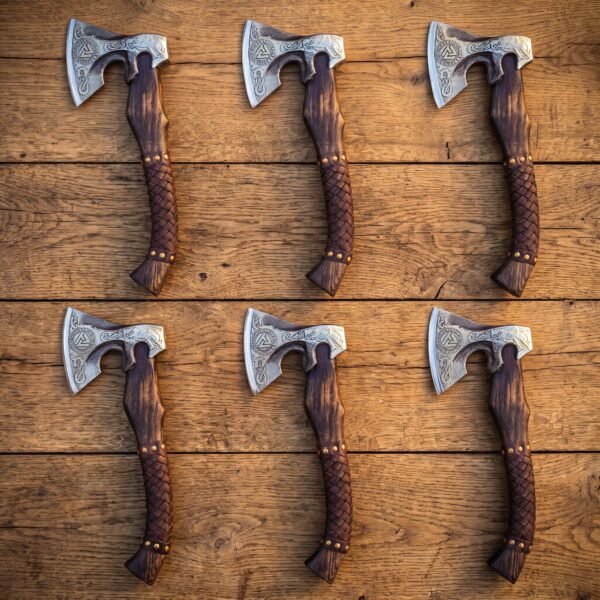
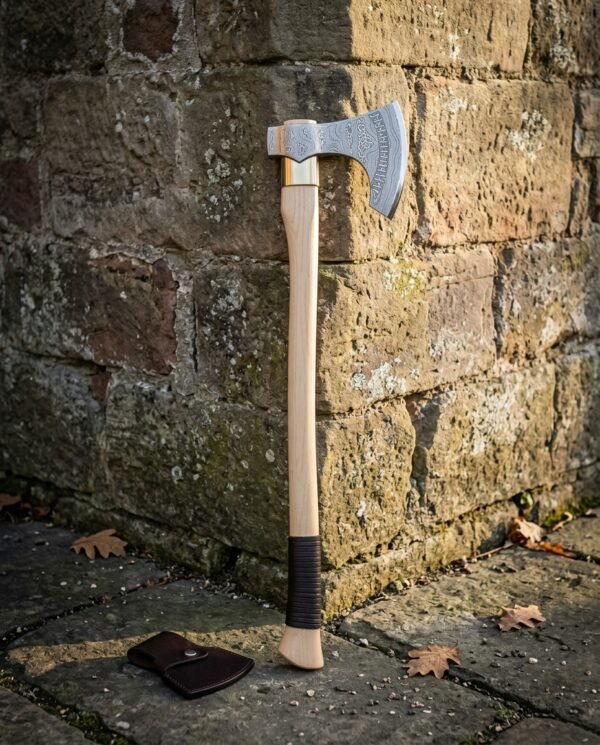
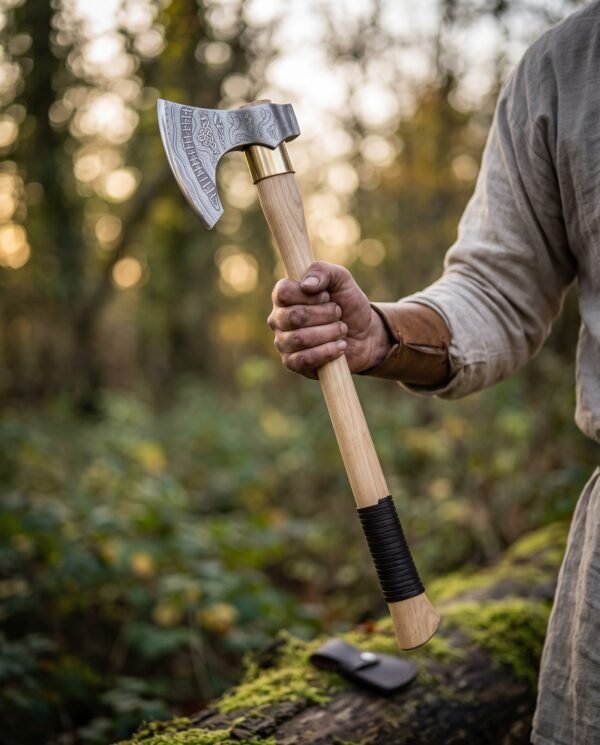
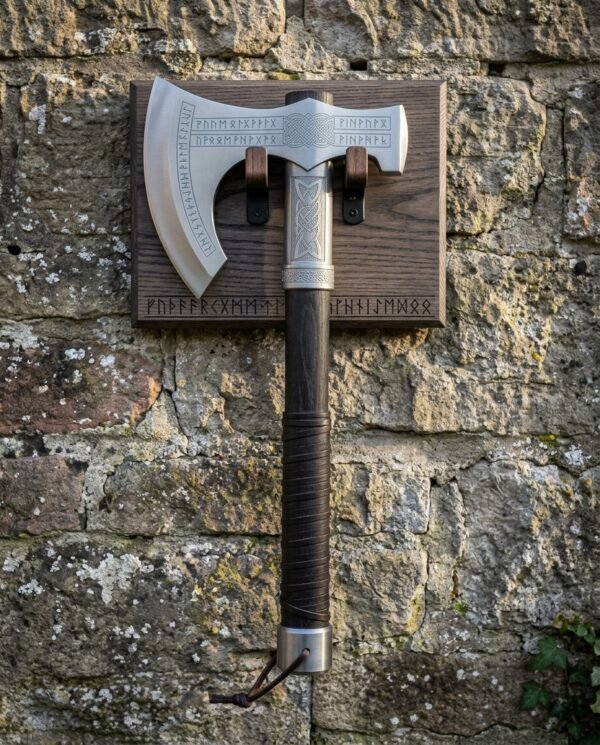
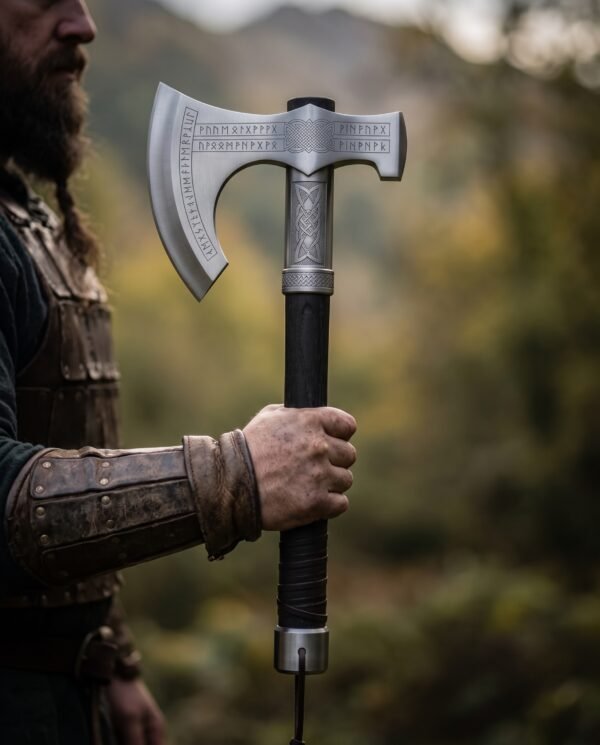
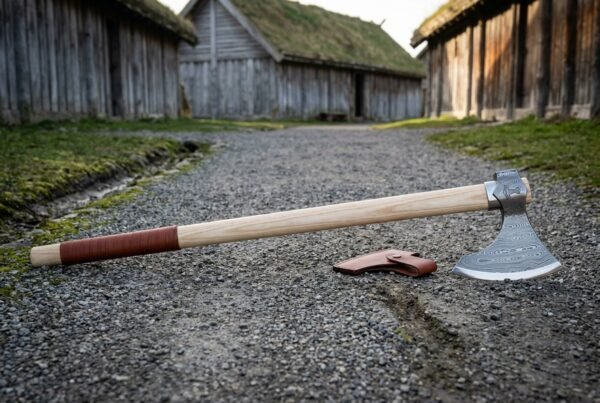
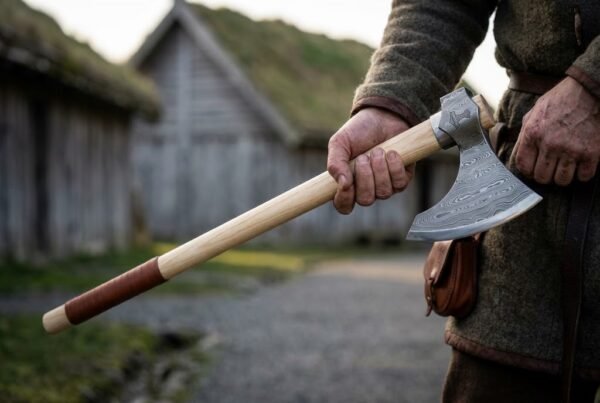
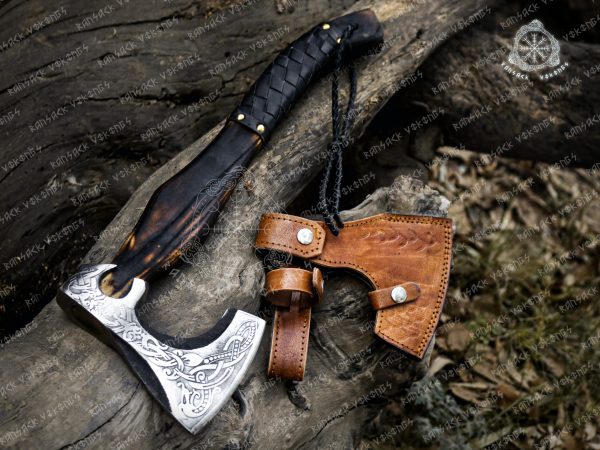
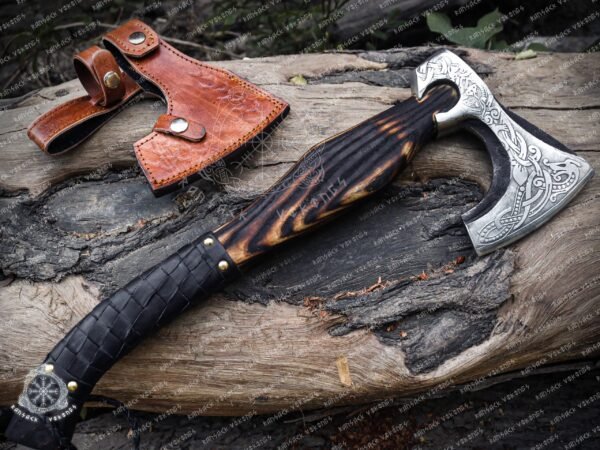
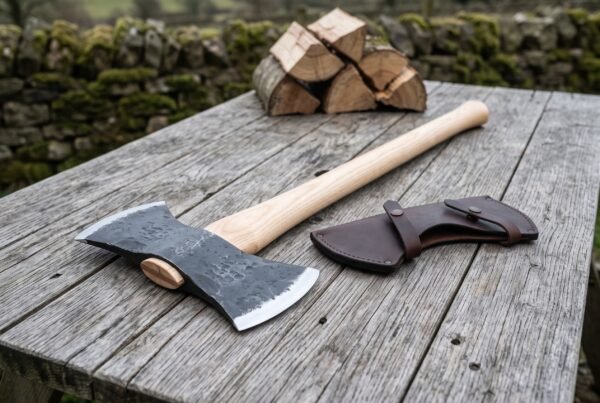
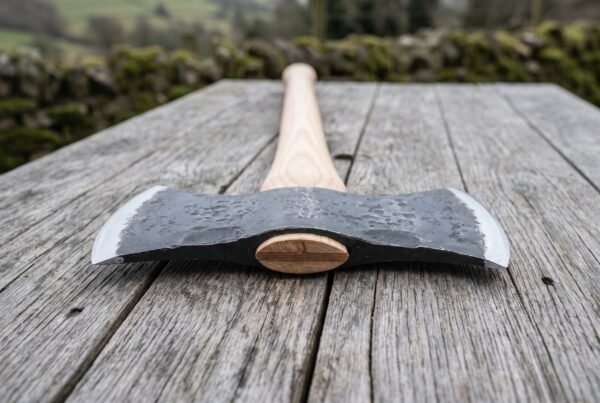
Frostrune is a full size Norse war axe built on the bearded pattern, with a broad crescent bit, a deep cut rune line running across both faces of the head, and a dark haft with oiled leather wrapped over the grip down to the butt. The bearded profile, the skeggox of the sagas, is the most recognisable Viking age axe shape, and it exists for reasons that have nothing to do with looks. Drawing the lower corner of the edge down and back below the eye buys cutting length without buying weight, so a bearded head carries ten inches of edge on a head lighter than a solid slab of the same span would ever be. The hook that shape creates was used on purpose. Norse fighting accounts describe an axe corner caught over the rim of a shield and hauled down to open the man behind it. The same profile stayed in Scandinavian carpentry for centuries after it left the shield wall, because the notch behind the beard lets a woodworker choke right up under the head and hold the haft directly behind the cut. If you are choosing runes for it, the Elder Futhark lists every character with its name and sound.
Every one of these is forged and finished in the Czech Republic. The head is drawn, punched and shaped over the anvil, the rune channels are cut into the steel by hand and darkened with a tone that sits down inside the cuts rather than on top of the surface, and the haft is fitted, wedged and wrapped one at a time. It ships with a riveted black leather head sheath that covers the whole bit and closes with a snap strap, a care card with the sharpening and oiling instructions, and free shipping inside the United States.
Specifications
| Steel | 1095 high carbon steel, hand forged, hand ground |
|---|
| Hardness | 54 to 58 HRC at the edge, softer through the eye and poll |
|---|
| Overall length | 24 inches |
|---|
| Cutting edge | 10 inches along the crescent, beard to upper horn |
|---|
| Head | Broad bearded crescent bit, 11 inches horn to horn, knotwork at the eye and an Elder Futhark rune band along the beard and edge with a dark fill |
|---|
| Collar | Steel sleeve over the top of the haft below the head, engraved with a knotwork band |
|---|
| Haft | American ash, dark stained, with leather cord wrapped over the grip |
|---|
| Butt | Steel butt cap with a leather lanyard loop |
|---|
| Sheath | Black leather head sheath with brass rivets and a snap strap |
|---|
| Weight | Approximately 4 lb 6 oz |
|---|
| Finish | Polished head with brightened edge bevels |
|---|
| SKU | RK-1220 |
|---|
How a bearded crescent head is forged and why it cuts
A head like this one is not milled out of plate. It starts as a bar of high carbon steel that is drawn out, folded around a tapered mandrel to form the eye, and forge welded closed behind it so the socket is a wrapped tube rather than a drilled hole. That single decision is what gives a hand forged axe its toughness. The grain of the steel runs around the eye instead of across it, so the shock of a hard strike travels along the fibre rather than splitting through it. From there the two wings are spread on the horn of the anvil, the beard is drawn down, and the crescent is trued up by eye against a template.
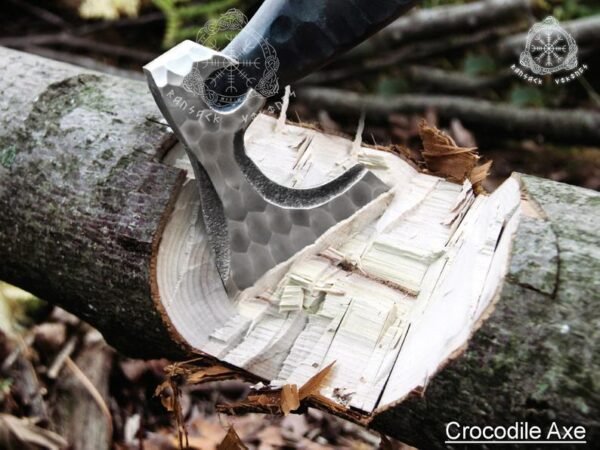
The cutting geometry does the rest. A crescent bit is thin behind the edge and thickens quickly toward the eye, which is the opposite of a splitting axe. A splitter wants a fat wedge that bursts wood apart. A war axe wants a lean, keen section that parts what it meets and keeps going, with the mass concentrated close to the eye where it does not slow the head down. Because the edge is curved, only a short section of it touches at any moment, so the whole force of the swing is concentrated into a couple of inches of steel. That is why a curved bit bites harder than a straight one of the same weight, and it is why the Norse kept making them long after straight edged tools were easy to produce.
The rune band and the dark fill
The band running across both faces is cut in Elder Futhark, the older of the two Norse rune rows, the one carved on standing stones across Scandinavia before the shorter Younger Futhark replaced it around the ninth century. The characters are cut into the steel rather than etched onto it, which is why they hold a shadow line even in flat light, and a dark tone is worked down into the channels so the letters read clearly against the bright polished head. The overall design owes something to Norse mythology and a great deal to the way modern Norse fantasy art and video game art have taught a generation to picture a Viking axe, with heavier ornament and colder colour than any excavated original ever carried. We are honest about that. This is a piece made in the modern Norse idiom, forged by traditional methods, not a museum reproduction of a specific grave find.
Why high carbon steel and not stainless
Stainless steel resists rust because it carries a large amount of chromium, and that chromium forms hard carbides that get in the way of everything an axe needs. Stainless is harder to forge, far harder to take to a fine edge by hand, and much more likely to chip when a heavy head lands badly. High carbon 1095 does the opposite. It moves cleanly under the hammer, it hardens deep and even, it takes a keener edge than any stainless in the same price band, and when it does dull it comes back on a stone in minutes rather than needing diamond abrasives. The trade is simple. It will rust if you leave it wet. Wipe it dry, put a film of oil on it, and it will outlast you. If you want the longer version of that argument, read our note on Damascus versus stainless, which covers the same ground for pattern welded blades.
The ash haft and the leather wrap
The haft is American ash, chosen the way axe hafts have always been chosen, for long straight grain that runs with the swing rather than across it. Ash is springy in a way hickory is not, so it takes the shock out of a hard landing before it reaches your hands, and it stays predictable in a room that goes from dry winter heat to summer humidity. The head is seated on a shoulder and wedged from the top, and the grip end of the haft is then wrapped in oiled leather cord, bound off at the butt so the wrap cannot creep. The wrap gives you a warm grip that does not go slick and a swell at the base that stops the axe walking out of your hand.
Leather and wood both want a little attention. Keep the axe out of direct sun and away from a radiator, wipe the wrap with a barely damp cloth if it picks up dust, and once or twice a year work a small amount of leather conditioner into the cord. If you ever unwrap the haft to refinish it, our guide to wooden handle care covers oiling and sealing bare wood again properly.
Engraving, runes and your own design
Use the rune converter on this page to turn a name, a date or a short phrase into Elder Futhark and we will cut it into the steel or the handle. If you would rather have a Viking pattern than a rune line, choose your own design in the engraving option above the add to cart button and tell us whether it goes on the blade or the handle. Where a piece already carries an engraved design, your chosen engraving replaces it rather than sitting alongside it. On this axe that means your rune line or pattern is cut into the same band the stock design occupies, in the same hand, with the same dark fill if you want it. Full details of what we can and cannot cut are on the engraving page.
Care and sharpening
After handling, wipe the head down with a dry cloth and put a light film of mineral oil, camellia oil or paste wax over the steel. Fingerprints are slightly acidic and they will etch a shadow into bare carbon steel within a week if you leave them. Store the axe out of its sheath, or at least not sealed inside it for months at a time, because leather holds moisture against steel. A little grey patina that comes up over the years is protective and worth keeping. Orange rust is not, and it comes off with fine steel wool and oil.
Sharpening a curved bit is a matter of following the arc rather than fighting it. Work in short sections with a coarse stone or a puck held flat to the existing bevel, move along the curve, and finish with a fine stone and a few light passes on a strop. Do not put a hollow grind on it and do not take it to a high speed wheel, which will burn the temper out of the edge before you notice. Our guides to steel care and sharpening with a whetstone go through both jobs step by step.
Made in the Czech Republic
This is a handmade piece from the Czech Republic, made in a workshop that still forges, grinds and finishes by hand instead of stamping parts out. The smiths there have kept the older way of working, and the wood, horn and leather are shaped and fitted by hand as well. Two pieces of the same design will never be identical, and that is part of what you are buying.
Ransack Viking is a United States company. We handle the import ourselves, look over every piece when it lands and ship from our warehouse in Chicago, Illinois. Engraving is done in the United States after the piece arrives, so your design goes on before we send it out.
A note on handmade variation
This axe is hand forged. It is not machine made and it is not bulk produced, so what arrives will not be a pixel for pixel copy of the photograph on this page. The grain of the ash runs differently in every haft, the tone of the leather takes the oil differently, the hammer texture across the cheeks of the head falls where the hammer fell, and the exact profile of the crescent varies by a fraction because it is trued by eye against a template rather than stamped out of a die. The dimensions, the steel, the hardness and the build are the same every time. The character is not, and that is the point of buying something a person made.
Frequently asked questions
Does it arrive sharp?
Yes. It ships with a working edge, sharp enough to cut cleanly into seasoned wood straight out of the sheath. It is not honed to a razor, because a razor edge on an axe chips the first time it meets a knot. Ten minutes on a stone will take it as fine as you want.
Can it actually be used, or is it a display piece?
It is a functional forged axe with a hardened edge and a wedged ash haft, so it will chop. Most people buy it to display it, and that is the use we design the finish around. It is not a throwing axe and it is not a sparring axe. Never throw it and never use it against another blade or a shield in contact work.
Can I have my own runes engraved on it?
Yes. Use the rune converter on this page for Elder Futhark, or pick your own Viking pattern in the engraving option. Your engraving replaces the stock rune band rather than being added next to it, so you get one clean design rather than two competing ones.
Will mine look exactly like the photographs?
It will be the same axe in every measurable way and it will not be identical in character. Wood grain, leather tone, the depth of the dark fill in the rune cuts and the hammer marks on the cheeks all vary from one to the next because a person made each one.
What is the difference between a bearded axe and a Dane axe?
A bearded axe has the lower edge drawn down into a hook and a haft in the two to three foot range, meant for one hand or a short two handed grip. A Dane axe is a two handed axe with a wide thin crescent on a haft of four feet or more, built for reach and speed rather than for the hooking work the beard allows.
How long does shipping take?
Shipping inside the United States is free and takes three to five business days once the axe leaves the shop. If we have to forge yours, add two to three weeks to that. International orders ship at cost and vary by destination.
What is in the box
- One Frostrune hand forged high carbon steel Norse runic bearded war axe, 24 inches overall
- Black leather head sheath with snap strap
- Care and sharpening card
- Protective oil film on the steel for transit
- Fitted, padded shipping box
- Forged and finished in the Czech Republic
Explore the range
See the rest of the Viking axes, the heavier battle axes, the full run of bearded axes and everything in engraved and personalised. If you are still deciding between shapes, start with the guides.
Worth a look beside this
Next along the rack is the Stavebeard bearded axe, forged from 1095. For a straight comparison, see the Knotwarden bearded axe, pattern welded Damascus. Worth putting side by side with this is the Ashbite bearded axe.
If you are putting a set together, the Ashwarden battle axe sits alongside it. Or start from a blank sheet on the custom Viking axe page.


This is exactly what I wanted and then some. Couldn’t be happier with this.
My husband was speechless when he opened this.
Nice piece for the price. Second time ordering from Ransack Viking and still happy overall. Sheath is nice. Wish it had more padding but it does the job. Glad I made this purchase.