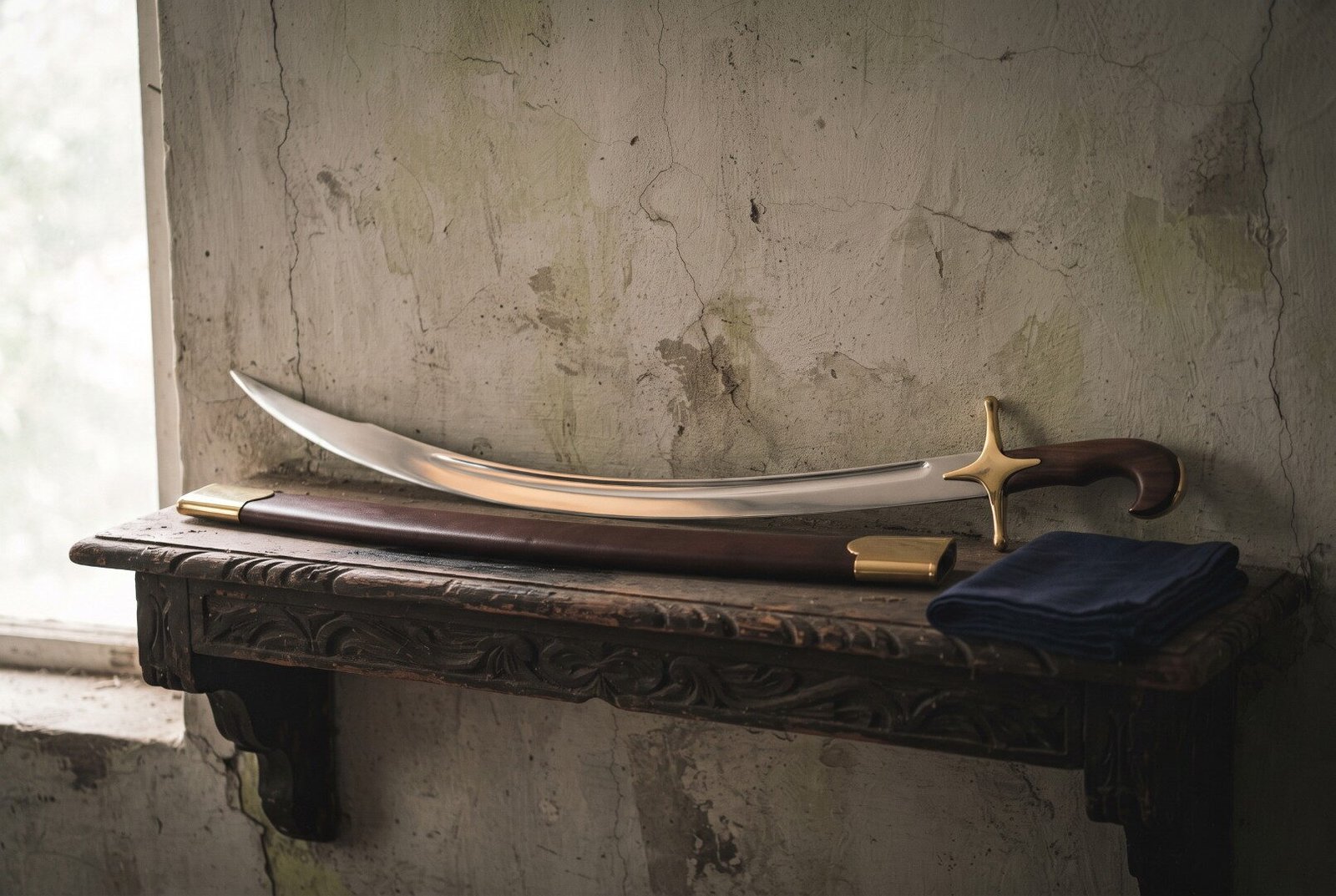
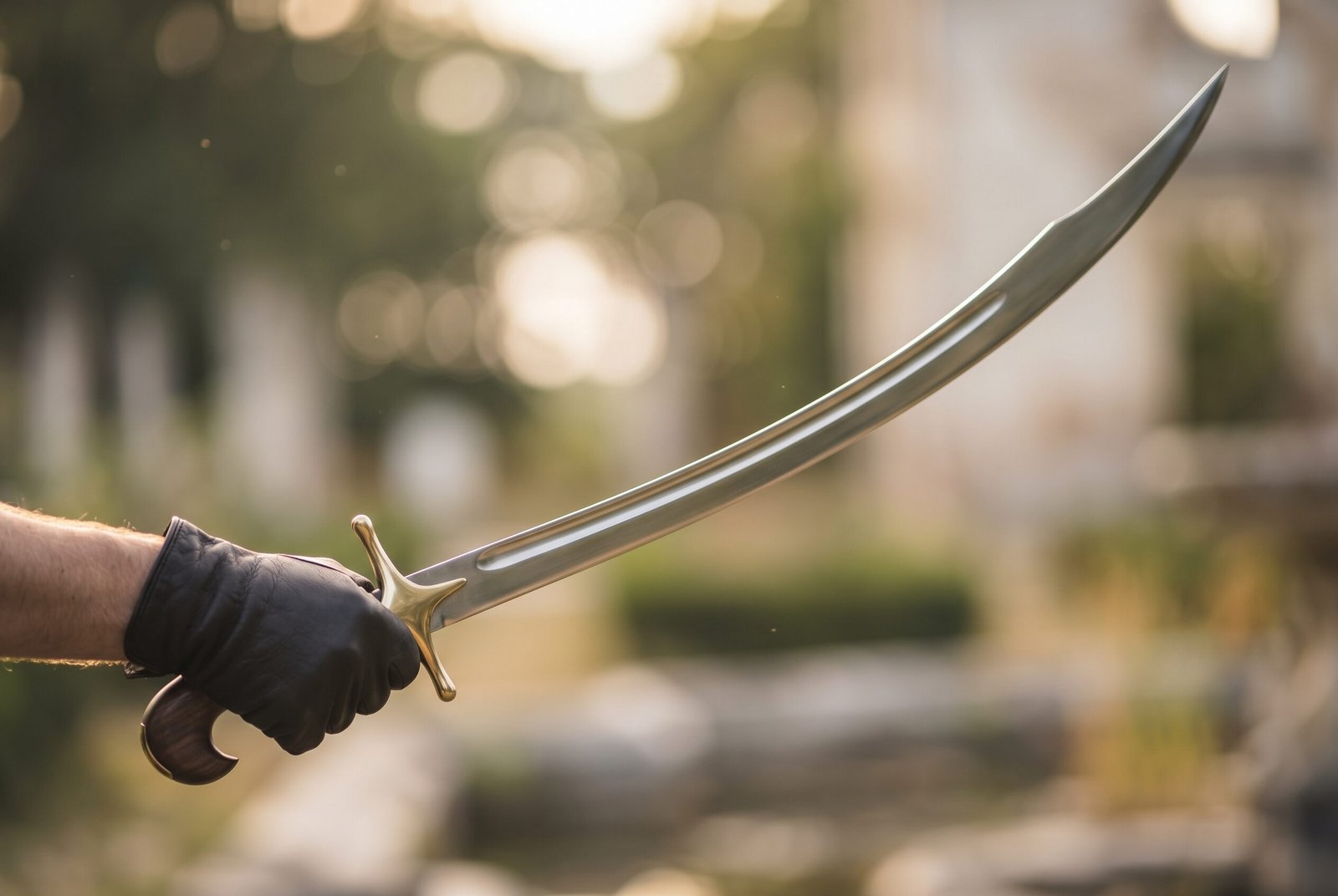
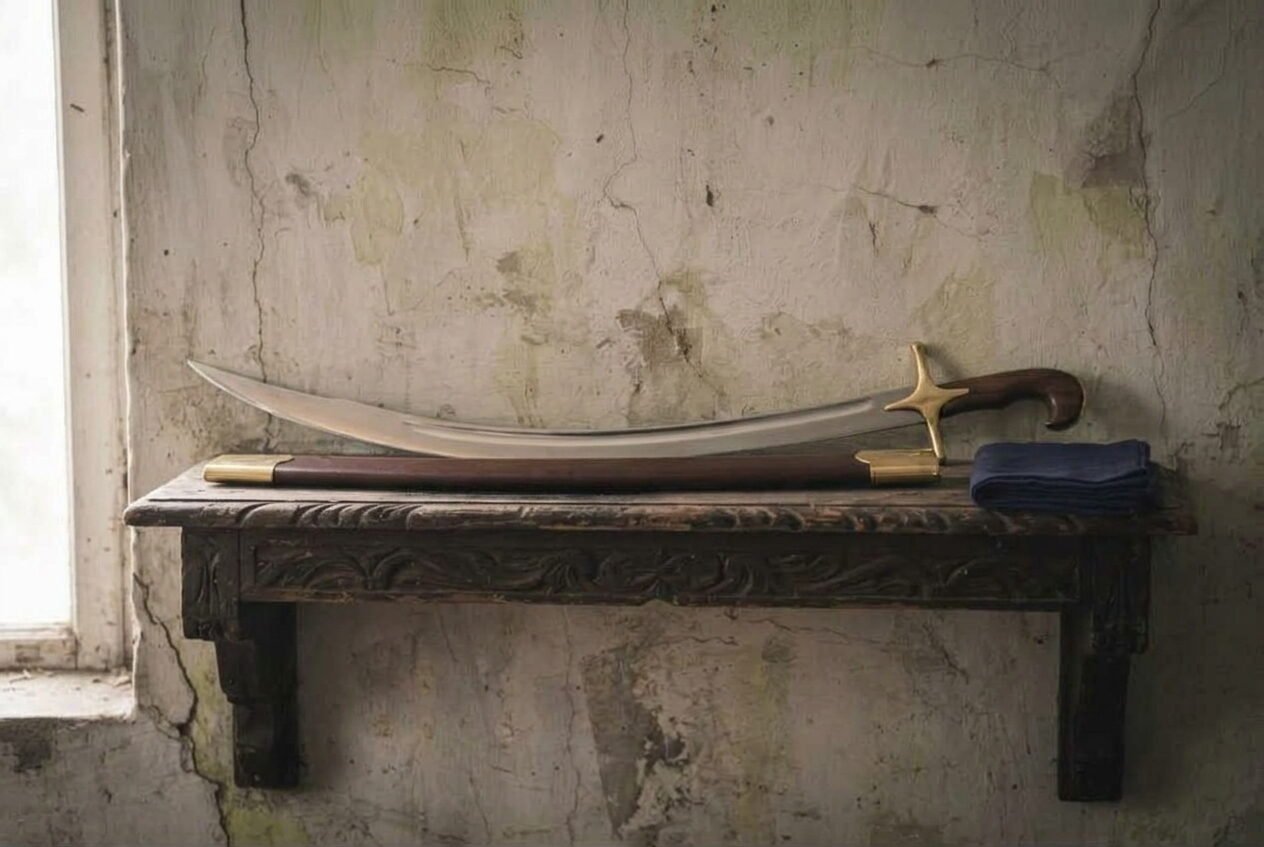
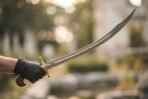
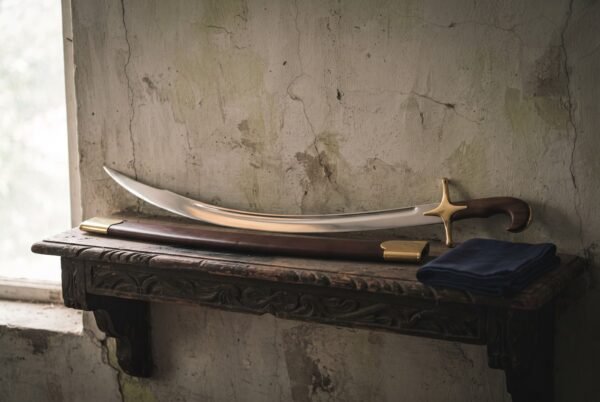
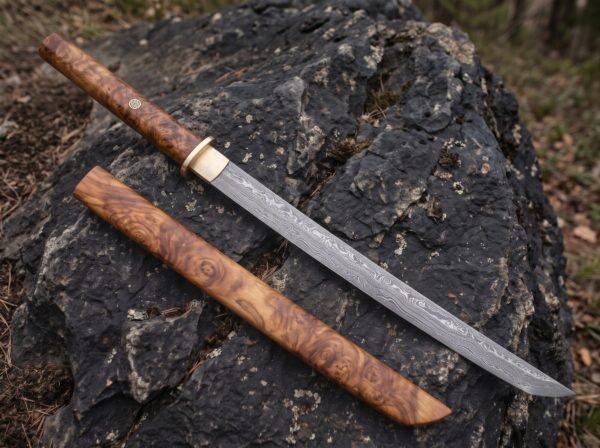
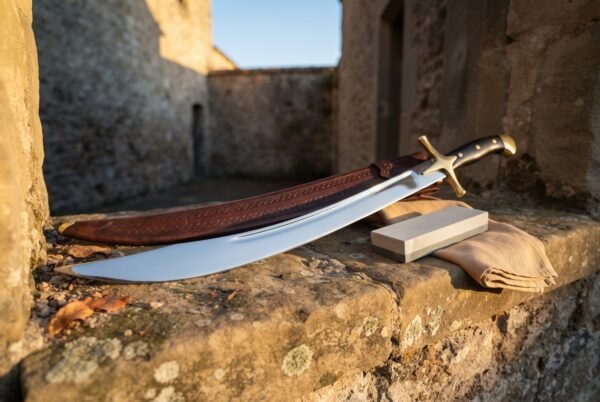
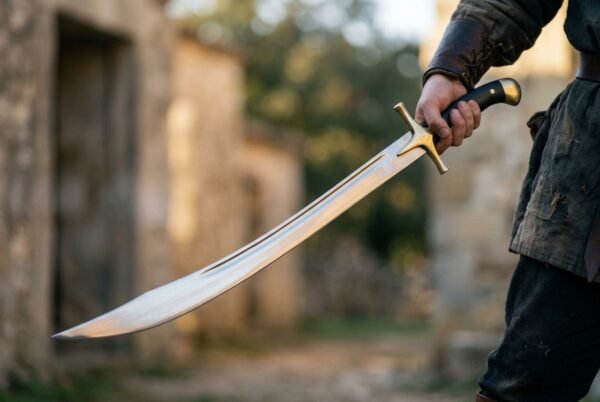
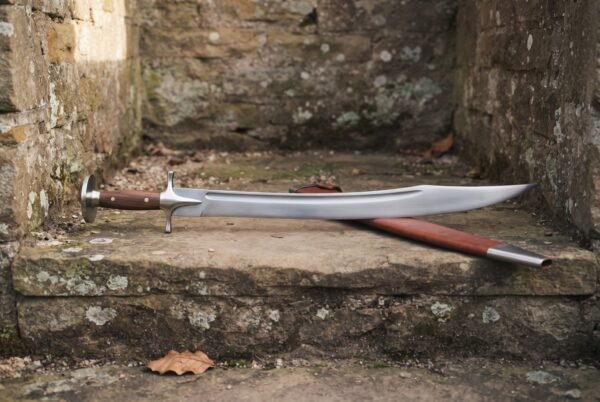
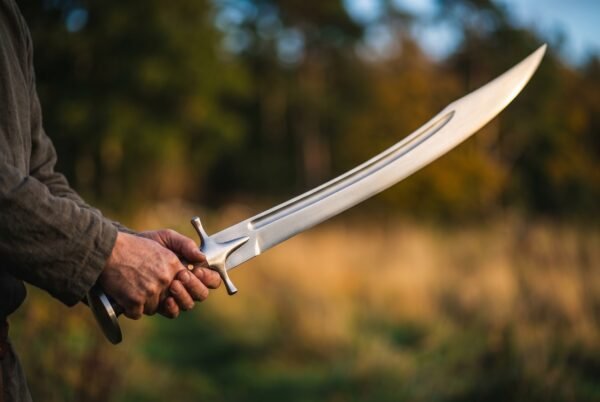
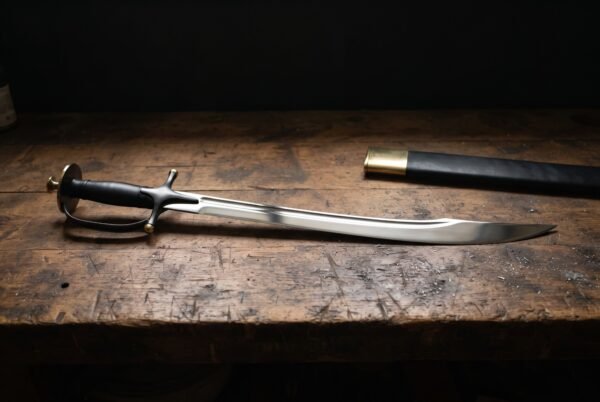
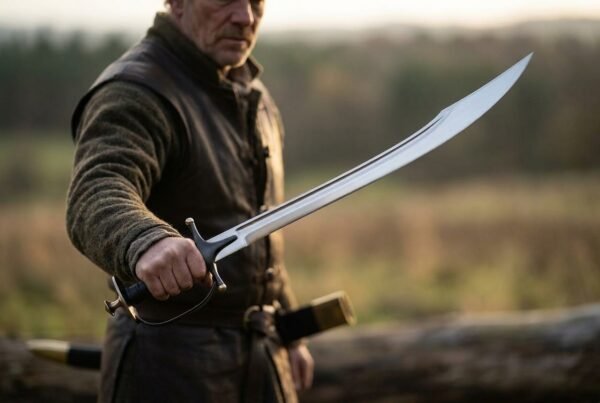
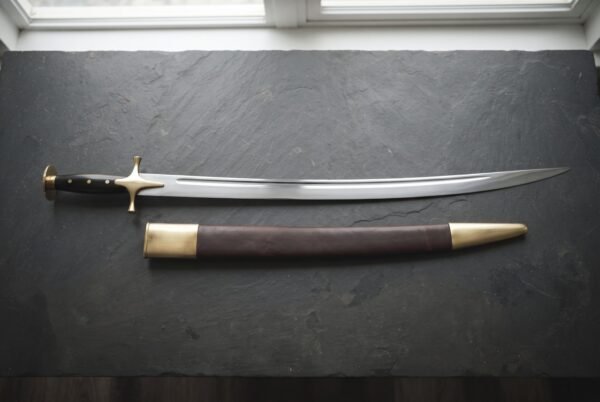
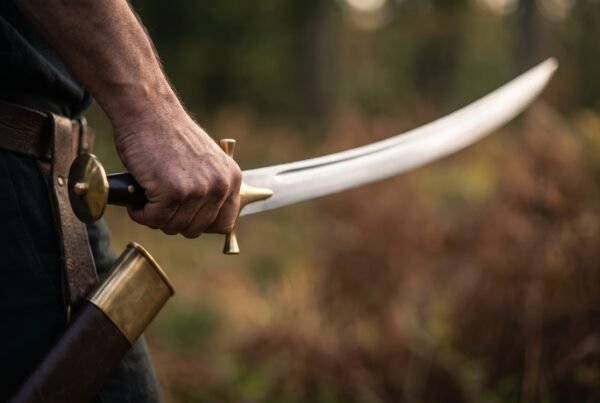
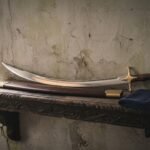
The Hollowmoon is a shamshir sword, the Persian pattern: narrow, unflared and curved evenly along its entire length, with a cross guard and the downturned hooked pommel that the type is defined by. This example uses a one piece rosewood grip rather than riveted scales, the hilt slotted and fitted over the tang so that no fasteners show and the wood runs unbroken from the guard to the hook. It is the cleaner of the two traditional constructions and the more difficult, because the slot has to be cut accurately along a curve before anything can be assembled.
Forged and finished in the Czech Republic. The blade is 1095 high carbon steel, hardened, tempered and polished. It ships in a leather covered scabbard with a brass throat and chape, with a care card, and shipping inside the United States is free.
Specifications
| Steel | 1095 high carbon steel |
|---|
| Hardness | 54 to 58 HRC |
|---|
| Overall length | 36 inches |
|---|
| Blade length | 30 inches |
|---|
| Blade | Polished, narrow, with an even Persian curve and a fuller running along the spine |
|---|
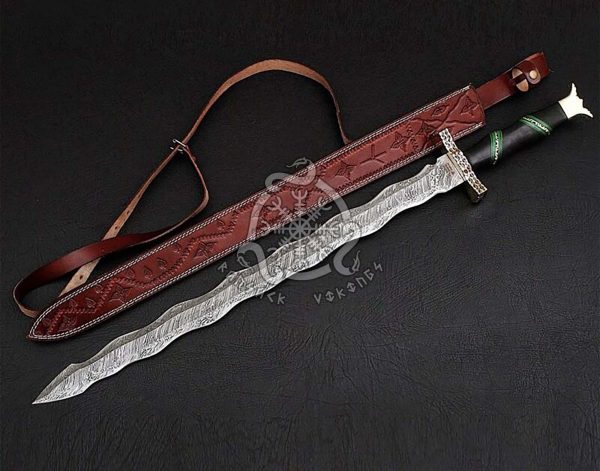
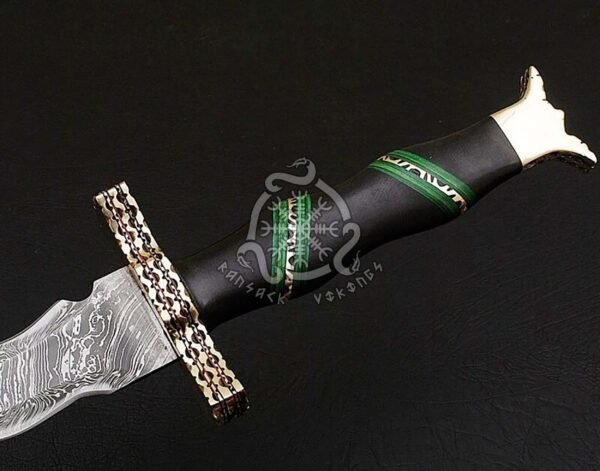
| Guard | Brass cross guard with drooping quillons and langets above and below |
|---|
| Grip | One piece dark rosewood grip ending in a hooked pommel with a small brass cap |
|---|
| Scabbard | Brown leather covered with brass throat and chape |
|---|
| SKU | RK-1396 |
|---|
How a curve gets into a blade
There are two ways to end up with a curved sword and they produce different objects. The cheap way is to take a straight bar and grind the curve out of it, cutting away steel from one side until the outline looks right. The result is curved but the grain of the steel still runs straight through it, so the fibre of the metal is cut across at every point along the edge, and the blade is weakest exactly where it is asked to work hardest.
The other way, and the way this one is made, is to forge the curve in. The bar is worked hot and the steel is moved rather than removed. Hammering along one side lengthens that side, which pulls the whole bar into an arc, and the internal grain of the metal follows the shape as it bends. When the blade is finished the fibre runs continuously from guard to point along the curve, and the edge is supported by unbroken grain the whole way.
There is a second thing that happens on the anvil. Setting the curve unavoidably distorts the cross section, so a smith works the two sides against each other, thinning the spine here to bring the edge out there, judging the result by eye and by the way the blade rings. It is the slowest part of making a sword like this and the part that cannot be automated. It is also the reason two blades from the same shop are never quite identical.
Why 1095 high carbon steel and not stainless
1095 carries just under one percent carbon and nothing else of significance. That plainness makes it forgiving on the anvil, which matters a great deal when the curve is being set hot, and it hardens fully through a slim blade like this one. Its fine grain lets the edge come to a genuine apex, and tempered to 54 to 58 HRC it stays springy enough to bend and return.
Stainless resists rust because of its chromium, and chromium ties carbon up into hard carbides. That is worth it in a paring knife and not worth it in a thirty inch blade, where those carbides make chipping and cracking more likely under shock. What you take on with 1095 is that it will corrode if you neglect it, which is a rag and a bottle of oil. The whole argument is on Damascus versus stainless.
The one piece rosewood grip
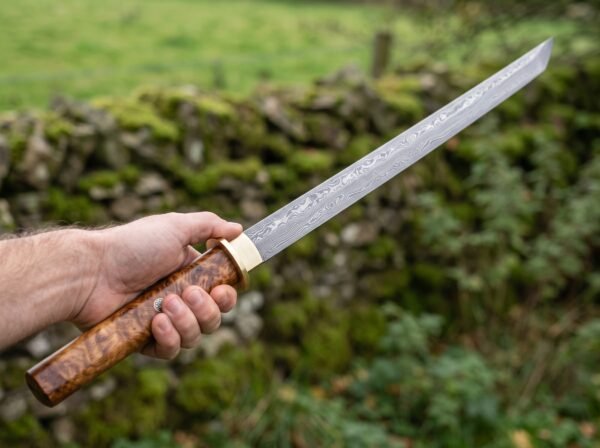
The grip is a single block of rosewood, slotted to take the tang and fitted over it, then shaped down to the finished profile with the hook cut from the same piece of wood. Nothing is pinned through and nothing shows on the outside, which is why the grain runs unbroken around the curve of the pommel.
The advantage is not only visual. A one piece grip has no seam for moisture to work into and no rivet holes to become the place a crack starts, and because the wood is continuous around the hook it can take the load of the hand pressing against it without any risk of a scale lifting. The disadvantage is that it is unforgiving to make. The slot has to follow the tang exactly, and if it is cut a fraction wide the whole block is scrap. Rosewood is the right timber for it: dense, naturally oily, dimensionally stable and grippy under a warm hand. Give it a wipe of oil once or twice a year, especially in a dry heated room, as set out on wooden handle care.
Engraving, runes and your own design
Use the rune converter on this page to turn a name, a date or a short phrase into Elder Futhark and we will cut it into the steel or the handle. If you would rather have a Viking pattern than a rune line, choose your own design in the engraving option above the add to cart button and tell us whether it goes on the blade or the handle. Where a piece already carries an engraved design, your chosen engraving replaces it rather than sitting alongside it. On a one piece grip like this, a short line cut into the wood along the spine of the hilt works particularly well, because there are no rivets to interrupt it. See the engraving page.
Care and sharpening
Wipe the blade down after handling and keep a thin film of light oil on the steel. Polished carbon steel takes fingerprints as etched grey marks within a couple of weeks, and prevention is a great deal easier than repolishing. Once a month with an oiled rag is enough for a sword displayed indoors. Store it drawn on a stand or a mount rather than left inside the scabbard, since leather holds moisture and tanning salts against a blade. Our routine is on steel care.
Sharpening follows the curve. Work three or four inches at a time, keep the bevel angle steady, and draw the blade across the stone along its arc so the contact point travels the way it does in a cut. On an evenly curved blade the whole edge wants identical treatment, so count your passes rather than working by feel. Finish fine and strop. Full walkthrough on sharpening with a whetstone.
Made in the Czech Republic
This piece is made by hand in the Czech Republic, in a workshop that still works the old way. The steel is forged, ground, heat treated and finished by smiths who learned the trade from the people before them, and the wood, horn and leather are cut and fitted by hand rather than pressed out on a line. That is also why no two pieces come out exactly the same.
Ransack Viking is a United States company. We import these pieces ourselves, check every one when it lands and ship from our warehouse in Chicago, Illinois. Engraving is done here in the United States after the piece arrives, so your runes or your own design go on before it leaves for you.
A note on handmade variation
This shamshir is hand forged. It is not machine made and it is not bulk produced, so what arrives will not be a pixel for pixel copy of the photograph on this page. Rosewood figure differs from block to block and on a one piece grip that difference is on show along the whole hilt. The brass takes its own tone, the leather has its own grain, and the exact radius of the curve moves a fraction from blade to blade because it is hammered rather than machined. Dimensions, steel and build stay the same. The character does not.
Frequently asked questions
Is it sharp when it arrives?
It comes with a working edge rather than a razor edge, which is right for a sword of this length. If you want it keener, say so in the order notes and we will take it further first.
Is a one piece grip stronger than riveted scales?
In practice yes, because there are no rivet holes and no seam. Both constructions are historical and both are sound, but the one piece hilt has fewer places to fail and takes longer to make, which is why it costs more.
Can I spar with it?
No. It is a sharp, hardened sword and not a trainer. Light test cutting on mats or bottles is fine, blade contact and hard targets are not.
What is the difference between this and a sabre?
A sabre is a European cavalry sword with a knuckle bow and usually a shallower curve and a usable point. A shamshir is Persian, more deeply curved, with a cross guard and a hooked pommel, and it does not thrust.
Can I have a date engraved on the handle?
Yes. Rosewood cuts cleanly and a date or short phrase sits well along the spine of the grip. Use the rune converter for Elder Futhark or choose your own design in the engraving option.
How long does shipping take?
Free inside the United States. Two to three business days for a stock sword and two to three weeks for one that is engraved.
What is in the box
- Hollowmoon hand forged 1095 high carbon steel shamshir sword
- Leather covered scabbard with brass throat and chape
- Care card with oiling and storage instructions
- Certificate of hand forging
- Forged and finished in the Czech Republic
Explore the range
Browse the other scimitars, the full swords collection, the sabres and the engraved and personalised pieces, or read the guides.
Close to this one
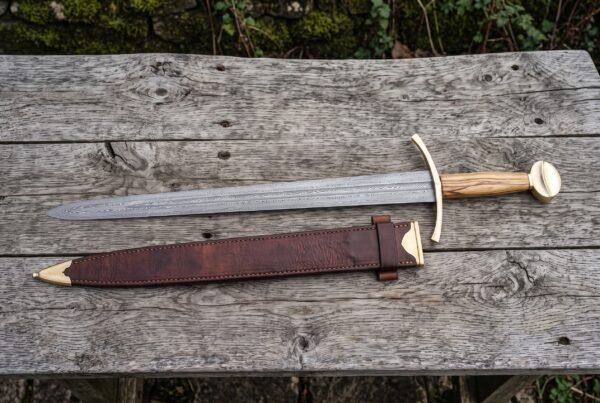
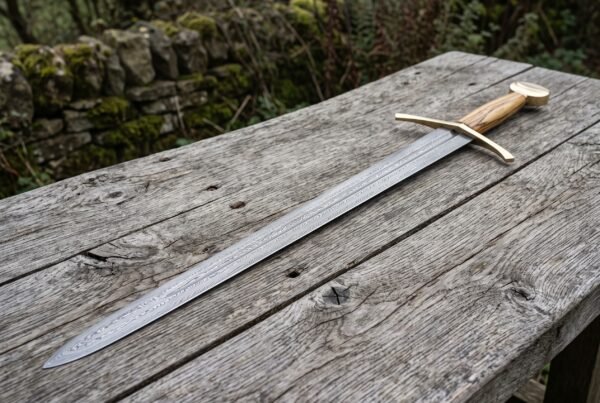
Closest to this in the range is the Sandreaver scimitar, 36 inches overall. If this one is not quite right, there is the Emberledge scimitar, 37 inches overall. Also in this group is the Nightwheel scimitar, 35 inches overall.
If you are putting a set together, the Knotwarden arming sword sits alongside it. Nothing here exactly right, build one to your own spec on the design your own page.


This sword is well made. Just a couple small things kept it from 5 stars.