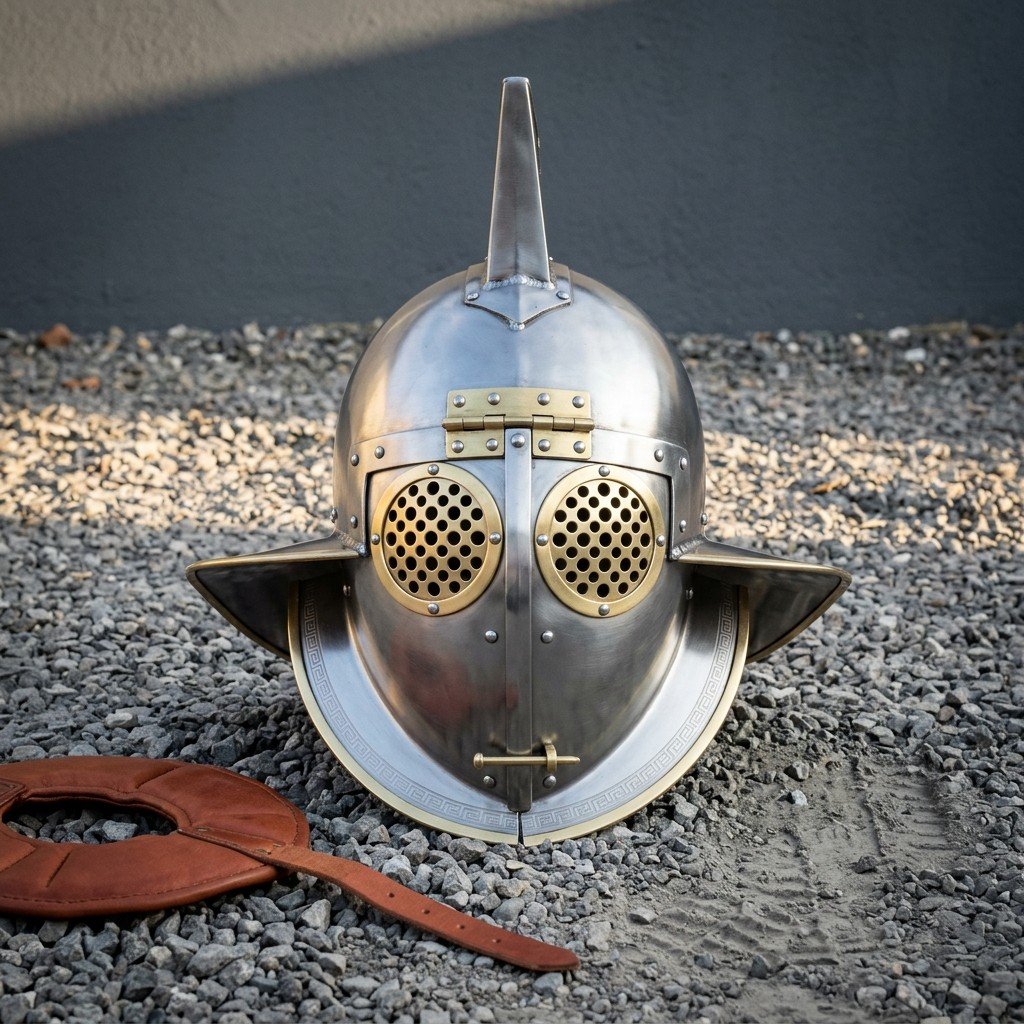
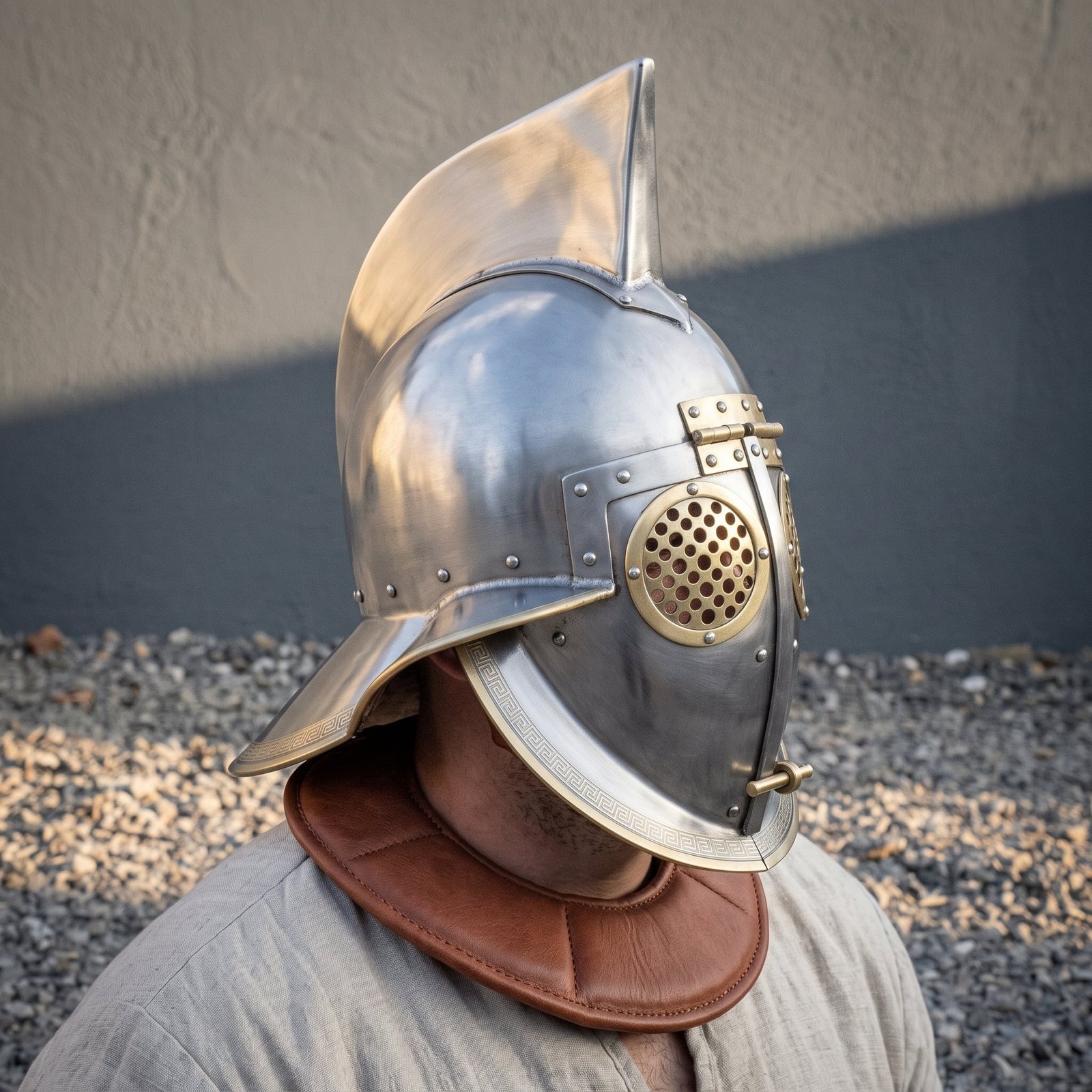
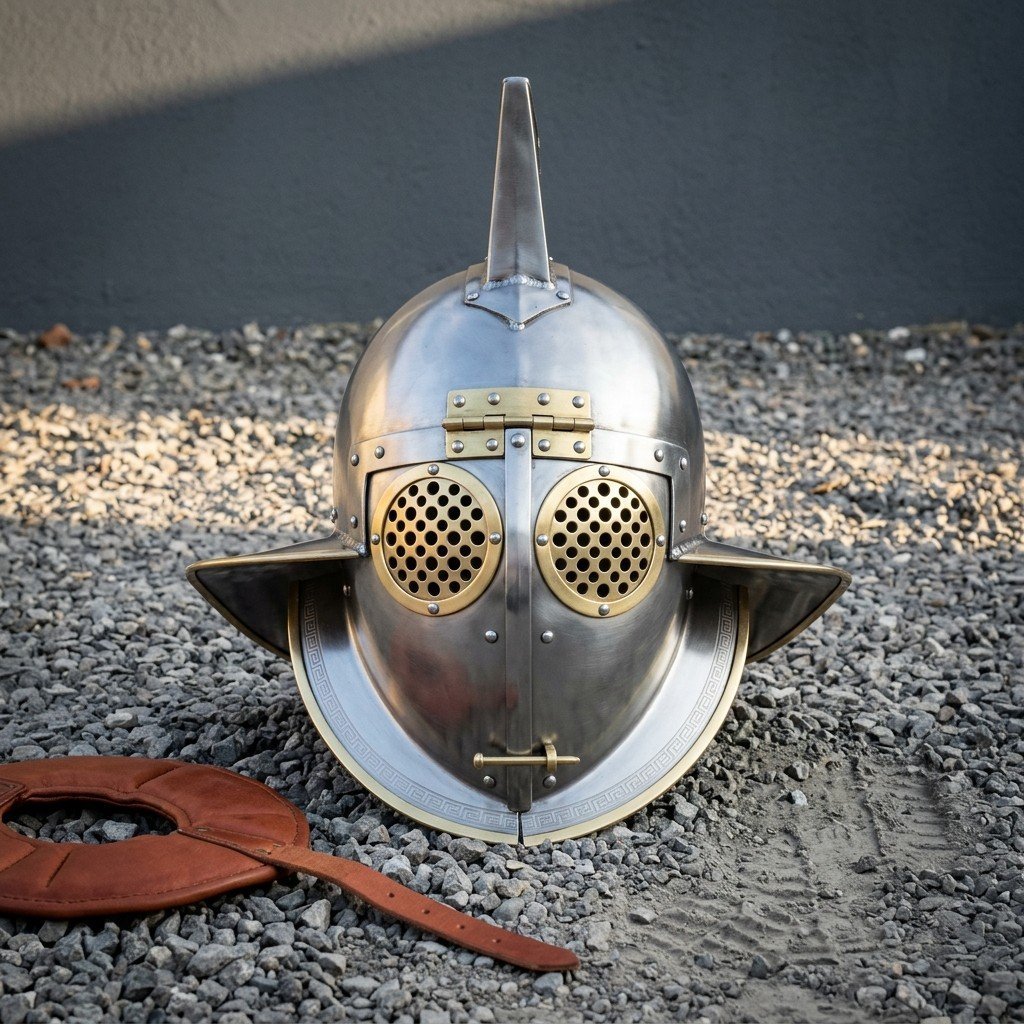
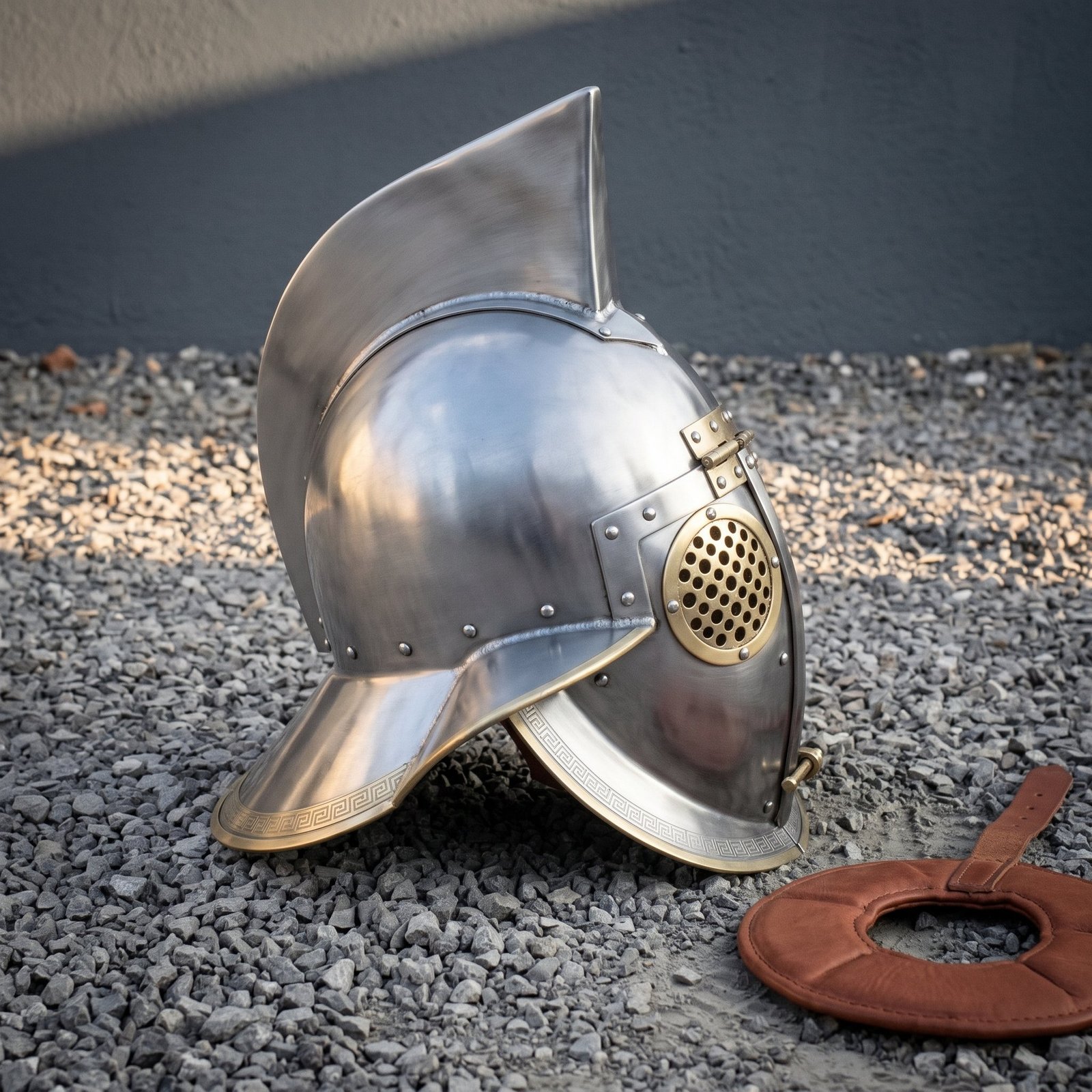
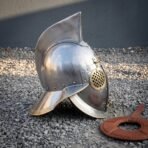
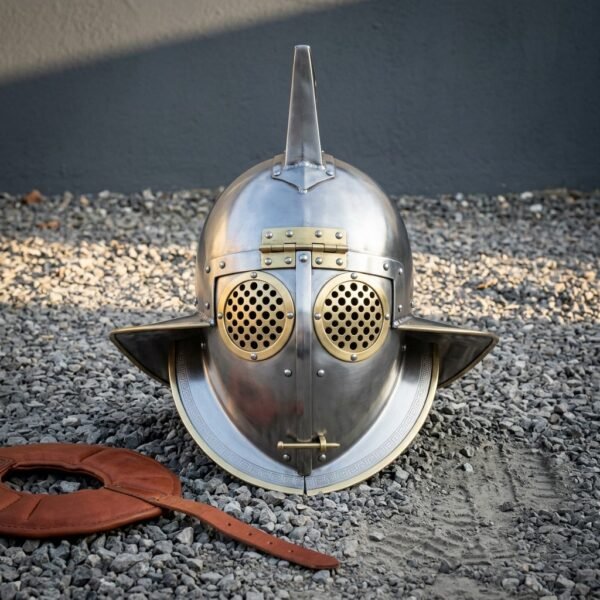
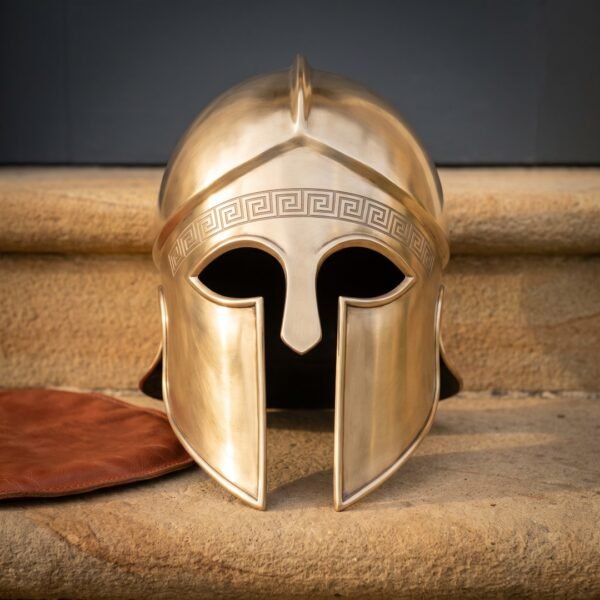
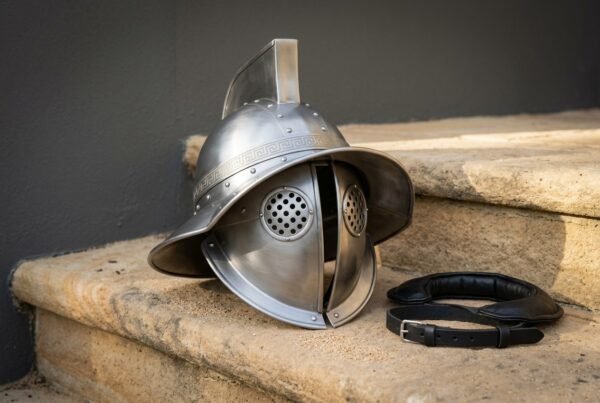
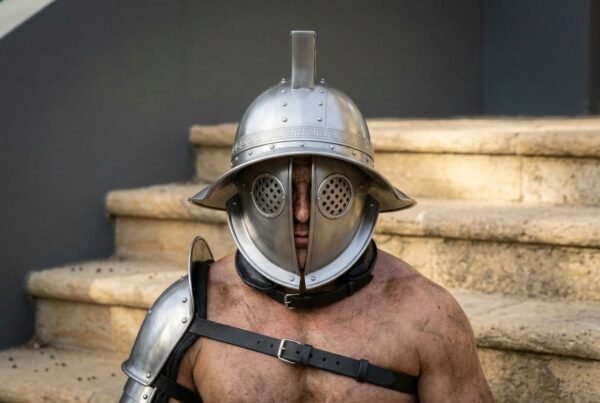
The Arenaward is a gladiator helmet in the murmillo pattern, with a rounded skull, a tall angular crest fin standing up from the crown, a broad brim that sweeps down and out into a neck guard, and a hinged full face visor pierced by two perforated brass rimmed eye discs. It is hand raised from mild steel with brass edging and brass grilles, and it closes at the front with a simple pin catch under the chin.
The helmets recovered from the gladiator barracks at Pompeii in the eighteenth century are the reason we know what these looked like, and the thing that surprises people is the weight. Arena helmets ran between about seven and eleven pounds, which is far heavier than anything a legionary wore on campaign. The reason is simple. A soldier had to march in his helmet and fight in it all day, so weight was the enemy. A gladiator wore his for a single bout in front of a crowd, so the design could afford to be as enclosing and as heavy as it liked, and it bought protection with that budget. Every Arenaward is raised, pierced, hinged and finished in a Czech Republic workshop. Roman and Greek kit sat alongside mail and plate in the same centuries, compared in chainmail versus plate versus lamellar.
Specifications
| Material | Mild steel sheet, hand raised, with brass edging and brass grille rims |
|---|
| Gauge | 18 gauge, approximately 1.2 mm |
|---|
| Style | Murmillo pattern arena helmet with a tall angular crest fin |
|---|
| Visor | Full face, hinged at the brow on a brass hinge plate, two perforated brass rimmed eye discs |
|---|
| Closure | Sliding pin catch at the chin |
|---|
| Neck guard | Wide flared brim running the full circumference, brass bound with a patterned border |
|---|
| Fittings | Steel rivets along the visor frame and the crest |
|---|
| Head size | Fits approximately 22 to 24 inch head circumference |
|---|
| Weight | Approximately 7 to 8 pounds |
|---|
| Lining | None fitted, intended to be worn over a padded arming cap |
|---|
| Intended use | Display, film and light reenactment. Not rated for full contact combat |
|---|
| SKU | RK-1499 |
|---|
Grilles instead of slits, and why the brim goes all the way round
Look at almost any military helmet with a face defence and you will find a slit or a T shaped opening. Arena helmets use perforated discs instead, and the difference is deliberate. A slit is a channel that a narrow point can find. A field of small round holes cannot be entered by a sword tip or a trident prong at all, and it gives you vision across a much wider arc than a slit does, because your eye can move behind it. You lose some light and some clarity. You gain a face that no point can reach.
The brim is the second signature feature. On a legionary helmet the neck guard covers the back of the neck only, because the man is standing in a line with comrades either side and behind. A gladiator is alone in a circle with a crowd all around and an opponent who can move anywhere, so the guard runs the whole way round the helmet at shoulder level and turns every downward blow away from the collarbone. That flare is also why an arena helmet cannot be worn with a shield tucked into the shoulder in the military manner. It is a helmet for single combat and for nothing else.
The crest fin on the murmillo is the visual identifier for the type, and it is structural too. A raised fin along the crown is a stiffening rib on the thinnest and most exposed part of the shell. Originals carried plumes and horsehair in sockets on either side, and the fin is what the crowd used to tell one class of fighter from another across an arena.
The steel, the brass and the gauge
Originals were bronze, which is heavy, workable and expensive. Ours is raised from 18 gauge mild steel, roughly 1.2 mm, with brass used for the edging and the grille rims so the piece carries the correct two tone look without the price and mass of a bronze shell. Steel also takes a satin finish that photographs far better under artificial light than bronze does.
Eighteen gauge is display and light reenactment weight. It is right for events, museums, film work, gyms and collections, and it keeps this helmet at seven to eight pounds rather than eleven. It is not battle rated plate. Combat societies that fight in steel require heavier and often hardened stock, and this helmet is not certified to those standards. That is not a knock on it. It is what it is built for.
The brass is cut, filed and fitted by hand around the brim and the eye discs, and it is left bright. It will darken with time into a warmer gold, which sits better against the steel than fresh brass does. The grilles are pierced individually rather than punched as a sheet, which is why the hole spacing has a very slight hand cut irregularity when you look closely.
Engraving, runes and your own design
Use the rune converter on this page to turn a name, a date or a short phrase into Elder Futhark and we will cut it into the steel or the brass. If you would rather have a Viking pattern than a rune line, choose your own design in the engraving option above the add to cart button and tell us where it goes. Where a piece already carries an engraved design, your chosen engraving replaces it rather than sitting alongside it. On the Arenaward the brass brim band and the flat of the crest fin are the two places a line reads well, and a fighter name is the most requested. Full detail is on the engraving page.
Fit and sizing
This helmet is made to a stated size rather than to your measurements. Run a tape around your head above the ears and across the brow, then add for the padding that goes underneath. A padded arming cap adds roughly half an inch to three quarters of an inch of circumference.
With a full face helmet, the height of the eye discs relative to your eyes decides whether it is usable or not. Padding at the crown of the cap raises the helmet and drops the discs, and half an inch of packing makes a large difference. Get that right before you decide the helmet does not fit, because most of the time it is the cap and not the shell.
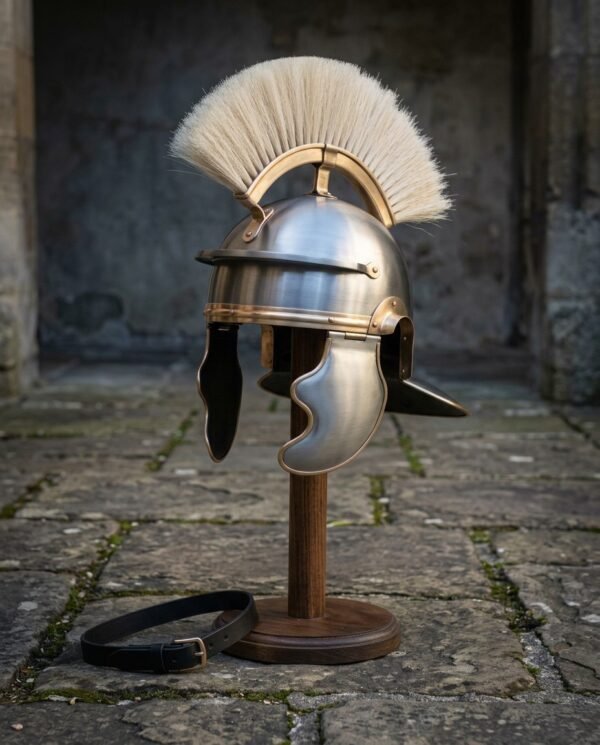
Do not wear it bare headed. Seven to eight pounds of steel resting directly on the skull is uncomfortable within a couple of minutes and spreads no load at all under impact. The padded leather cap and the belt shown lying beside the helmet in the photograph are photography props and are not included.
Care
Wipe the steel with a lightly oiled cloth after handling and before storage. Bare mild steel takes fingerprints and they etch in over weeks. Keep polish off the pierced grilles, because it packs into the holes and dries white, and clean those with a soft brush instead. Oil the visor hinge and the chin catch once or twice a year. Store the helmet upright on a stand or on its brim rather than face down, so the crest fin and the visor are not carrying the weight. Our full notes on protecting bare steel are on the steel care page. Care is the same as for any steel armour, covered in caring for chainmail and steel armour.
Made in the Czech Republic
Every piece we sell is made by hand in the Czech Republic. The smiths there work the way the trade has been worked for a long time, heating and hammering the steel, taking the bevels down by eye, and fitting the handle and the leather one at a time. There is no automated line anywhere in it, so small differences from one piece to the next are normal and expected.
Ransack Viking is a United States company based in Chicago, Illinois. We bring the pieces in ourselves, inspect them on arrival and ship them from our own warehouse. If you add engraving, that is carried out here in the United States before your order goes out.
A note on handmade variation
This helmet is hand made, not machine made or bulk produced, so what arrives will not be a pixel for pixel copy of the photograph. The planishing across the bowl, the exact rake of the crest fin, the spacing of the pierced holes in the eye discs and the tone of the brass vary from one helmet to the next, because each one is worked by hand from natural materials. The dimensions, the material and the build are the same every time. The character is not.
Frequently asked questions
Can you see through the grilles
Yes, better than you would expect and better than through a narrow slit, because your eye can move behind the perforations. Light levels drop noticeably, so give yourself a minute to adjust before moving around in it.
Is this bronze like the originals
No. The shell is mild steel with brass edging and brass grille rims. That keeps the weight and the price sensible while giving the correct two tone appearance.
Is it safe for full contact fighting
No. At 18 gauge it is a display and light reenactment helmet. Steel fighting societies require heavier and usually hardened stock and their own certification, and this is not built to that.
Does the visor open
Yes. It is hinged at the brow and secured with a pin catch at the chin, so it lifts clear for talking, drinking and breathing between bouts.
What do I wear under it
A padded arming cap. No liner is fitted, because a cap gives a better fit and lets you tune the height of the eye discs. The cap in the photograph is a prop and is not included.
How soon does it ship
Processing is one to two weeks because each helmet is raised, pierced and fitted to order, then shipping is free within the United States.
What is in the box
- One Arenaward murmillo gladiator helmet in 18 gauge mild steel
- Hinged full face visor with two perforated brass rimmed eye discs
- Brass bound flared neck guard and a raised crest fin
- Care card covering oiling the steel and cleaning the grilles
- Lifetime warranty against defects in forging, grind, heat treat and fittings
- Forged and finished in the Czech Republic
Explore the range
See more in Roman and Greek helmets, medieval helmets and round shields, or read the guides before you choose a size.
Others in the same line
If this one is not quite right, there is the Eaglecrest Greek helmet. Also in this group is the Legionplume Greek helmet. Sitting beside it in the catalogue is the Aegiscrest Greek helmet.
From the same corner of the shop, there is the Ridgehelm Medieval helmet. You can have this made your way instead on the design your own page.




Reviews
There are no reviews yet