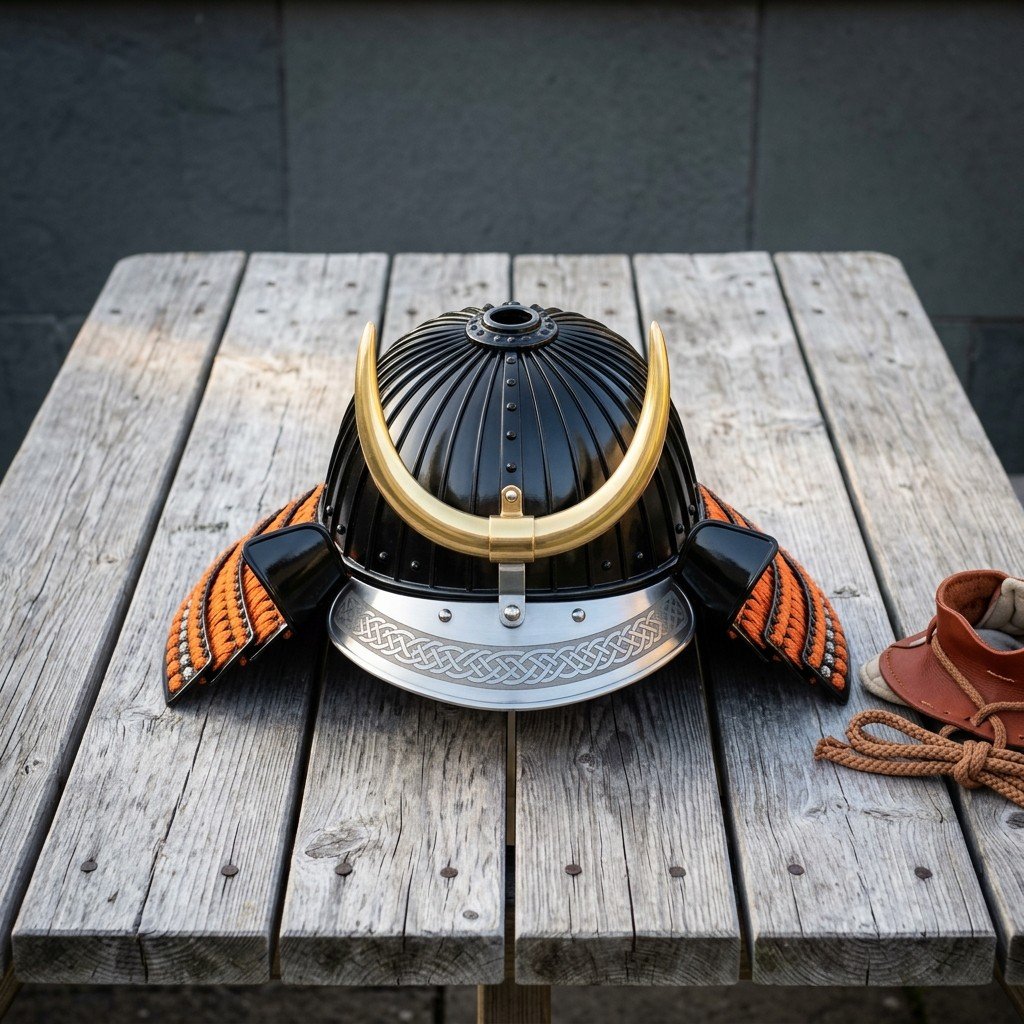
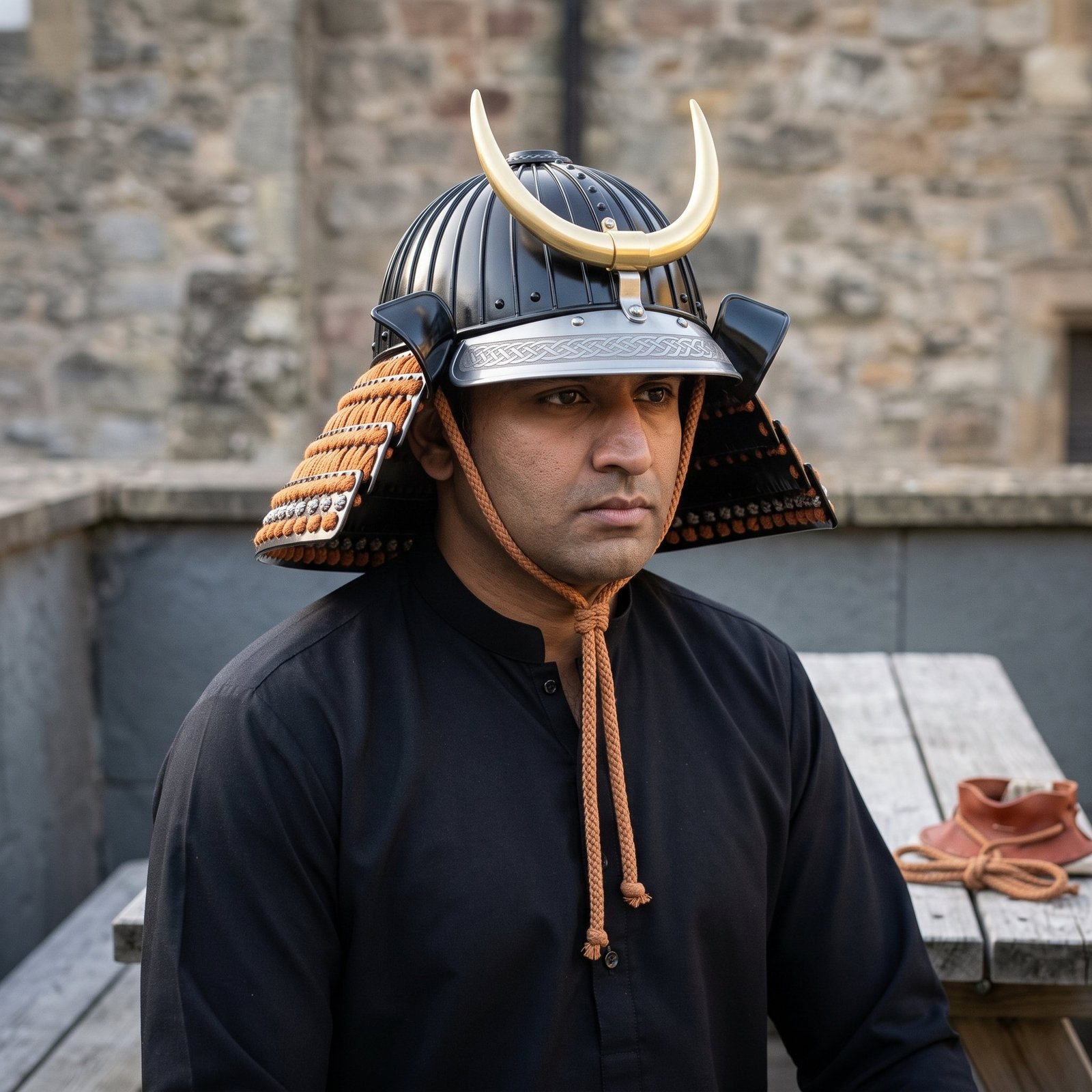
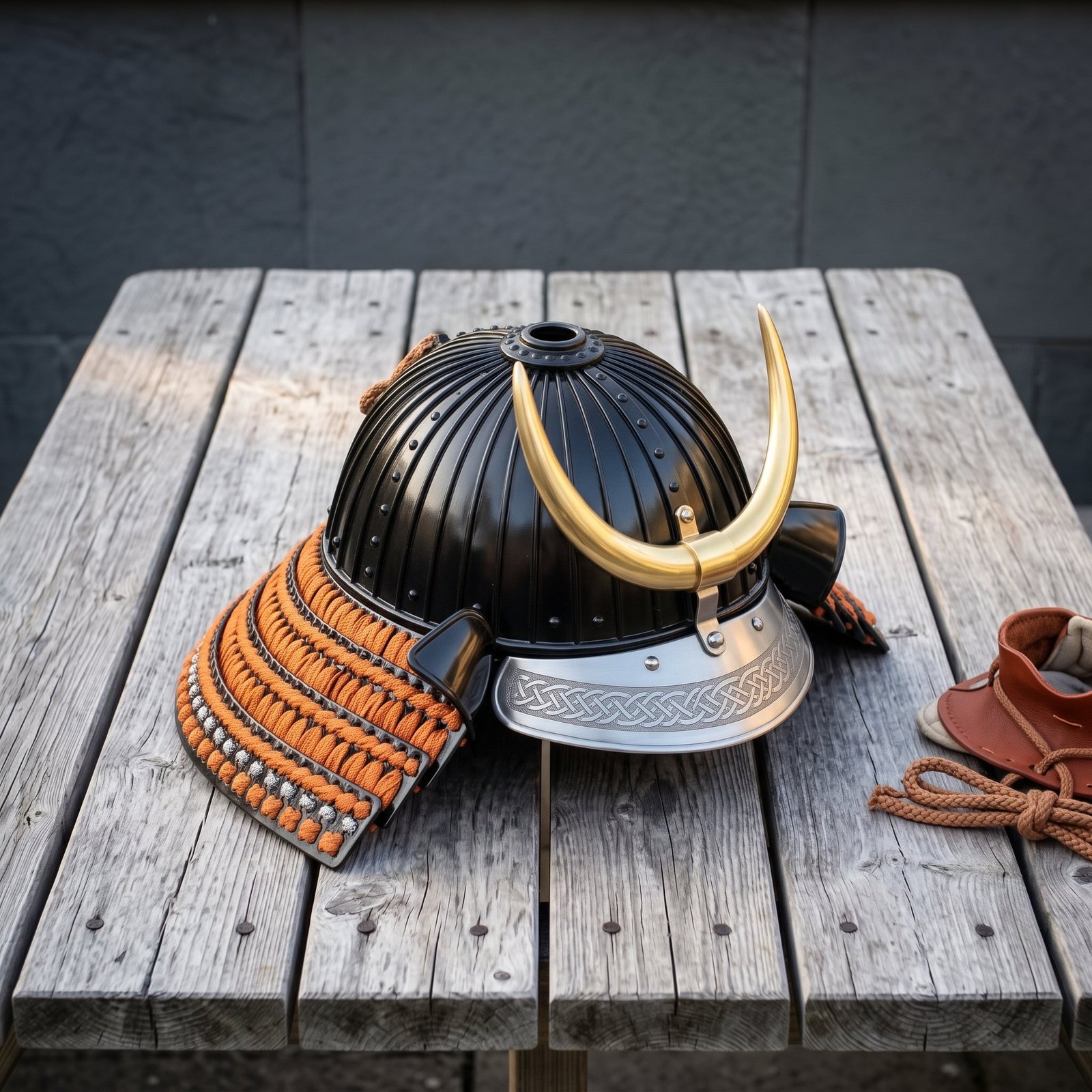
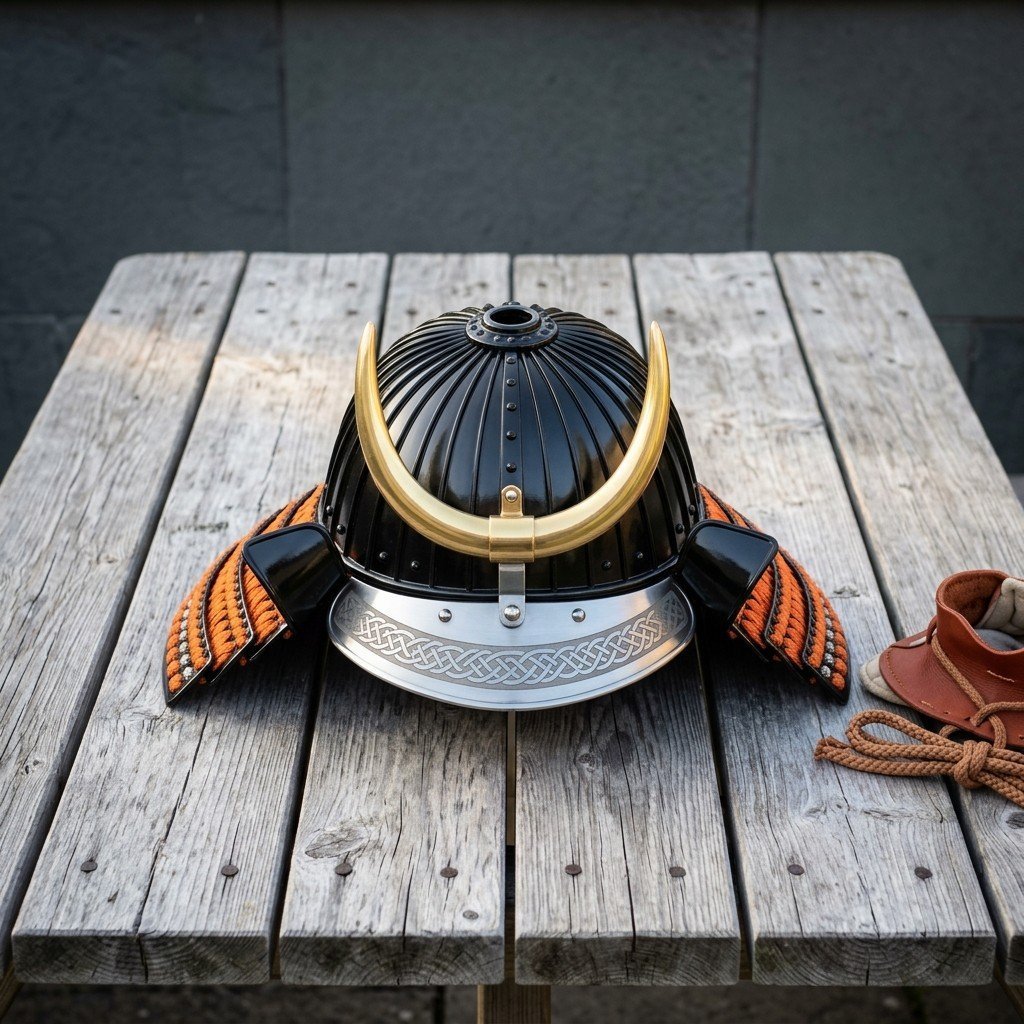
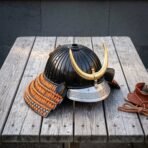
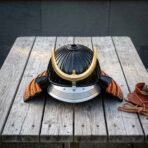
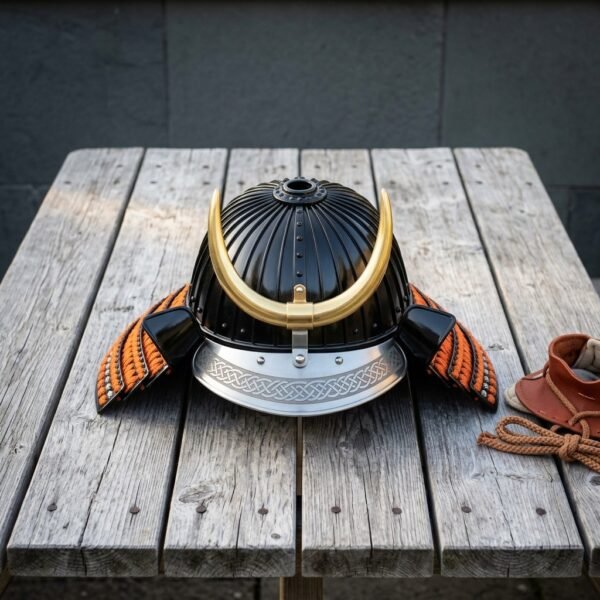
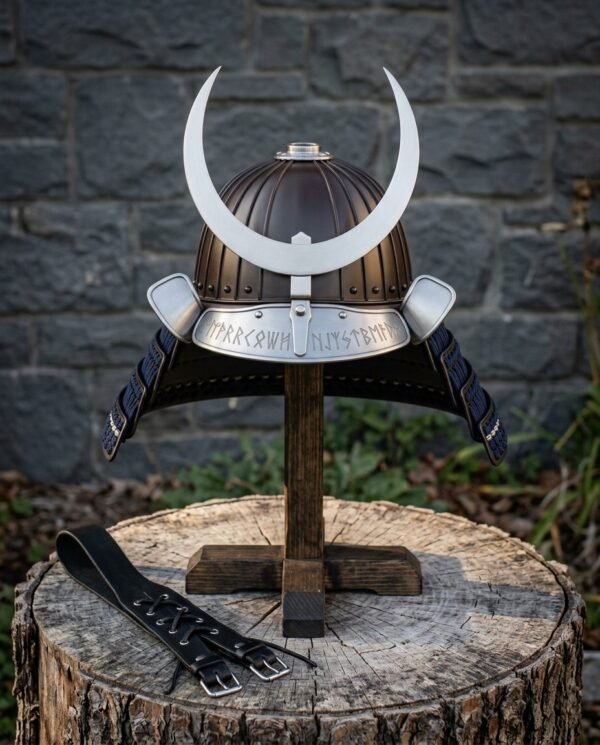
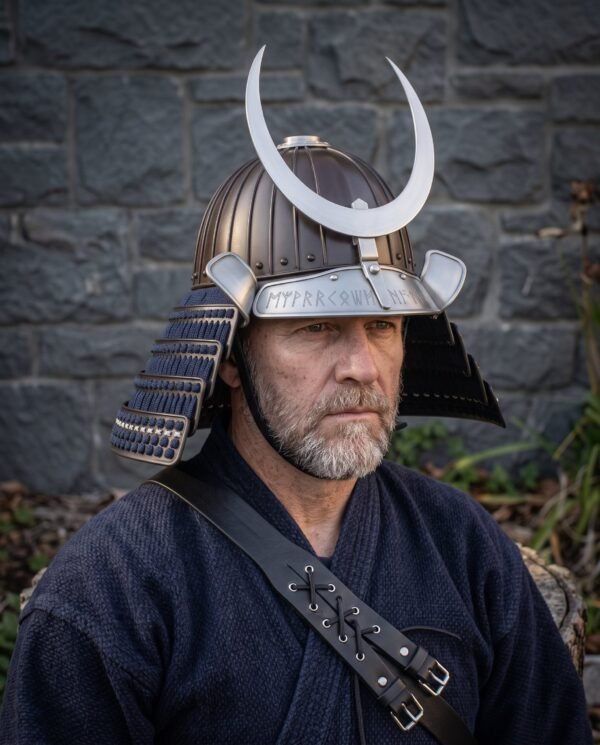
A ribbed bowl helmet built the Japanese way and finished with a Norse hand. The skull is raised from steel plates with standing ribs between them, black lacquered and riveted, with a pierced ring fitting at the crown and a brass crescent crest standing in a bracket at the brow. Below the ribs sits a polished steel brow band engraved with interlaced knotwork, and behind that a flared neck guard of lacquered plates laced with orange cord, with two upturned side flaps at the temples. It is a deliberate crossbreed and we would rather say so plainly than pretend it is a museum piece from either tradition.
The small ring at the very top is worth explaining, because most people assume it is a vent. It is a tehen kanamono, the fitting around the tehen no ana, the opening at the peak of the bowl. In the earliest helmets that hole existed because the wearer pulled his topknot up through it. The hairstyle went out of fashion centuries before the helmet did, so armourers kept the hole, capped it in decorative metal and let it become the crown jewellery of the piece. This helmet is formed, lacquered, laced and engraved in a Czech Republic workshop and it ships fully assembled with the neck guard laced on and the crest fitted. The picnic table, the loose leather straps and the cord in the photograph are studio props and are not part of the order. Japanese armour is lamellar to its core, and chainmail versus plate versus lamellar explains how that differs from mail.
Specifications
| Material | Mild steel bowl and neck guard plates, solid brass crest, polished steel brow peak |
|---|
| Gauge | 18 gauge, approximately 1.2 mm, display and light reenactment weight |
|---|
| Bowl | Black lacquered ribbed bowl, riveted along the ribs, with a ring fitting at the crown |
|---|
| Brow peak | Polished steel peak engraved with an interlaced knotwork band |
|---|
| Crest | Brass crescent in a riveted steel bracket at the brow |
|---|
| Side flaps | Black lacquered upturned flaps at the temples |
|---|
| Neck guard | Flared laced plate shikoro, orange cord lacing |
|---|
| Finish | Black lacquer on the bowl and plates, bright polish on the brow peak and crest |
|---|
| Size or fit | Made to a stated head circumference, fits over a padded cap |
|---|
| Weight | Approximately 5 to 6 pounds with the neck guard fitted |
|---|
| Lining | Suspension liner and orange cord chin tie fitted, no arming cap supplied |
|---|
| SKU | RK-1512 |
|---|
What the ribs and the laced neck guard are for
The standing ribs are not styling. A curved sheet of steel resists a blow badly along its smooth face and very well along a fold, which is why every armourer in history who wanted strength without weight put ridges in the metal. Raising a rib at each plate joint does two jobs at once. It stiffens the bowl like the flute in a girder, and it hides and protects the rivet line where the plates meet. That is the whole logic of a ribbed bowl helmet, and it is why a lighter gauge ribbed skull can outperform a heavier smooth one.
The laced neck guard solves a different problem. A rigid neck plate would either stop your head turning or leave a gap you could put a hand through. Lacing lets plate follow plate on cords so the whole assembly hangs, spreads and swings. It closes the gap between the helmet and the shoulders while still letting you look over your shoulder, and it drops rain and sun off the back of the neck. The upturned flaps at the temples keep the lacing clear of the face and give a downward cut something to skid off before it reaches the jaw.
Steel, lacquer and brass
The bowl and neck plates are mild steel at 18 gauge. That is display and light reenactment weight. It is right for a display stand, a costume, a photograph, a stage or a light contact event, and it is not certified armour and not built for full contact steel combat where a helmet has to meet a league standard. Do not buy this to be hit in.
The black finish is lacquer over the steel, which is how the originals were protected against a humid climate, and it is tougher than paint but it will still mark if you drag it across concrete. The brow band and the crest are polished bright so the engraving reads against the black. The crest is solid brass, so it will mellow to a deeper gold over time rather than flaking the way a plated finish does.
Engraving, runes and your own design
Use the rune converter on this page to turn a name, a date or a short phrase into Elder Futhark and we will cut it into the steel. If you would rather have a Viking pattern than a rune line, choose your own design in the engraving option above the add to cart button and tell us where it goes. Where a piece already carries an engraved design, your chosen engraving replaces it rather than sitting alongside it. On this helmet the brow band is the obvious canvas, and the existing knotwork is what your line would replace. Samples are shown at the engraving page.
Fit and sizing
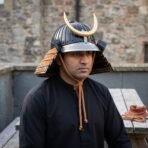
Give us the circumference of your head measured just above the ears and across the brow, then add for whatever you intend to wear underneath. A helmet is meant to sit on a padded cap, not on hair, and a good cap is worth close to an inch of circumference on its own. We build the bowl to that figure and fit an adjustable suspension liner and a chin tie inside.
Two practical points. A helmet that fits snugly at the brow but rocks front to back is too long for your head, so tell us if your head is noticeably long or round rather than average. And the neck guard flare means this helmet needs more space above the shoulders than a plain skull cap, so if you plan to wear it over a high collared coat or a mail coif, say so and we will lengthen the lacing accordingly.
Care
Lacquer keeps the bowl safe from rust so long as it is intact, so the real care job is the bare steel. Wipe the brow band and the crest after handling and keep a thin film of light oil on them. Dry the inside of the bowl after a hot day, because sweat runs into the liner and sits on the steel where you cannot see it. Store the helmet upright on a stand or a bowl of cloth rather than face down on the crest, and never stack anything on the neck guard, because the lacing takes a set if it is crushed for months. Check the lacing once a year and tell us if a cord frays, we will relace it. The oiling routine on steel care applies to the bright parts. Care is the same as for any steel armour, covered in caring for chainmail and steel armour.
Made in the Czech Republic
This piece is made by hand in the Czech Republic, in a workshop that still works the old way. The steel is forged, ground, heat treated and finished by smiths who learned the trade from the people before them, and the wood, horn and leather are cut and fitted by hand rather than pressed out on a line. That is also why no two pieces come out exactly the same.
Ransack Viking is a United States company. We import these pieces ourselves, check every one when it lands and ship from our warehouse in Chicago, Illinois. Engraving is done here in the United States after the piece arrives, so your runes or your own design go on before it leaves for you.
A note on handmade variation
This is hand made, not machine made or bulk produced, so what arrives will not be a pixel for pixel copy of the photograph. The rib spacing, the depth of the lacquer, the exact tension of the cord and the tone of the brass all vary slightly, because each helmet is raised and laced by hand from natural materials. The dimensions, the material and the build are the same every time. The character is not.
Frequently asked questions
Is this an accurate Japanese reproduction
No, and we will not claim it is. The bowl, the crest bracket and the laced neck guard follow Japanese practice, the engraved knotwork brow band is a Norse addition of ours. It is a crossover display helmet, not a museum grade copy of a specific kabuto.
Can I be hit in it
Not in full contact steel combat. At 18 gauge it is display and light reenactment weight and it carries no impact certification. For light contact or theatrical use with controlled blows it is fine, and for anything harder you need a league approved helmet.
Does it come with an arming cap
No. It has a fitted suspension liner and a chin tie, and you should still wear a padded cap under it. Measure your head over that cap when you order so the fit allows for it.
Can I have the lacing in a different colour
Yes. Orange is what is photographed, and we lace in black, indigo, deep red or natural cord at no extra cost. Put the colour in the order notes.
Will the lacquer chip
It can if the helmet is dropped on a hard edge, the same as any lacquered or painted steel. Small chips can be touched in and we will supply a matching lacquer pen on request rather than have you use household paint.
How long does it take to arrive
Processing is one to two weeks because the bowl is built to your head size and the neck guard is laced to order, then shipping is free inside the United States.
What is in the box
- One ribbed steel kabuto style helmet with a black lacquered bowl
- Laced plate neck guard with side flaps, fitted
- Brass crescent crest in its riveted bracket
- Engraved knotwork brow band, fitted
- Suspension liner and chin tie
- Care sheet and lifetime warranty against defects
- Forged and finished in the Czech Republic
Explore the range
See more in medieval helmets, viking helmets, scale and lamellar armor and plate armor, or read the guides on helmet sizing.
Close to this one
Closest to this in the range is the Moonhorn lamellar armor. If this one is not quite right, there is the Wyrmscale lamellar armor. Also in this group is the Ashscale lamellar armor.
If you are putting a set together, the Grimward plate armor sits alongside it. Nothing here exactly right, build one to your own spec on the design your own page.

Incredible craftsmanship on this one. Fit is excellent and the steel gauge feels genuinely protective. Already planning my next purchase from this shop.