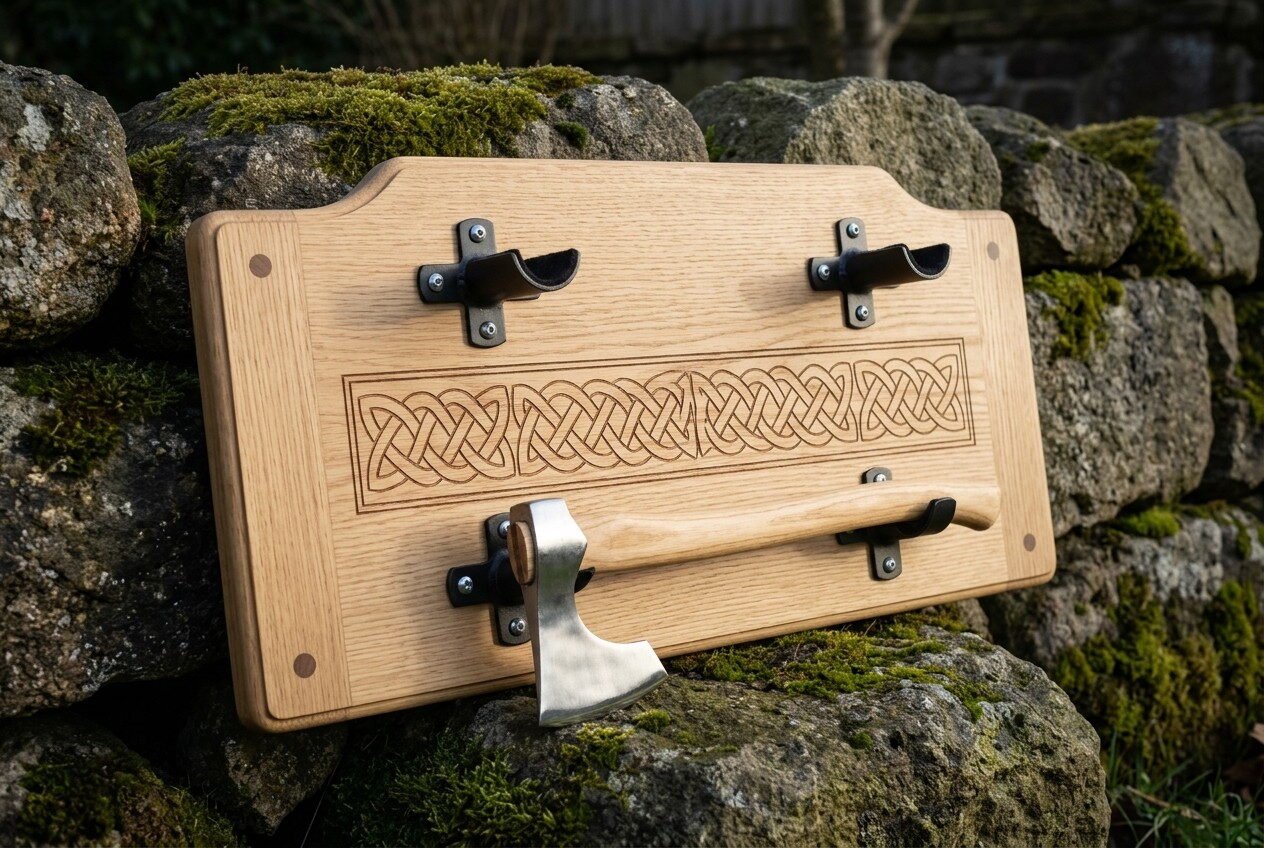
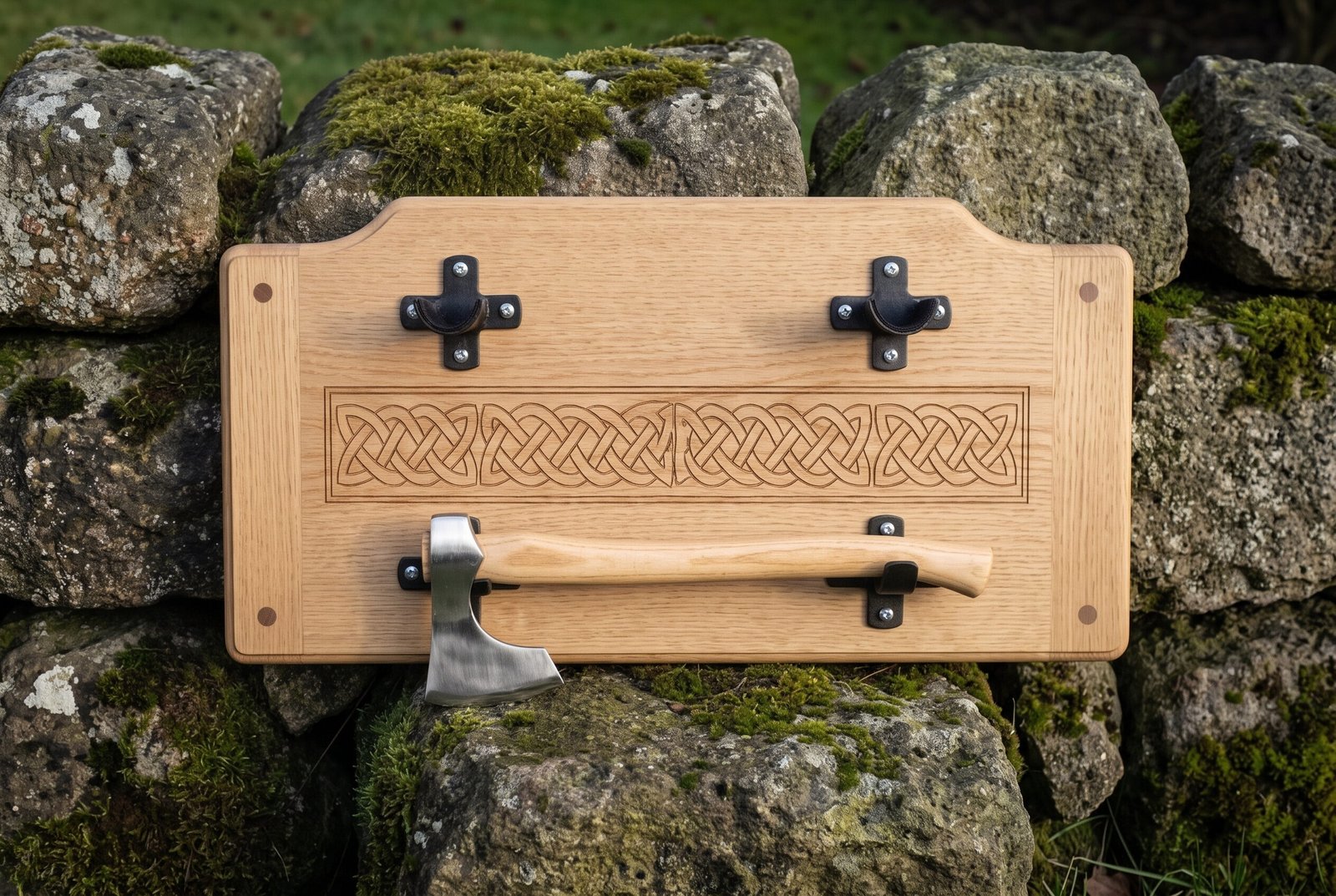
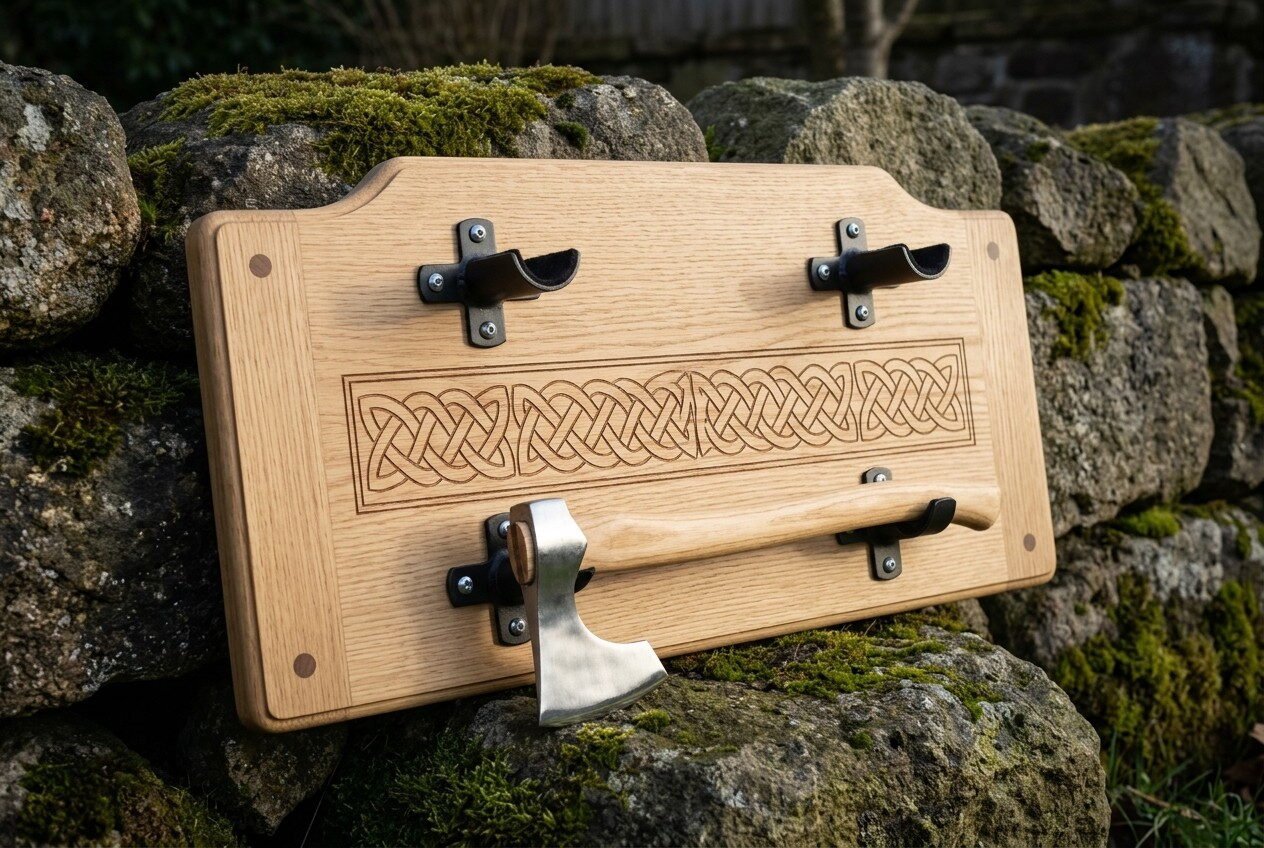
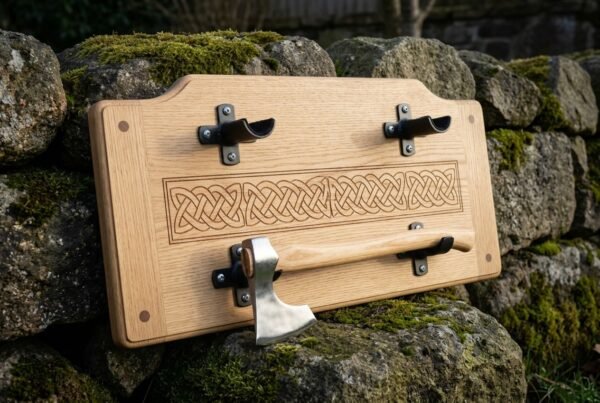
The Oakhewn is a bearded axe supplied on its own carved oak wall board. The board is solid oak with shaped shoulders, a band of Celtic knotwork cut across the centre and plugged dowels at the corners, and it carries four steel cradles lined in black leather so the axe can be lifted off and put back without marking either the head or the haft.
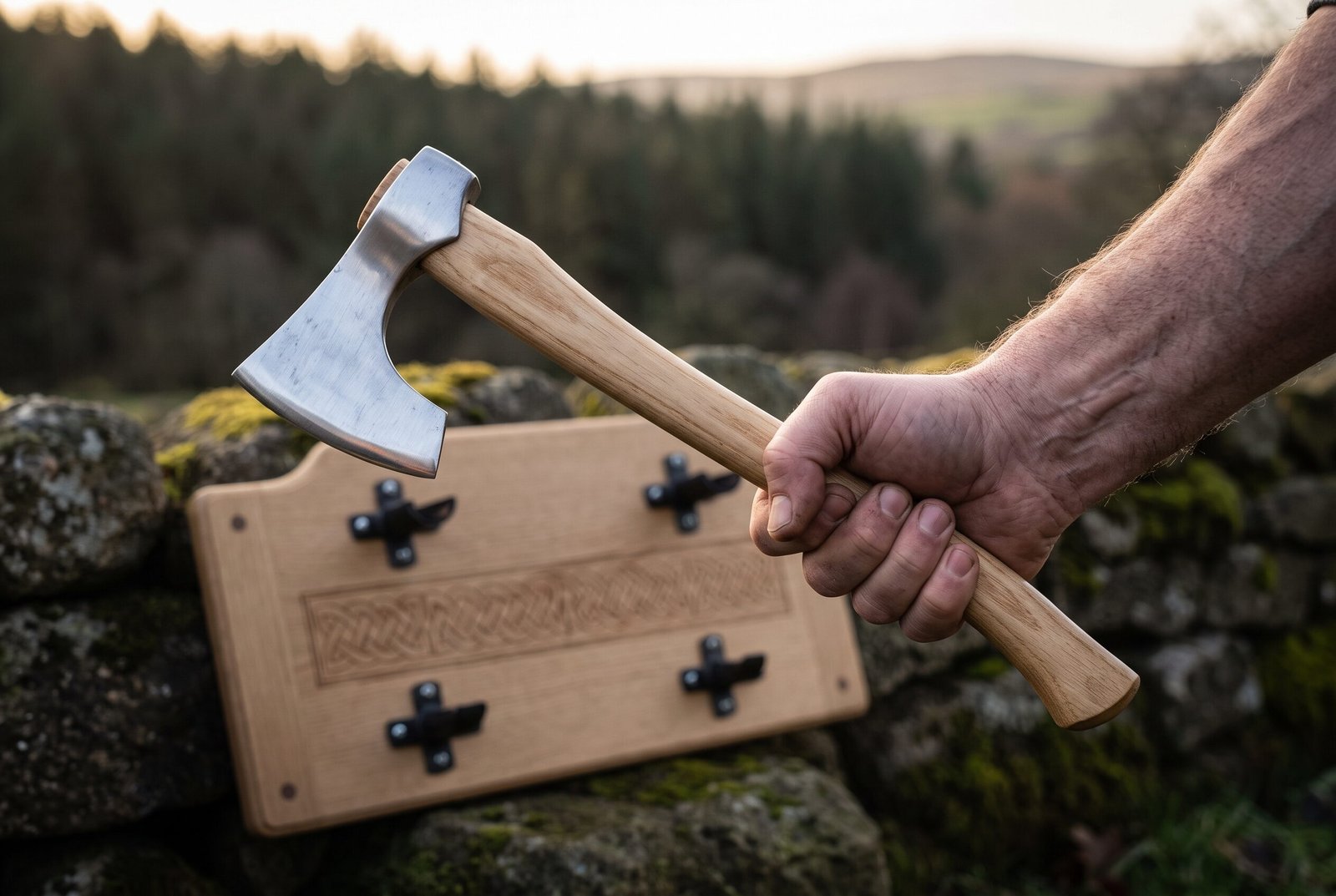
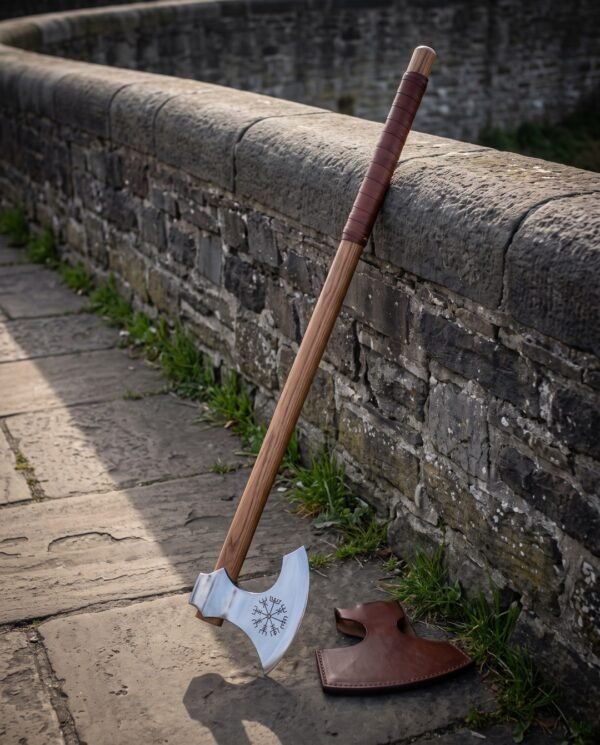
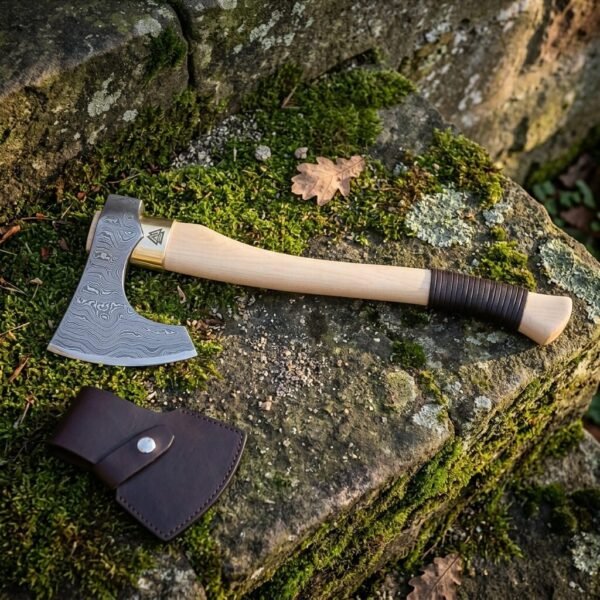
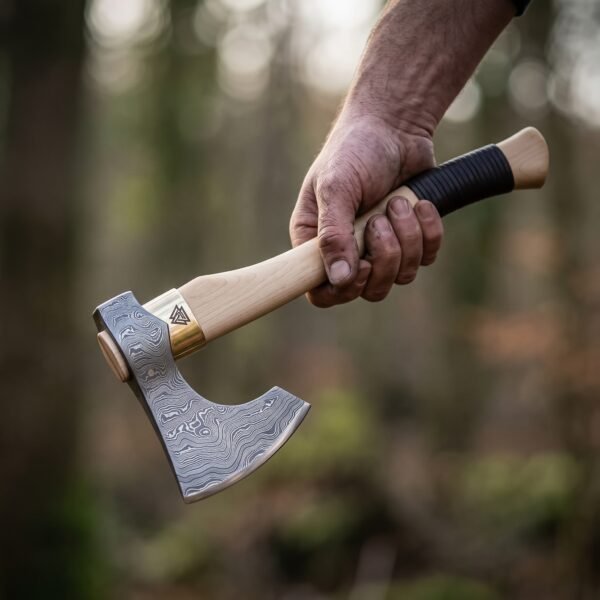
The axe itself is the skeggox, the bearded axe, and the beard is the hook of steel that hangs below the eye. It is not decoration and it is not there to look fierce. A bearded head gives you a long cutting edge for very little metal, because the beard extends the edge downward without adding a thick heavy body behind it. That mattered in a period when good steel was expensive, and it is why bearded heads turn up across Scandinavia from the ninth century on. The whole thing is forged and finished in the Czech Republic. It is part of the bearded axes, and the sword stands and displays are put together the same way.
Specifications
| Material | Hand forged 1095 high carbon steel head, light hardwood haft, solid oak board |
|---|
| Head | Bearded hatchet head with a dropped beard and a forged eye, brushed finish |
|---|
| Hardness | 54 to 58 HRC at the edge |
|---|
| Haft | Light hardwood, gently curved with a flared knob, oiled and wedged |
|---|
| Board | Solid oak with shaped shoulders and dark plugged dowels at the corners |
|---|
| Carving | Celtic knotwork band cut into a recessed panel across the face of the board |
|---|
| Cradles | Four black steel brackets lined in black leather, screwed and mounted |
|---|
| Mounting | Fixings and keyhole hanging points on the reverse of the board |
|---|
| Finish | Brushed steel head, oiled hardwood haft, oiled oak board |
|---|
| Included | Bearded axe and carved oak wall board |
|---|
| SKU | RK-1683 |
|---|
Why a bearded axe is shaped like that
Put a finger in the hollow behind the beard. That gap is the second reason the shape exists. It lets you choke right up under the head and hold the axe just below the bit, turning a swinging axe into a controlled cutting tool for close work. Norse woodworkers used the same heads for shaping timber, and a bearded axe with a straight lower edge will plane a flat on a beam in a way a wedge shaped head never could.
The third advantage is reach and hooking. A long lower edge hanging below the haft line can catch a shield rim or the top of a boot, and the sagas describe exactly that sort of hooking use. All three benefits, the long edge for little steel, the choke grip and the hook, come from the same piece of geometry.
The eye is forged rather than drilled, which means the steel is punched through and drifted open while hot so the grain of the metal flows around the hole rather than being cut across. A drilled eye has severed fibres all round it and is a natural place for a crack to start. A drifted eye does not.
The steel, the haft and the oak
The head is 1095 high carbon steel, forged, drifted, ground and heat treated to 54 to 58 HRC at the edge. That is the correct range for an impact edge. Push it harder and the bit chips when it meets a knot or a stone. Leave it softer and the edge rolls and needs constant attention. The body behind the edge stays softer than the bit, which is what stops a hard blow from cracking a head.
The haft is a light hardwood, shaped and oiled rather than lacquered, and fitted to the eye with a wedge. Oil is the right finish because it can be topped up in half a minute with a rag when the timber starts to look dry, whereas a lacquered haft chips at the head and cannot be repaired without stripping it.
The board is solid oak. Oak is the obvious timber for a Norse display piece and it is also the practical one, because it is dense enough to take a mounting screw properly and stable enough not to cup on a wall. The knotwork band is cut into the face with a router and finished with hand tools, the corners carry plugged dowels rather than visible screws, and the whole board is oiled so it will darken slowly rather than yellowing under lacquer.
Engraving, runes and your own design
Use the rune converter on this page to turn a name, a date or a short phrase into Elder Futhark and we will cut it into the steel, the leather or the wood. If you would rather have a Viking pattern than a rune line, choose your own design in the engraving option above the add to cart button and tell us where it goes. Where a piece already carries an engraved design, your chosen engraving replaces it rather than sitting alongside it, so a rune line on the board takes the place of the knotwork band. Runes can also be cut into the cheek of the axe head instead. Full details are on the engraving page.
Mounting and display
The board hangs from fixing points on the reverse and it is heavier than it looks, because it is solid oak carrying a forged steel head. Find a stud or use proper wall anchors rated well above the weight of the piece. A single picture hook into plasterboard is not enough and it will pull out at some point, usually onto a floor.
Hang it level and roughly at eye height, and leave clear space below it. The axe lifts up and out of the cradles rather than sliding sideways, so you need a hand’s width of clearance above the board to take it down. The cradles are lined in black leather so the head and haft rest on leather rather than on bare steel, which is what stops the finish being scratched every time the axe is handled.
Keep it off an outside wall that gets condensation and away from a bathroom, because a forged head on a damp wall will spot. Above a fireplace is a traditional spot and a poor one for the steel if the fire is used, so if the room gets warm and smoky, wipe the head over more often.
Care
Wipe the head with an oiled cloth every few months, more often if you handle it regularly, because fingerprints on bare high carbon steel turn into grey marks and then into rust spots. A light mineral oil or a paste wax both work. Do not use a household abrasive cleaner on the head, because it will cut through the brushed finish.
Dust the oak with a dry cloth and re oil it once a year with a hard wax oil or a furniture oil, working with the grain and paying attention to the carved band where dust collects. The hardwood haft takes the same treatment. Wipe the leather cradle linings with a barely damp cloth and feed them occasionally with a leather balm so they stay soft against the steel. Our steel care notes cover the head in full.
Made in the Czech Republic
This is a handmade piece from the Czech Republic, made in a workshop that still forges, grinds and finishes by hand instead of stamping parts out. The smiths there have kept the older way of working, and the wood, horn and leather are shaped and fitted by hand as well. Two pieces of the same design will never be identical, and that is part of what you are buying.
Ransack Viking is a United States company. We handle the import ourselves, look over every piece when it lands and ship from our warehouse in Chicago, Illinois. Engraving is done in the United States after the piece arrives, so your design goes on before we send it out.
A note on handmade variation
This is hand made rather than machine made or bulk produced, so what arrives will not be a pixel for pixel copy of the photograph. Oak has strong figure and every board is different, so yours may be lighter, more heavily rayed or more evenly grained. The brushed finish on the head, the exact line of the beard and the depth of the carved knotwork all vary because they are worked by hand. The dimensions, the steel, the hardness and the build are the same every time. The character is not. The long form of that is the gap between a display sword and a battle ready one, with how to hang a blade on a wall next to it.
Frequently asked questions
Is the axe real or a display replica
It is a real forged axe with a heat treated edge. The board is a display mount. We would not sell you a cast ornament and call it forged.
Is it sharp when it arrives
Yes, the bit is sharpened. Hang it out of reach of children and take it down carefully.
Can I use the axe rather than display it
It is a collector and display piece with a functioning head. It is not sold as a working felling or splitting axe and it is not made for sparring.
Are wall fixings included
The board has hanging points on the reverse. Use anchors suited to your wall, because a solid oak board with a steel head on it needs more than a picture hook.
Will the axe come off the board
Yes. It lifts up and out of the leather lined cradles, so you can take it down and put it back without tools.
Can I have runes carved on the board
Yes. Use the rune converter on this page and your line is carved in place of the knotwork band.
What is in the box
- Oakhewn forged bearded axe, high carbon head at 54 to 58 HRC
- Oiled hardwood haft, wedged into a drifted eye
- Solid oak wall board with carved Celtic knotwork band
- Four leather lined steel cradles and rear hanging points
- Care card for high carbon steel and oiled timber
- Lifetime warranty against defects in forging, heat treat and fittings
- Forged and finished in the Czech Republic
Explore the range
See more in bearded axes, viking axes, sword stands and displays and viking home decor, or read the guides.
Also in this part of the catalogue
Worth putting side by side with this is the Ravenperch sword stand. In the same category sits the Oakrest sword stand. A near match for this one is the Stavecradle sword stand.
For a different piece from the same family, look at the Thundergrain blacksmith tool. Or start from a blank sheet on the design your own page.


Bought this on a whim and it turned out to be one of my favorite purchases this year. If you’re on the fence just get it. You won’t regret it.
Solid display piece. Glad I ordered it. Good quality. Just wish the wood had a smoother finish. Looks great on the wall. Mounting hardware was a bit flimsy though. Good product. Just not quite perfect.
Was nervous ordering something like this online but so glad I did. Easily the best looking piece in my collection room now. Worth every penny.
I collect stuff like this and this display piece is on another level. Mounting hardware included made it easy to hang. Shipping was fast and everything arrived well packaged.
Was nervous ordering something like this online but so glad I did. Easily the best looking piece in my collection room now. Couldn’t be happier with this.
Middle of the road experience with this one. Fine for the price. Finish could be better. Might work for casual use or display. Ransack Viking is hit or miss it seems. This one landed in the middle.
No regrets on this purchase at all. Great combination of the wood and metal work. Already telling my friends to check this out. Ordered from Ransack Viking before and the quality stays consistent every time.
My whole family was impressed when I unboxed it. Easily the best looking piece in my collection room now. This will be a family heirloom for sure.
Incredible craftsmanship on this one. Easily the best looking piece in my collection room now. Looks fantastic mounted on the wall. Exactly the centerpiece I wanted. Great combination of the wood and metal work. Already planning my next purchase from this shop.
Knew this display piece was special the second I opened the box. Mounting hardware included made it easy to hang. Great buy overall.