
Blog
Round Shield vs Kite Shield: Shape, Period and Which Suits You

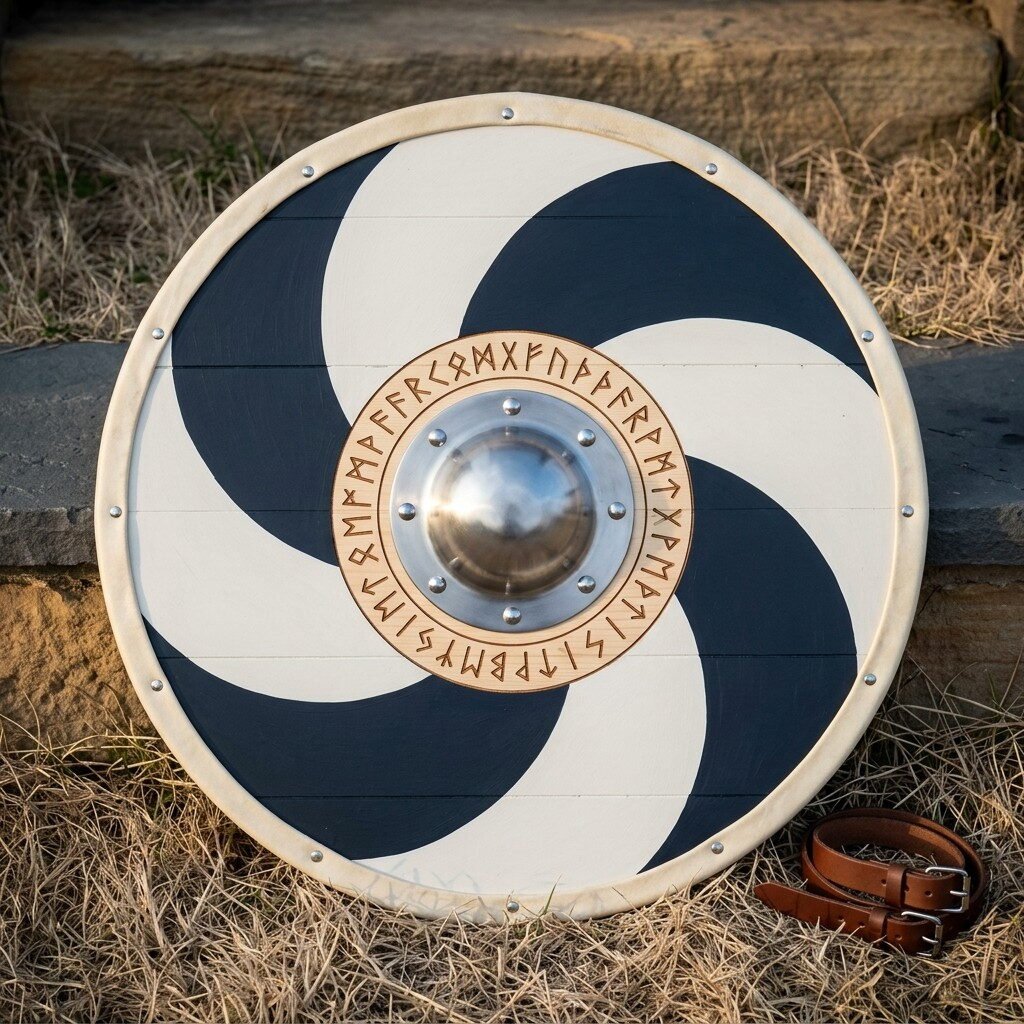
Buy the round shield. For nearly everyone it is the right call: lighter, cheaper, easier to hang, and Norse to anyone who glances at it. Buy a kite shield only if your impression is eleventh century Norman or later, you need the leg covered, or you have a tall wall and an appetite for filling it.
The two are separated by about a century and by one design decision: where your hand goes. A round shield is held in the centre by a single grip behind an iron boss. A kite shield is strapped to your forearm. Everything else, the shape, the weight, the way it moves, follows from that.
The short comparison
| Round shield | Kite shield | |
|---|---|---|
| Period | Iron Age through the Viking Age, into the eleventh century | Late tenth century onward, Norman and high medieval |
| Grip | Centre grip, one hand, behind an iron boss | Straps on the forearm, with a shoulder strap for carrying |
| Shape | Flat or slightly dished disc | Teardrop, rounded top tapering to a point |
| Typical size | Roughly 24 to 36 inches across | Roughly 30 to 45 inches tall |
| Covers | Torso and the sword arm, actively moved | Torso down to the leg, held in one place |
| Weight in the hand | Light and quick, tiring on the wrist | Heavier but the arm carries it, tiring on the shoulder |
| Wall space | A square roughly its own diameter | Tall, needs vertical clearance |
| Best for | Viking Age kit, display, most first buyers | Norman impressions, mounted looks, big wall pieces |
The round shield
A Viking Age round shield is a disc of planks, usually softwood, butted edge to edge and held together by a facing of leather or linen, a rawhide or metal rim, and a hole in the middle covered by a domed iron boss. Your hand goes through that hole and grips a bar behind the boss. The whole thing is lighter than people expect, because it was made to be moved, not to be leaned on.
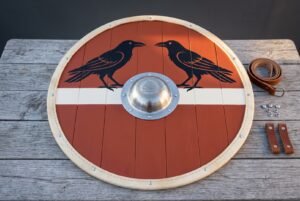 Ravenhold Hand Made Viking Round Shield | 24 Inch Diameter | Twin Ravens on Red and White with Steel Valknut Boss | Norse Reenactment Gift | RK-1433
 Stormwheel Hand Made Viking Round Shield | 24 Inch Diameter | Navy and White Pinwheel with Steel Boss and Elder Futhark Rune Ring | Norse Reenactment Gift | RK-1553
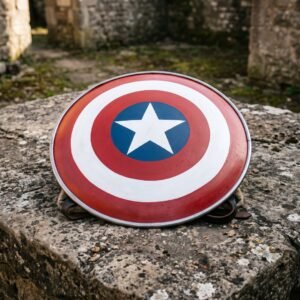 Starguard Hand Made Steel Round Shield with Painted Star and Concentric Bands | 24 Inch Diameter | Leather Arm Straps and Polished Rim | Cosplay and Display Gift | RK-1988
The best known survivals come from the Gokstad ship burial in Norway, where a row of shields was found along the ship’s sides. Those were around 94 centimetres across, thin and painted. Modern reproductions often run smaller, because most buyers want a shield they can lift twice.
Our round shields sit in the armor range with painted and carved faces, steel rims or bosses, and leather arm straps on the pieces built for display carry. For the archaeology behind the construction, our Viking shields explained post goes through planks, bosses and rims in detail.
What a round shield does well
It moves. A centre grip means the shield pivots around your fist, so you can rotate it, angle it, push a blow aside and bring it back without moving your whole arm. That is an active defence and it is why the shape lasted for a thousand years. A strapped shield cannot do it.
It attacks. The boss is a steel dome on the end of your arm and it was used. You can punch with it, bind an opponent’s blade against the rim, and hook with the edge. None of that is available on a shield fixed to your forearm.
It is light and cheap. Less wood, less leather, less metal, and a simpler build. For a first shield, or a display piece, or a piece a child will pick up at an event, this matters.
What a round shield does badly
Your wrist takes everything. All the weight hangs off one hand, so a heavy round shield becomes painful fast. Anyone drilling for more than a few minutes arrives at the same conclusion the originals did, which is to keep the weight down.
It leaves your legs open. A disc centred on your fist covers the torso and not much below it. In a shield wall that is fine because the line covers itself. On your own, or on horseback, it is a gap.
It is fragile by design. Thin planks split, and the historical answer was to patch it or go and get another. Modern display boards are built more solidly, but no wooden shield survives repeated hard contact without maintenance.
The kite shield
The kite shield appears late in the Viking Age and takes over in the eleventh century. The Bayeux Tapestry shows it everywhere, on foot and on horseback, which tells you what problem it solved. A rider has one leg hanging exposed on the shield side, and a round shield centred on the fist cannot cover it. Stretch the bottom of the shield into a point and the leg is protected without adding much weight.
With the shape came the straps. Instead of one central grip, the kite shield uses enarmes, leather loops that hold your forearm against the board, plus a guige, a longer strap over the shoulder so you can carry it or let it hang. That takes the load off the wrist and puts it on the arm and shoulder, which is the only way you carry something that big for a whole day.
Our kite shields and bucklers group covers the Norman teardrop boards along with the small centre grip bucklers from the other end of the size range, and the wider Viking armor category holds helmets, mail and the rest of the kit that goes with either shield.
What a kite shield does well
Coverage. From shoulder to shin on one side, held in place without effort. If you want protection rather than active defence, this is a far more efficient shape than a disc.
Endurance. Straps spread the weight across your forearm and shoulder, and the guige means you can carry it slung on a march or let it hang while you do something else. A round shield has to be held or put down.
Presence on a wall. A kite shield is tall, and tall reads as impressive. On a stairwell or a high ceilinged room it does something a round shield cannot, and heraldic designs suit the shape because that is what the shape was designed to carry.
What a kite shield does badly
It is passive. Strapped to your arm, the shield goes where the arm goes, and you lose the pivot, the punch and the bind. Sword and shield play with a kite is a different discipline from the round shield, and it is a slower one.
It is heavier and it costs more. More board, more leather, more edging. Coverage is not free.
It is wrong for a Viking Age impression, mostly. The overlap between the kite shield and the Viking Age is narrow, right at the end. If you are building a ninth or tenth century kit, a kite shield is the first thing an experienced reenactor will mention, and they will enjoy mentioning it.
Where the buckler fits
A buckler is a small round shield, often a foot or so across, with a centre grip behind a boss like its bigger cousin. It came into its own in the later medieval period as a companion to a sword, used to bind rather than to cover. Worth knowing about because shops file it alongside kite shields, ours included.
Choosing by what you will do with it
Display
Round shield for most rooms, kite shield if you have height. A painted round shield with a steel boss above a fireplace is the classic Norse look and it is easy to hang level. A kite shield wants a tall clear space and looks best mounted a little above eye level so the point does not crowd the floor.
Reenactment
Match the century, then check your group’s rules, which will cover rim material, boss shape and minimum thickness. A Viking Age impression takes a round shield. A Norman or crusading impression takes a kite. Ask your group before ordering, because a shield that fails inspection is an expensive mistake.
Cosplay and events
Round shield, and go smaller than you think. A 24 inch board is easy to carry all day and photographs well. A full sized shield becomes a burden by the afternoon, and many venues have size limits anyway.
Group combat and drill
Round shield if the style involves active blocking and binding, kite if you are standing in a line and want coverage. Whatever you buy, expect it to wear. Shields are consumables in any contact discipline.
Gifts
Round shield, almost always. It is instantly recognisable, it does not need a stand, and the recipient can hang it the day it arrives. A kite shield is the better gift only for someone you know has the wall for it.
What the parts are made of
The board on either shape is wood, faced and edged. The metal parts are the boss, the rim fittings and the rivets, and each listing says which of those a given shield has. Where a fitting is hand forged high carbon steel, that is the plain 1095 at 54 to 58 HRC used across the rest of the range, which is a tough forgiving hardness and the right one for a part that takes impact rather than an edge that has to cut.
Steel rusts, and a shield spends time outdoors in ways a knife does not. Wipe the metal down after an event, keep a light film of oil on it and do not store a damp shield flat against a wall where the back cannot breathe. Leather straps want an occasional dressing, and a painted face stays brighter out of direct sun. If you want the background on the steel itself, the steel glossary covers what 1095 is and what hardness numbers actually mean.
Buy this one if
Buy a round shield if you want a Viking Age look, you are buying your first shield, you want something light enough to carry all day, you want to hang it without special mounting, or you want the active centre grip defence.
Buy a kite shield if your impression is eleventh century or later, you want leg coverage, you want the weight on your arm rather than your wrist, or you have a tall wall and want a piece that fills it.
Buy a buckler if you want something small to pair with a sword, you have no wall space, or you are working in a later medieval style where the buckler is the correct companion.
What we stock
The round shields group holds carved hardwood boards, painted faces, steel bosses and rune ring detailing, mostly around 24 inches across, with leather arm straps fitted. The kite shields and bucklers group covers the Norman teardrop boards with rawhide rims and strap sets. There is a broader Viking shields category if you want to see everything shield shaped in one place, and shield bosses and fittings on their own if you are building a board yourself. Ransack Viking is a US company in Chicago, Illinois. Every piece is handmade in the Czech Republic the old way, then imported, inspected and shipped from Chicago, and engraving is done in the US after arrival. If you are putting a whole kit together, the Viking axe history post is a good companion read for what went in the other hand.
Either board can be bought to hang rather than to carry, which changes what matters, as we set out in choosing a display shield. A helmet usually follows, covered in buying a helmet that fits.
Questions people ask
Which came first, the round shield or the kite shield?
The round shield, by a long way. Discs with a central boss and a centre grip were in use across northern Europe from the Iron Age and remained standard through the Viking Age. The kite shield appears late in the tenth century and becomes common in the eleventh, largely because of mounted fighting.
Why did the kite shield replace it?
Leg coverage on horseback, mainly. A rider has a leg exposed on the shield side and a disc held on the fist cannot reach it. Extending the bottom of the board into a point solved that, and the arm straps that came with the shape let you carry a bigger shield all day without wrecking your wrist.
How big should a shield be?
Round shields commonly run around 24 to 36 inches across, and kite shields roughly 30 to 45 inches tall. For display, pick the size that suits the wall. For carrying, go smaller than feels impressive. A full sized board gets heavy inside an hour, and most events have size limits regardless of your ambitions.
Can I use one of these in reenactment?
Check with your group before you pay, not after. Most societies set rules on rim material, boss profile, board thickness and edge treatment, and those rules differ between groups. Tell us what standard you are working to before you order and we can tell you whether a piece is likely to pass inspection.
What is the boss actually for?
It covers the hole your hand goes through on a centre grip shield, so it is structural as well as protective. It shields your knuckles from anything that lands on the middle of the board, and the domed steel makes the shield useful for pushing and striking rather than only blocking.
How do I hang a shield on a wall?
Two hooks under the rim carrying the weight, and a third fixing near the top to stop it tilting, is enough for most boards. Do not hang it from the arm straps alone. Leather stretches, and gravity is patient. Keep it out of direct sun and off damp walls so the back can dry.
Things you can actually hold
Ready to ship, the Ravenhold Viking round shield and the Stormwheel Viking round shield. The Palewing Norman kite shield and the Wavewarden wooden kite shield are the other two.
Smaller still
Shrink the shield far enough and you arrive at the buckler, which still turns up in HEMA classes next to a sidesword. Rapier versus sidesword explains where the sidesword sits. The Valdris sidesword trainer has a single side ring, and the others are under HEMA sideswords.
Shop the range
Ravenhold Hand Made Viking Round Shield | 24 Inch Diameter | Twin Ravens on Red and White with Steel Valknut Boss | Norse Reenactment Gift | RK-1433Stormwheel Hand Made Viking Round Shield | 24 Inch Diameter | Navy and White Pinwheel with Steel Boss and Elder Futhark Rune Ring | Norse Reenactment Gift | RK-1553Starguard Hand Made Steel Round Shield with Painted Star and Concentric Bands | 24 Inch Diameter | Leather Arm Straps and Polished Rim | Cosplay and Display Gift | RK-1988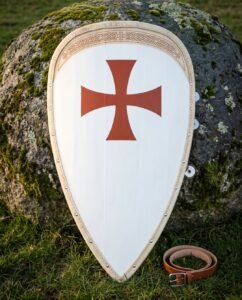 Palecross Hand Made Wooden Templar Kite Shield | Rawhide Bound Edge | Red Cross Pattee on a White Field | Crusader Reenactment Gift | RK-1440
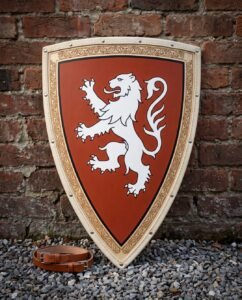 Lionward Hand Made Wooden Heater Shield | 30 Inch Tall | Painted Rampant Lion, Knotwork Border and Leather Arm Strap | Medieval Reenactment Gift | RK-1452
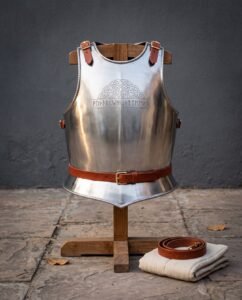 Runeheart Hand Forged Steel Breastplate Cuirass | 18 Gauge Mild Steel | Roped Edges, Chased Knotwork and Leather Harness | Norse Display Gift | RK-1471