
Blog
The Swords of Middle Earth and the Real Blades Behind Them

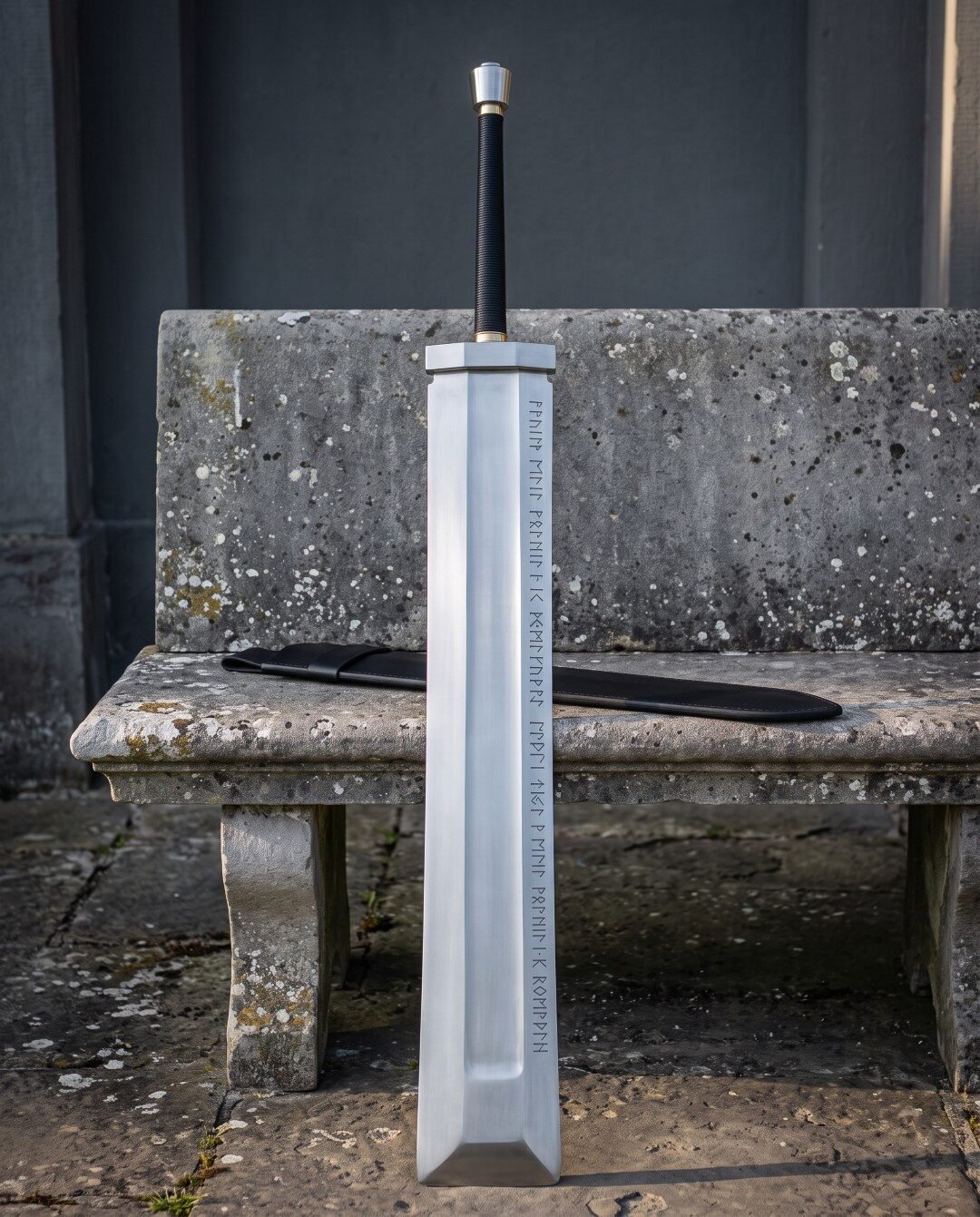
The swords of Middle Earth are built from real medieval literature and almost no real archaeology. Tolkien was a professor of Anglo-Saxon, and the named blades, the inherited heirlooms and the sword broken and reforged all come straight out of Beowulf, the Norse Eddas and the Volsunga saga. The shapes everyone actually pictures are a different matter. Those were designed for the films in 2001 and after, and most of them have no historical model at all.
Separating the two is worth doing, because the literary borrowings are far more interesting than the prop design, and they are the half nobody ever talks about.
The literature Tolkien was working from
Tolkien held the chair of Anglo-Saxon at Oxford and spent his professional life inside exactly the texts his fiction draws on. The Hobbit appeared in 1937 and The Lord of the Rings across 1954 and 1955, and both are saturated in older material that he knew in the original languages.
Named swords
Early medieval literature names its swords constantly. Beowulf gives us Hrunting, lent to the hero and found wanting, and Naegling, which fails him at the worst possible moment. Early medieval literature is markedly harder on its famous swords than modern fiction is. Icelandic sagas name Skofnung and treat it as an object with rules attached to its use. The Norse habit of naming a blade and tracking its ownership across generations is not a fantasy convention that Tolkien invented. It is a documented feature of the literature he taught.
The point of naming in those sources is inheritance. A named sword carries a history, and a character who receives one is receiving an obligation along with it. That is precisely how the heirloom blades work in Tolkien, and it is the clearest single case of him lifting a real literary mechanism rather than an image.
The sword broken and reforged
This is the most direct borrowing of all. In the Volsunga saga, Sigmund’s sword is shattered in his last battle, the fragments are kept, and they are later forged anew for his son Sigurd, who uses the reforged blade to kill the dragon Fafnir. The shape of that story, an inheritance destroyed and then remade to fit a successor who must prove himself worthy of it, is transplanted whole into The Lord of the Rings.
Tolkien did not hide this and had no reason to. He was drawing deliberately on a northern European story tradition that he thought England had lost, and the reforging is one of the load bearing borrowings in the whole book.
Runes and inscriptions
Tolkien invented his own writing systems, and the angular one he used for dwarvish inscriptions is modelled on the look of Germanic and Anglo-Saxon runes without being them. That is an invention with a real ancestor.
The real ancestor is genuinely striking. The Seax of Beagnoth, a ninth century single edged blade recovered from the Thames and now in the British Museum, carries the full Anglo-Saxon runic row inlaid along its blade together with a personal name. It is an actual inscribed and named blade from the period Tolkien studied, and it does more to justify the fiction than any prop ever made. Our page on the seax and its history covers the type it belongs to.
The other great inscribed blades of the period are the Ulfberht swords, Frankish blades of the ninth to eleventh centuries with a name inlaid in iron letters into the steel. They were prestigious enough to be copied and faked in their own time, which is a fair definition of a legendary sword.
What the film designs actually are
The blades most people picture were designed for Peter Jackson’s films from 2001 onward, largely by John Howe and Alan Lee and built by Weta Workshop in New Zealand. They are a considerable achievement in design, and they are reconstructions of nothing.
 Nightbriar Hand Forged 1095 High Carbon Steel Elven Style Longsword | Fantasy Collector and Display Gift | RK-1250
 Palefrost Hand Forged 1095 High Carbon Steel Elven Style Longsword | Fantasy Collector and Display Gift | RK-1251
 Elmshade Hand Forged 1095 High Carbon Steel Fantasy Longsword | 43 Inch Overall with 34 Inch Blade | Ribbed Cord and Leather Grip over Hardwood Core | Collector and Display Gift | RK-1252
The design languages divide roughly by culture. The horse people of the fiction were given Anglo-Saxon and Norse forms, which is faithful to Tolkien, since he explicitly modelled that culture on Anglo-Saxon England down to its names and its poetry. Their gear on screen is the closest thing in the films to real early medieval equipment: round shields, spangenhelm style helmets, and straight cutting swords with simple guards. It is the one corner of the design a reenactor can watch without wincing.
The men of the southern kingdom were given a taller, more late medieval look, closer to a fourteenth century arming sword with a long cruciform hilt. The elves were given curved single edged blades with sweeping fittings, which have no European historical model whatsoever and were invented to look otherworldly. That was the intent, and it works.
What is real and what is invented
Real: named swords as a literary institution. Real: inherited blades carrying obligation. Real: a shattered sword remade, straight from the Volsunga saga. Real: inscribed blades with names cut or inlaid into the steel, in both Anglo-Saxon and Frankish practice. Real: leaf shaped blades, which existed in bronze across prehistoric Europe long before anybody put them in a fantasy novel. Real: the Anglo-Saxon flavour of one of the fiction’s cultures, which was deliberate and thorough.
Invented: a blade that glows in the presence of enemies. Invented: the curved elvish forms, which are a twenty first century design decision. Invented: swords that never dull, never chip and never need maintenance, which is the quiet fantasy underneath all screen arms. Invented: the specific scripts, though their look is borrowed honestly.
One thing sits awkwardly between the two columns. Fantasy fiction generally, and film design in particular, gives heroes swords that are too big. Real single handed swords are lighter than people expect, because a heavy sword is a slow sword and a slow sword loses. Screen blades are sized for the frame rather than for the hand, and that has quietly reset what a whole generation thinks a sword weighs.
Why the material matters more than the shape
The interesting question about a legendary sword is rarely its outline. It is what it was made of and who could make it. Early medieval smiths worked with inconsistent iron and had to build good blades out of it, and pattern welding was the answer: bundles of iron and steel rods forge welded together, twisted, and drawn out so the finished blade carries a pattern in its surface and a mix of properties through its body.
That technique is why a fine blade was worth an estate and worth a name. It represented labour and skill that could not be bought casually, and the visible pattern advertised the fact. The modern descendant of that process is what the trade now calls Damascus, and our explanation of what Damascus steel actually is is the honest version, including what it does and does not do for performance.
From our own range
We do not name anything after a book, a film or a character, and nothing we sell is connected to or endorsed by any of them. What we make covers both halves of this subject. Our fantasy and display swords are our own designs in the heroic register: greatswords over four feet, rune etched panels, blackened finishes and sculpted guards, all built for a wall rather than a field. At the historical end, the hand forged Norse and early medieval swords follow documented hilt forms with lobed and brazil nut pommels, and a pattern welded Damascus blade among them is the closest honest answer to what a named heirloom sword really was. The wider sword range covers everything in between, and the oak and walnut stands and wall mounts matter more than people expect, since a display sword lives or dies by how it is hung.
Blades are plain 1095 carbon steel at 54 to 58 HRC, or Damascus of 1095 and 15N20 forge welded and taken to 58 to 60 HRC. Every piece is handmade in the Czech Republic the old way, then imported, inspected and shipped from Chicago, Illinois. Engraving is done in the US after arrival, which is the point at which a blade can be given a name of your own choosing rather than somebody else’s.
If you are buying your first serious display sword, our notes on what collectors should check before buying will save you the two most common mistakes, which are ignoring tang construction and buying the blade before working out where it will hang.
If you came for the film blades, the same treatment is given to Excalibur and the replicas made of it and to the two swords carried in The Witcher.
Questions people ask
Were Tolkien’s swords based on real ones?
The ideas were. The shapes largely were not, and the shapes are the part everyone remembers. Named blades, inherited heirlooms and a shattered sword reforged are all drawn from Beowulf and the Norse sagas, which Tolkien taught professionally. The physical designs people recognise were created for the films from 2001 onward and owe more to art direction than to archaeology.
Which real story does the reforged sword come from?
The Volsunga saga. Sigmund’s sword is broken in his final fight, the pieces are kept, and they are reforged for his son Sigurd, who then kills the dragon Fafnir with the remade blade. The structure of inheritance, destruction and renewal is transplanted almost intact into The Lord of the Rings.
Did real swords have runes on them?
Some did. The Seax of Beagnoth, a ninth century blade from the Thames now in the British Museum, carries the full Anglo-Saxon runic row and a personal name inlaid along it. Frankish Ulfberht swords carry an inlaid name in letters rather than runes. Inscribed blades were rare, prestigious and sometimes copied by others.
Do elvish curved swords have a historical basis?
None at all in Europe. The sweeping single edged forms in the films were invented to signal a culture that was not human, and they succeed at that. Curved single edged swords do of course exist elsewhere in the world, but the specific film designs owe them nothing.
How heavy were real medieval swords?
Much lighter than film suggests. A single handed sword of the period is a fast object, because a slow sword loses fights. Screen swords are sized to look impressive on camera, and the result is that many people are genuinely surprised, and occasionally disappointed, the first time they pick up a properly proportioned blade.
Do you sell Middle Earth swords?
No. We do not use any franchise name on a product, and nothing we sell is connected to or endorsed by any film or book. We sell our own fantasy styled display swords and a separate range of historically grounded Norse and early medieval swords, and either can be engraved to order once it reaches us.
Pieces in the catalogue
Ready to ship, the Nightbriar elven longsword and the Palefrost elven longsword. The Fernstride ranger longsword and the Longwake half longsword are the other two.
From the page to the club
Most of the swords in these films are longswords of one kind or another, and so is the sword HEMA clubs use most, though theirs comes blunt. What a feder is explains that training shape, the Vardholt blunt longsword is a plainer option, and HEMA longswords has the rest.
Shop the range
Nightbriar Hand Forged 1095 High Carbon Steel Elven Style Longsword | Fantasy Collector and Display Gift | RK-1250Palefrost Hand Forged 1095 High Carbon Steel Elven Style Longsword | Fantasy Collector and Display Gift | RK-1251Elmshade Hand Forged 1095 High Carbon Steel Fantasy Longsword | 43 Inch Overall with 34 Inch Blade | Ribbed Cord and Leather Grip over Hardwood Core | Collector and Display Gift | RK-1252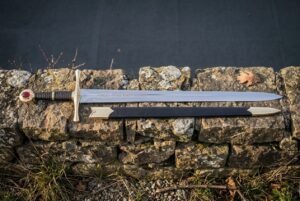 Runemark Hand Forged 1095 High Carbon Steel Inscribed Longsword | Norse Collector and Display Gift | RK-1254
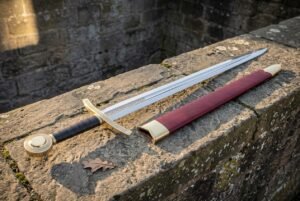 Kingsbarrow Hand Forged 1095 High Carbon Steel Camelot King Sword Replica | 44 Inch Overall with 35 Inch Blade | Cosplay and Display Gift | RK-1256
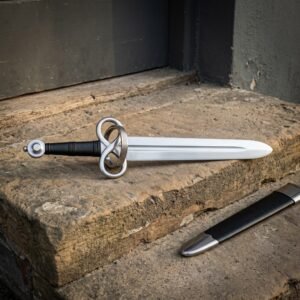 Everknot Hand Forged 1095 Steel Fantasy Sword with Twisted Loop Guard | 14 Inch Polished Blade | Black Leather Grip and Steel Mounted Black Scabbard | Display Collector Gift | RK-1724