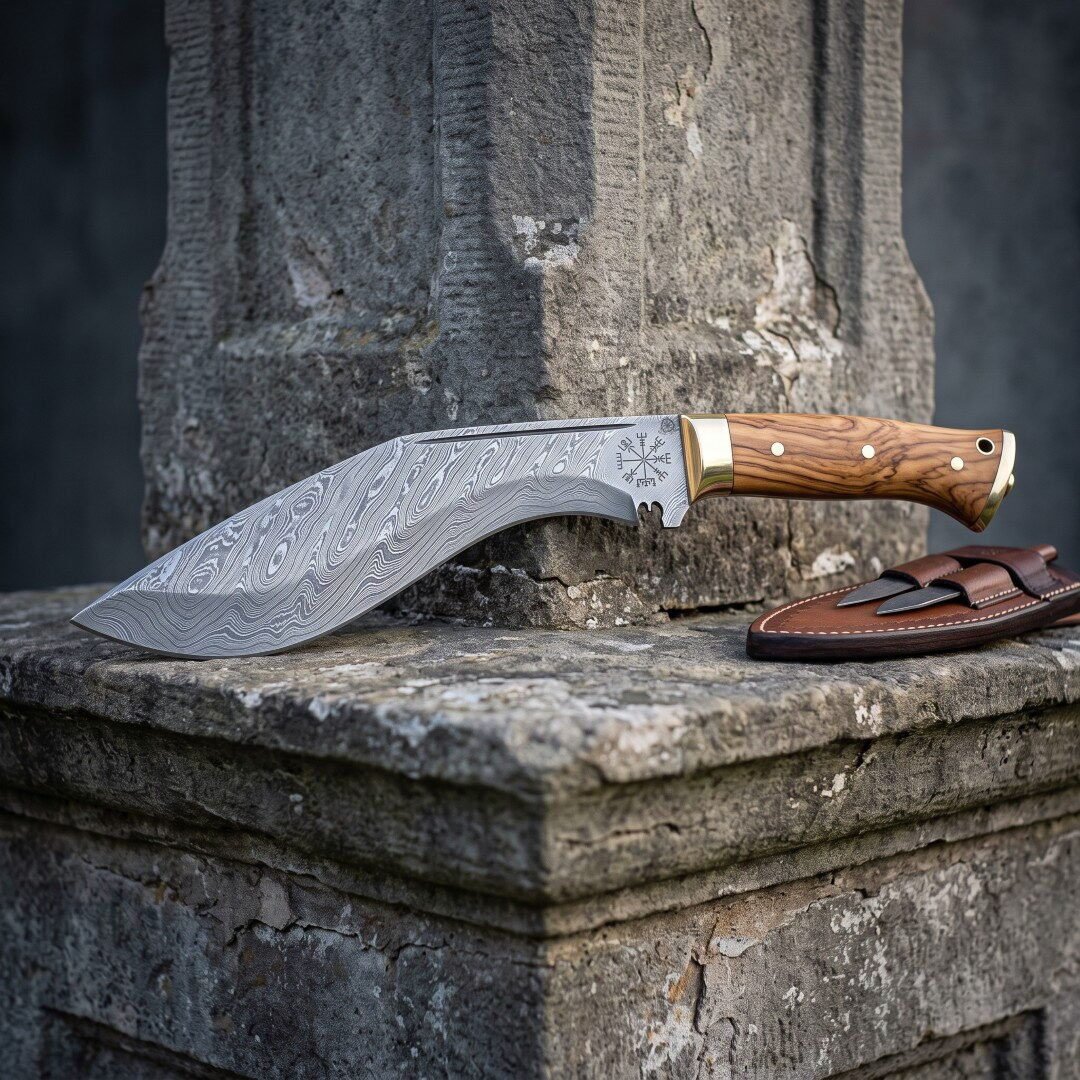
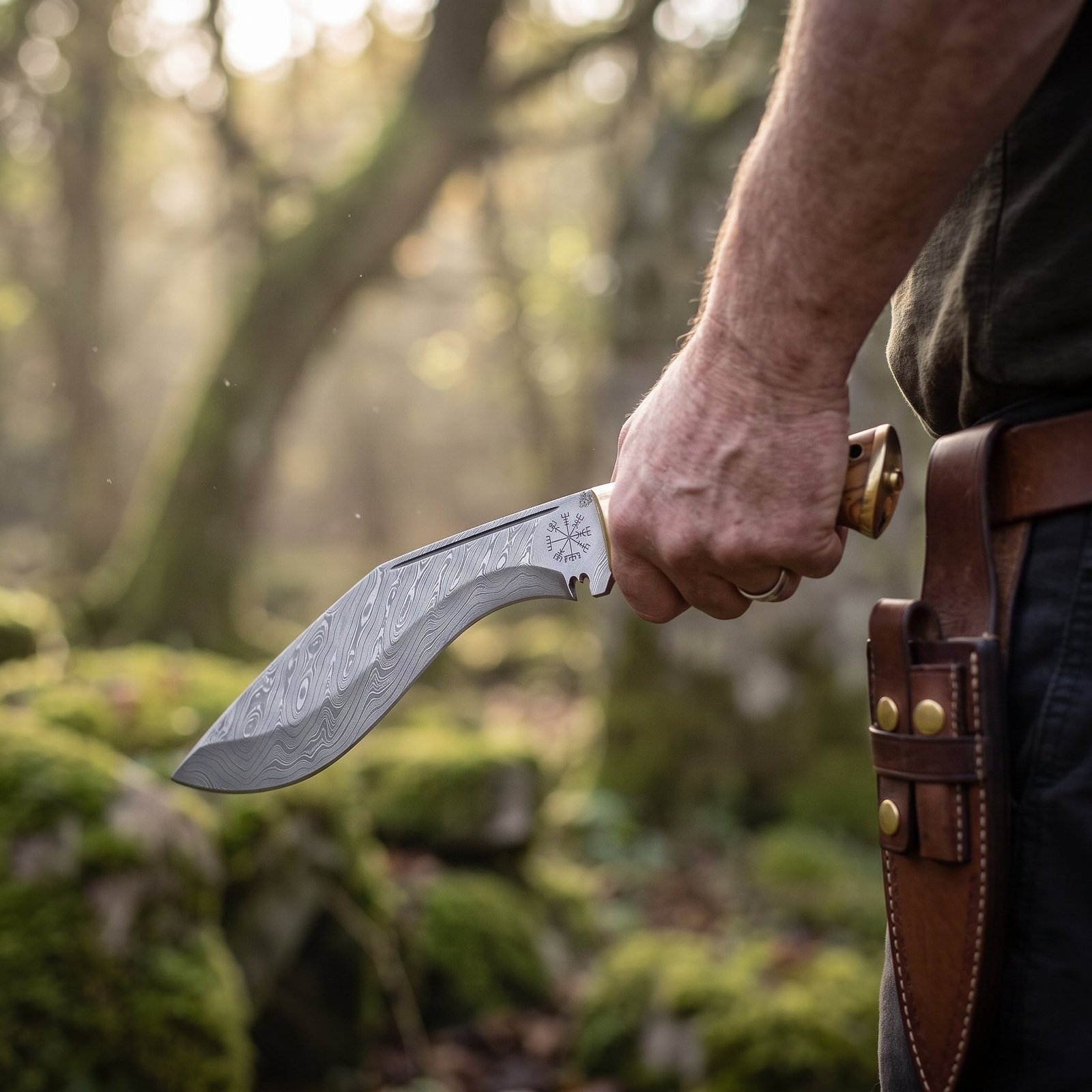
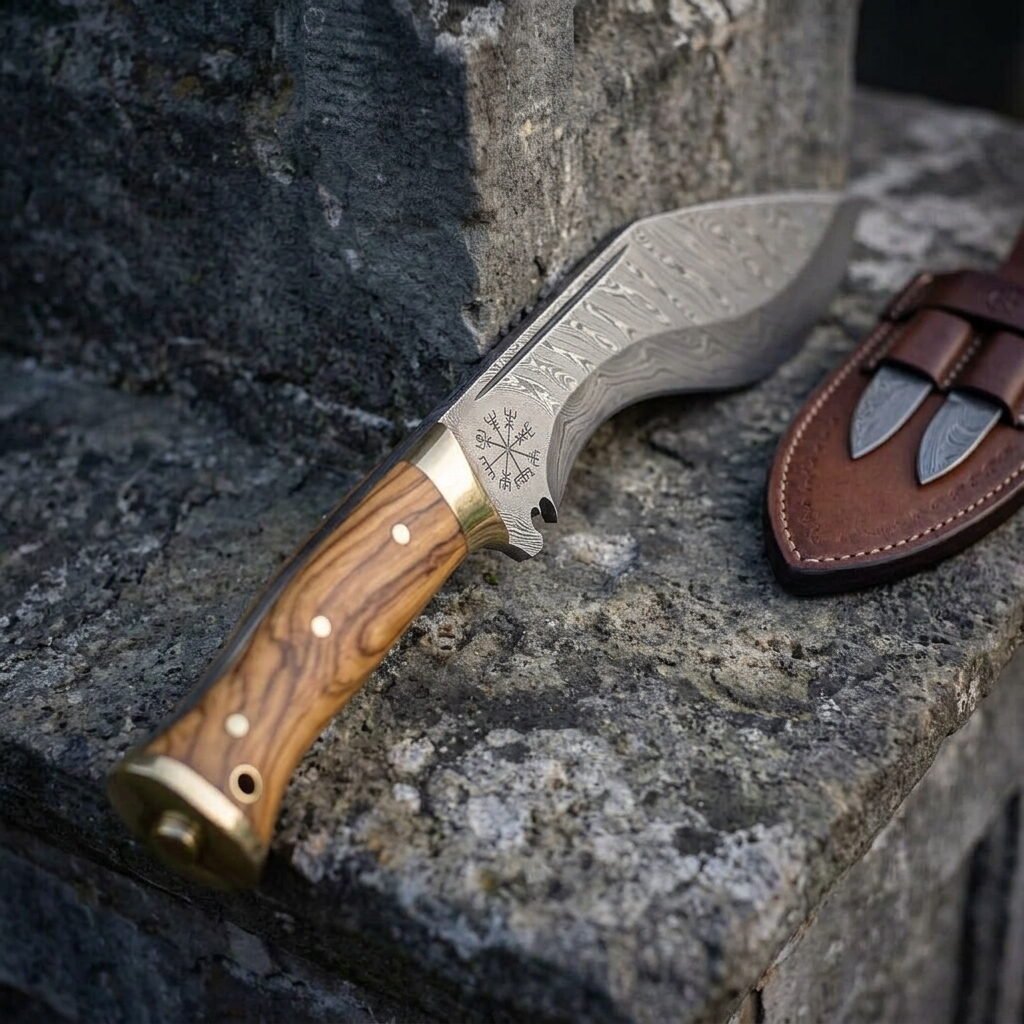
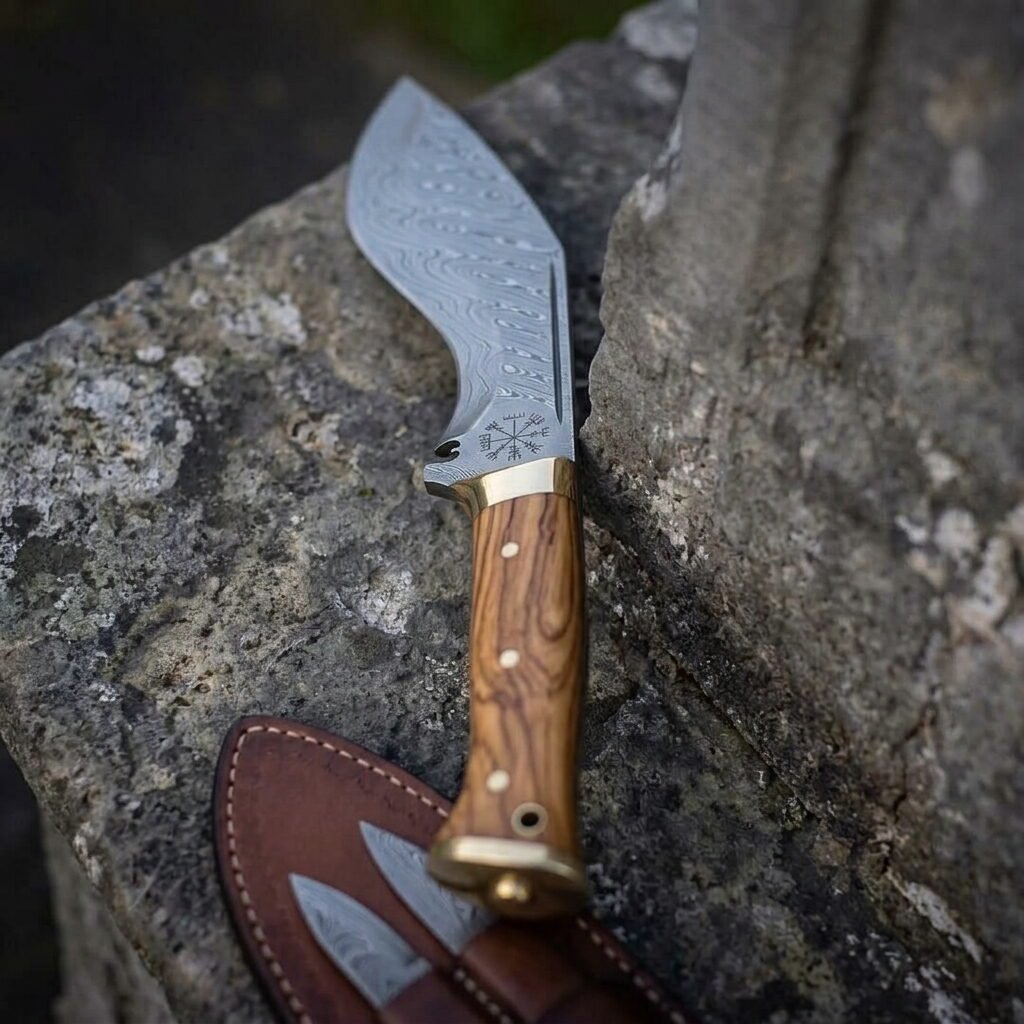
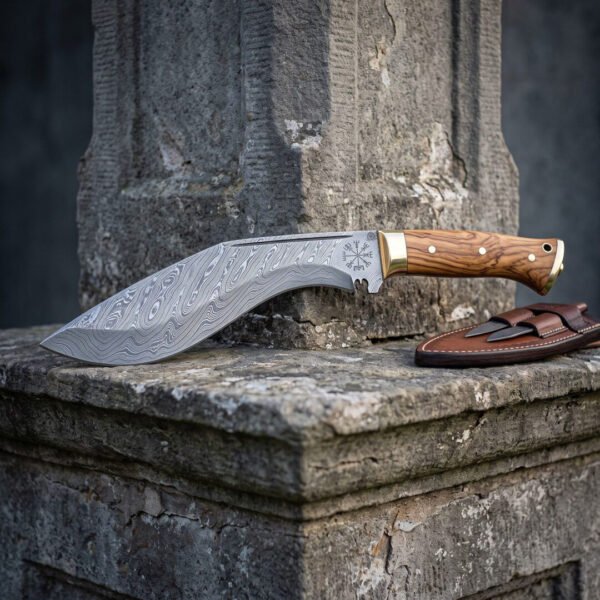
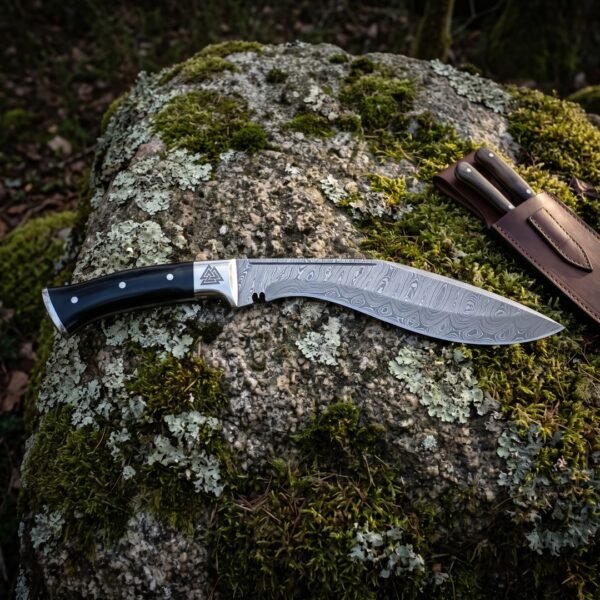
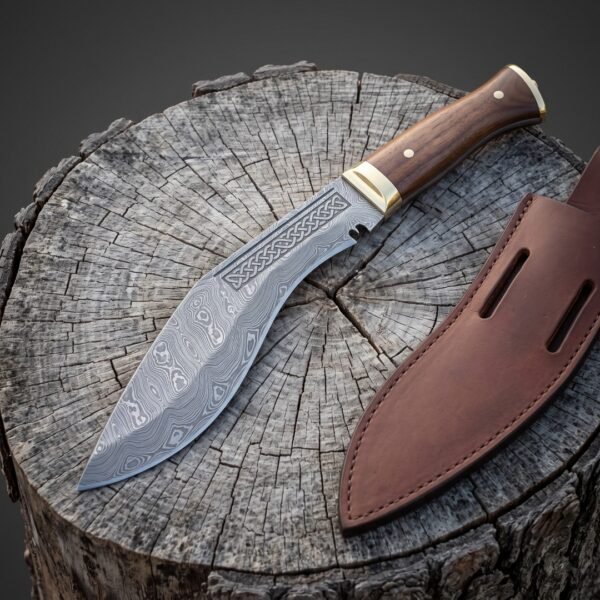
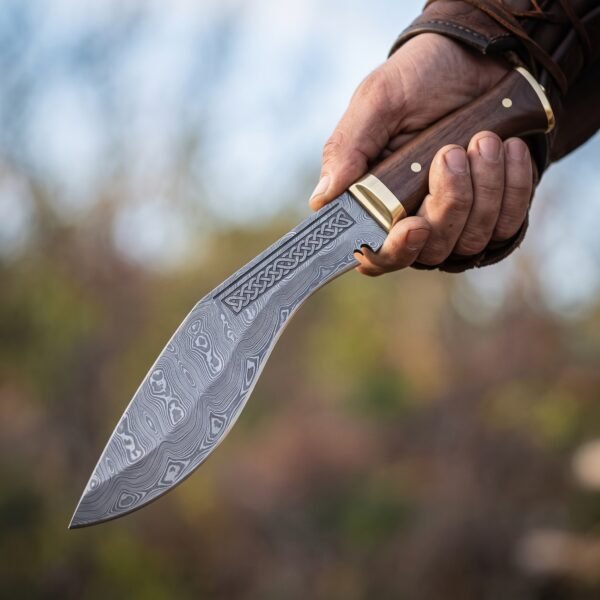
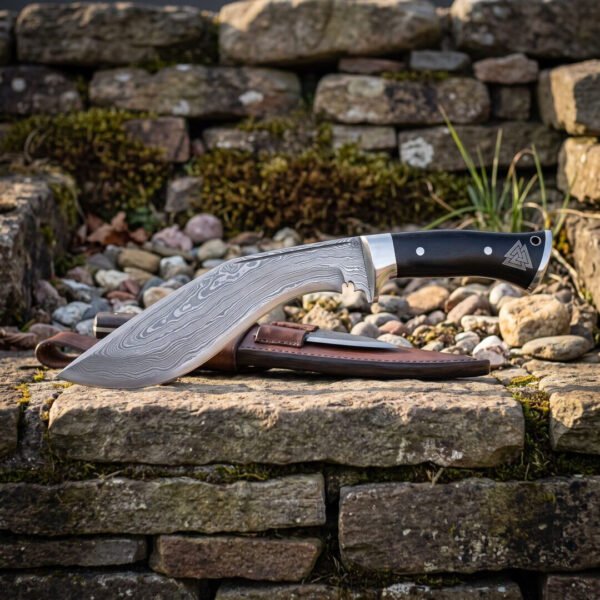
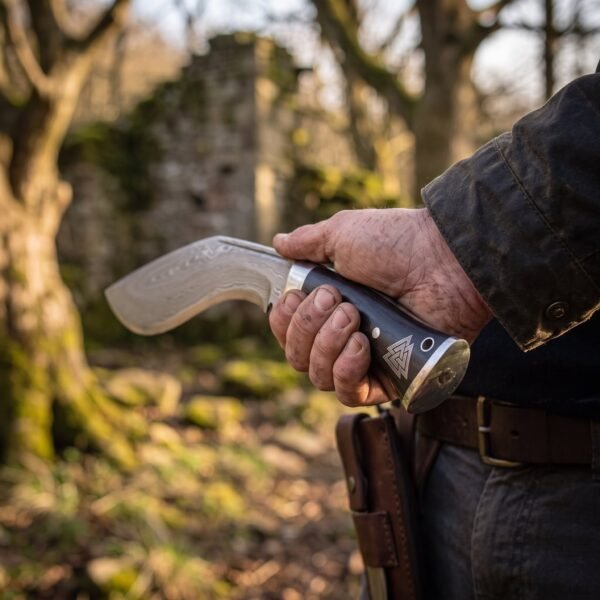
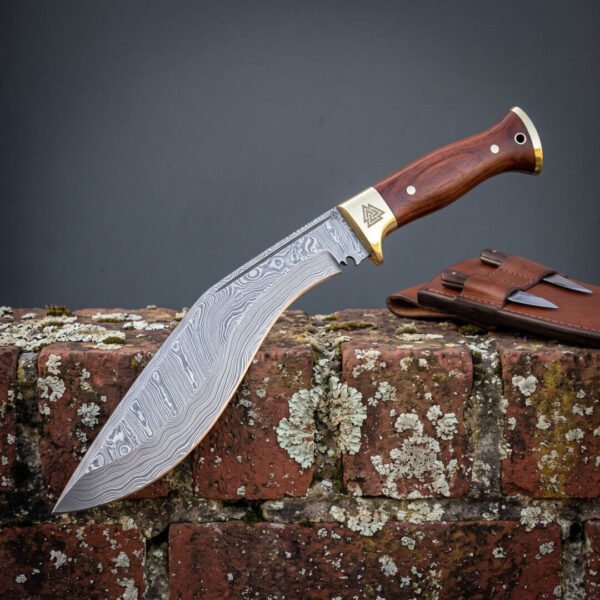
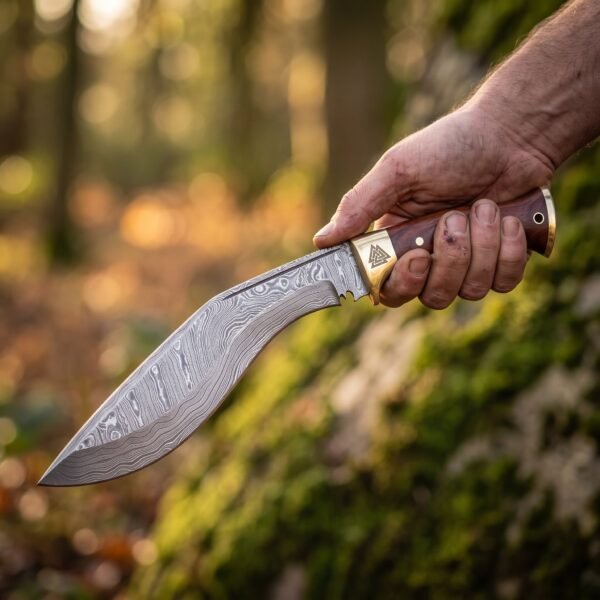
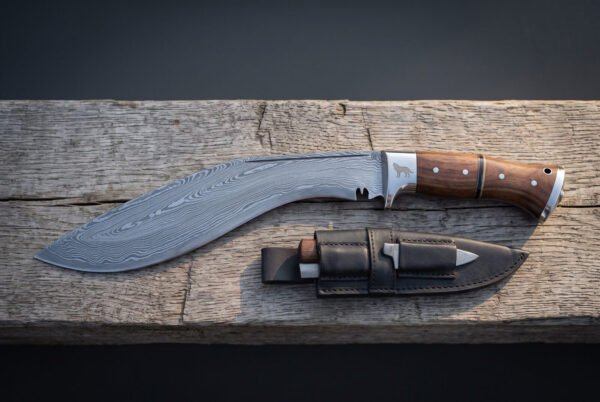
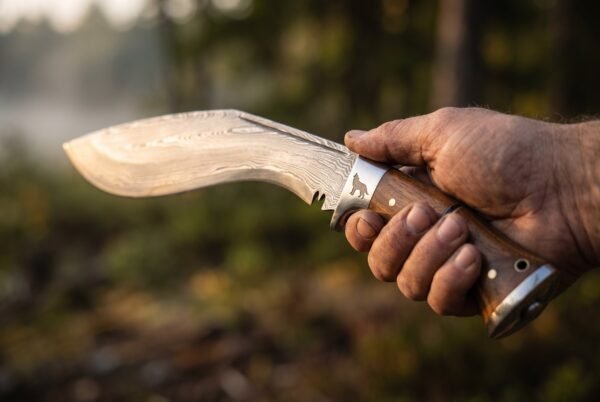
The Olivewhorl is a Damascus kukri with pale olive wood scales and a Vegvisir etched into the blade just forward of the bolster. Olive is an unusual choice for a handle and a good one. It is dense, close grained, naturally oily and wildly figured, with dark streaks wandering through a cream and honey background, so no two handles look remotely alike. Brass fittings at the bolster and the butt cap tie the warm wood to the cool grey of the pattern welded steel.
The Vegvisir is worth being straight about. It is an eight staved Icelandic symbol whose earliest known appearance is in the Huld manuscript, compiled in 1860, with a note saying that a person carrying it will not lose their way in storms or bad weather even on unfamiliar ground. That is four hundred years after the Viking age ended, so it is Icelandic folk magic rather than Norse archaeology. It is still a beautiful and genuinely old piece of Icelandic tradition, and we would rather tell you what it is than sell you a myth. This kukri is made by hand in the Czech Republic, imported and checked by Ransack Viking, and shipped from our Chicago, Illinois warehouse.
The forward angle is the whole point of a kukri, and what a kukri is actually for goes through where the shape came from. The vegvisir is Icelandic and centuries later than the Viking age, which where the vegvisir comes from sets out plainly. If you want a shorter belly for dressing game, the skinner knives cover that job.
Specifications
| Material | 1095 and 15N20 pattern welded Damascus, hardened to 58 to 60 HRC |
|---|
| Overall length | Approximately 17 inches |
|---|
| Blade length | Approximately 12 inches along the curve |
|---|
| Blade shape | Recurved kukri with a cho notch at the base of the edge |
|---|
| Handle | Approximately 5 inches, figured olive wood scales on a full tang |
|---|
| Finish | Etched and polished Damascus with a bright ground edge |
|---|
| Bolster | Single brass bolster |
|---|
| Fittings | Brass butt cap, three brass pins and a brass lined lanyard hole |
|---|
| Engraving | Etched Vegvisir stave forward of the bolster |
|---|
| Sheath | Brown leather sheath with contrast stitching and pockets for the karda and chakmak |
|---|
| SKU | RK-2111 |
|---|
Reading the Vegvisir
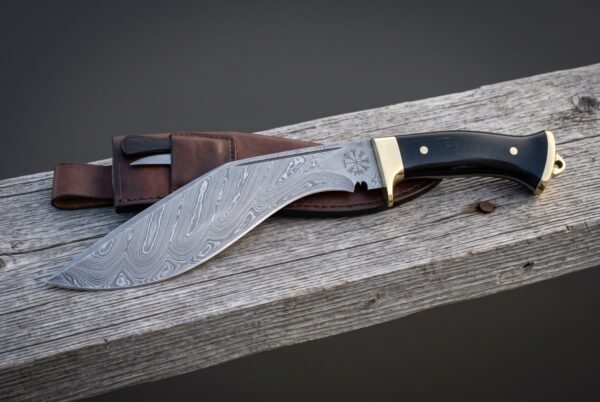
Look at the etch closely and you will count eight staves radiating from a centre, each one different from the others and each ending in a distinct set of cross bars, hooks and forks. That is the whole design. It is not a compass rose, despite the nickname runic compass, and the arms do not correspond to the cardinal directions. In the Icelandic grimoire tradition each stave is a separate magical sign and the composition works as a group.
The Huld manuscript, written by Geir Vigfusson in Akureyri, is the source everyone cites, and the accompanying text is short. It says the bearer will not lose their way in storms or bad weather even when the way is unknown. There is no mention of Vikings, no mention of ships and no reference to the sagas. Icelandic magical staves like this belong to a tradition of household and farm charms recorded in manuscripts from roughly the seventeenth century onward.
Damascus, olive wood and brass
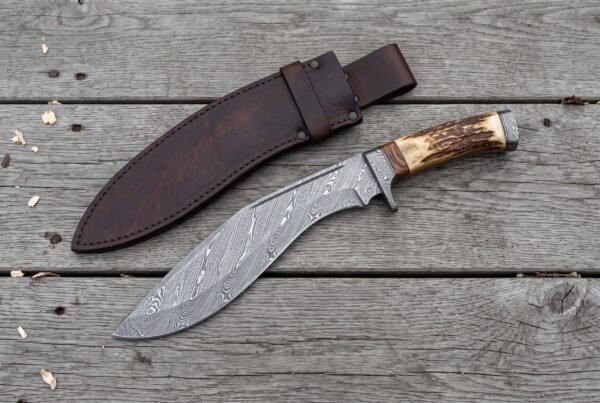
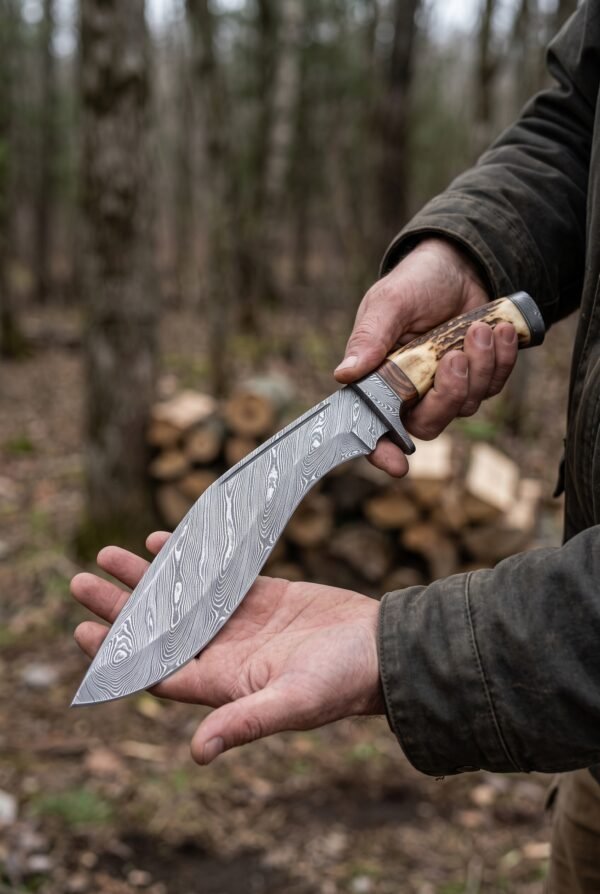
The blade is forge welded from alternating layers of 1095 and 15N20, folded, ground and acid etched at 58 to 60 HRC. Nickel in the 15N20 resists the etch and stays bright, the 1095 darkens, and you see the layer stack in cross section. Because the belly of a kukri is drawn out much further than the spine, the pattern crowds and stretches through the curve in a way it never does on a straight blade.
Olive wood is one of the hardest and heaviest woods used for handles. It has a natural oil content that resists water without any treatment, and it is stable once it has been properly dried, though it is prone to fine surface checking if it is left in very dry heat for a long time. The brass bolster gives the front of the handle mass and protects the front edge of the scales, and there is a lanyard hole through the butt.
Engraving, runes and your own design
Use the rune converter on this page to turn a name, a date or a short phrase into Elder Futhark and we will cut it into the steel, the leather or the wood. If you would rather have a Viking pattern than a rune line, choose your own design in the engraving option above the add to cart button and tell us where it goes. Where a piece already carries an engraved design, your chosen engraving replaces it rather than sitting alongside it, so a rune line ordered for the flat by the bolster takes the place of the Vegvisir. If you want to keep the stave, the brass bolster and the olive wood both engrave well, and olive in particular takes a burned rune line with real contrast. Engraving is done here in the United States after the piece arrives. See the engraving page.
Handling and balance
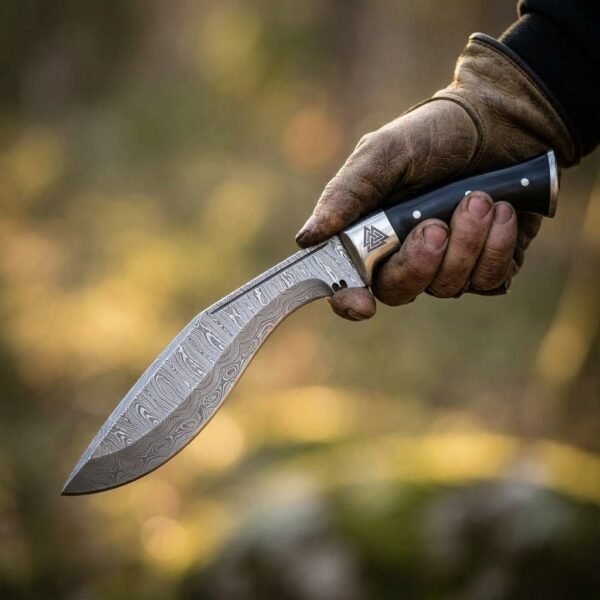
Olive is heavy for a wood, so the Olivewhorl balances a touch further back than a kukri with lighter scales, which makes it noticeably easier to control on fine work. The brass bolster still puts enough weight forward for the blade to chop properly. The scales are shaped with a swell at the rear that fills the palm, and the lanyard hole is worth using if you are swinging hard, since a wet handle and a heavy blade is a poor combination.
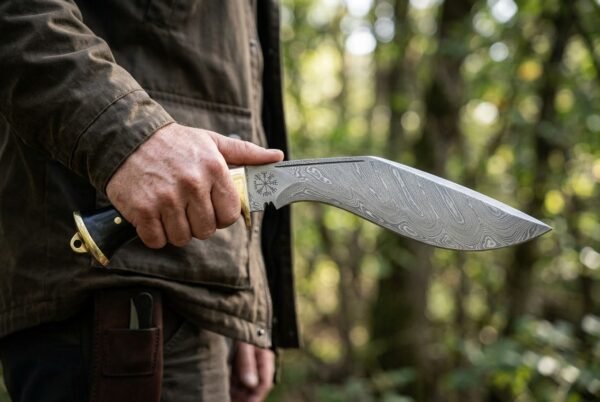
Choke up onto the bolster for skinning, food prep and carving. Drop back for chopping and let the recurve do the work rather than forcing it. This is a full tang working blade, not a display piece, though it earns its place on a shelf easily enough.
Care
Damascus made from carbon steels rusts and pitting flattens the pattern, so wipe the blade after use and keep a thin film of mineral or camellia oil on it. Do not store the knife in the leather sheath for months. Olive wood needs almost nothing, but a wipe of the same oil once or twice a year keeps it from checking, especially if the knife lives in a heated room. Feed the leather with a balm and keep it out of direct sun, which will fade the contrast stitching. Brass will darken to honey and a brass cloth restores it. Detail on sharpening and re etching is in our steel care notes.
Damascus wants oil more than plain steel does, because the etch that shows the pattern also opens the surface, and caring for a Damascus pattern covers what to use.
Made in the Czech Republic
This kukri is made by hand in the Czech Republic. Nothing here is an importer catalogue item shipped on by a seller who has never seen it. Ransack Viking buys these outright, brings them into the United States, unpacks and checks each one for pin fit, bolster seating, edge and sheath stitching, and holds stock in our Chicago, Illinois warehouse. Damascus billets are welded, folded and ground by hand in small runs, so allow one to two weeks of processing before your order ships. Shipping inside the United States is free, and the lifetime warranty against defects in forging, grind, heat treat and fittings applies with no end date and no receipt needed.
A note on handmade variation
Hand made is not machine made or bulk produced, so what arrives will not be a pixel for pixel copy of the photograph. Olive wood varies more than almost any other handle material. Some sets are pale and quiet, others carry heavy black streaking and burl figure, and none of them repeat. The Damascus pattern is unique to your blade because it records how one billet was worked. The etched Vegvisir sits a fraction differently, and brass polishes to slightly different tones. The dimensions, the steels, the heat treat and the build are the same every time.
Frequently asked questions
Is the Vegvisir a genuine Viking symbol
It is genuinely Icelandic and genuinely old, but it is recorded in a manuscript from 1860 and belongs to Icelandic folk magic rather than the Viking age. Anyone selling it as a Norse runestone symbol is overreaching.
Will the olive wood crack
It is stable when properly dried. Fine surface checking can appear if the knife sits in very dry heat for a long time, which a light oiling once or twice a year prevents.
Is the blade sharp on arrival
Yes, it ships with a working edge suitable for camp and outdoor use straight out of the sheath.
What is the hole in the end of the handle for
A lanyard. On a heavy chopping blade a wrist loop is a sensible safety measure rather than a decoration.
Can I get runes and keep the stave
Yes. Put the rune line on the brass bolster or burned into the olive wood and the Vegvisir on the blade stays as it is.
What is the shipping timeframe
One to two weeks of processing, then free shipping inside the United States, with returns accepted within seven days.
What is in the box
- Olivewhorl kukri with a 1095 and 15N20 pattern welded Damascus blade
- Olive wood scales on a full tang with brass bolster and brass butt cap
- Etched Vegvisir stave on the blade
- Karda utility knife and chakmak burnishing steel
- Brown leather sheath with contrast stitching and pockets for both companion blades
- Lifetime warranty against defects in forging, grind, heat treat and fittings
- Hand made in the Czech Republic, shipped from our Chicago, Illinois warehouse
Explore the range
Browse the other kukri knives, the wider Viking knives and the engraved and personalized pieces. Symbol and steel reading is in the guides.
Other pieces in this group
For a straight comparison, see the Hornstag kukri knife, 16 inches overall. Worth putting side by side with this is the Fellcarve kukri knife, pattern welded Damascus. In the same category sits the Coilbrand kukri knife, pattern welded Damascus.
From the same corner of the shop, there is the Gurkhastag bowie knife. Nothing here exactly right, build one to your own spec on the custom hunting knife page.

Was nervous ordering something like this online but so glad I did. Ransack Viking is quickly becoming my go to shop for anything Norse themed. Love that this is Czech craftsmanship and shipping from the US meant it showed up in just a few days.
Solid knife. Glad I ordered it.
Five stars isn’t even enough honestly. Ransack Viking’s attention to detail is honestly unmatched.