Blog
Damascus Steel Care: Oiling, Rust and Keeping the Pattern


Damascus care is ordinary carbon steel care with one extra thing to lose. The steel rusts like any other high carbon steel, and the pattern that made you buy the piece sits in the top few microns of the surface, where a scouring pad can take it off in about four seconds. Nothing here is difficult. It is a wipe, a dry and a thin coat of oil, and then you leave the blade alone. The people who ruin Damascus almost never do it through neglect. They do it in a burst of enthusiasm with the wrong abrasive. This guide covers the routine, rust removal that keeps the pattern, faded contrast, sharpening, long blades and saya, storage, and a schedule you will probably ignore for a while and then adopt after the first rust spot.
What You Are Actually Looking After
A Damascus blade is not one steel. It is two, forge welded in alternating layers and then folded and drawn out until the layer count runs into the hundreds. The Damascus we stock is made from 1095 and 15N20. The 1095 is a plain high carbon steel. The 15N20 carries nickel. That nickel is the whole trick, because when the finished blade is etched in acid the 1095 darkens and the 15N20 barely reacts, so the layers separate into the light and dark bands you can see. The pattern is not printed, dyed or coated. It is the two steels responding differently to the same acid.
Two consequences follow, and they are the reason this page exists. First, neither steel is stainless, so both will rust, and rust does not respect the pattern. Second, the visible contrast lives in an etched surface layer that is thinner than a sheet of paper. Polish that layer away and the steel underneath is still perfectly good Damascus, but it looks like grey steel. If you want the long version of how the material is made, what Damascus steel actually is covers the forging side, and telling real Damascus from fake is worth reading before you buy anything from anyone.
The Routine After Every Use
Under a minute, every time. Do it and the rest of this page stays theoretical.
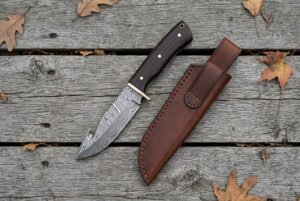
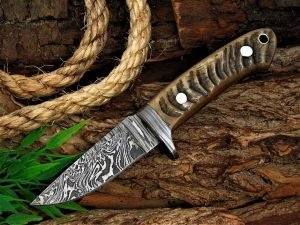 Ramcrest Hand Forged Damascus Skinner Knife with Ram Horn Handle & Leather Sheath | Compact Hunting and Collector Gift | RK-408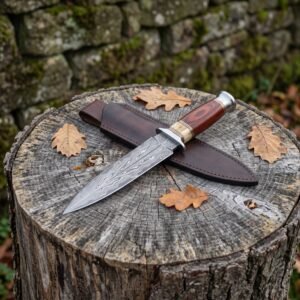
Clean it by hand
Warm water, a drop of mild dish soap, a soft cloth or a sponge. Wipe along the blade, not across it, and keep your fingers behind the edge. Acidic residue is the thing to get off quickly: citrus, tomato, vinegar, onion, marinade, blood, salt. Left for an hour on a display piece that has been handled at a party, that residue will etch its own pattern into yours. The dishwasher is not an option, and this is not fussiness. The heat, the detergent and the standing steam will rust a carbon blade in a single cycle and loosen the handle scales while they are at it.
Dry it completely, straight away
Drying is the step that actually does the work. Towel the blade dry, then give it another pass, then pay attention to the places water hides: the ricasso, the join where the blade meets the guard or habaki, around bolsters and pins, and the underside of the spine. Air drying is not drying. A blade left on a draining board to dry itself will develop spotting along the exact line where the water sat.
Put a thin coat of oil on it
A few drops on a cloth or a folded paper towel, wiped over the whole blade including the tang area you can reach, then wiped back off so what is left is a film rather than a layer. Oil is a barrier between the steel and the air. You are not lubricating anything. A visible wet coat just collects dust and lint, and on a display blade it will run down and mark the wall or the stand.
Which oil to use
Food grade mineral oil for anything you might cut food with. It is cheap, food safe, never goes rancid and is sold in every pharmacy as a laxative, which is a slightly undignified fact that has saved a lot of blades. Camellia oil is the traditional choice for Japanese blades and is excellent, thin and clean smelling. A dedicated blade oil such as a Renaissance style microcrystalline wax is the best option for a piece that lives on a wall and never gets handled, because it dries to a hard film instead of staying wet.
Do not use cooking oils. Olive, sunflower, vegetable and coconut oil all go rancid, and rancid oil turns into a sticky yellow varnish that traps moisture against the steel, which is the opposite of the intention. WD40 is a water displacer and a solvent, not a protectant. It will strip a blade clean and then evaporate, leaving it bare.
Rust: Taking It Off Without Taking the Pattern Off
Damascus rusts and always has. Finding an orange fleck on a blade you paid real money for feels worse than it is. Almost all of it comes off, and the pattern survives, provided you resist the urge to attack it.
Fresh orange spotting
Surface rust that has been there days rather than months usually comes off with oil and pressure alone. Put a drop of mineral oil on the spot, leave it five minutes, then rub with a cork, the edge of a wine cork works well, or a folded cloth. If that is not enough, a used piece of 0000 grade steel wool with oil on it will lift the rest. Work in short strokes along the blade and stop the moment the orange is gone. Check the pattern under a light after every few passes rather than at the end.
Set rust and light pitting
Older rust that has bitten into the steel will leave a dark grey or black mark after the orange is removed. That mark is a pit, and it is permanent. You can either accept it, which most collectors do because it reads as age, or you can take the blade back to bare steel with progressively finer abrasive and have it re etched, which removes the pattern and then restores it. That second option is a job for someone with an etching setup, and it is worth doing only for a piece that means something to you.
What never to go near it with
Green scouring pads, kitchen scourers, wire brushes, bench grinders, rotary tools, sandpaper coarser than about 1000 grit, rust removal gels, oxalic acid, vinegar soaks and citric acid baths. Every one of them takes the etched layer off faster than it takes the rust off. The gels and acids are the sneakiest, because they work beautifully on a plain steel blade and will strip a Damascus blade to uniform grey while you watch and feel pleased about the rust disappearing.
When the Pattern Goes Flat
Contrast fades over years of handling and cleaning. Skin oil, repeated washing and light polishing all wear at the etched surface, and a blade that was sharply banded when new can go muted. Before you conclude the pattern has worn off, degrease it properly. Wipe the blade with isopropyl alcohol and look at it dry under a strong light. A surprising amount of what people read as a faded pattern is a film of old oil and finger grease sitting on top of a perfectly good etch.
If it really has gone flat, the pattern is still in the steel, because the layers run all the way through. Only the etched surface is gone. Restoring it means degreasing the blade completely, immersing or wiping it with a mild etchant such as diluted ferric chloride, neutralising with a baking soda solution, rinsing, drying hard and oiling immediately. It is not complicated but it is easy to do badly, the fumes are unpleasant, and an uneven etch looks worse than a faded one. If the blade matters, send it to someone who does this regularly rather than practising on it.
Sharpening Damascus
There is no special technique. The layers do not need a different angle and the pattern does not run in a direction you have to respect. Sharpen it as you would any high carbon blade, which for most of ours means a whetstone and patience. Sharpening on a whetstone covers the method, and working a curved edge covers the awkward ones.
The one Damascus specific point is the bevel. Sharpening removes the etched surface from the bevel itself, so a heavily sharpened blade often shows a bright unpatterned strip along the edge while the flats stay dark and banded. That is normal, it happens to every working Damascus knife, and most owners stop noticing it. Pulling the whole blade through a carbide sharpener is the thing to avoid. Those things tear steel rather than cut it, and they will chew the etch along the shoulder of the bevel as well as the edge.
Long Blades, Katana and Saya
A Damascus katana or wakizashi has three parts that need different things, and the blade is the easy one.
The blade gets the same routine as everything else, with one addition: draw it and wipe it every few weeks even if it has not been used. A long blade sitting in a scabbard is not in a neutral environment. Always draw and sheathe along the spine, never edge first, and never in a hurry.
The saya is lacquered wood and wants nothing from you except to be kept dry and out of sunlight. Do not oil the inside. Oil soaks into the wooden liner, stays there and holds moisture against the blade for years. If a saya has picked up moisture, stand it mouth down somewhere airy for a day or two and keep the blade out of it in the meantime. If something rattles inside, stop using it and have it looked at rather than shaking it out.
The tsuka and its ito wrap should be kept dry and handled with clean hands. Rayskin and cord both take up skin oil and grime, and neither cleans easily once it has. A soft dry brush now and then is the whole of it. The habaki and the collar area where blade meets fitting is the single most common place for rust on a long blade, because it is the one part people never dry properly. Get a corner of the cloth in there every time.
Damascus Rings and Small Pieces
Damascus jewelry has the same steel and the same problem in a form that spends its life against skin. Sweat is salty and mildly acidic and it will spot a Damascus ring faster than anything a kitchen knife encounters. Take rings off before swimming, showering, washing up and the gym, dry them properly when they do get wet, and give them an occasional wipe of mineral oil or a rub of paste wax. A ring that goes dull can be brought back with a jewellery cloth and light pressure, but the same rule applies as with blades: nothing abrasive, nothing acidic, no ultrasonic cleaner.
Storage, Which Is Where Most Damage Happens
Blades rarely rust in use. They rust in drawers, in cases and in sheaths, quietly, over months, and you find out when you next pick the piece up.
Store Damascus oiled, dry and out of leather. Leather holds moisture and residual tanning salts against steel, and a blade left in a fitted sheath for a season will often come out spotted in the exact shape of the sheath. Sheaths are for carrying. For storage, keep the piece uncovered on a stand, in a blade roll or in a cloth wrap, with the sheath sitting alongside it.
Avoid the obvious traps: garages, basements, lofts, sealed plastic cases that trap humid air, foam lined boxes that hold damp against the steel, and exterior walls in cold rooms where condensation forms on cold metal every time the heating comes on. A wall display in a normal heated room is fine and is what most of these pieces are for. If you keep several pieces in a case, put a few silica gel packs in it and change them once a year, or use a vapour corrosion inhibitor strip, which is the same idea in a form you do not have to think about.
Engraved Damascus
Engraving is cut into the blade after the etch, so an engraved Damascus piece has a fresh, unprotected steel surface inside every cut line. Those lines are exactly where moisture sits. Oil them the same as the rest of the blade and make sure the oil actually reaches into the engraving rather than bridging over it, then wipe the surface back. Never clean engraving with a brass or wire brush, and never pick at it with anything metal. A soft toothbrush with oil on it is the correct tool and is more than enough. Our engraving is done here in the United States after the piece arrives, so if you have had a blade personalised, it left our hands with the cuts oiled and it should stay that way.
A Care Schedule
After every use: clean, dry, thin coat of oil. Under a minute.
Every month for a piece in regular use: a proper look under good light, checking the tang area, the guard join and the spine, with a fresh coat of oil after.
Every three months for display pieces: draw, inspect, wipe, re oil, sheathe or restand. Long blades benefit from this more often than people expect, because a scabbard hides the early stage of everything.
Once a year: check silica packs, condition any leather that lives with the piece, and look properly at the pattern contrast to see whether it is actually fading or just dirty.
Every piece we sell is made by hand in the Czech Republic and ships from our warehouse in Chicago, and every one of them arrives with a protective coat on the blade. That coat is a shipping film, not a maintenance plan. Wipe it off, look the piece over and start the routine from day one rather than from the day you find the first spot.
Related reading: the general routine for all our carbon steel in the knife care guide, the material comparison in Damascus against plain high carbon steel, kitchen pieces in looking after a hand forged kitchen knife, axes in axe care, and the full set in our guides.
Damascus Steel Care Questions
How often should I oil a Damascus blade?
After every use, and every few weeks if it is not being used at all. A blade on a wall in a dry heated room can go a month between coats without trouble. A blade in a garage, a coastal house or a humid climate wants attention every week or two, and a piece stored in a case wants checking on a schedule rather than when you happen to remember it.
Will the Damascus pattern wear off?
Not from normal use. The layers run through the whole thickness of the blade, so the pattern is structural. What wears is the etched surface that makes the layers visible, and that fades from repeated cleaning and handling over years. It can be brought back by re etching. The fast way to lose it is abrasive cleaning or an acid soak, not use.
Can I put Damascus in the dishwasher?
No. Heat, harsh detergent and a long steam cycle will rust a carbon steel blade in one wash, dull the etch and loosen wooden handle scales. There is no version of this that ends well.
Is Damascus steel stainless?
Ours is not. It is 1095 and 15N20, both plain carbon steels, and both will rust if left wet. Stainless Damascus exists, made from stainless layers, but it etches with much lower contrast, which is why most patterned blades are made the way these are.
How do I get rust off without ruining the pattern?
Oil and a cork for fresh spotting, oil and used 0000 steel wool for anything more stubborn, working along the blade in short strokes and checking often. Stop when the orange has gone. Skip the rust gels, acid soaks and scouring pads entirely, because they remove the etch faster than they remove the rust.
My blade came with a greasy coating. Is that the finish?
No, that is a protective film applied for shipping. Wipe it off with a cloth and a little warm soapy water, dry the blade fully, then put your own thin coat of oil on it.
Why does the edge look plain after sharpening?
Because sharpening cuts away the etched surface on the bevel and exposes fresh steel underneath. It is normal on any Damascus blade that gets used, and it stops at the bevel. If it bothers you, the bevel can be re etched, but most people find they stop seeing it within a week.
Can I store a Damascus knife in its leather sheath?
For carrying, yes, that is what a sheath is for. For storage, no. Leather holds moisture and tanning residue against the steel and is the single most common cause of spotting on pieces that were otherwise well looked after. Store the blade oiled and uncovered, with the sheath kept beside it.
What happens if my blade gets soaked?
Dry it at once and completely, including every join and recess, then oil it heavily and check it again the next day. Do not use a heat gun, an oven or a hairdryer on high, particularly on a piece with a wooden or horn handle. Room temperature air and time are what you want.
Does a Damascus ring need the same care?
Broadly yes, and it gets a harder life. Take it off for swimming, showering and the gym, dry it when it gets wet, and wax or oil it occasionally. Keep it away from ultrasonic cleaners and jewellery dips, which will strip the etch.
On the shelf
In the shop right now, the Bullhorn folding pocket knife and the Sandspire dagger knife. The Trailhorn tracker knife and the Blockbreaker cleaver sit next to them.
Shop the range
Ramcrest Hand Forged Damascus Skinner Knife with Ram Horn Handle & Leather Sheath | Compact Hunting and Collector Gift | RK-408