
Blog
Viking Beard Rings and Braids: What They Were and How They Are Worn

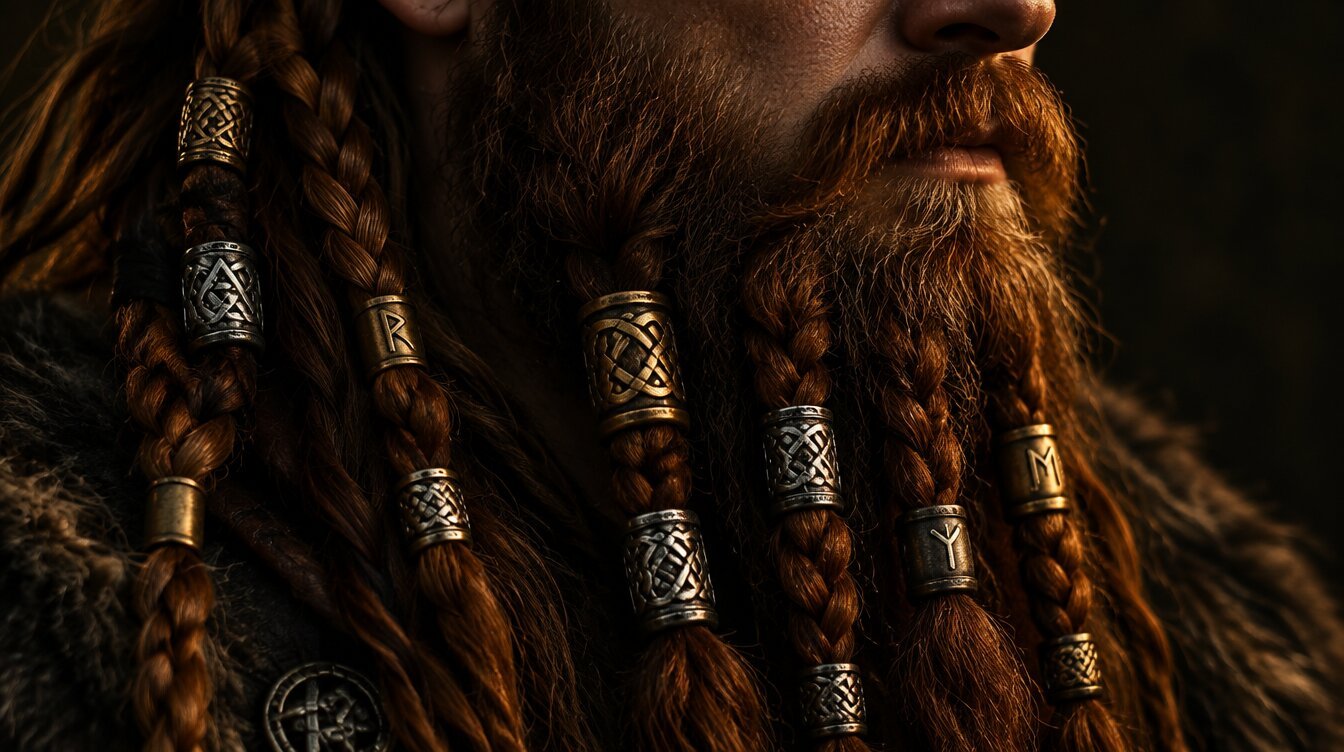
Start with the awkward part. No Viking Age grave has produced a metal ring that archaeologists agree was worn in a beard. Beads turn up by the thousand, mostly glass and mostly strung as necklaces. Rings turn up as finger rings, arm rings and dress fittings. The beard ring as a distinct object, sized and shaped to slide down a braid of facial hair, is a modern thing wearing a very old coat.
That is not a reason to stop wearing one. It is a reason to know what you are wearing, which is a better position than most of the internet manages. The grooming itself is real, well documented and rather more interesting than the jewellery.
What the Sources Actually Say About Norse Grooming
Combs, everywhere
The single most common personal object recovered from Viking Age sites is the comb. They are made from antler in composite construction, riveted together from cut plates, and they appear in graves of men and women alike, often with a case to protect the teeth. Comb making was a specialist trade with its own waste debris, which is how excavators identify workshop sites at places such as Ribe and Birka. A culture that buries its dead with combs was not indifferent to hair.
Complaints from the neighbours
An English chronicle attributed to John of Wallingford, written long after the events, grumbles that the Danes combed their hair every day, bathed on Saturdays and changed their clothes often, and that this was how they seduced English women. It is a late source and a hostile one, so it is evidence of reputation rather than routine. Still, the reputation is telling. Nobody accuses a filthy enemy of excessive bathing.
An Old English letter from around the year 1000, usually attributed to the homilist Aelfric, warns a man named Edward against adopting Danish fashion with a bared neck and blinded eyes. That reads as a description of a specific haircut: long at the front, cut back or shaved at the nape. It is one of very few direct comments on Norse hair from someone who saw it.
Carved faces
Small carved heads give the clearest picture. A well known piece of elk antler from Sigtuna in Sweden shows a man with a carefully shaped moustache and a pointed, apparently trimmed beard. Carvings from the Oseberg ship burial show bearded faces with deliberate styling. Gotland picture stones and a scattering of metal figures show the same. What they do not show, anywhere, is a beard threaded with metal rings.
Beards in Names and Bynames
Old Norse naming habits give beards away. Sveinn tjuguskegg, the Danish king English sources call Sweyn Forkbeard, carried his beard in his name. So did assorted men called Skeggi, from skegg, the word for beard. Harald Fairhair was known earlier as Lufa, a shock or tangle of hair, before the byname changed. Bynames were descriptive and often unkind, and a society that hands out nicknames about hair is a society that notices hair.
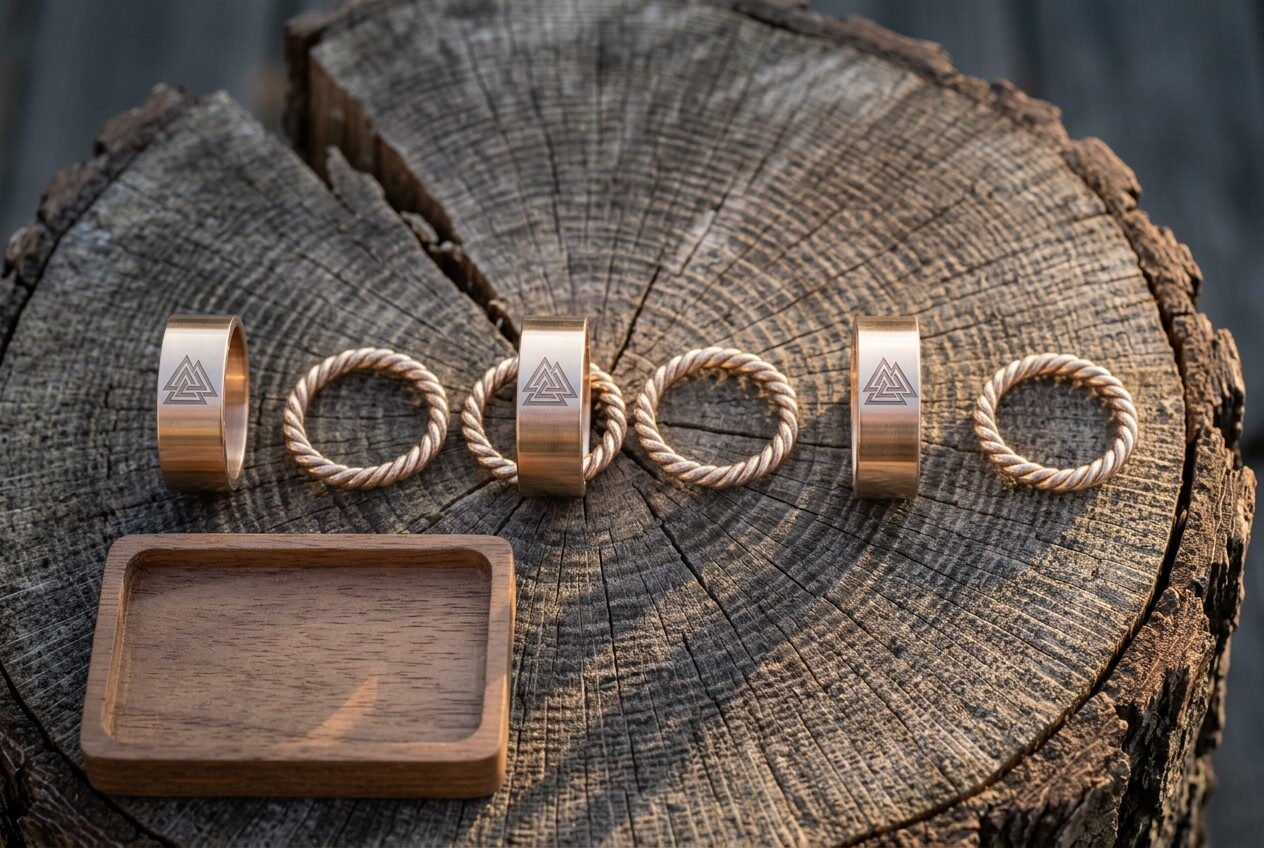
 Beardknot Hand Made Bronze Tone Viking Ring Set with Valknut Bands & Twisted Wire Rings | Seven Piece Stacking Ring Gift | RK-1616
 Braidhorn Hand Made Viking Beard Comb with Wooden Box | Natural Horn | Vegvisir Stave and Dotted Spine Border | Groomsmen Gift | RK-1681
 Ropewind Hand Made Norse Rune Ring with Twisted Rope Borders & Elder Futhark Centre Band | 9mm Wide | Groomsmen Gift | RK-1604
The wider habit of naming people after visible features is covered in Viking names and what they meant, which is where most of these bynames sit alongside the given names they replaced.
The Evidence for Beard Rings, Stated Plainly
Here is the honest ledger. Hair rings and small spiral rings of bronze and silver exist in Iron Age and Viking Age contexts across northern Europe. What is missing is any find where such a ring was recovered in position around facial hair, or any written description of the practice, or any carving that depicts it. Facial hair does not survive, so absence of direct evidence is expected. But absence of depiction is harder to wave away, because the carvings that show beards in detail show them plain.
The reasonable conclusion is the boring one. Beard rings may have existed and left no trace, but nobody can currently show that they did, and anyone telling you that Vikings wore them is stating a preference rather than a fact. The site takes the same line on the horned helmet and on the Vegvisir stave, both of which are worth wearing and neither of which is Viking Age in the way people assume.
Where the Modern Beard Ring Came From
The current fashion has two parents. One is the reenactment and living history scene, where a visible metal fitting reads as period at ten paces and gives a costume a focal point. The other is the beard care boom of the 2010s, which produced a market for anything that could be sold alongside oil and balm. Screen Vikings did the rest. Once a television character wears something for four seasons, its historical status becomes largely academic.
None of that makes the object dishonest. It makes it modern, in the same way that a knotwork pendant with a rune row on it is modern in execution and old in vocabulary. What matters is whether the piece is well made and whether the symbol on it means what the seller claims. On that second point, Viking symbols and their meanings separates the genuinely attested from the nineteenth century and later inventions, and the Elder Futhark lists every rune with its actual sound value.
How Beard Rings and Beads Are Worn
Sizing
Internal diameter does all the work. Somewhere between eight and twelve millimetres suits most beards, with the smaller end for a single thin braid and the larger for a gathered tail. Too tight and you will pull hair out every time you remove it. Too loose and it migrates down and falls off in the shower, usually into the drain.
Placement
The stable positions are near the end of a braid, where the taper holds the ring in place, and at the top of a braid immediately under the chin, where it gathers the strands and stays put through weight alone. The middle of a braid is where rings slide. If you want a mid braid ring, put a second one below it as a stop.
How many
One reads as deliberate. Two reads as a choice. Four or more reads as a costume, which is entirely fine if a costume is what you are after. There is no rule here, and the only practical limit is weight, since a heavy stack pulls on the follicles at the jaw and that gets sore over a long day.
Braids That Hold
The single centre braid
The simplest and the most secure. Gather from the chin down, plait to within an inch of the end, slide the ring up from the tip and let the taper trap it. Works on anything from four inches of beard upward.
The split double
Two braids from either side of the chin, each ringed. It needs more length than people expect, because splitting the volume makes each braid thinner and thinner braids unravel faster. Below six inches it looks sparse.
The gathered tail
No plait at all. Gather the beard into a tail and ring it once, low. This is the one that suits a broad beard that does not want to hold a braid, and it is closer to what the carvings suggest than anything with metal threaded through it.
Beeswax based balm helps every one of these hold. Oil alone will not, because oil is for the skin underneath and does nothing for grip.
Materials, and What Your Skin Will Tolerate
Stainless steel is the default for anything worn daily. It does not corrode against sweat, it takes a clean engraved line, and it survives being dropped on tile. Bronze and brass develop a warm patina, which many people want, and can leave a temporary green mark on skin where they sit against the jaw. Silver finish pieces look best in photographs and need the most upkeep. Pewter is soft and will deform if you crush it.
If you know you react to nickel, buy steel and ask what the alloy is. A ring sitting in a beard is in near constant contact with skin at the jaw, which is a more demanding position than a pendant hanging clear on a chain.
Keeping a Set in Order
Take rings out before you sleep, both because they snag and because a night of pressure against a pillow bends softer metals. Wash them in warm water with a little soap when the balm builds up, since wax collects and goes grey. Dry them properly. Store them somewhere that is not the edge of a basin, which is where beard rings go to die.
A comb matters more than the rings do. Horn and antler combs run through a beard without the static and snagging you get from injection moulded plastic, and they were the one grooming item the period genuinely did have in quantity.
Choosing a Set
Look at the join. Cheap beard rings are rolled from strip and the seam is visible, which catches hair. Look at the inner edge, which should be rounded rather than cut square. Check the engraving depth on any symbol, because a shallow stamp will polish away in a year of handling. And decide honestly whether you want one good piece or a set of seven, since the sets look generous in a photograph and most people wear two of them.
The beard rings and beads range covers both, alongside horn combs. The wider Damascus steel jewelry range carries the pendants and rune rings that go with them, and arm rings and torcs cover the one form of Norse jewellery that genuinely is well attested in the ground.
Ransack Viking is a US company in Chicago, Illinois. The pieces are made by hand in the Czech Republic and are imported, inspected and shipped from Chicago, with any engraving cut here after arrival. US orders ship free and tracked with no duty, and everything carries a lifetime warranty against defects. Engraving to order is arranged through custom engraving, and the rest of the writing is in the guides.
Questions people ask
Did Vikings really wear beard rings?
There is no evidence that they did. No excavated ring has been recovered in a position that shows it was worn in facial hair, no written source describes the practice, and the carvings that show beards in detail show them plain. Beard rings are a modern object built from an old vocabulary.
What did Norse men actually do with their beards?
They combed them, and there is good evidence for that. Antler combs are among the commonest personal finds of the period, comb makers were a recognised trade, and carved heads show trimmed and shaped beards. Bynames such as Forkbeard suggest deliberate styling that others noticed.
What size beard ring do I need?
Most people want an internal diameter of eight to twelve millimetres. Take the smaller end for a single thin braid worn near the tip, the larger for a gathered tail or a thick plait high under the chin. A ring that has to be forced over the hair is too small.
How do I stop a beard ring sliding out?
Put it where the beard tapers, near the end of a braid, so the hair itself traps it. If you want it higher up, fit a second ring below it as a stop, and use a wax based balm rather than oil. Oil makes hair slippery, which is the opposite of helpful here.
How long does a beard need to be for a braid?
About four inches from the chin for a single centre braid. Six inches or more before a split double looks like anything, because dividing the volume thins each side. A gathered tail with one low ring works at shorter lengths than either.
Will bronze or brass mark my skin?
It can, in the same way a brass ring marks a finger. The mark is a harmless surface reaction with sweat and washes off. If it bothers you, or if you react to nickel in cheap alloys, stainless steel is the safe choice for something worn against the jaw every day.
Is a beard comb worth buying separately?
Yes, and it is the one item on this list with real period credentials. Horn and antler run through hair without the static and snag of moulded plastic, and a comb with a case will outlast several beards.
The shop side of this
In the shop right now, the Beardknot Viking beard bead and the Braidhorn Viking beard comb. The Tinebraid bone Viking comb and the Coilbright Viking arm ring sit next to them.
Shop the range
Beardknot Hand Made Bronze Tone Viking Ring Set with Valknut Bands & Twisted Wire Rings | Seven Piece Stacking Ring Gift | RK-1616Braidhorn Hand Made Viking Beard Comb with Wooden Box | Natural Horn | Vegvisir Stave and Dotted Spine Border | Groomsmen Gift | RK-1681Ropewind Hand Made Norse Rune Ring with Twisted Rope Borders & Elder Futhark Centre Band | 9mm Wide | Groomsmen Gift | RK-1604 Everrune Hand Made Viking Rune Ring with Elder Futhark Band & Bevelled Polished Edges | 6mm Wide | Norse Wedding Gift | RK-1603
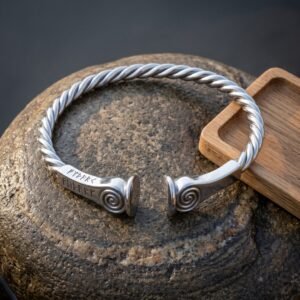 Coilspire Hand Made Twisted Viking Arm Ring with Spiral Terminals & Elder Futhark Runes | Open Cuff Torc | Norse Oath Gift | RK-1761
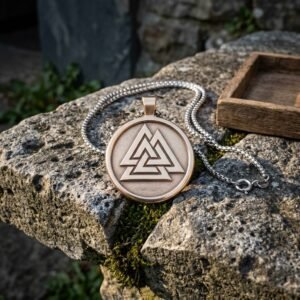 Kinbound Hand Made Bronze Tone Valknut Pendant with Raised Triple Triangle & 22 Inch Box Chain | Norse Memorial Gift | RK-1601