Blog
Heimdall in Norse Mythology: The Watchman, the Horn, and the End of Everything

Who Heimdall Was
Heimdall is the watchman of the gods. He stands at the top of Bifrost, the rainbow bridge connecting Midgard (the human world) to Asgard (the realm of the gods), and his job is to see everything coming. The Prose Edda calls him “the white god” and says he needs less sleep than a bird, can see for a hundred leagues in any direction, and hears grass growing on the ground and wool growing on sheep. That is not a metaphor. The Norse meant it literally.
His Old Norse name is Heimdallr. The etymology is debated, but the most common reading splits it into “world” (heimr) and “shining” or “bright” (dallr), making him something like “the one who illuminates the world.” His other name, Hallinskidi, is even less clear, though some scholars connect it to a ram, which fits his association with horns.
The Horn That Ends the World
Heimdall carries Gjallarhorn, the horn that will sound when Ragnarok begins. The name translates to “yelling horn” or “resounding horn,” and when Heimdall blows it, every being in every realm hears. It is the alarm system for the end of all things. Until that moment, he waits.
The Voluspa, the most important poem in the Poetic Edda, describes the moment: “Heimdall blows loudly, the horn is aloft.” That single line signals the beginning of the final battle. The gods gear up. The giants march. The world serpent rises. And it all starts with Heimdall’s horn, which means the end of everything depends on one figure deciding the time has come.
There is a separate tradition that Heimdall hid Gjallarhorn in the well of Mimir, alongside Odin’s pledged eye. This detail appears in some readings of the Voluspa, though the stanza is famously difficult to translate. If accurate, it means both Odin and Heimdall sacrificed something of themselves to the well of wisdom: Odin his sight, Heimdall his hearing instrument.
The Nine Mothers
Heimdall has nine mothers. The Hyndluljod, a poem in the Poetic Edda, names this directly: “One there was born, in times of old, / strong in might, of the race of gods; / nine giant maidens gave him birth.” The poem then lists names: Gjalp, Greip, Eistla, Angeyja, Ulfrun, Eyrgjafa, Imd, Atla, and Jarnsaxa.
Who these nine figures are, and how one being can have nine mothers, has been argued over since the medieval period. The most common scholarly interpretation connects them to waves. Nine waves giving birth to a god at the edge of the sea fits the imagery of Heimdall as a figure who stands at the boundary between worlds. The Norse associated the number nine with cosmic significance (Odin hung on Yggdrasil for nine nights; there are nine realms), and Heimdall’s nine mothers put him at the intersection of that numerology and the physical world.
Heimdall and Human Society
The Rigsthula, a poem preserved separately from both Eddas, tells how a figure called Rig (identified with Heimdall in the poem’s prose introduction) walks through the human world and fathers the three social classes. He visits three households. At the first, a poor couple named Ai and Edda, he sleeps between them and their child becomes Thrall, ancestor of all slaves. At the second, a comfortable couple named Afi and Amma, the child becomes Karl, ancestor of the free farmers. At the third, a wealthy couple named Fadir and Modir, the child becomes Jarl, ancestor of the nobles.
The poem is blunt about social hierarchy. Each child inherits physical traits that match their class: Thrall is dark skinned and rough handed; Karl is ruddy and capable; Jarl is blond and bright eyed. The Norse did not pretend their class system was accidental. They wrote a myth that said a god created it on purpose, and that god was Heimdall.
Whether Rig is actually Heimdall is debated. The prose header says so, but some scholars argue Rig is Odin. The identification with Heimdall is the older and more widely accepted reading, and it gives him a role that goes beyond sentry duty: he is the architect of human social order.
Heimdall and Loki
Heimdall and Loki are enemies, and their enmity runs deeper than personality conflict. Heimdall guards the boundary. Loki crosses boundaries. Heimdall keeps order. Loki creates chaos. They are structural opposites in the mythology, and Ragnarok ends with them killing each other.
The Voluspa describes their final fight in a single compressed reference, and Snorri expands it in the Prose Edda: at Ragnarok, after the Bifrost shatters and the armies of the dead pour into Asgard, Heimdall and Loki meet on the battlefield and each destroys the other. Neither survives. The watchman and the trickster cancel each other out, which is about as neat a narrative conclusion as Norse mythology allows.
There is also a reference in the Lokasenna (Loki’s flyting with the gods) where Loki tells Heimdall he has a “hateful life” standing guard in all weather. Heimdall does not respond with much force, which some scholars read as restraint and others as a sign that his characterisation in that poem is underdeveloped. Either way, the two are positioned as natural adversaries long before the final battle.
Heimdall in the Sources
Heimdall appears in the Poetic Edda (Voluspa, Hyndluljod, Lokasenna, Rigsthula), the Prose Edda (Gylfaginning, Skaldskaparmal), and scattered references in skaldic poetry. He does not have his own saga. Compared to Odin, Thor, or Loki, his source material is thin but consistent: the watchman, the horn, the nine mothers, the social classes, the final fight with Loki.
Snorri says Heimdall lives in a place called Himinbjorg (“heaven’s cliffs” or “heaven’s castle”), situated where the Bifrost meets Asgard. He rides a horse called Gulltoppr (“gold mane”) and carries a sword. The image is of a permanent sentry at the most important gate in the cosmos, armed, mounted, and waiting for the one event that will require him to act.
Viking Age art occasionally depicts a figure with a horn at what appears to be a bridge or boundary. The Gosforth Cross in Cumbria, England (10th century), may include a Heimdall figure among its Norse mythological carvings, though identifications of individual figures on stone crosses are always uncertain. The horn is the identifying feature: no other Norse figure carries one as a defining attribute.
Why Heimdall Matters
Heimdall is the only figure in Norse mythology whose primary role is patience. Odin seeks knowledge. Thor fights. Loki destroys. Valkyries choose the dead. Berserkers lose control. Heimdall waits. His entire existence is oriented toward a single future moment, and everything he does (the watching, the listening, the standing at the bridge) is preparation for Ragnarok.
That makes him an unusual figure in a mythology that generally rewards action. The Norse valued deeds, and their heroes are defined by what they do, not by what they endure. Heimdall endures. He stands guard in the wind and rain, season after season, for an undefined stretch of cosmic time, doing nothing dramatic until the moment when everything depends on him blowing the horn.
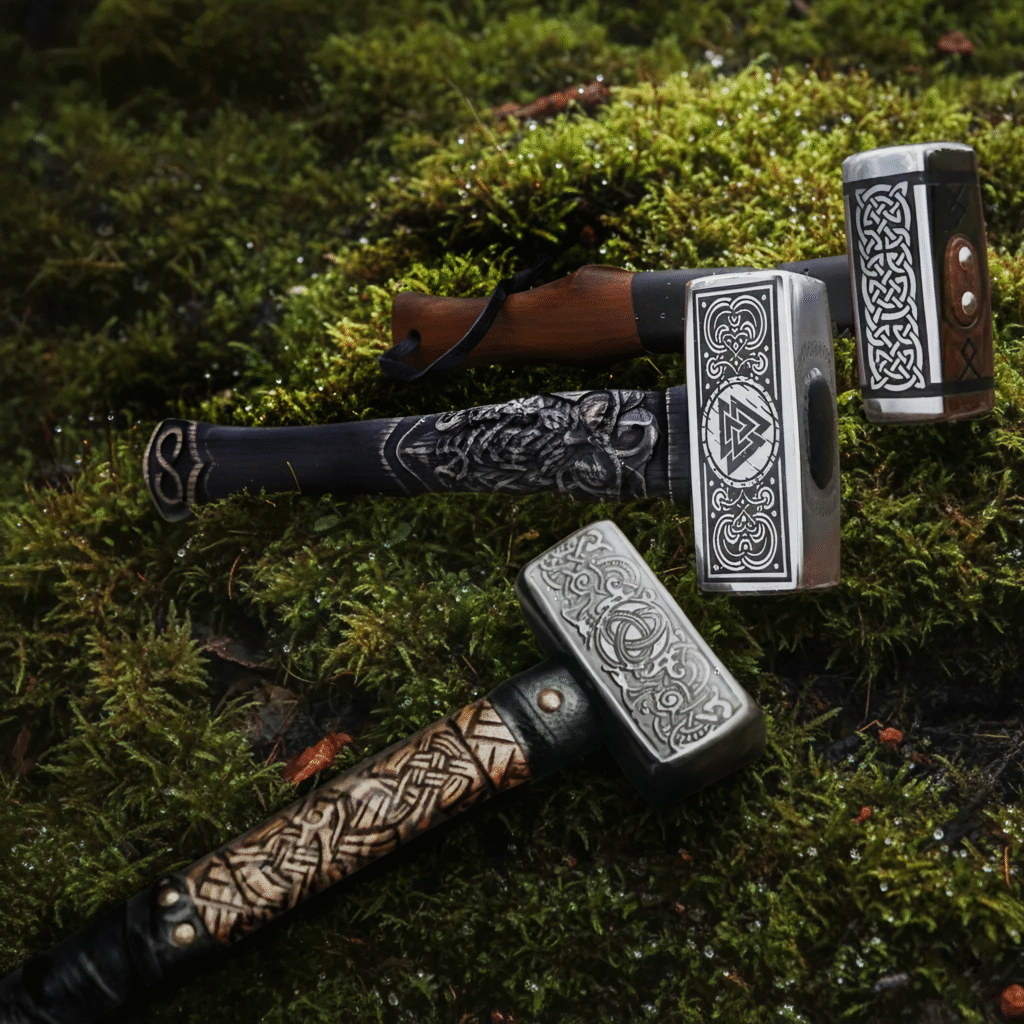
The watchman’s tools came from the same craft tradition that produced the objects of his mythology. A hand forged axe with a raven head or a Damascus sword with knotwork carry the same idea: patient work in service of a decisive moment.
For more on the Norse world Heimdall guards, read our guides on Valhalla, Loki, the Valkyries, the famous Vikings, and Elder Futhark runes.
Frequently Asked Questions
Is Heimdall a god?
Yes. He is one of the Aesir, the principal group of Norse gods. The Prose Edda calls him “the white god” and places his dwelling at the entrance to Asgard. He is not as widely worshipped or as frequently depicted as Odin or Thor, but he is unambiguously divine.
What does Gjallarhorn do?
Gjallarhorn is the horn Heimdall blows to signal the beginning of Ragnarok. When it sounds, every being in every realm hears it, and the gods prepare for the final battle. Until that moment, it remains silent.
Why does Heimdall have nine mothers?
The Hyndluljod names nine giant maidens as his mothers. Most scholars interpret them as personifications of waves, connecting Heimdall’s birth to the sea. The number nine recurs throughout Norse mythology as a number of cosmic significance.
How does Heimdall die?
He dies at Ragnarok in mutual combat with Loki. Both kill the other. The Prose Edda treats this as the final act of their long enmity, the watchman and the trickster destroying each other as the world ends.
What is Heimdall’s connection to the rainbow bridge?
Heimdall stands guard at the Asgard end of Bifrost, the rainbow bridge connecting the realm of the gods to the other worlds. His dwelling, Himinbjorg, is positioned at the bridge’s highest point, giving him a vantage over all nine realms.
On the shelf
Pieces in the catalogue that fit, the Draughtraven leather belt hanger and the Runemead rune drinking horn. So are the Gazeward Viking spectacle helmet and the Stormwheel Viking round shield.