Blog
Rapier vs Sidesword: What Actually Separates Them

A rapier and a sidesword can sit next to each other on a rack and look like cousins who had a falling out. Both are straight bladed. Both have a hilt sprouting rings and bars in directions that take a while to make sense of. Both belong to the same rough slice of the 16th century. They are still two different tools, they teach two different games, and buying the wrong one is one of the more expensive ways to start fencing.
The short version is this. A sidesword cuts and thrusts with roughly equal conviction and has a blade built to survive both. A rapier is built around the thrust, carries a longer and narrower blade, and treats the cut as something you do when the opportunity falls in your lap rather than something you plan around. Everything else, the hilt, the fitting, the price, follows from that one distinction.
If you are still working out what any of this is for, start with what HEMA actually is and then how to choose your first HEMA sword. If you already know which family you want and you only need to compare pieces, the HEMA rapiers and HEMA sideswords categories are the fastest route.
The short answer, before the detail
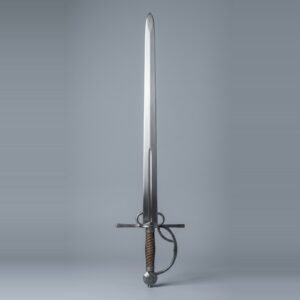
A sidesword is the broader, shorter, earlier piece. Think of it as an arming sword that grew a knuckle bow and a couple of finger rings when civilian fencing started caring about the unarmoured hand. It cuts properly. It thrusts properly. It works in the Bolognese tradition, it works with a buckler, it works with a cloak if your club is that sort of club.
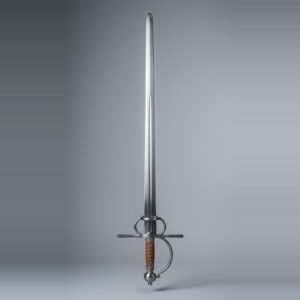
A rapier is what happens when the thrust wins the argument. The blade gets longer, narrower and stiffer in cross section. The hilt gets more elaborate because the hand is now the closest target on the field and the cut that would have taken the arm off has become a cut that mostly scores lines on steel. Rapier proper starts around 1540 and is displaced by the smallsword by about 1715, which is a respectable run for something that spends most of its career being called impractical by people holding longswords.
Where each one comes from
The sidesword
Sidesword is a modern label for a real historical object. The Italians of the period called it a spada da lato and did not spend much energy distinguishing it from the sword their grandfather carried. What changed was the hand protection. Once fencing moved off the battlefield and into streets and salles, fingers were being lost to blades that armour would previously have handled, so the cross grew rings to let a finger hook over the quillon safely, then a knuckle bow.
It is the direct ancestor of both the rapier and the cut and thrust swords of the 17th century. If your club teaches Marozzo, Manciolino, Dall Agocchie or any of the Bolognese material, this is the piece the book assumes you are holding.
The rapier
The rapier is the civilian sword of the late Renaissance and it is the first sword in European history that was designed almost entirely around a duelling context rather than a battlefield one. Historical examples come in at around 1 kg with an average blade of 104 cm. Italian pieces run longer, over 115 cm and occasionally as far as 130 cm, with a blade width of 2.5 cm or less at the base. That is a lot of reach hanging off one wrist, which is exactly the point and also the reason rapier fencers develop forearms that look slightly rented.
Blade geometry, which is where the real difference lives
Ignore the hilts for a moment. Put both blades flat on a table and the story is obvious. The sidesword blade is wide at the base, tapers in profile, usually carries a fuller for part of its length and has enough edge geometry to mean something in a cut. The rapier blade is narrow, often diamond or hexagonal in section rather than lenticular, and carries its stiffness in thickness rather than width.
That difference decides the handling. A sidesword recovers from a cut quickly because the mass is closer to the hand. A rapier holds a line beautifully and resists being beaten off it, because a long stiff blade with the balance close to the guard is very hard to shove sideways. Ask a rapier to throw a rising cut from a low guard and it will do it, slowly, while the other fencer walks a thrust into your arm.
Blade flex matters differently too. On a rapier you are looking for a blade that bends predictably on a hard thrust and returns straight, because you will land dozens of thrusts a session. On a sidesword you want a blade that survives a hard bind and an edge on edge parry without taking a set. We use 51CrV4 spring steel at 49 to 52 HRC across the line for the same reason everyone serious does: it bends and returns instead of taking a permanent bow or snapping. More on that in HEMA sword flex explained.
Hilt families and what they tell you
Swept hilt
The Italian pattern, and the one most people picture when they hear the word rapier. Bars sweep from the ring down around the knuckles in curves that look decorative and are not. Each bar is closing a line into the hand. A swept hilt is lighter than a cup and gives better airflow, which matters after ninety minutes in a mask.
Cup hilt
Spanish, from the early 1600s. A solid steel bowl over the hand with long straight quillons and usually a knuckle bow across the outside. It is the most protective hilt of the three and the heaviest, and it changes the balance noticeably. Destreza people tend to like it. It is also the hilt that makes the sword awkward to store, which is nobody’s historical concern but becomes yours the first time you try to fit one in a kit bag.
Pappenheimer
German, with pierced shell plates either side of the blade inside the sweep. The piercing is not there to look pretty, although it does. It cuts weight out of the plates while keeping the surface area that stops a point sliding through. If you want rapier protection without a cup, this is the compromise the 17th century already worked out for you.
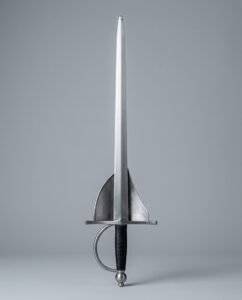
Sidesword hilts are simpler by comparison: a cross, one or two finger rings, usually a knuckle bow, sometimes a counterguard loop or a side ring. The Orveldt sidesword is the piece to look at if you want to see where a sidesword hilt starts turning into a rapier hilt without committing to the blade length.
How they actually fight differently
In a sidesword pairing, measure changes constantly. People step in, cut, bind, wrestle for the inside line, come apart and do it again. Off hand tools are normal: buckler, dagger, cloak. The tempo is busy.
Rapier is slower and far more patient, and the first time you watch it you will probably think nothing is happening. What is happening is two people negotiating a distance of about four feet with the points of two very long blades, each waiting for the other to commit a hand. When it goes, it goes in a quarter of a second. Rapier rewards fencers who can stand still without getting bored, which is a smaller group than you might hope.
Which one should you buy first
Buy the one your club teaches. That is not a cop out, it is the only answer that survives contact with reality, because a sword nobody at your club can coach you on is an ornament with a good story.
If you genuinely have a free choice, the sidesword is the more forgiving first purchase. It crosses over to arming sword material, to cut and thrust, to sword and buckler, and the technique transfers if you later move to rapier. Going the other way is harder, because rapier trains a set of reflexes about distance and blade contact that a cutting sword will happily punish.
If you are torn between these two and a third option entirely, the smallsword and spadroon guide covers the lighter end and the HEMA sabre guide covers the curved side of the house. The messer guide is the one to read if the German material appeals more than the Italian.
Fitting, length and the navel rule
There is one fitting check worth knowing and it takes three seconds. Stand the sword point down on the floor in front of you. The quillons should sit at about your navel. Higher than that and the blade is long for you, which on a rapier means you will struggle to recover the point and will find yourself fencing at a distance you cannot control. Lower and you are giving away reach you paid for.
Buyers under about five foot six should be honest with themselves about Italian rapier lengths. A 130 cm blade is a magnificent object and it is also a lever, and the person holding the other end of the lever is gravity.
Steel, flex and the tip rules
Both types are made here from 51CrV4 spring steel hardened to 49 to 52 HRC. Not stainless. Stainless on a sword listing is the single clearest sign that the piece is decorative, because stainless is chosen for shop shelves that nobody wants to oil, not for anything that takes repeated impact.
Tips matter more on rapier than on anything else you will own. The Berlin HEMA Cup gear requirements are explicit that rounded tips are not allowed on rapier and sabre. Permitted tips are spatulated or rolled, with a minimum diameter of 1.5 cm. Check your own event’s ruleset before you travel, and check whether your club insists on a tournament supplied cap. We do not claim any piece is tournament legal without naming the ruleset, and neither should anyone else. HEMA tournament gear rules goes through it properly.
If you want a sharp rather than a trainer, that is a separate purchase and a separate conversation. See blunt versus sharp training swords before you order something you cannot spar with.
Where to see these
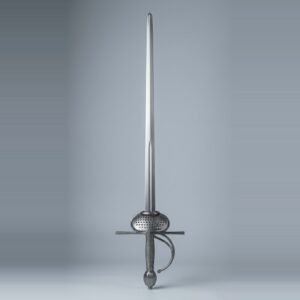
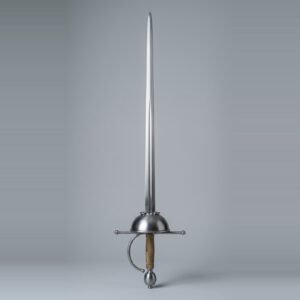
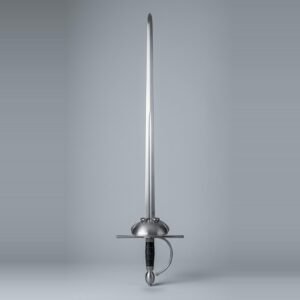
Four pieces worth putting side by side. The Ceravalt rapier carries paired triangular shell plates and a ridged blade with no fuller, which is the Pappenheimer idea in its plainest form. The Corvalde rapier takes the pierced dish route with a knuckle bow and a branch bar over a steel wire grip. On the shorter side, the Elmgarth sidesword is a two finger ring Bolognese form with a fullered cutting blade, and the Thanmir sidesword adds a second side ring and a counterguard loop for anyone who wants more hand cover without going to a cup.
All of them are made by hand in the Czech Republic, inspected at our North Babylon warehouse and shipped from there. If you want a name, a date or a short line cut into the steel, that is done in the United States after arrival and the options are on the engraving page.
Questions people ask
Is a sidesword just a short rapier?
No, and the difference is in the blade rather than the length. A sidesword blade is wide at the base with real cutting geometry, while a rapier blade is narrow and built for the thrust. You can find a short rapier and a long sidesword whose overall lengths almost match, and they will still handle nothing alike.
Which is heavier, a rapier or a sidesword?
They land in a similar band, with historical rapiers averaging around 1 kg, but the mass is distributed differently. A rapier puts more of its weight near the hilt because of the elaborate guard, so it feels lighter in the point than the total figure suggests. A sidesword carries more mass out in the blade, which is what makes it cut.
Can I use a rapier for Bolognese sidesword material?
Badly. The cuts in that material assume a blade with the mass and the edge to actually land, and a rapier blade will not give you that. It is a bit like practising rugby passes with a javelin. Buy the piece the source assumes.
What length rapier should I buy?
Stand the sword point down on the floor and check that the quillons reach your navel. That fitting rule does more for you than any chart. If you are between sizes, go shorter, because a rapier you cannot recover is a rapier you cannot fence with.
Do I need a dagger or a buckler as well?
Not to start. Single sword is where most clubs begin in both traditions, and off hand tools come later once your measure and your point control are reliable. Ask your instructor rather than buying a matched set on day one.
Are these tournament legal?
That depends entirely on the ruleset of the event you are entering, so check it and do not take any seller’s word for it. What we can tell you is the tip standard most events reference: spatulated or rolled tips at a minimum of 1.5 cm diameter, with rounded tips not permitted on rapier and sabre under the Berlin HEMA Cup requirements.
Why spring steel rather than a harder steel?
Because a trainer has to bend and come back. Spring steel at 49 to 52 HRC takes a hard bind and a hard thrust and returns straight, where a harder blade at 56 HRC and up is more likely to take a set or break. Hardness is not a quality score, it is a design choice, and for sparring steel the softer answer is the correct one.
Is stainless steel ever acceptable on a rapier?
On a wall piece, yes. On anything you intend to fence with, no. Stainless is picked because it does not need oiling, and the trade is a blade that is too brittle for repeated impact. If a listing leads with stainless, it is telling you what the piece is for.
Keep reading
The rest of the HEMA writing lives in the guides index, and the full range sits under HEMA swords if you would rather browse than read.