Blog
Nylon Waster vs Steel: Which Trainer to Buy First

The honest answer to nylon waster versus steel is that they are different tools for different jobs, and almost everybody who fences seriously ends up owning both. The nylon comes first because it is cheaper and safer. The steel comes later because it is what the sport actually runs on. Anyone who tells you one of them makes the other pointless has a strong opinion and something to sell.
What is worth your time is knowing exactly what each one gives you and exactly what it costs you, so you can work out which one to buy this month rather than in theory. That is what this guide is for.
If you are at the very start, read what HEMA actually is and then how to choose your first HEMA sword, because the answer to this question changes depending on what your club does. The whole line sits in HEMA swords if you want to look while you read.
The short answer
Buy nylon if you are brand new, if your club runs beginner sessions without full protective kit, if you travel with your sword, or if you want something you can drill with in a garden without worrying. Buy steel when your club expects it, when you want handling that matches the sources, and when you have the protective gear the sport requires for steel sparring.
Most people who stay in the sport go nylon first and steel within a year. That is not a rule, it is just what happens.
What a nylon waster actually is
A moulded high density nylon blade with a matte finish, with steel fittings bolted through it. The cross, the pommel and any other furniture are separate metal parts rather than moulded plastic, which is what separates a real training tool from a toy.
The important thing about nylon is that it flexes and absorbs. A thrust that would put a real dent in your day with steel becomes something your partner can shrug off in modest kit. That is the entire value proposition and it is a good one.
Nylon is also consistent. Every piece out of the same mould behaves the same way, which is useful for a club buying ten of them and less romantic than a hand forged blade but considerably more practical.
The polypropylene problem
Here is the thing nobody tells beginners. The cheap black polypropylene swords you find everywhere are not the same product. They are stiff, they are not weighted anything like a sword, and clubs usually ban them outright because they hit harder than people expect while teaching you handling that is actively wrong.
If you are buying synthetic, buy a proper nylon waster with steel fittings. The black polypropylene stick is cheaper for a reason and the reason is not in your favour.
What steel gives you
Handling, mostly, and there is no substitute for it. A steel trainer has the mass distribution, the blade presence and the behaviour in the bind that the historical sources assume. Techniques that work with steel sometimes do not work with nylon, and the reverse is also true, which is why clubs eventually insist on steel for anything serious.
HEMA blades are spring steel: 51CrV4, 6150, 9260 or 1095, typically hardened to 49 to 52 HRC. That relatively soft hardness is deliberate. Spring steel is chosen because it bends and returns instead of taking a set or snapping under a hard bind, and a harder blade would hold an edge better while breaking more readily, which is the opposite of what a sparring tool needs.
Stainless is the warning sign to look for, on any listing anywhere. It is used on decorative swords because it never needs oiling, and it is too hard and brittle to take repeated impact. A stainless training sword is a wall piece with ambitions.
For the whole flex question, which is where steel gets genuinely technical, read HEMA sword flex explained. For what a feder is and why it is not the same as a blunt longsword, that one is covered separately.
Safety, honestly
Nylon is safer, and the difference is real rather than marketing. A nylon blade flexes further and transmits less shock, so the consequences of a bad thrust are smaller. That is why beginner classes hand them out and why solo drilling with nylon in a space with low ceilings is sensible.
Nylon is not, however, harmless. People are injured by synthetic trainers regularly, mostly on the hands and mostly because someone assumed plastic meant safe and left their gloves at home. Mask and gloves are the floor with any of it.
Steel sparring requires the full kit your club specifies, and that gear costs more than the sword does. If your budget is the constraint, buying nylon and putting the difference toward a mask and gloves is a better plan than buying steel you cannot use.
On tournament use, check the ruleset every time. The Berlin HEMA Cup gear requirements, for example, are specific that permitted tips are spatulated or rolled at a minimum diameter of 1.5 cm, and that rounded tips are not allowed on rapier and sabre. We do not describe any piece as tournament legal without naming the ruleset. HEMA tournament gear rules has the detail.
Durability and what wears out
Nylon blades take a set over time. Heavy use rounds the edges and can leave a permanent bow in the blade, and once that happens the piece is a drill tool rather than a sparring one. They do not rust and they survive being left in a car boot, which steel emphatically does not.
Steel lasts longer if you maintain it and fails faster if you do not. A wipe and a thin film of oil after every session is the whole maintenance routine, plus checking that the pommel is tight and the cross has not shifted. Neglect it and you get rust pitting, which is permanent, and a loose hilt, which is dangerous.
The failure mode that matters on steel is the blade taking a set or breaking, and that is what the spring steel choice exists to prevent. On nylon the failure mode is gradual softening and deformation rather than a sudden break, which is another point in the beginner column.
Which to buy first, by situation
Complete beginner with no kit
Nylon, without much hesitation. It gets you training immediately, it works in a class where not everyone is in full protection, and it leaves your budget for a mask and gloves, which you will need regardless.
Your club already told you what to buy
Buy that. This is the easiest case in the entire sport and people still manage to overthink it.
Training at home or in a small space
Nylon, and it is not close. Solo drills in a room with a ceiling light are a very different proposition with a synthetic blade.
Sparring regularly in full kit
Steel. You have the protection, your partners have the protection, and the handling difference is the whole reason you are doing this.
Travelling or flying to events
Nylon travels better in every respect, from weight to the conversations you have at borders. Plenty of people keep a synthetic specifically as a travel piece.
What about the cheap middle ground
There is a third option people forget: the dussack. A leather or wooden dussack costs less than either a nylon waster or a steel sword, teaches cutting mechanics extremely well and cannot hurt anybody very much. If your interest is single edged material rather than longsword, it is the most sensible first purchase in the sport. The dussack guide covers it, and the messer guide covers the steel it leads toward.
If what you are really asking is whether to buy something sharp, the answer is separate again, and blunt versus sharp training swords explains why a sharp is not a sparring tool under any circumstances.
Where to see these
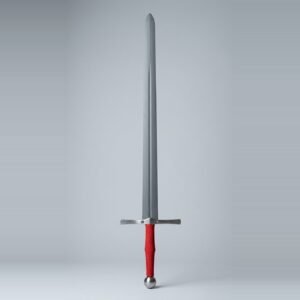
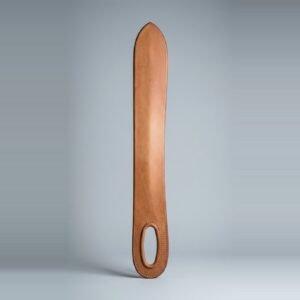
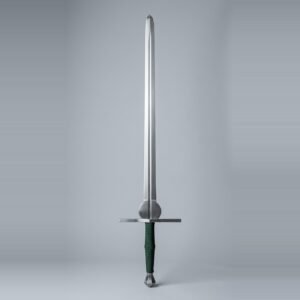
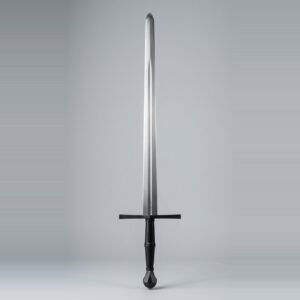
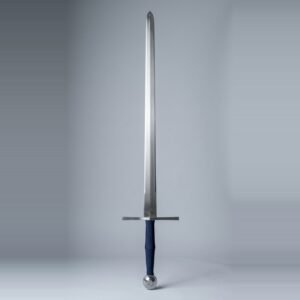
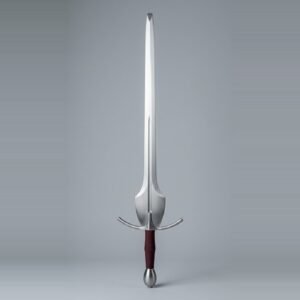
Four pieces that cover the range. The Tevrand nylon waster is the synthetic longsword: a matte moulded blade with a steel cross bolted through it, a ball pommel and a red cord grip. The Reifholm leather dussack is the cheapest serious training tool here, one slab of thick vegetable tanned leather with the grip cut through it. On the steel side, the Vindlaur feder is the purpose built sparring tool with a rounded schilt and a scent stopper pommel, and the Myrkvald blunt longsword is the sword shaped blunt for drill and pair work.
The steel pieces are made by hand in the Czech Republic and the nylon and leather are made there too. All of it is inspected at our North Babylon, New York warehouse and shipped from there. Engraving is done in the United States after arrival, with options on the engraving page.
Questions people ask
Is a nylon waster good enough for real training?
For learning mechanics, drilling and controlled sparring, yes, and clubs use them for exactly that. What it will not give you is the mass distribution and bind behaviour of steel, which is why it is a starting point rather than a permanent substitute.
What is the difference between nylon and polypropylene trainers?
A proper nylon waster is moulded high density nylon with steel fittings bolted on, built to flex and to handle something like a sword. The cheap black polypropylene swords are stiff, weighted wrongly and usually banned by clubs. They are not the same product at a different price.
Can you spar with a nylon waster?
Yes, with a mask and gloves at minimum and whatever else your club specifies. Synthetic does not mean harmless, and most synthetic injuries are to hands belonging to people who assumed otherwise.
Why is HEMA steel softer than a knife?
Because it needs to bend and come back rather than hold an edge. HEMA blades are spring steel at roughly 49 to 52 HRC, where a kitchen or hunting blade sits considerably harder. A harder sparring blade is more likely to take a set or break under a hard bind.
Which steels are used for HEMA blades?
Spring steels: 51CrV4, 6150, 9260 or 1095, typically at 49 to 52 HRC. If a listing says stainless, it is a decorative sword, because stainless is too hard and brittle to take repeated impact and is chosen for shelf life rather than use.
Do nylon trainers wear out?
They do. Heavy use rounds the edges and eventually leaves a permanent bow in the blade, at which point the piece is still fine for drills but no longer ideal for sparring. They do not rust, which is their compensating advantage.
Should I buy nylon or steel for my first sword?
Ask your club, then buy what they say. Failing that, nylon first is the usual answer, because it costs less, works in a class where not everyone is in full kit, and leaves money for the mask and gloves you need either way.
Can I use a nylon waster in a tournament?
Only where the event runs a synthetic category, and the ruleset will tell you. Steel events specify steel, and requirements for tips and blades are set out event by event, so read the rules rather than assuming.
Keep reading
The rest of the HEMA writing is in the guides section, and the longswords, both steel and synthetic, sit in HEMA longswords.