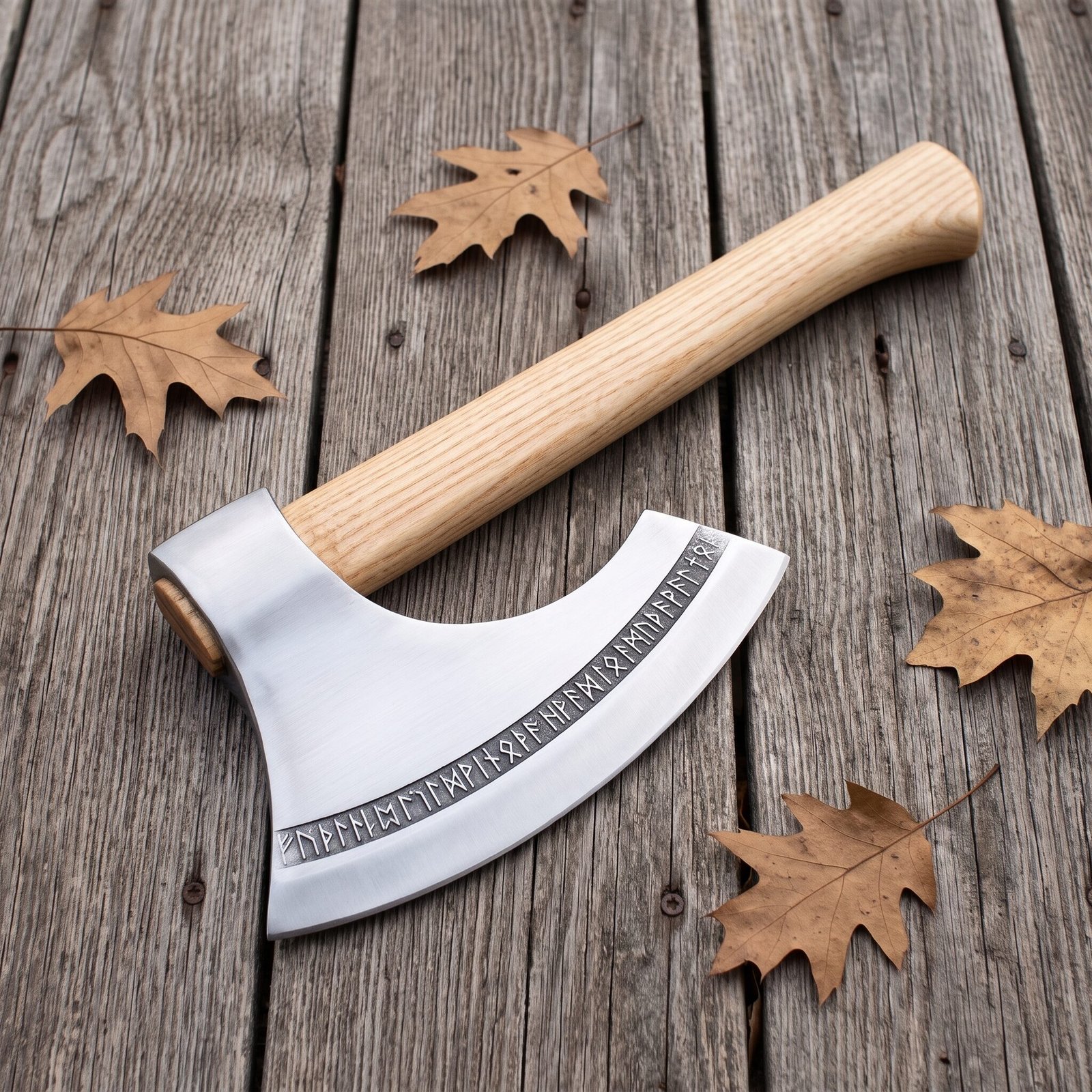
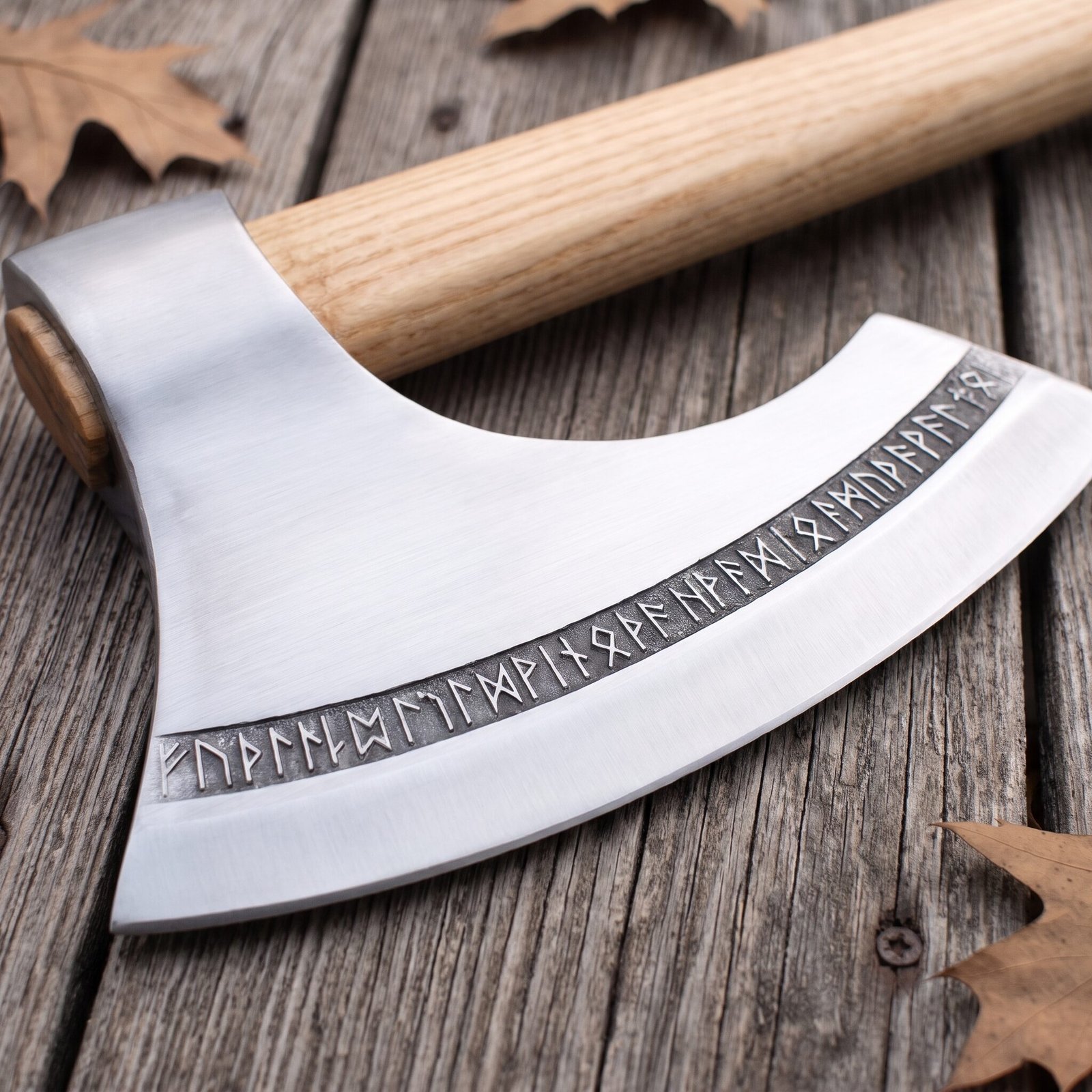
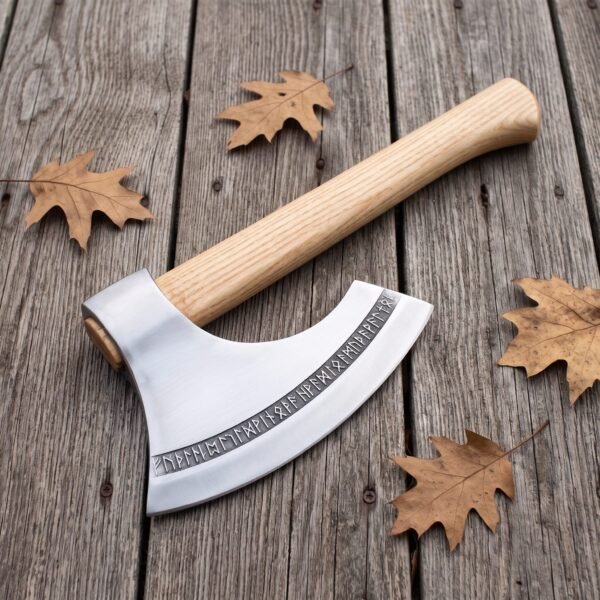
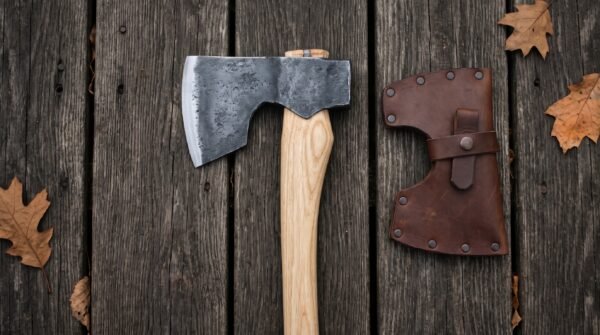
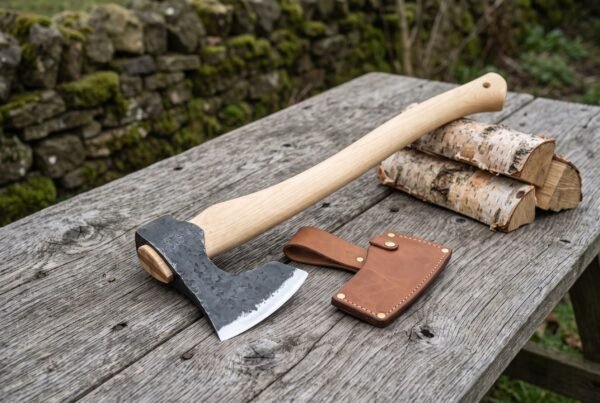
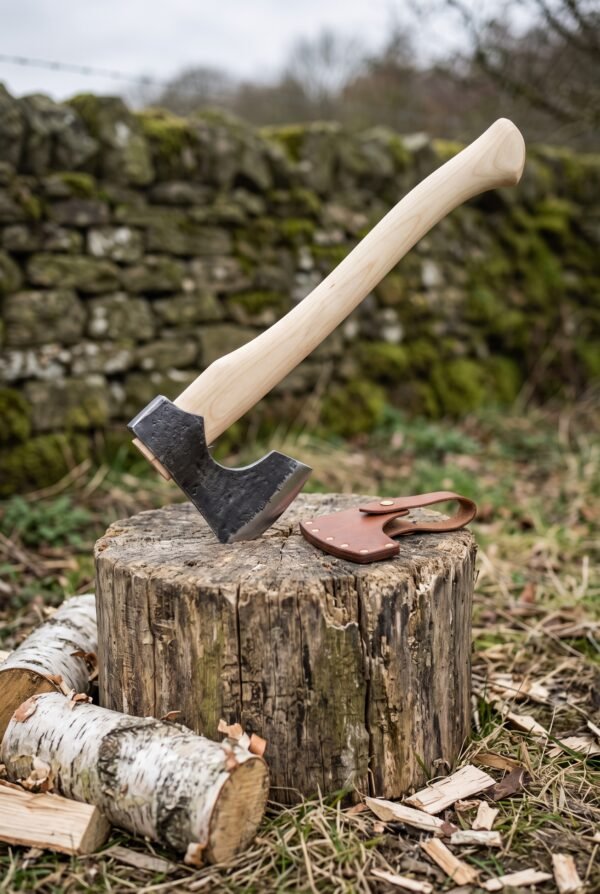
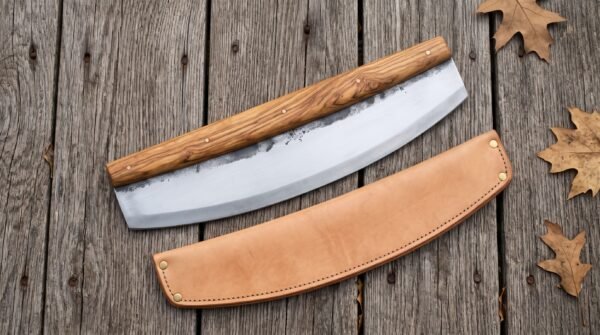
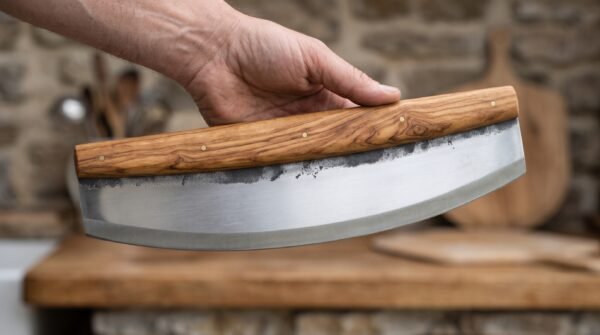
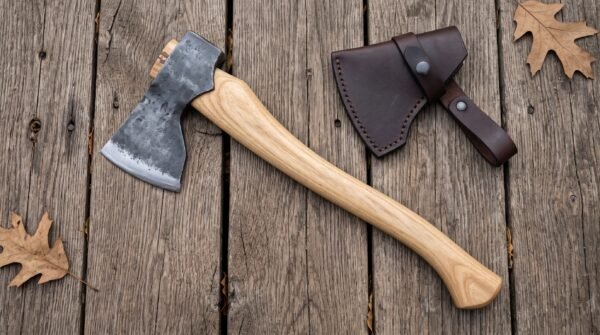
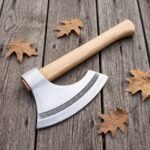
Runecrust is the quiet one. A single line of Elder Futhark runes is etched along the cheek of the stainless head, running parallel to the curved edge like a border, and nothing else is on the steel. The haft is pale straight grained ash. From across a room it looks like a clean, well made pizza axe. Up close you notice the line of runes following the edge and realise someone has thought about it.
It suits people who like Norse things but do not want a kitchen tool that shouts. The rune band is narrow enough to read as an ornament and complete enough to repay a closer look. For something louder with the same alphabet, the Sealrune pizza axe wraps a ring of runes around a Helm of Awe.
Runecrust is forged and etched by hand in the Czech Republic, ships with a leather blade cover, and goes out free from Chicago, Illinois.
Specifications
| Steel | Hand forged stainless steel |
|---|
| Head finish | Satin stainless |
|---|
| Decoration | Band of Elder Futhark runes etched along the curve |
|---|
| Cutting edge | About 7 inches along the curve |
|---|
| Haft | Ash, about 12 inches |
|---|
| Overall length | About 14 inches |
|---|
| Cover | Leather blade cover included |
|---|
| Use | Kitchen tool for pizza, flatbread, herbs and vegetables |
|---|
| SKU | RK-2345 |
|---|
How to use a pizza axe
Set the curved edge down on the pizza at one side of the cut you want, hold the haft in your working hand, and rock the head forward so the curve rolls across the pie. Lift, move along, rock again. A 7 inch curve gets across a 12 inch pizza in two rocks, and the second one lands in the groove the first one left, so the line stays straight without you having to try very hard.
The reason this works better than a wheel is that the edge comes down rather than along. A wheel has to travel through the food in front of it, which is how toppings end up shoved into a heap at the rim and how cheese gets stretched into strings instead of cut. A rocking edge presses through everything under it at the same moment. Crisp rims, thick crusts and pies loaded past the point of good sense all give way to downward pressure.
Cut on a wooden or plastic board, never in the steel pan and never on the pizza stone. Driving any edge into something as hard as itself is the quickest way to make it blunt, and a pizza stone will win that argument every time.
The Elder Futhark
The Elder Futhark is the oldest form of the runic alphabet, 24 characters used by Germanic peoples from roughly the second century to around the eighth. The name comes from its first six letters, f, u, th, a, r and k, the same way alphabet comes from alpha and beta. By the Viking Age proper, Scandinavians had mostly moved to the shorter Younger Futhark of 16 runes, so strictly speaking the Elder set is a little early for Vikings. It is also the set people recognise and the one most rune converters use, which is why we etch it.
Runes were cut into wood, bone, metal and stone, and their straight strokes reflect that. There are almost no curves in the Elder Futhark because curves are hard to carve across wood grain. Etched on steel they look crisp and deliberate. Every rune, its name and its sound is laid out in the Elder Futhark guide.
Why the band follows the edge
Putting the runes along the curve rather than across the middle does two things. It frames the edge, so the shape of the crescent reads more clearly, and it leaves the centre of the cheek empty, which keeps the piece calm. Decorative bands along the edges of objects are common in Norse metalwork, from brooches to sword fittings, so the layout feels at home even on a tool the Vikings would not have recognised.
The band on the head is decorative and is not a personal message. If you want words of your own, the rune converter on this page will turn a name or a date into Elder Futhark and we can put it on the haft or the plain reverse cheek, where it sits nicely with the band on the front.
Why stainless and not carbon steel
We are a carbon steel shop by habit. 1095 and pattern welded Damascus make up most of the rack because they take a fine, hard edge and they suit axes and field knives. A pizza axe lives on a kitchen counter, though, and the counter is hostile to plain carbon steel. Acid from sauce, salt, steam from the oven and the sink all work on it, and the result is a grey, spotted head within a week.
Stainless resists all of that because the chromium in it forms a passive surface layer. It will not hold an edge quite as long as hardened 1095, and it is slower on the stone, but crust and cheese barely load an edge at all. For this job it is the sensible steel, and pretending otherwise to sound more traditional would be silly. Background on the steels we use is in the steel glossary.
The ash haft
Ash is the classic axe timber of northern Europe. It is pale, straight grained and springy, it does not split easily, and it has been hung under axe heads for centuries for exactly those reasons. On a kitchen tool the springiness matters less, but the light colour sets off a dark etching on the head very nicely and the grain feels clean in the hand.
Pale wood shows neglect sooner than dark wood, so look after it. Hand wash, dry it straight away, and rub in a little food safe mineral oil every few months. If it starts to look thirsty and pale grey, it is asking for oil. Method in wooden handle care.
Personalising it
A name, a date or a short line can be engraved on the haft or on the plain cheek of the head. Use the rune converter on this page if you want it written in Elder Futhark, or choose your own design in the engraving option above the add to cart button and tell us where it should go. If you choose a different design for the decorated face of the head, it replaces the existing artwork rather than sitting beside it. Sizes and placement are on the engraving page.
As a gift
Pizza axes get bought as gifts more than almost anything else we sell, and the reason is simple. Most people already own a knife block and a pizza wheel, and nobody gets excited about either. A forged axe head on a wooden haft is a kitchen tool that gets picked up, passed round the table and talked about, and it still gets used every week once the novelty has worn off.
They suit housewarmings, birthdays, Father’s Day, groomsmen and anyone who has a wood fired oven in the garden and wants to tell you about it. Add a name or a date and it stops being a gadget and becomes the thing that comes out every time there is pizza in the house. It arrives in gift packaging with its leather cover on, so it can go straight under the tree or onto the table.
Storing and displaying it
Keep it in its leather cover if it goes in a drawer, so the edge does not meet the cutlery. If you would rather see it, hang it from the haft on a pair of hooks or a peg rail, edge toward the wall, somewhere away from the steam directly over the stove. It looks good next to a wooden board or a row of pans and it saves you hunting for it on pizza night. For wall mounting ideas, see how to display axes safely.
Looking after it
Hand wash only, then dry it. That is most of the job. The steel will put up with a bit of neglect, the wood and the leather cover will not, so do not leave it soaking in the sink while you finish the wine.
For the edge, a fine whetstone every few months is plenty. Follow the curve in short sections at a steady angle and finish on a leather strop. Pull through gadgets do a poor job on a curved edge and are best kept away from it. Sharpening with a whetstone covers the method, and caring for a hand forged kitchen knife covers the rest.
Made in the Czech Republic
Every piece we sell is made by hand in the Czech Republic. The head is forged and ground at the bench, the haft is shaped and fitted to its own head, and the leather is cut and stitched one piece at a time. There is no automated line in any of it.
Ransack Viking is a United States company based in Chicago, Illinois. We check each piece when it reaches us and ship it from our Chicago warehouse, free within the United States.
A note on handmade variation
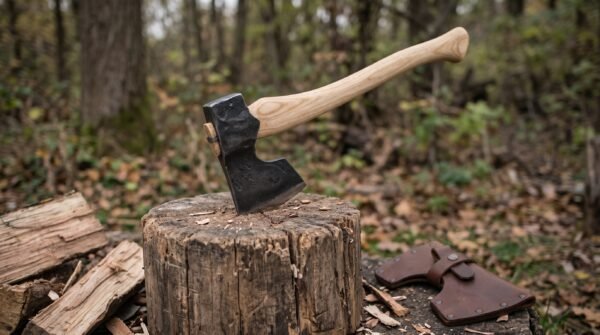
Nothing here comes off a production line, so your piece will differ slightly from the one in the photographs. Wood grain is never the same twice, the finish on the steel picks up light in its own way, and the curve of the edge is ground by hand rather than against a machine stop. Dimensions, steel and design stay the same. If you wanted every one identical, a supermarket pizza wheel would be cheaper and considerably less interesting.
The rest of the pizza axe range
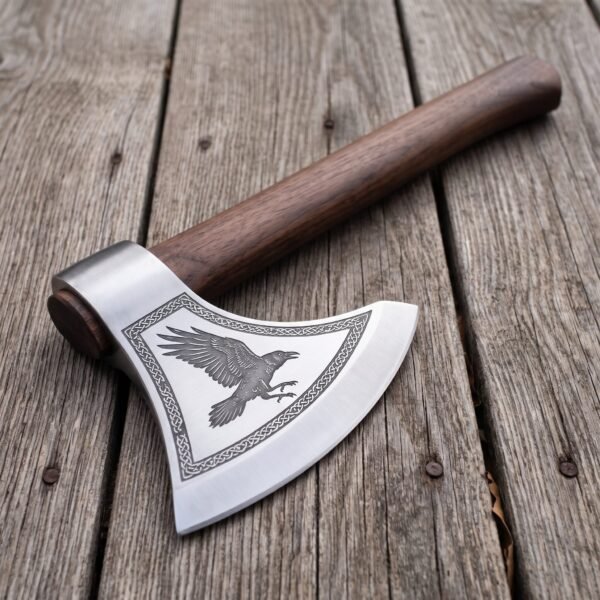
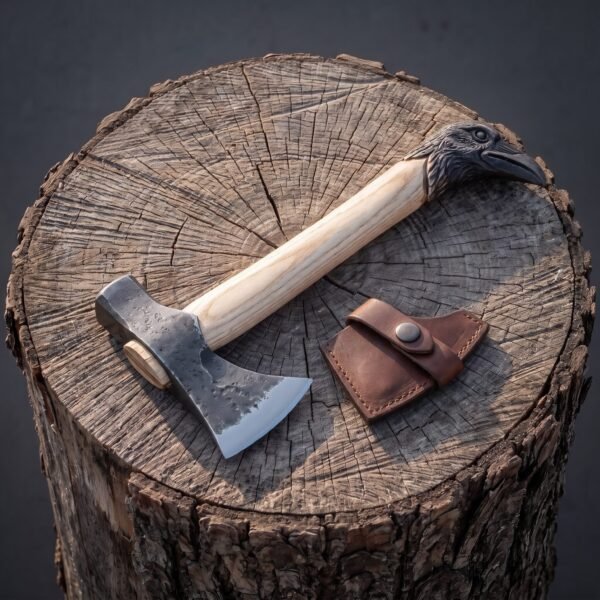
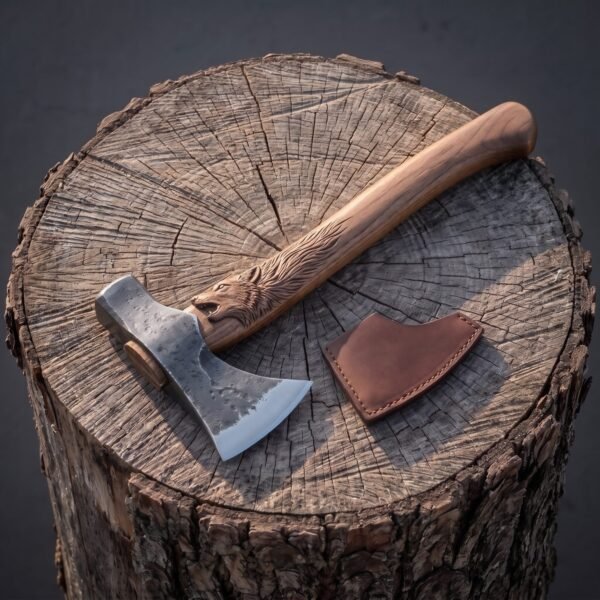
If this is not quite the one, the others in the line differ in design rather than in size or steel. The Hoodfang has a blackened head and a cobra carved along the haft. The Grinslice carries an etched skull on the steel. The Bonecap has a carved skull at the end of a rosewood haft. The Awecrust has a large Helm of Awe and a brass collar. The Allfeast carries an etched portrait of Odin. The Sealrune rings a small Helm of Awe with runes. The Ravenwake has a raven in flight inside a knotwork border. The Wyrmslice ends in a carved dragon head.
Frequently asked questions
Do the runes on the head spell something?
The band is a decorative run of Elder Futhark characters, not a personal message. If you want a name or phrase in runes, add it as engraving on the haft or the reverse cheek.
Why Elder Futhark and not Younger Futhark?
The Elder set is the one most people recognise and the one rune converters use. The Younger Futhark was the everyday script of the Viking Age, so if you want strict accuracy for the period, say so in your engraving note.
Is it sharp when it arrives?
Yes. The edge is set before it is boxed and it will cut a pizza the day it lands.
Can it go in the dishwasher?
No. The steel would cope, but the wooden haft will dry out and crack and the leather cover will stiffen. Hand wash and dry it.
How long does delivery take?
Allow one to two weeks of processing, plus engraving time if you add it, plus transit. Shipping is free inside the United States and returns are accepted within 7 days of delivery.
What is in the box
- One Runecrust pizza axe with rune band etched stainless head and ash haft
- Leather blade cover
- Gift packaging
Explore the range
More pieces sit in Viking axes, chef knives and engraved and personalised pieces. If you want the plain version, the Hearthcutter pizza axe is the undecorated one. Steel, sharpening and handle care are covered in the guides.


Reviews
There are no reviews yet