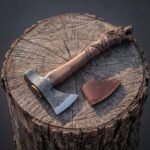
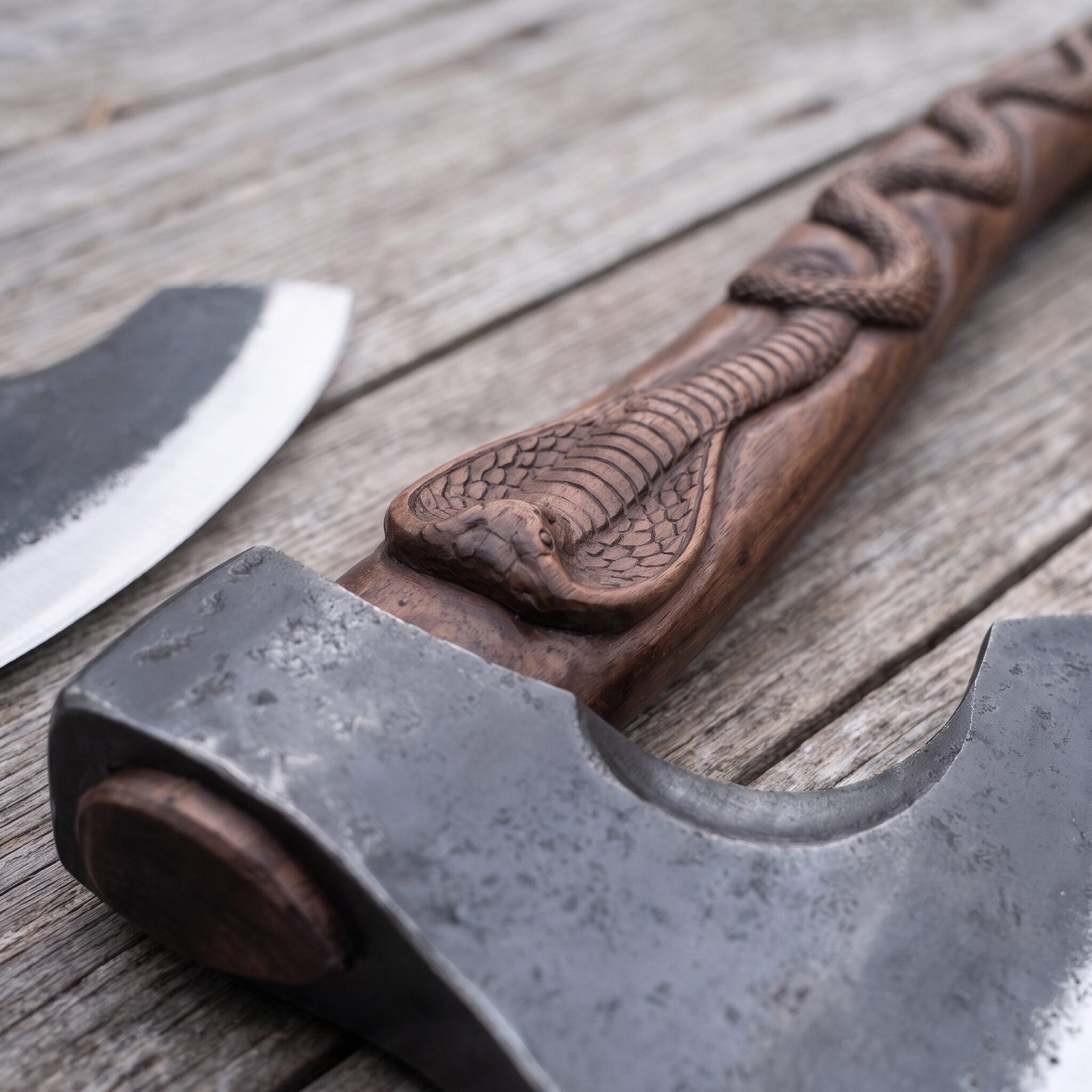
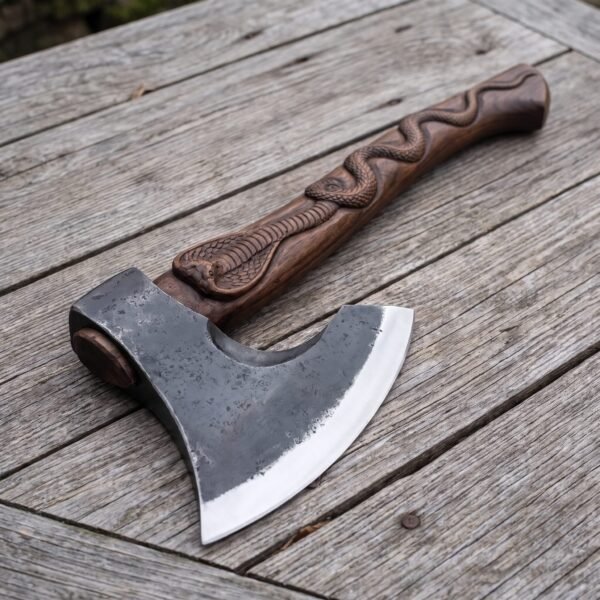
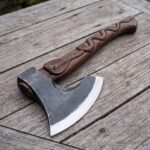
Hoodfang is a pizza axe for people who find a plain wooden handle a little too polite. The head is hand forged stainless steel with a blackened finish across both cheeks and a bright band ground along the curved edge, so the cutting line shows up as a clean silver crescent against the dark steel. The walnut haft is carved by hand along most of its length with a coiled cobra, its scales cut in relief, and the hood flares open just below the head as if it has noticed the pizza before you have.
It is a working kitchen tool. The curved edge is about 7 inches long, the haft about 12, and the whole thing is about 14 inches end to end. Rock it across a pie in two passes and every slice comes away with its toppings still on it. If you want to see how the plain house version compares, the Hearthcutter pizza axe is the same idea without the snake.
Hoodfang is forged, carved and fitted by hand in the Czech Republic and ships with a leather blade cover. It ships free from Chicago, Illinois.
Specifications
| Steel | Hand forged stainless steel |
|---|
| Head finish | Blackened cheeks with a bright ground edge band |
|---|
| Decoration | Coiled cobra carved in relief along the haft |
|---|
| Cutting edge | About 7 inches along the curve |
|---|
| Haft | Walnut, about 12 inches |
|---|
| Overall length | About 14 inches |
|---|
| Cover | Leather blade cover included |
|---|
| Use | Kitchen tool for pizza, flatbread, herbs and vegetables |
|---|
| SKU | RK-2341 |
|---|
How to use a pizza axe
Set the curved edge down on the pizza at one side of the cut you want, hold the haft in your working hand, and rock the head forward so the curve rolls across the pie. Lift, move along, rock again. A 7 inch curve gets across a 12 inch pizza in two rocks, and the second one lands in the groove the first one left, so the line stays straight without you having to try very hard.
The reason this works better than a wheel is that the edge comes down rather than along. A wheel has to travel through the food in front of it, which is how toppings end up shoved into a heap at the rim and how cheese gets stretched into strings instead of cut. A rocking edge presses through everything under it at the same moment. Crisp rims, thick crusts and pies loaded past the point of good sense all give way to downward pressure.
Cut on a wooden or plastic board, never in the steel pan and never on the pizza stone. Driving any edge into something as hard as itself is the quickest way to make it blunt, and a pizza stone will win that argument every time.
The blackened head
The dark finish covers the cheeks of the head and stops short of the edge, where the steel is ground back to bright metal. That contrast is the whole look of the piece. In the hand it reads as a dark axe with a silver smile, and on a board next to a pizza it reads as something you probably should not let the children borrow.
The black is a surface finish on stainless steel. It is not paint and it does not need special treatment, but it is a finish, which means it wears. Over years of washing and use, the high spots and the area near the edge will slowly brighten. Most owners like that. A tool that shows where it has been used looks better than one that looks like it came out of the box yesterday. If you want it to stay as dark as possible for as long as possible, avoid scouring pads and abrasive cleaners and you will slow the change right down.
The cobra on the haft
The snake is carved from the walnut of the haft itself, not glued on. The body coils around the handle in a long spiral so your fingers sit naturally in the gaps between the coils, and the scales are cut across the body in small overlapping rows. Near the head, the cobra rises and spreads its hood, which also gives your thumb a firm stop when you lean on the haft for a deep crust.
Cobras have nothing to do with Norse history, and we are not going to pretend otherwise. This piece is here because a snake wrapped round an axe handle looks good and feels good to hold, and plenty of people want a kitchen tool with a bit of menace in it. Carved snakes on tool handles are an old idea in many places. The Norse had their own serpent in Jormungandr, the one that circles the world, but he was never described with a hood. Hoodfang borrows the shape from the cobra and the attitude from wherever it pleases.
Because the carving has depth, it collects crumbs and flour if you let it. A soft brush under warm water after use clears it in seconds. Dry it properly before the cover goes back on.
Why stainless and not carbon steel
We are a carbon steel shop by habit. 1095 and pattern welded Damascus make up most of the rack because they take a fine, hard edge and they suit axes and field knives. A pizza axe lives on a kitchen counter, though, and the counter is hostile to plain carbon steel. Acid from sauce, salt, steam from the oven and the sink all work on it, and the result is a grey, spotted head within a week.
Stainless resists all of that because the chromium in it forms a passive surface layer. It will not hold an edge quite as long as hardened 1095, and it is slower on the stone, but crust and cheese barely load an edge at all. For this job it is the sensible steel, and pretending otherwise to sound more traditional would be silly. Background on the steels we use is in the steel glossary.
The walnut haft
Walnut is a dark, close grained hardwood with a chocolate brown heart and the occasional lighter streak. It is stable once dry, which matters on a tool that goes from a warm oven to a cool sink, and it takes an oil finish well without needing varnish. It also feels good in the hand, smooth without being slippery.
Keep it out of the dishwasher. Heat and long soaking pull the oil out of any timber and open fine cracks along the grain. Wipe it after use and every few months rub in a little food safe mineral oil, let it sit, and buff off what is left. The routine is in wooden handle care.
Personalising it
A name, a date or a short line can be engraved on the haft or on the plain cheek of the head. Use the rune converter on this page if you want it written in Elder Futhark, or choose your own design in the engraving option above the add to cart button and tell us where it should go. If you choose a different design for the decorated face of the head, it replaces the existing artwork rather than sitting beside it. Sizes and placement are on the engraving page.
As a gift
Pizza axes get bought as gifts more than almost anything else we sell, and the reason is simple. Most people already own a knife block and a pizza wheel, and nobody gets excited about either. A forged axe head on a wooden haft is a kitchen tool that gets picked up, passed round the table and talked about, and it still gets used every week once the novelty has worn off.
They suit housewarmings, birthdays, Father’s Day, groomsmen and anyone who has a wood fired oven in the garden and wants to tell you about it. Add a name or a date and it stops being a gadget and becomes the thing that comes out every time there is pizza in the house. It arrives in gift packaging with its leather cover on, so it can go straight under the tree or onto the table.
Storing and displaying it
Keep it in its leather cover if it goes in a drawer, so the edge does not meet the cutlery. If you would rather see it, hang it from the haft on a pair of hooks or a peg rail, edge toward the wall, somewhere away from the steam directly over the stove. It looks good next to a wooden board or a row of pans and it saves you hunting for it on pizza night. For wall mounting ideas, see how to display axes safely.
Looking after it
Hand wash only, then dry it. That is most of the job. The steel will put up with a bit of neglect, the wood and the leather cover will not, so do not leave it soaking in the sink while you finish the wine.
For the edge, a fine whetstone every few months is plenty. Follow the curve in short sections at a steady angle and finish on a leather strop. Pull through gadgets do a poor job on a curved edge and are best kept away from it. Sharpening with a whetstone covers the method, and caring for a hand forged kitchen knife covers the rest.
Made in the Czech Republic
Every piece we sell is made by hand in the Czech Republic. The head is forged and ground at the bench, the haft is shaped and fitted to its own head, and the leather is cut and stitched one piece at a time. There is no automated line in any of it.
Ransack Viking is a United States company based in Chicago, Illinois. We check each piece when it reaches us and ship it from our Chicago warehouse, free within the United States.
A note on handmade variation
Nothing here comes off a production line, so your piece will differ slightly from the one in the photographs. Wood grain is never the same twice, the finish on the steel picks up light in its own way, and the curve of the edge is ground by hand rather than against a machine stop. Dimensions, steel and design stay the same. If you wanted every one identical, a supermarket pizza wheel would be cheaper and considerably less interesting.
The rest of the pizza axe range
If this is not quite the one, the others in the line differ in design rather than in size or steel. The Grinslice carries an etched skull on the steel. The Bonecap has a carved skull at the end of a rosewood haft. The Awecrust has a large Helm of Awe and a brass collar. The Runecrust runs a band of runes along the edge. The Allfeast carries an etched portrait of Odin. The Sealrune rings a small Helm of Awe with runes. The Ravenwake has a raven in flight inside a knotwork border. The Wyrmslice ends in a carved dragon head.
Frequently asked questions
Is the black finish safe on a kitchen tool?
It is a finish on stainless steel, washed by hand like the rest of the piece. It will wear slowly toward bright steel at the high spots with use and washing, which is normal.
Does the carved haft make it awkward to hold?
No. The coils sit where your fingers go and the hood gives your thumb a stop. It is easier to lean on than a smooth round handle.
Is it sharp when it arrives?
Yes. The edge is set before it is boxed and it will cut a pizza the day it lands.
Can it go in the dishwasher?
No. The steel would cope, but the wooden haft will dry out and crack and the leather cover will stiffen. Hand wash and dry it.
How long does delivery take?
Allow one to two weeks of processing, plus engraving time if you add it, plus transit. Shipping is free inside the United States and returns are accepted within 7 days of delivery.
What is in the box
- One Hoodfang pizza axe with blackened stainless head and carved cobra walnut haft
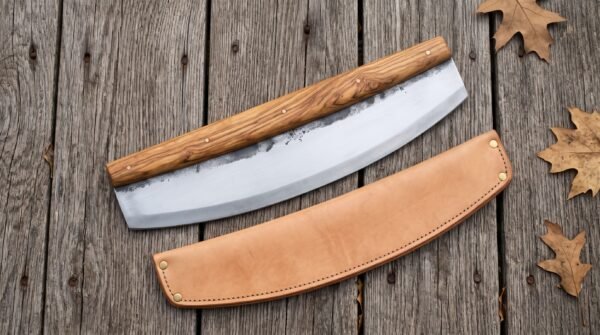
- Leather blade cover
- Gift packaging
Explore the range
More pieces sit in Viking axes, chef knives and engraved and personalised pieces. If you want the plain version, the Hearthcutter pizza axe is the undecorated one. Steel, sharpening and handle care are covered in the guides.




Reviews
There are no reviews yet