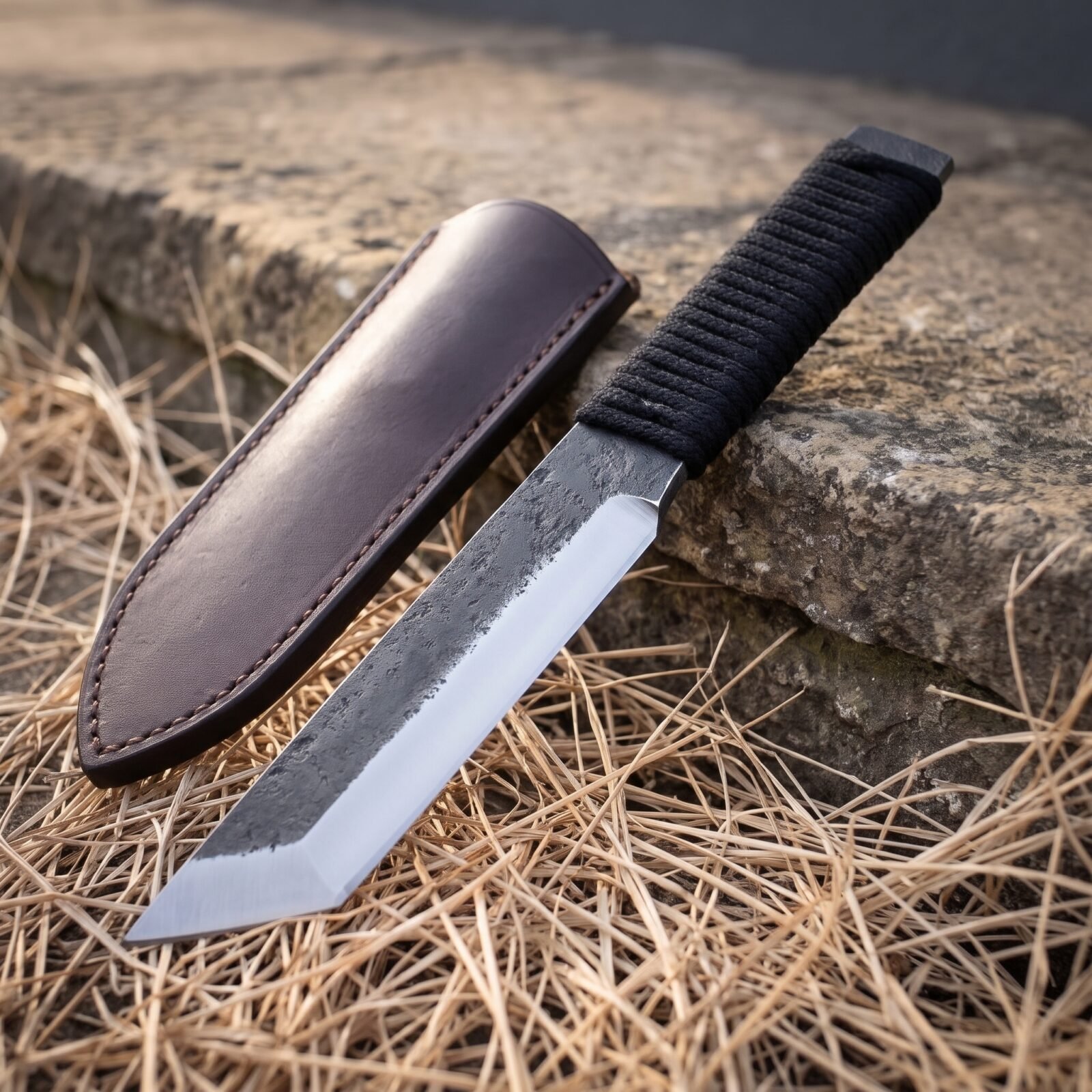
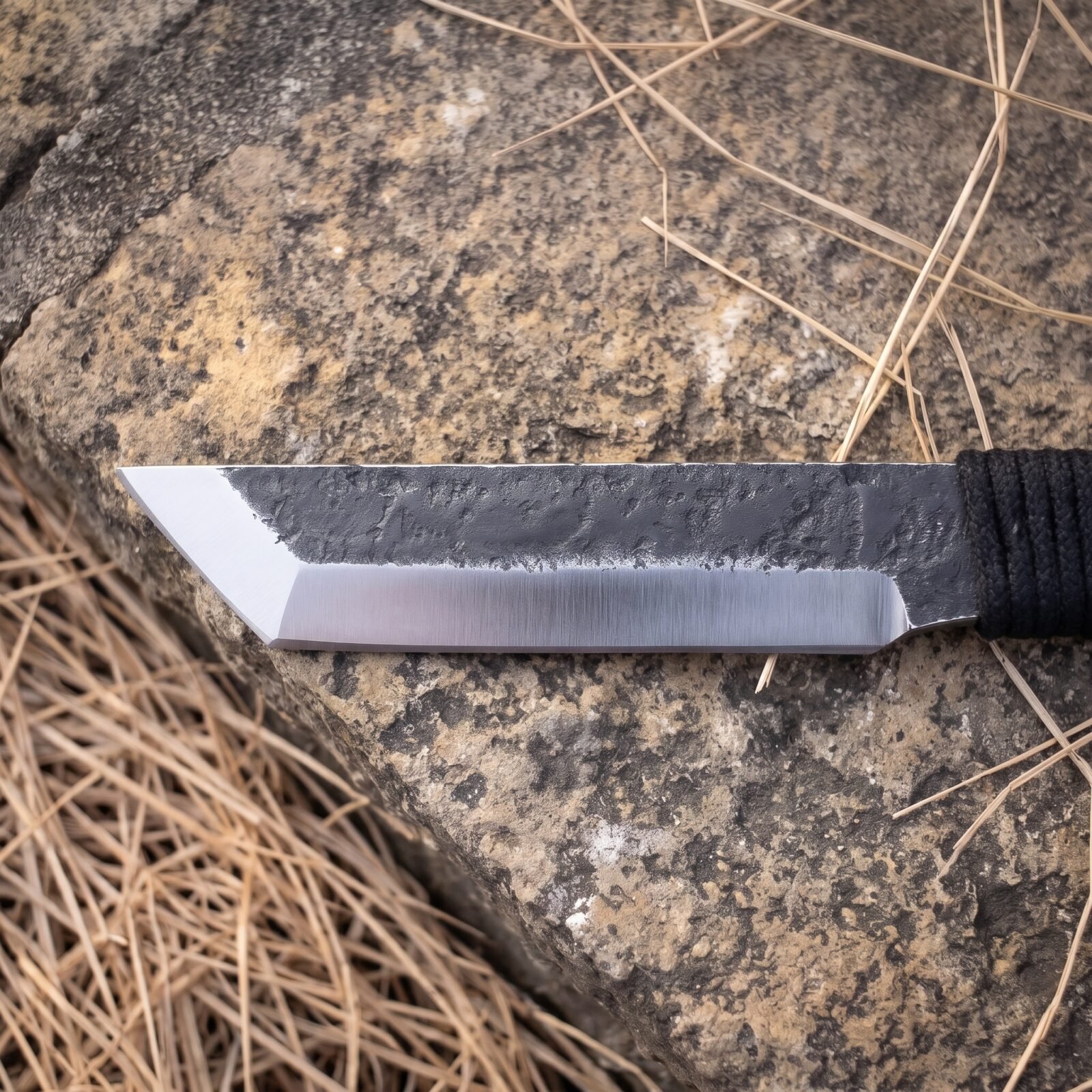
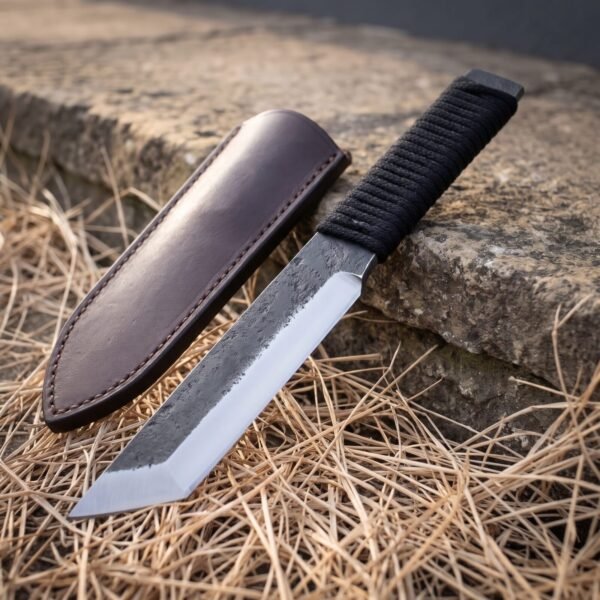
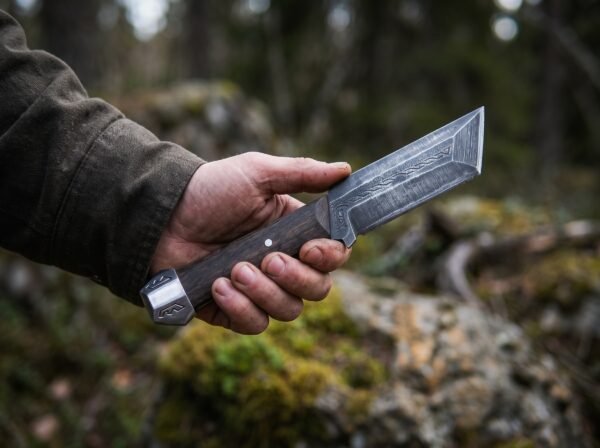
A hand forged kiridashi, the small Japanese utility knife made from a single bar of steel with a skewed edge at the tip. It is about six inches overall. The front of the bar is ground at a steep angle across its width to form the cutting edge, and that edge is chisel ground, bevelled on one side only with the back left flat. The body keeps its dark forge scale, the bevel is polished bright, and the back half of the bar is wrapped tight in black cotton cord to make the handle. It comes with a dark brown leather slip sheath.
The steel is 1095 high carbon, the same steel used across our tanto range, hardened to 54 to 58 HRC and sharpened before it ships. A kiridashi is about as simple as a knife can be, and that is exactly why woodworkers, leather workers, bookbinders and people who make things by hand have used them for a very long time.
Our guide to what a tanto is covers the Japanese blade shape this knife sits beside in the shop, and knife blade shapes explains how a skewed edge differs from the others. The rest of our Japanese style knives are under tanto knives.
Specifications
| Blade steel | 1095 high carbon steel, hand forged |
|---|
| Hardness | 54 to 58 HRC |
|---|
| Overall length | Approximately 6 inches |
|---|
| Edge | Skewed edge at the tip, chisel ground on one side, flat back |
|---|
| Finish | Dark forge scale body with a polished bevel |
|---|
| Handle | Black cotton cord wrap over the bare steel |
|---|
| Sheath | Dark brown leather slip sheath, included |
|---|
| Sharpness | Sharpened, ready to use |
|---|
| SKU | RK-2387 |
|---|
What a kiridashi is
Kiridashi roughly means to cut out, and in Japan the knife has been an everyday tool for a long time. It was the knife schoolchildren used to sharpen pencils, the knife a carpenter used to mark a line or trim a joint, and the knife a craftsman kept on the bench for paper, leather, bamboo and cord. It was cheap, easy to make and easy to sharpen, and there was usually one within reach.
The design comes straight from that use. There is no separate handle, no guard and no bolster. A smith takes a short bar of steel, grinds the end at an angle, puts a bevel on one face and that is the knife. Some are left completely bare and some have the handle end wrapped in cord or tape for comfort. Ours is wrapped in cotton cord, which gives a dry grip and can be replaced easily if it ever wears.
Why a chisel grind
Most knives are sharpened on both sides so the edge sits in the middle of the blade. A chisel grind puts the whole bevel on one side and leaves the other side dead flat, exactly like a wood chisel.
That flat back is the whole point. Lay it against a straight edge or a piece of wood and the cutting edge sits right on the surface, which lets you cut tight to a ruler, pare a joint flush or trim the edge of leather without the blade wandering. It also makes the edge very easy to sharpen: you hone the bevel side at its angle, then lay the flat back on the stone and take off the burr. There is no guesswork about where the edge is.
The skewed angle of the edge gives you a sharp point for scoring and marking and a slicing edge behind it for longer cuts. Hold it like a pencil for fine work and like a small chisel for paring.
Chisel ground knives are handed. This one is ground for a right handed user. If you are left handed, ask before ordering.
The steel and the finish
1095 is a plain high carbon steel. It takes a fine, keen edge and comes back quickly on a stone, which matters on a tool you will sharpen often. At 54 to 58 HRC it is a little softer than some Japanese kiridashi, which makes it more forgiving if you use it to pry or tap with a mallet, and less likely to chip.
The dark forge scale on the body is left on deliberately. It gives some protection against rust, it shows the knife was hammered rather than cut from sheet, and it contrasts with the bright polished bevel so you can see the cutting edge at a glance. More on steel in the steel glossary.
Who uses a kiridashi
Woodworkers use it as a marking knife. A pencil line has width, and on a fine joint that width is the difference between tight and loose. A knife line has none, and the flat back of a kiridashi puts that line exactly against the square or the rule. It also gives the chisel a small groove to register in when you start to pare to the line.
Leather workers use it for trimming edges, cutting thread, skiving thin spots and opening up stitch lines. Bookbinders and paper artists use it for clean cuts through card and board. Bushcraft people carry one for fine carving, cutting notches and making tinder. Gardeners use it for grafting and cutting twine. Model makers use it the way they would use a hobby knife, with the advantage that it does not need new blades.
What they all have in common is that they want an edge they can sharpen themselves in a minute, a point they can control, and a tool that is simple enough to throw in a bag without worrying about it. A kiridashi is that tool.
Kiridashi and tanto
People sometimes confuse the two because both are Japanese and both have an angled point. A tanto is a dagger, historically a short sword companion carried by samurai, with a full handle, a guard and a double bevel blade. Modern tanto knives borrow its angled front edge. A kiridashi is a workshop tool with a single bevel and no handle beyond a wrap. One was carried for defence, the other for making things.
Engraving and your own design
Use the rune converter on this page if you would like an Elder Futhark line, or choose your own design in the engraving option above the add to cart button for initials, a name, a maker’s mark of your own or Japanese characters. For Japanese text, send it typed and we will confirm the layout with you before anything is cut. Where a piece already carries an engraved design, your chosen engraving replaces it rather than sitting alongside it. The flat back of the blade just ahead of the wrap is the best place, as the bevel side is too narrow. More on the engraving page.
Using it
This knife arrives sharp. For marking and scoring, hold it like a pen with your index finger on the spine and draw the point toward you along a straight edge, flat side against the rule. For paring, push it away from you with your thumb behind the spine. For cutting cord or tape, let the long skewed edge do the slicing rather than pressing with the point.
It is a craft knife and a utility knife. It is not a tool for prying open cans or splitting wood, and the point will break if it is used as a screwdriver.
Check your local laws before carrying any fixed blade. Knife laws by state is a starting point.
Care
1095 will rust if left wet. Wipe the blade after use and oil it now and then. If you use it on food, use a food safe mineral oil. Keep the cord wrap dry. If it does get soaked, take the knife out of the sheath and let it dry fully before putting it away.
Sharpen the bevel side on a whetstone at the existing angle until you can feel a small burr on the flat side, then lay the flat side completely flat on the stone and take the burr off with a few light strokes. Never put a bevel on the flat side. Sharpen a knife with a whetstone covers the basics, and the knife care guide covers storage.
Made in the Czech Republic
This kiridashi is made by hand in the Czech Republic. The bar is forged, the bevel ground and the edge set by hand, and the cord is wrapped one knife at a time. Every one is checked for a flat back and a clean edge before it is boxed. It ships from our Chicago, Illinois warehouse. Processing takes one to two weeks, and engraved orders sit at the longer end because the layout is agreed with you first. Shipping inside the United States is free. Returns are accepted for seven days. The lifetime warranty against defects in forging, grind, heat treat and fittings has no end date and needs no receipt.
A note on handmade variation
This knife is made by hand, not machine made or bulk produced, so what arrives will not be a pixel for pixel copy of the photograph. The forge scale texture is different on every blade. The exact angle of the skew varies by a degree or two. The cord wrap is tied by hand. The size, the steel and the grind are the same every time.
Frequently asked questions
Is it sharp?
Yes, it ships sharpened.
Is there a left handed version?
This one is ground for a right handed user. Ask us before you order if you need a left handed grind.
Is the cord replaceable?
Yes. Any cotton or nylon cord of a similar thickness works, and there are plenty of guides to wrapping a handle.
Can I use it for whittling?
Yes. It is good for fine carving and trimming, less good for heavy stock removal.
Is it a tanto?
No. It sits in our tanto category because that is where our Japanese style knives are, but a kiridashi is its own type of knife.
How is it shipped?
Free within the United States from Chicago, Illinois, with tracking sent when it is packed.
What is in the box
- One hand forged 1095 high carbon steel kiridashi, approximately 6 inches overall
- Dark brown leather slip sheath
- Engraving where ordered
- Care card for the steel and the cord
Explore the range
See the rest of the tanto knives, the katana and Japanese swords and the engraved and personalised pieces. Katana vs wakizashi vs tanto explains the Japanese blade family.
Close to this one
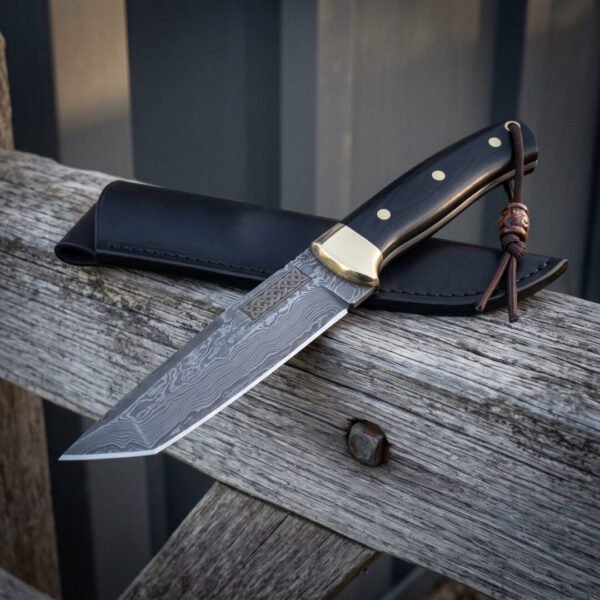
For a Japanese style blade with a proper handle and bolster, see the Pitchpoint blackened tanto. In Damascus, there is the Runespine Damascus tanto.



Reviews
There are no reviews yet