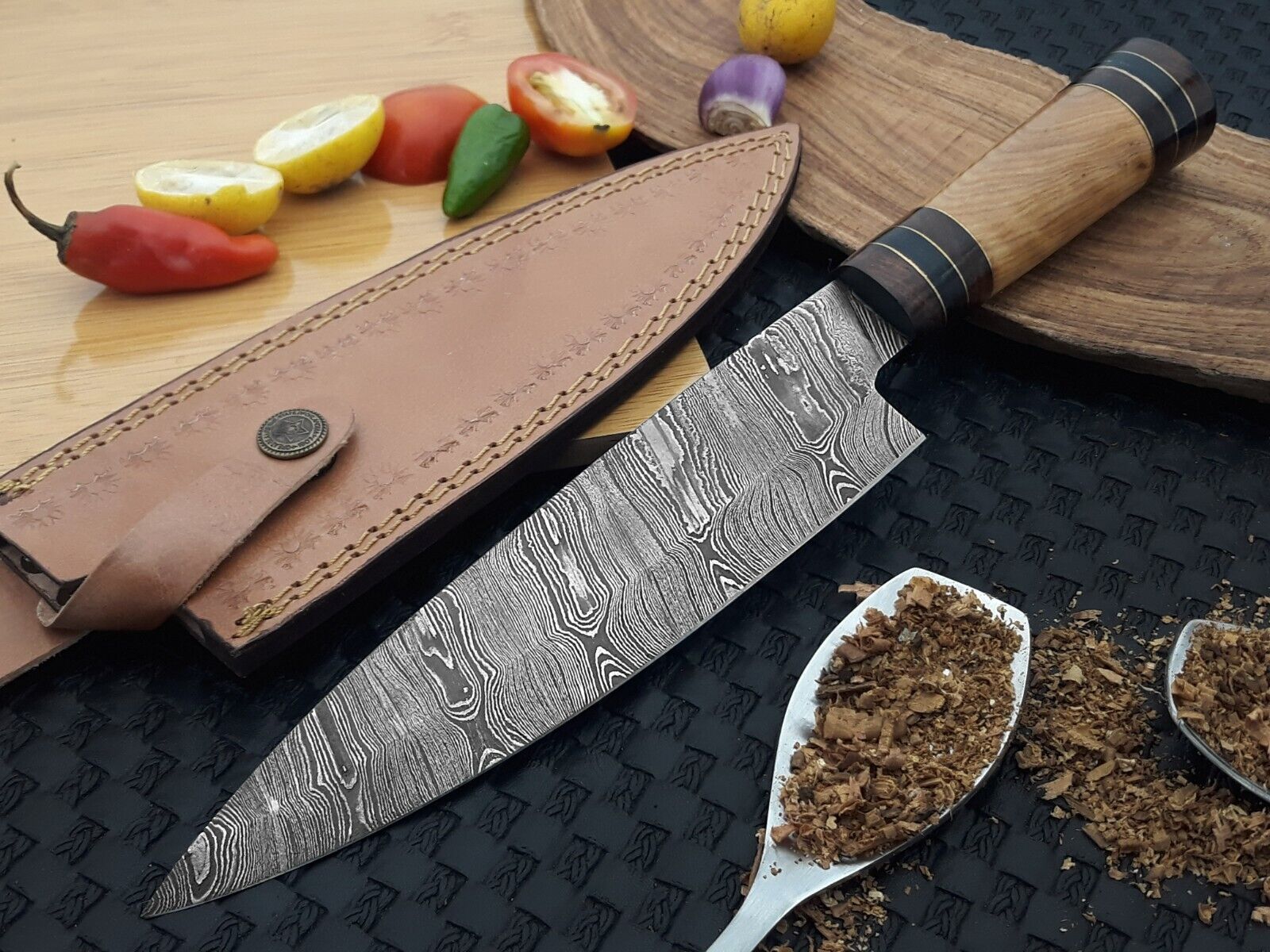
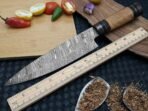
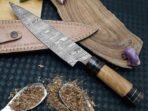
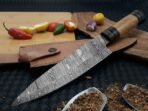
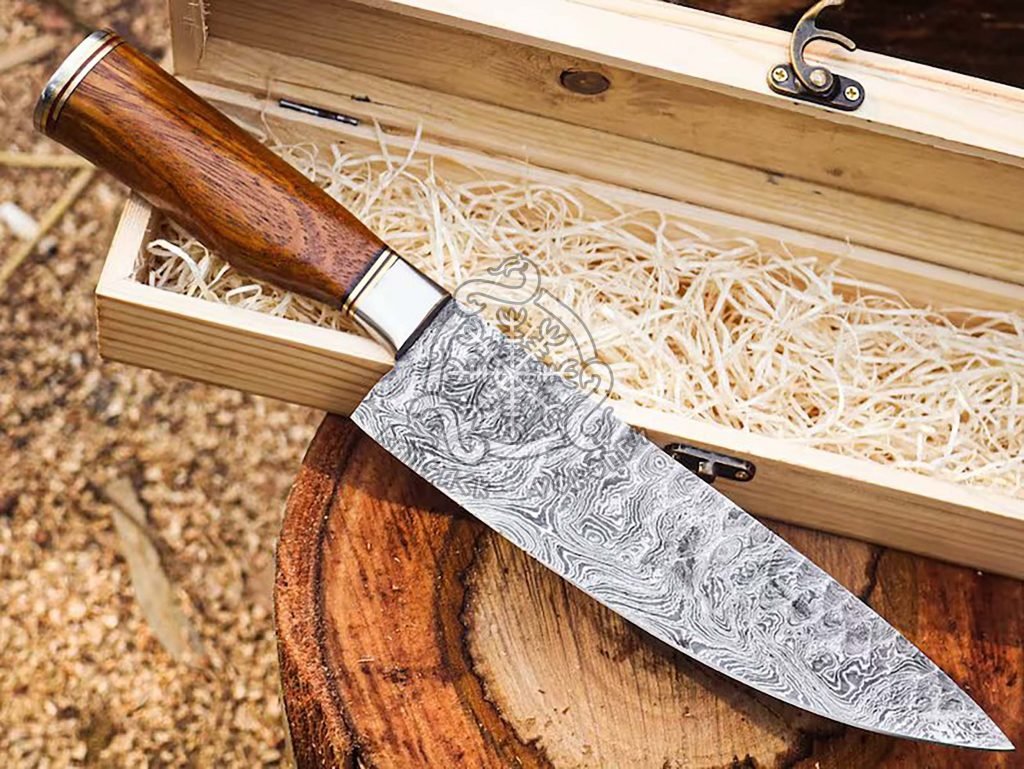
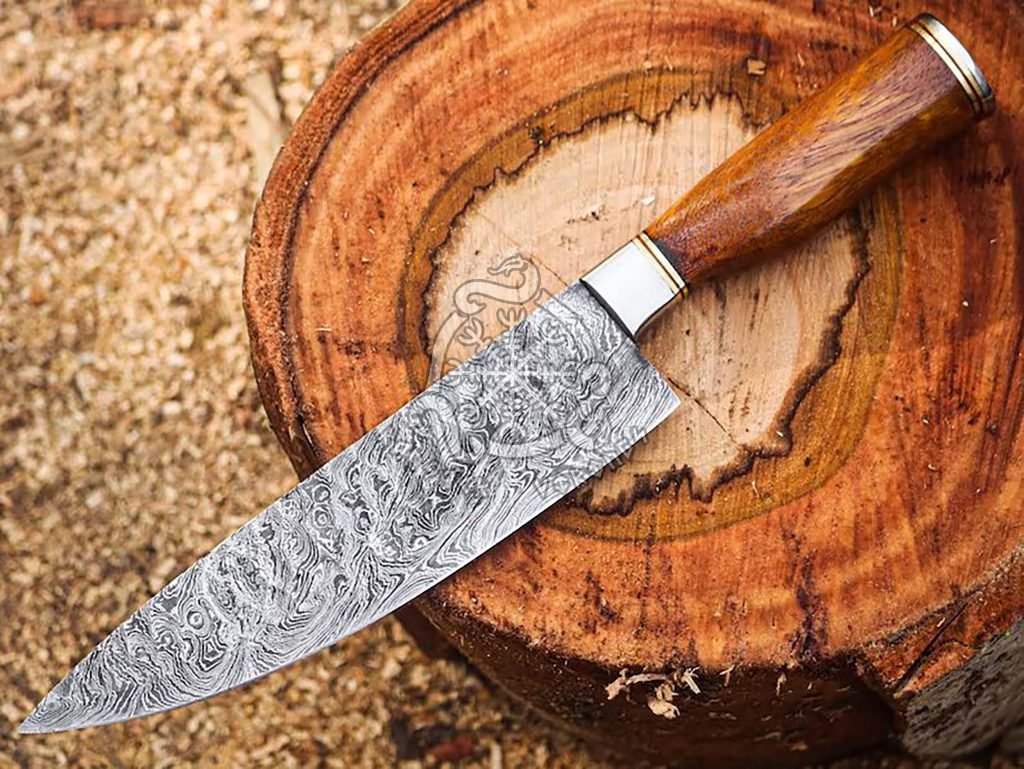
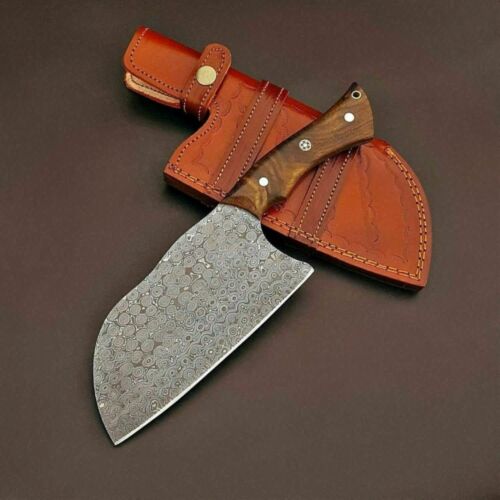
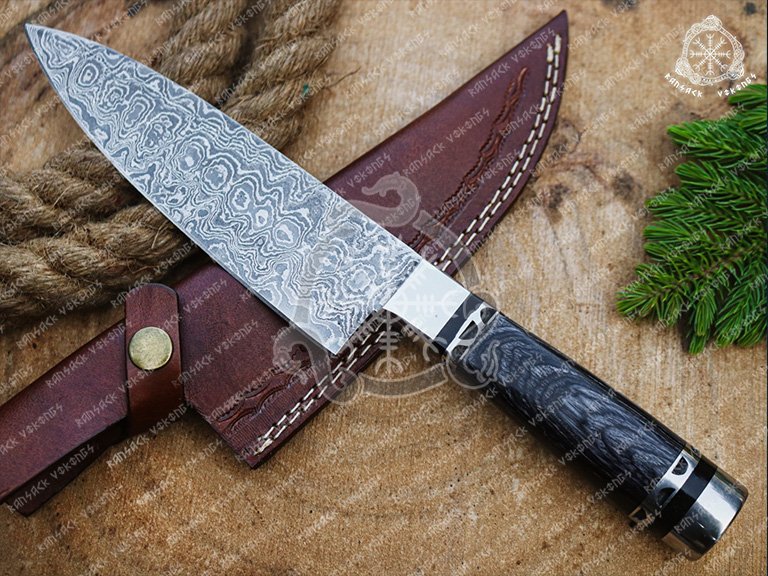
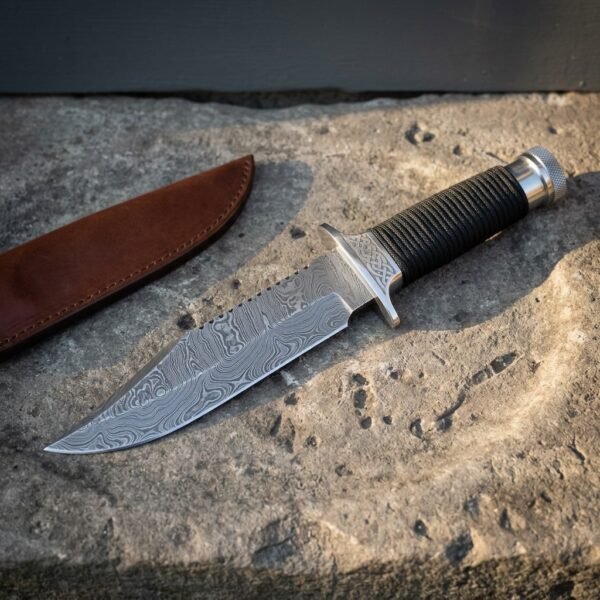
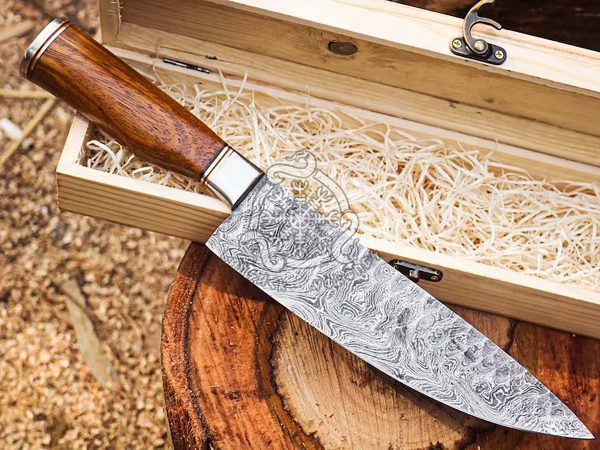
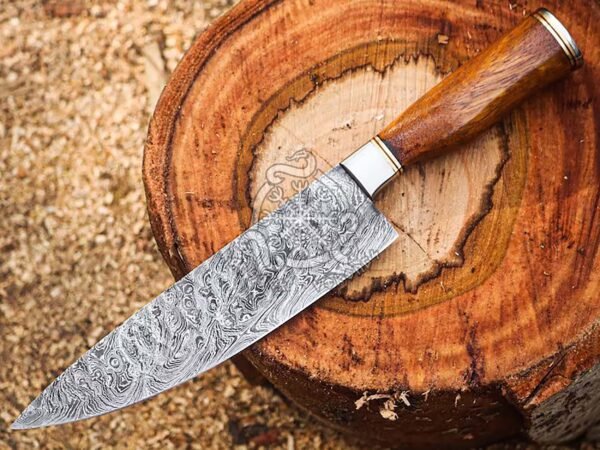
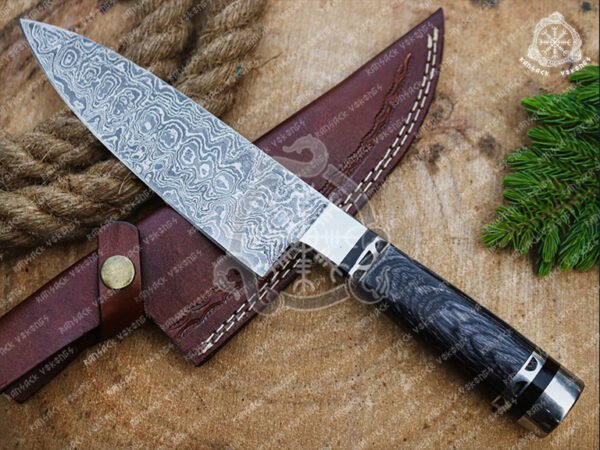
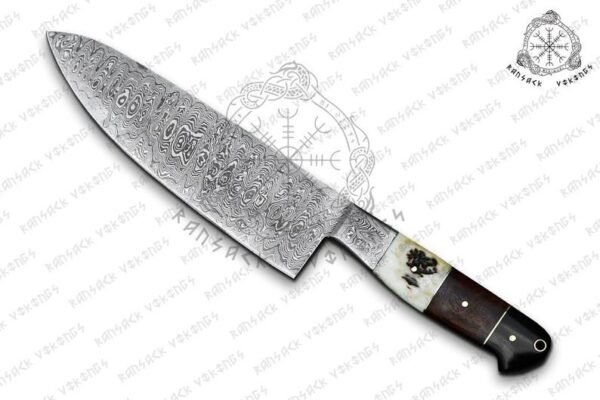
Most kitchen knives are pressed out of a sheet and handed a handle. The Olivekeen is not. The 8.5 inch fire pattern Damascus blade is forge welded from 393 layers and ground by hand, and the grip pairs stag horn with olive wood so the knife carries both a natural texture and real counterweight behind the edge. Overall it runs 14.0 inches with a 5.5 inch handle. How to keep a forged kitchen edge in good order is written up in looking after a forged kitchen edge.
The long chef knife is a European idea with a very specific origin. Before the nineteenth century most kitchen work was done with short utility blades and a cleaver, and the modern chef profile came out of French and German butchery, where a long belly and a raised tip let one knife both rock through herbs on a board and slice cleanly through a loin without ever leaving the cut. That is why the edge on a chef knife is curved rather than straight: the curve is a rocking surface, and the length is there so the whole stroke happens in one pass instead of three.
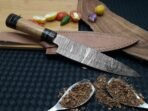
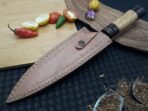
This one is forged, hardened, ground and fitted in the Czech Republic, and it arrives sharpened, in a fitted leather sheath, with free shipping inside the United States.
Specifications
| Steel | Hand forged Damascus, 1095 and 15N20 forge welded |
|---|
| Hardness | 58 to 60 HRC |
|---|
| Damascus layers | 393 layers |
|---|
| Pattern | Wind and mix twist fire pattern with brass file work |
|---|
| Overall length | 14.0 inches |
|---|
| Blade length | 8.5 inches |
|---|
| Handle length | 5.5 inches |
|---|
| Handle | Stag horn and olive wood |
|---|
| Sheath | Leather sheath |
|---|
| SKU | RK-434 |
|---|
What makes a chef knife cut, and why 8.5 inches
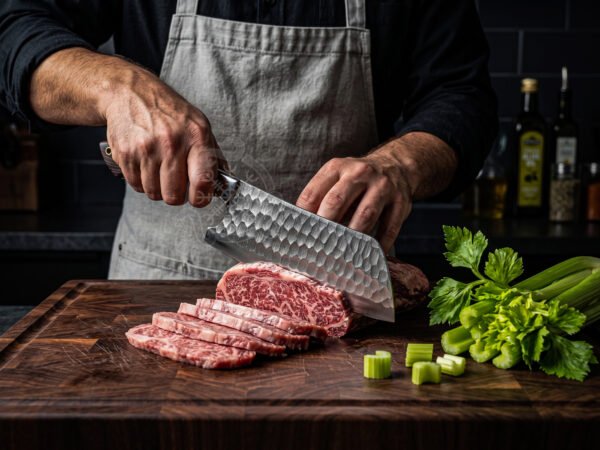
A chef knife has three working zones and they do different jobs. The heel, the inch or so nearest your hand, is where the force is, and it is what you use on hard vegetables, squash skin and anything that resists. The belly in the middle is the rocking curve for herbs, garlic and repetitive board work. The last two inches near the tip are for detail, for scoring, for splitting a shallot and for anything that needs a point rather than a wedge. A short knife makes you choose between those zones. A long one gives you all three.
At 8.5 inches this sits at the long end of a working chef knife, which is a deliberate choice. Length gives you a full stroke through a cabbage or a roast without dragging, it keeps your knuckles clear of the board, and the extra mass out toward the tip does a surprising amount of the work for you on a downstroke. The trade is that a long blade wants a big board and a bit of respect. If your board is small, this knife will tell you.
The other half of the geometry is what happens behind the edge. This blade is ground thin above the bevel, which is what lets food separate and fall away instead of sticking to the flat and splitting ahead of the cut. Thickness behind the edge matters far more to how a knife feels than sharpness alone, and it is the thing a stamped supermarket knife gets wrong.
Why Damascus and not stainless
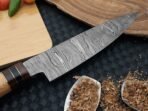
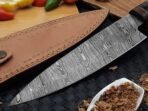
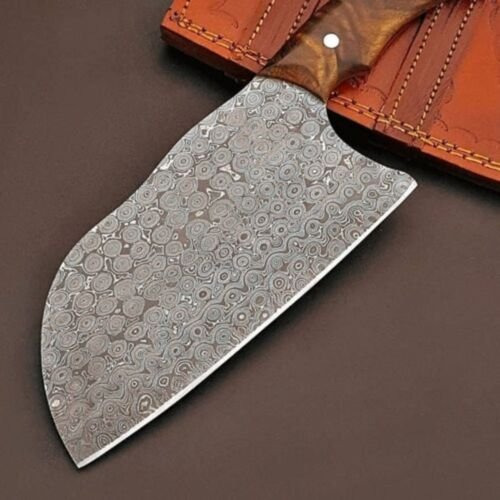
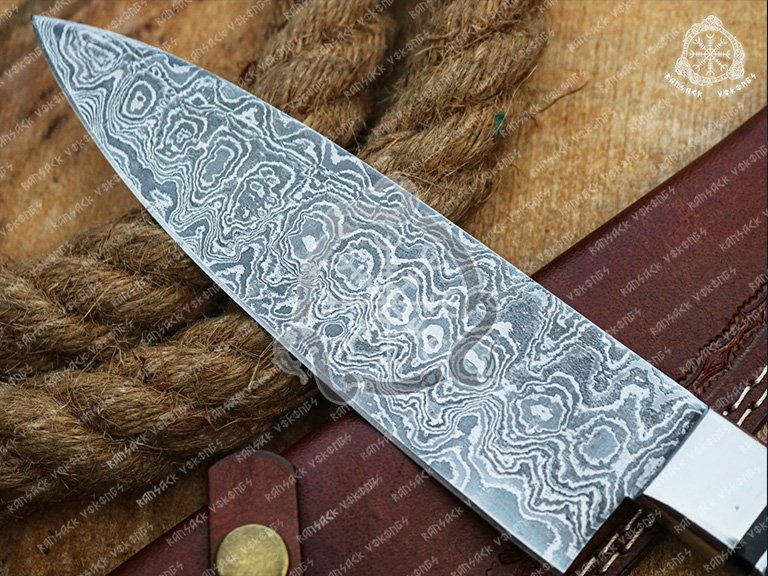
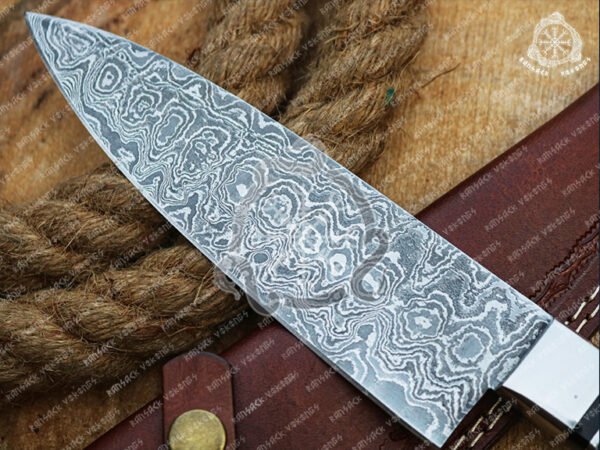
The blade is pattern welded from 1095 and 15N20, forge welded into one billet, folded and drawn out to 393 layers before the profile is cut from it. The light and dark bands are the two steels responding differently to the etch. It runs through the full thickness of the blade, so grinding and sharpening reveal the pattern rather than removing it.
In a kitchen, the honest case for this over stainless is edge quality. At 58 to 60 HRC the 1095 takes a finer, harder edge than the soft stainless in a mass market knife and holds it through far more board time, and when it does dull it comes back on a stone in minutes rather than fighting you. The cost is that it is not rust proof. Acidic food, a wet sink and a dishwasher are all bad news. Wash it by hand, dry it straight away, and it will be fine for decades. The trade off is set out in full in Damascus versus stainless.
Stag horn and olive wood in the hand
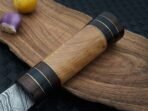
The grip on this one is a pairing rather than a single material. Stag horn is antler, hard and slightly textured, and it grips well when your hands are wet, which in a kitchen is most of the time. Olive wood is dense, oily by nature and figured with a deep interlocked grain, and it carries enough weight to bring the balance point back toward your hand on a blade this long.
Both are natural, so both vary. Olive wood in particular is famous for wild figure, and no two blocks cut the same. Neither needs much. Keep the handle out of standing water, never put it in a dishwasher, and feed it with a wipe of food safe mineral oil once or twice a year to keep the wood from drying and the horn from checking. The method is in wooden handle care.
Engraving, runes and your own design
Use the rune converter on this page to turn a name, a date or a short phrase into Elder Futhark and we will cut it into the steel or the handle. If you would rather have a Viking pattern than a rune line, choose your own design in the engraving option above the add to cart button and tell us whether it goes on the blade or the handle. Where a piece already carries an engraved design, your chosen engraving replaces it rather than sitting alongside it.
A chef knife has more usable blade flat than almost anything else in the range, so this is the piece that takes a long rune line or a full phrase most comfortably. It is a common wedding and chef gift for that reason. Engraving is cut in the same workshop that forged the blade, before it is packed. Details on the engraving page.
Care and sharpening
Hand wash, dry immediately, and keep it off bone and frozen food. Carbon steel will develop a grey patina over time from onions, tomatoes and citrus, which is normal and actually protective, but standing water and salt will take it past patina into rust. A thin film of food safe mineral oil before it goes into a drawer for a while solves that.
On the stone, hold a shallow angle, around fifteen to seventeen degrees per side, and sweep the belly across the stone so the curve gets even contact. A 1000 grit stone resets it and a 3000 polishes it. Strop on leather or a bare palm to knock the burr off. Full detail in steel care and sharpening with a whetstone.
Made in the Czech Republic
The work behind this piece happens in a Czech Republic workshop that has kept to the old methods. Steel is forged and heat treated by hand, the grind is taken down by eye rather than by machine, and the handle, fittings and sheath are cut and finished one at a time. Because of that, every piece carries small marks of the hand that made it.
Ransack Viking is a United States company. We import direct, check each piece when it reaches us, and ship from our North Babylon, New York warehouse. Engraving is added here in the United States after arrival, so the piece you receive is finished to your order.
A note on handmade variation
This chef knife is hand forged, not machine made and not bulk produced, so the one that arrives will not be a pixel for pixel copy of the photograph on this page. The Damascus pattern moves differently in every billet. The olive wood came from a different part of a different tree, so the figure and the tone will differ. The stag horn came off a different antler, so its texture and colour will differ too.
The dimensions, the steel, the layer count, the hardness and the build are the same every time. The grain, the tone, the pattern and the exact profile are not, because each one is worked by hand from natural materials. That variation is the evidence of the process, not a fault in it.
Frequently asked questions
Is it sharp enough to use straight out of the box
Yes. It is sharpened on a stone before it is packed and will slice paper and take the skin off a tomato without pressure. Give it a few passes on a strop after the first month of use and it will hold that level for a long time.
Is 8.5 inches too long for a home kitchen
It depends on your board more than your kitchen. On a board of about 18 by 12 inches or larger this length is a pleasure, because you get a full stroke and clear knuckles. On a small board a long blade overhangs and feels awkward. If your board is small, size the board up before you size the knife down.
Can it go in the dishwasher
No, and this is the one rule that matters. A dishwasher will rust the carbon steel, strip the oil out of the olive wood and can crack the horn. Hand wash in warm water, dry it immediately, and put it away dry.
Will the Damascus pattern wear off with sharpening
It cannot. The pattern is two different steels laid through the full thickness of the blade, not a coating or an etched print, so sharpening exposes fresh pattern rather than removing it. If the etch ever looks faded after years of use it can be re etched.
What is the difference between this and the cleaver in the range
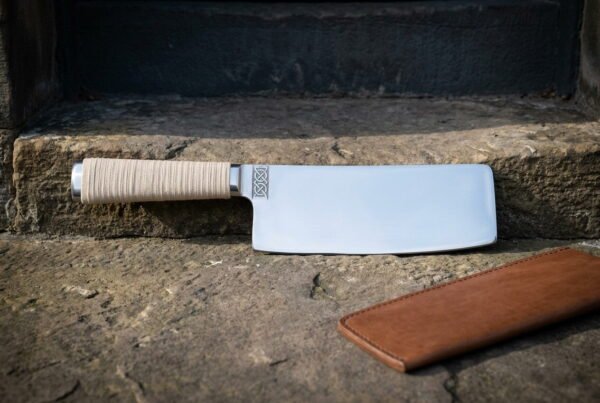
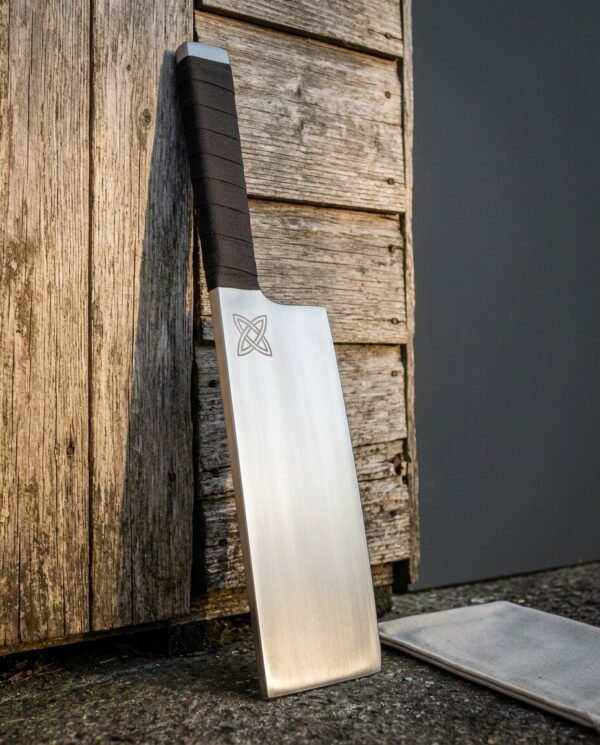
This is a slicing and rocking knife with a curved belly and a fine tip, built for prep, herbs, vegetables and boneless meat. A cleaver is a wedge with mass, built to go through joints and heavy work with a straighter edge. Most kitchens want the chef knife first and the cleaver second.
How long before it ships
Processing runs one to two weeks while the piece is made and finished, with engraved orders at the longer end. Shipping inside the United States is free and returns are open for seven days from delivery.
What is in the box
- One Olivekeen Damascus chef knife
- Leather sheath
- Protective packaging
- Forged and finished in the Czech Republic
Explore the range
Related collections: Chef Knives, Fish Fillet Knives and Viking Knives. The reasoning behind the steel and the handle materials is written up in the guides.
If this one is not it
Closest to this in the range is the Hearthfold chef knife, pattern welded Damascus. If this one is not quite right, there is the Boardkeen chef knife. Also in this group is the Blockward chef knife, 14 inches overall.
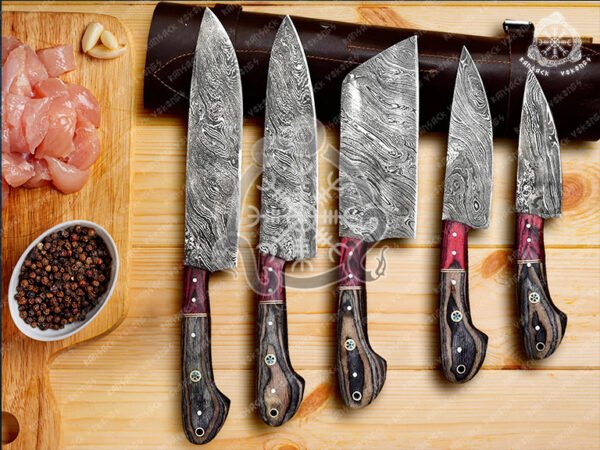
If you are putting a set together, the Hornspire dagger knife sits alongside it. Pick the steel, the length and the fittings yourself on the custom Damascus knife page.








Reviews
There are no reviews yet