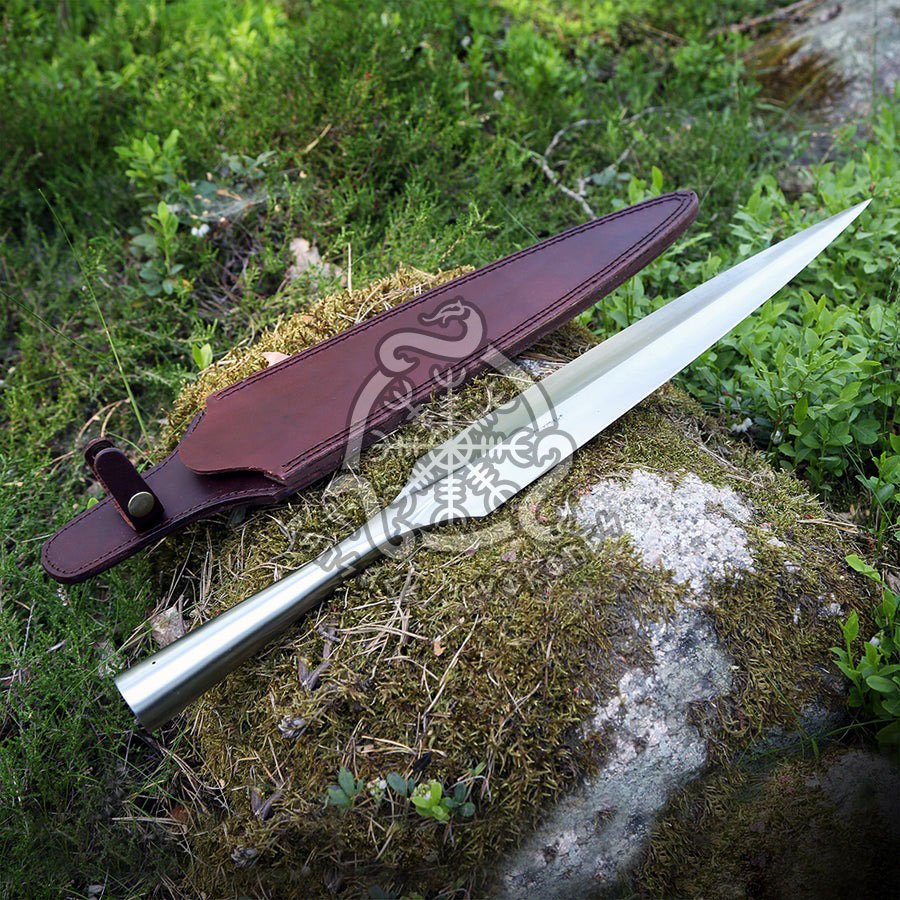
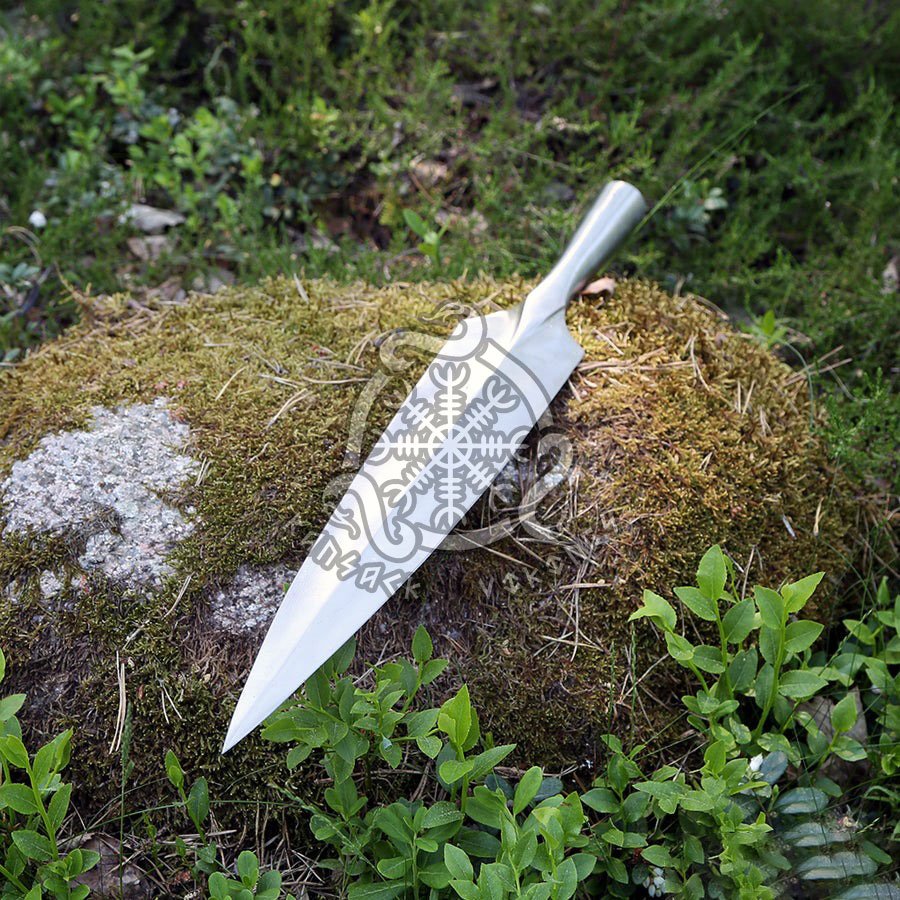
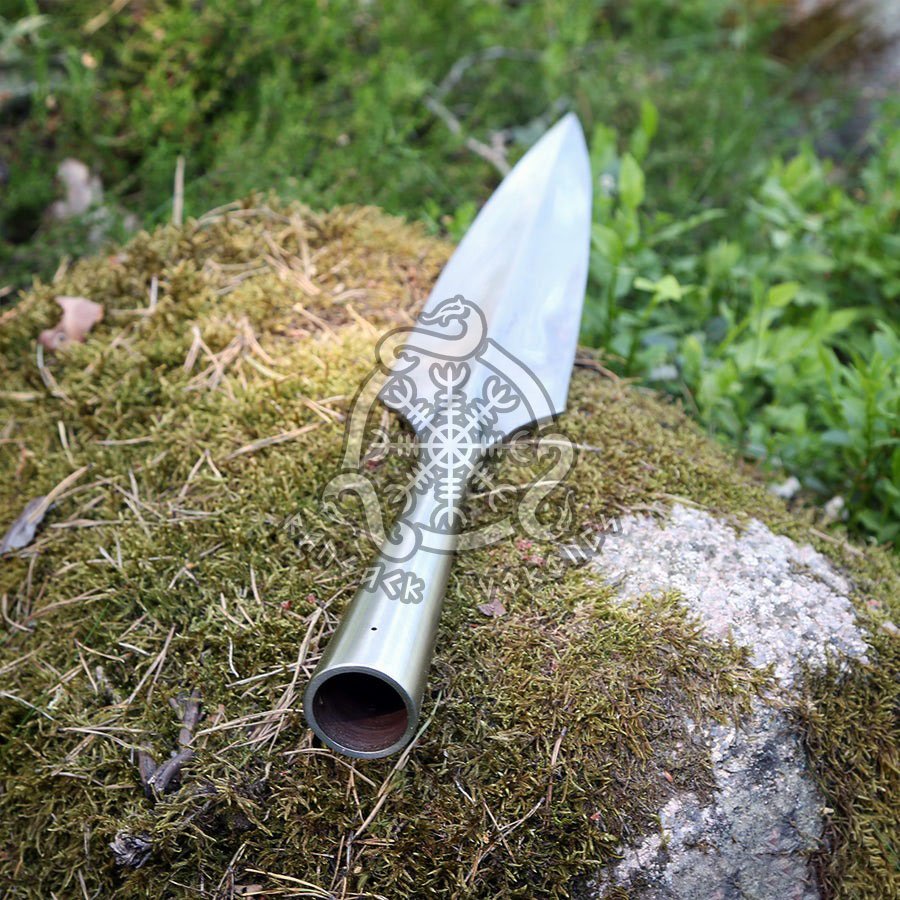
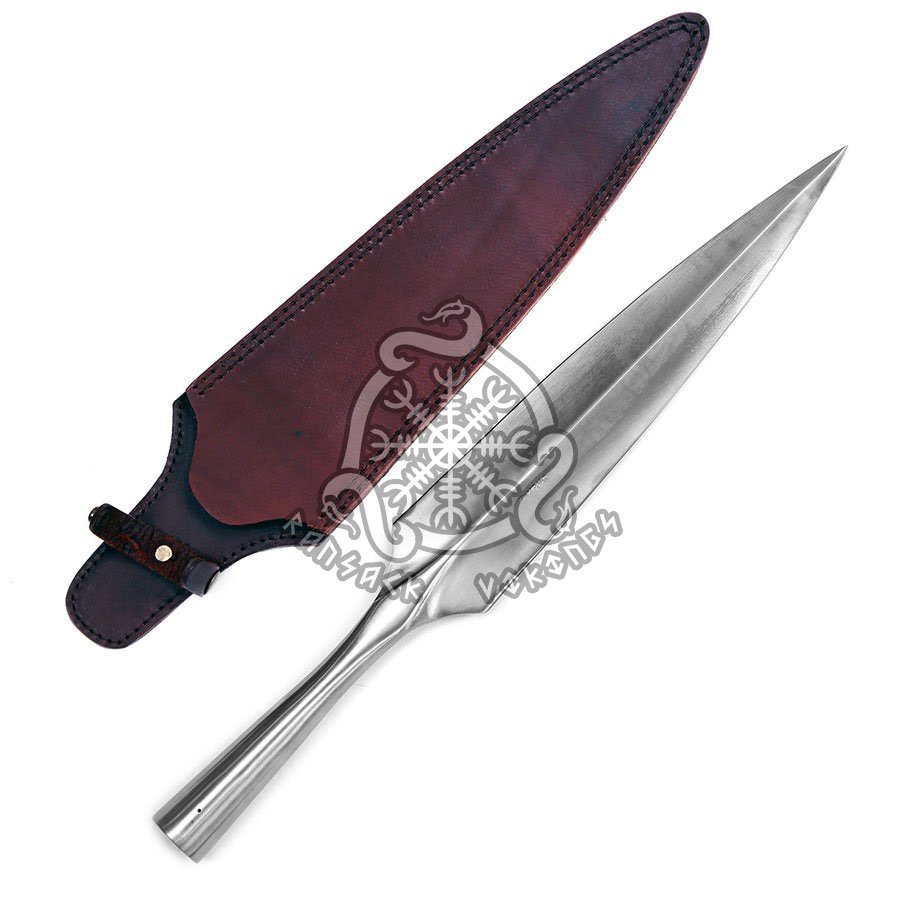
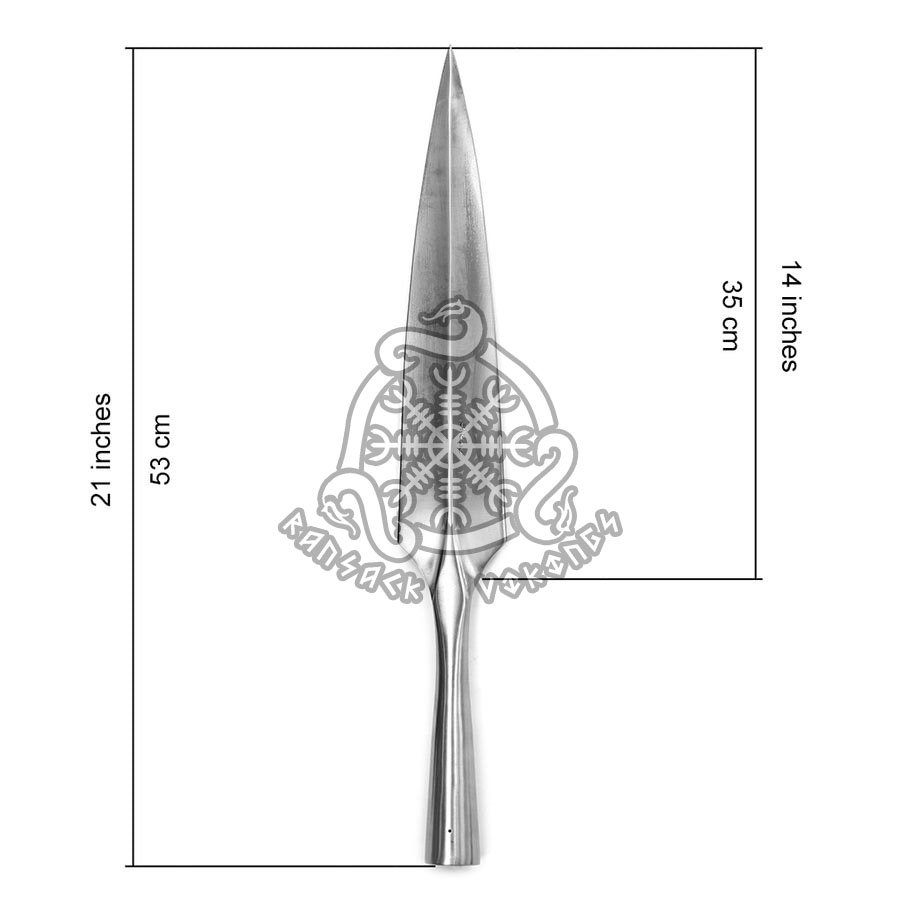
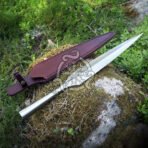
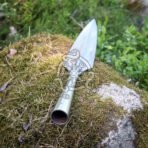
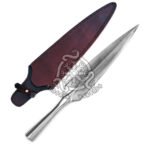
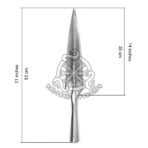
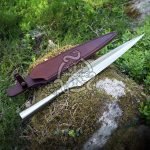
The Spearward is a hand forged Viking spear head in 1095 carbon steel, heat treated to 54 to 58 HRC. It runs 21 inches overall with a 14 inch blade, and the remainder is a hollow socket 1.1 inches in diameter, which is the part that takes the shaft. That is a large head by any standard, built to the proportions of the historical originals and sold as a collector and display piece. Why the spear mattered more than the sword in the North is set out in the Viking spear.
The spear deserves better billing than it usually gets. If you judge the Viking Age by television you would think everyone carried a sword, and if you judge it by what comes out of the ground you get a completely different answer. Spearheads are among the most common finds in Norse graves, far outnumbering swords, because a spear needed only a modest amount of iron and a length of ash while a sword needed a specialist smith, a great deal of costly metal and weeks of work. The spear was what armed the ordinary free man, and the shield wall was built around it.
It was also the spear of the gods. Odin carries Gungnir, made by the dwarfs, and there is a Norse practice recorded in the sources of hurling a spear over the enemy line before a battle to dedicate them to Odin, which is exactly what Odin himself does in Voluspa to start the first war in the world. A spear was not just a cheap alternative to a sword. It was the one with the deepest religious meaning attached to it.
Every Spearward is forged, heat treated, ground and finished in the Czech Republic. Shipping inside the United States is free, processing takes one to two weeks, and returns are accepted within seven days.
Specifications
| Steel | 1095 carbon steel, hand forged |
|---|
| Hardness | 54 to 58 HRC |
|---|
| Overall length | 21 inches, 53 cm |
|---|
| Blade length | 14 inches, 35 cm |
|---|
| Socket | Hollow shaft, 1.1 inch diameter, 28 mm |
|---|
| Production | Hand forged in a semi production environment |
|---|
| Intended use | Collector and display piece |
|---|
| SKU | RK-657 |
|---|
The socket, and why it is the clever part
Everyone looks at the blade. The socket is the piece of engineering worth understanding, because it is the difference between a spear that works and a spear that comes apart on first contact.
A Norse smith made a socket by taking flat stock at the base of the head and drawing it out into two wings, then wrapping those wings around a tapered mandrel to form a cone. On better spears the seam was forge welded closed. On simpler ones it was left as a butted or overlapped seam, and you can still see that split running down the sockets of many museum examples. The shaft was then pushed into the cone and secured with one or two rivets through the walls.
The reason this beats a tang is force distribution. A tang concentrates all the load of a thrust into a small area where the steel enters the wood, and wood splits along the grain very readily. A socket wraps the wood instead, gripping it around its whole circumference for several inches and spreading the shock over a long length of shaft. It also keeps the head aligned. A tanged head can rotate. A socketed one cannot.
At 1.1 inches across, this socket sits right in the historical range. Viking spear shafts were typically around an inch to an inch and a quarter in diameter and two to three metres long, made from ash for the same shock absorbing reasons ash was used for axe handles.
Why 1095 carbon steel and not stainless
1095 is a medium carbon steel with around 0.45 percent carbon, which is deliberately less than the 1095 we use on knives. That is not a compromise, it is a choice suited to the shape. A spear head is a long thin triangle of steel with a great deal of leverage available at the tip, and the failure mode that matters is not going dull, it is snapping. Lower carbon means lower attainable hardness and considerably more toughness, so at 54 to 58 HRC this head bends before it breaks. On a spear that is the right side of the trade.
Stainless would be the wrong material here for the same reasons it is wrong on an axe bit. Chromium carbides reduce toughness in thin section, and a display spear that snaps at the socket is worth nothing. Carbon steel does have to be kept dry and lightly oiled, since it has no chromium to protect it and will spot if left damp. That is a two minute job a few times a year. The full comparison sits in Damascus versus stainless.
Mounting a shaft
This listing covers the forged head with its socket. If you intend to mount it rather than display the head alone, the job is straightforward but worth doing properly.
Use ash or hickory. Both have long straight fibres that absorb shock and resist splitting, which is why every traditional shaft material worth having is one or the other. Turn or shave the top of the shaft to a slight taper matching the inside of the socket, aiming for a snug fit that needs a firm push rather than a hammer. Too tight and you risk splitting the wood as it swells with humidity. Once seated, drill through the socket wall and the shaft and fit a rivet or a pin. Do not rely on glue or friction alone.
Once it is mounted, treat the wood the way you would any tool handle. A light coat of oil once or twice a year keeps it from drying out and shrinking, which is what loosens a fitted head. The method is the same one in wooden handle care.
Engraving, runes and your own design
Use the rune converter on this page to turn a name, a date or a short phrase into Elder Futhark and we will cut it into the steel or the handle. If you would rather have a Viking pattern than a rune line, choose your own design in the engraving option above the add to cart button and tell us whether it goes on the blade or the handle. Where a piece already carries an engraved design, your chosen engraving replaces it rather than sitting alongside it. On a spear head the socket is the traditional place, since that is where the decorative inlay sits on the finest surviving examples, and the broad flat of the blade takes a longer line. See the engraving page.
Care and sharpening
Dry the steel after handling and put a thin film of oil over it before it goes on a wall or into storage, paying particular attention to the inside of the socket where moisture collects and is hard to see. If it is mounted on a shaft, check the rivet and the fit once a year. Surface rust lifts with fine abrasive and oil. Full routine in steel care.
A spear head is sharpened along both edges of the blade toward the point, following the existing bevel. Work with a stone rather than a file so you do not lose the profile, keep the angle consistent, and take particular care near the point where the steel is thinnest. The general technique is in sharpening with a whetstone. Never take a powered grinder to it, because the thin section heats and loses temper faster than on any other piece in the range.
Made in the Czech Republic
This is a handmade piece from the Czech Republic, made in a workshop that still forges, grinds and finishes by hand instead of stamping parts out. The smiths there have kept the older way of working, and the wood, horn and leather are shaped and fitted by hand as well. Two pieces of the same design will never be identical, and that is part of what you are buying.
Ransack Viking is a United States company. We handle the import ourselves, look over every piece when it lands and ship from our warehouse in Memphis, Tennessee. Engraving is done in the United States after the piece arrives, so your design goes on before we send it out.
A note on handmade variation
This spear head is hand forged. It is not machine made and it is not bulk produced, so what arrives will not be a pixel for pixel copy of the photograph. The hammer texture, the tone of the finish, the exact taper of the blade and the precise line of the socket seam all vary, because each is worked by hand from raw steel. The dimensions, the steel, the hardness and the build are the same every time. The character is not.
Frequently asked questions
Does it come with a shaft?
The 21 inch measurement is the forged head with its socket. If you want to mount it, fit a 1.1 inch diameter ash or hickory shaft and secure it with a rivet through the socket wall.
Why is the steel 1095 rather than the 1095 in your knives?
Because a spear head needs toughness more than it needs maximum hardness. Lower carbon at 54 to 58 HRC means the blade will flex and bend under a bad load rather than snapping, and on a long thin triangle of steel that is the failure mode that matters.
Is it sharpened?
It is finished as a collector and display piece with the edges ground to shape. Treat it as a display item rather than a working sword.
What is the hollow shaft measurement for?
It is the internal diameter of the socket, which is the cone at the base that a wooden shaft slides into. Match your shaft to it rather than the other way around.
Why were spears more common than swords?
Cost, mostly. A spear needed a small amount of iron and a length of ash. A sword needed several times the metal, a far more skilled smith and weeks of work. Spearheads outnumber swords heavily in Viking Age grave finds.
How is it packed for shipping?
It ships in protective packaging with the point guarded. Processing runs one to two weeks and shipping inside the United States is free.
What is in the box
- One Spearward forged spear head with hollow socket, 21 inches
- Protective packaging
- Forged and finished in the Czech Republic
Explore the range
Related collections: Swords, Viking Swords, Viking Axes and Viking Shields. The steel notes and the Norse background are in the guides.












Bought this on a whim and it turned out to be one of my favorite purchases this year. Haft feels sturdy and well balanced for the size of the head. It’s handmade in the Czech Republic but ships from a US warehouse so it arrived quicker than I expected. Worth every penny.
Solid polearm. Glad I ordered it. Haft is solid though a touch shorter than I pictured. Still very happy with it and would recommend.
Knew this polearm was special the second I opened the box. Already planning my next purchase from this shop.