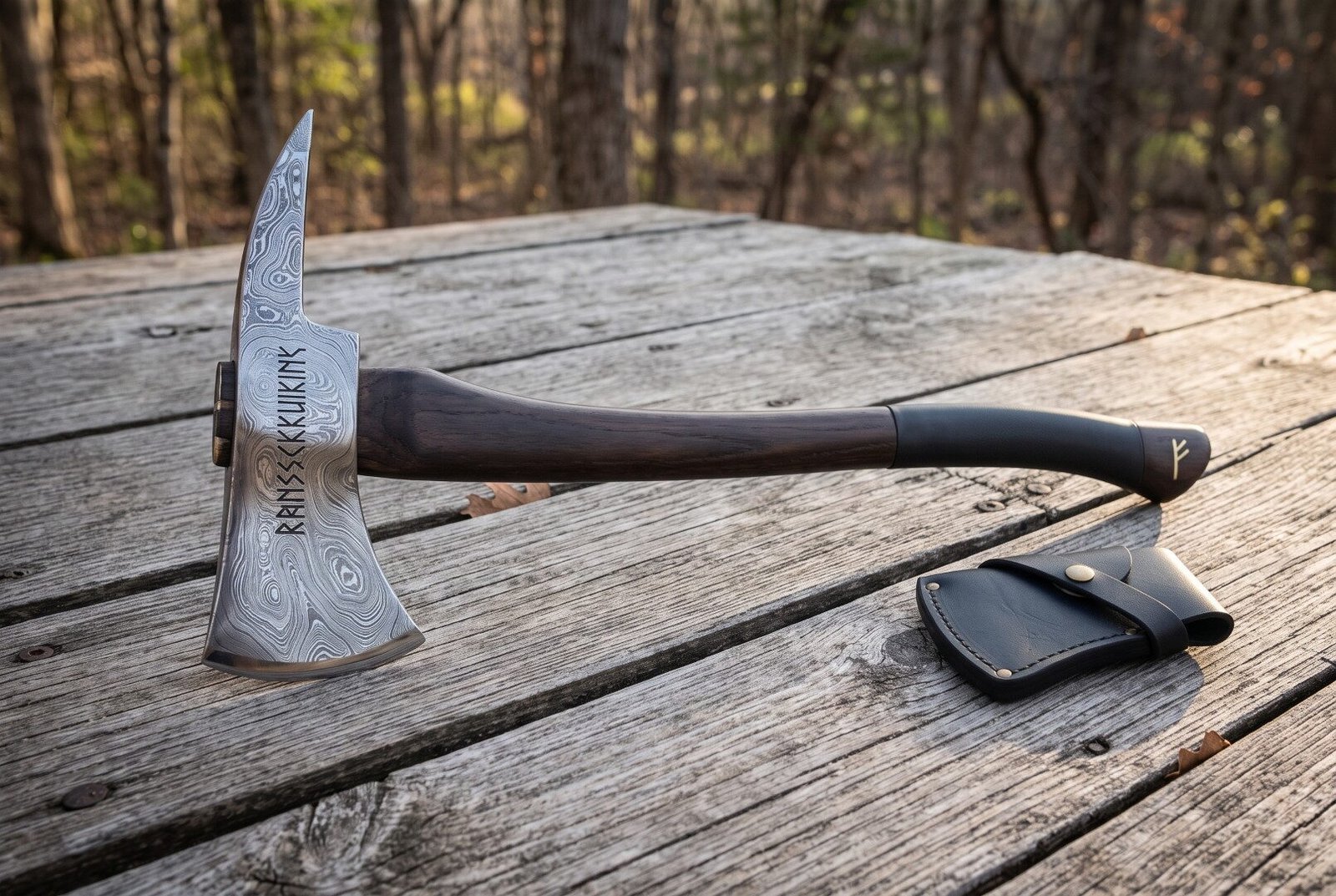
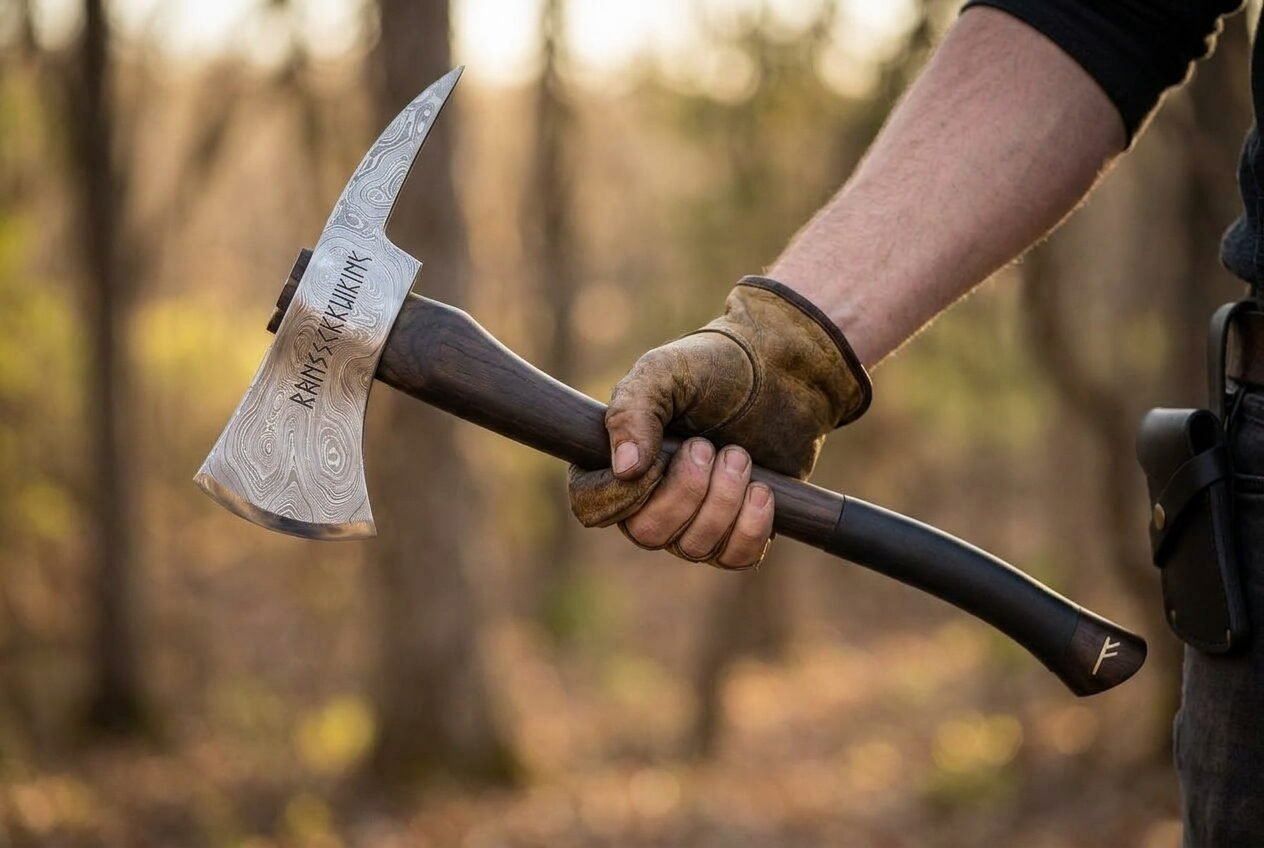
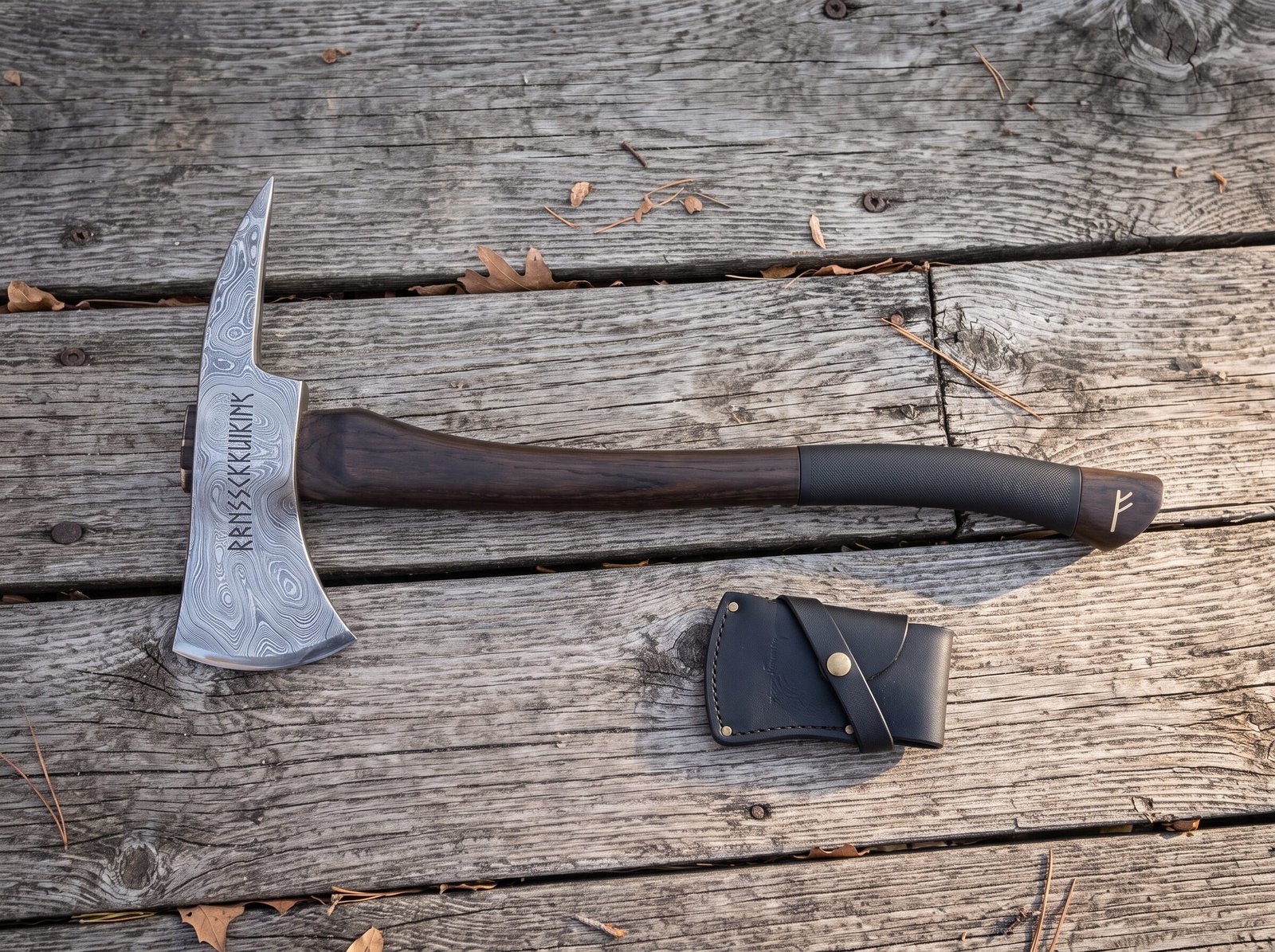
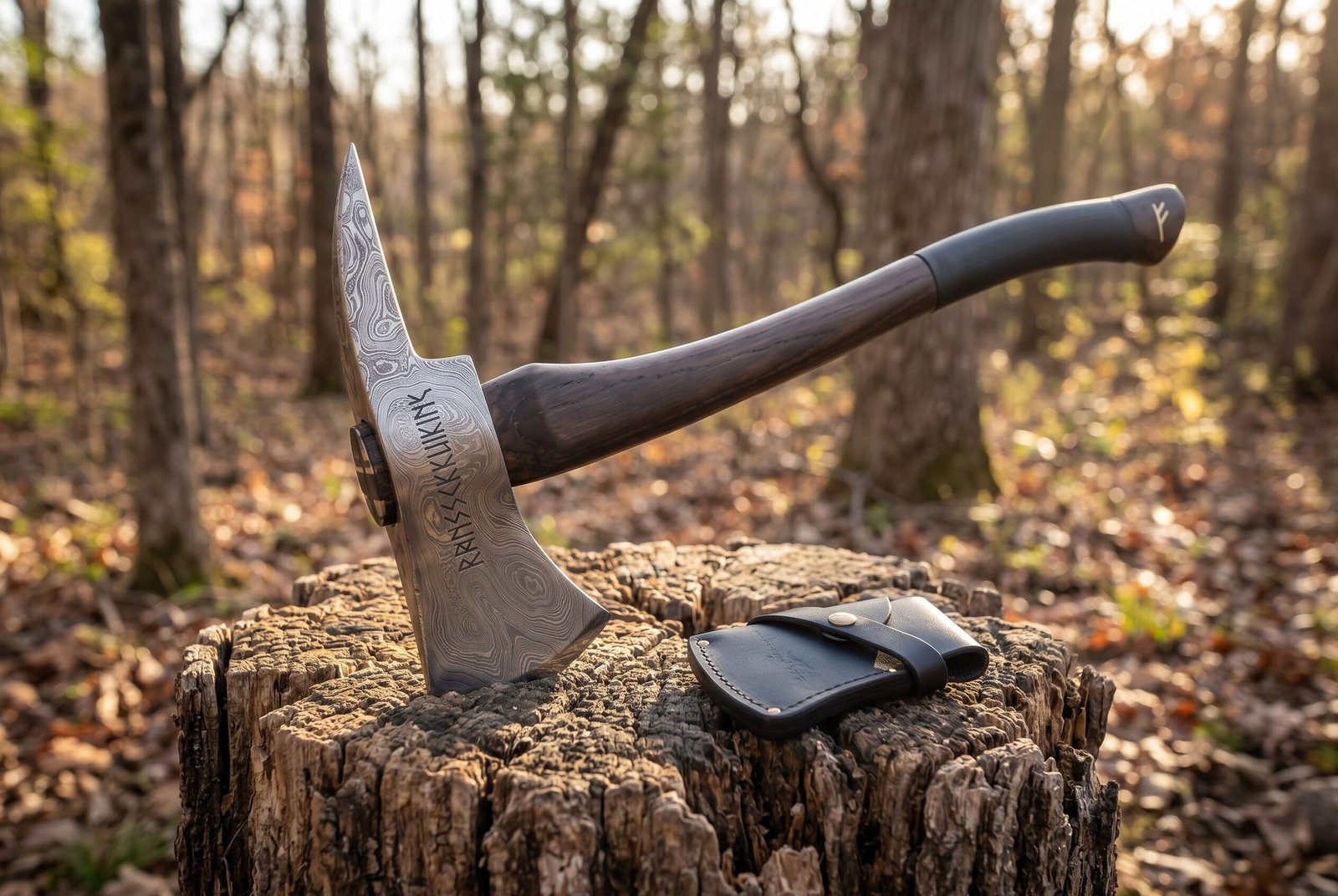
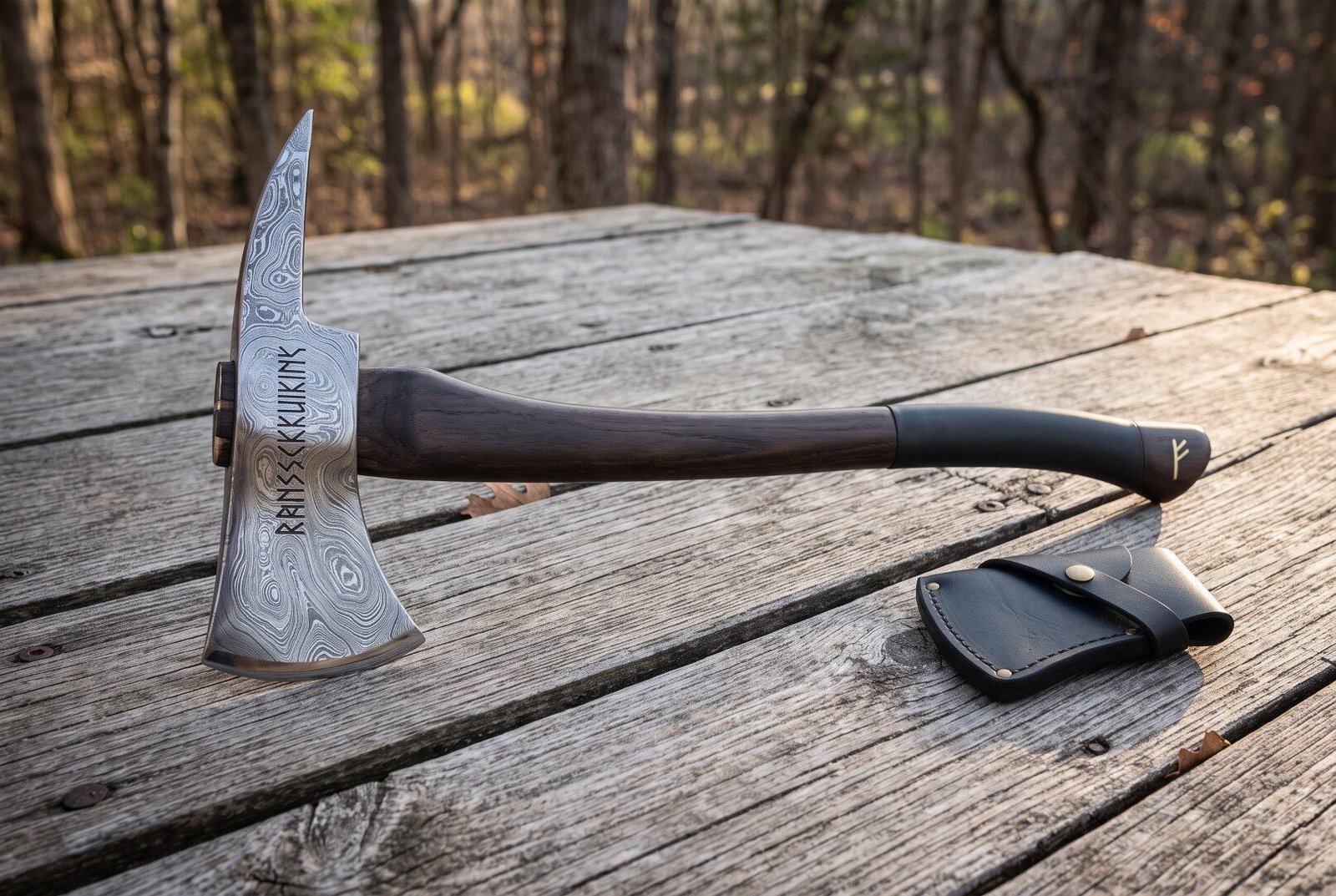
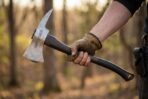
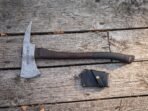
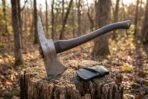
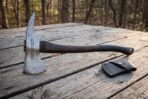
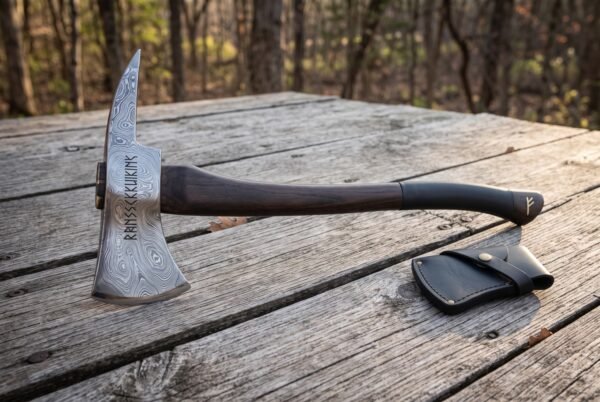
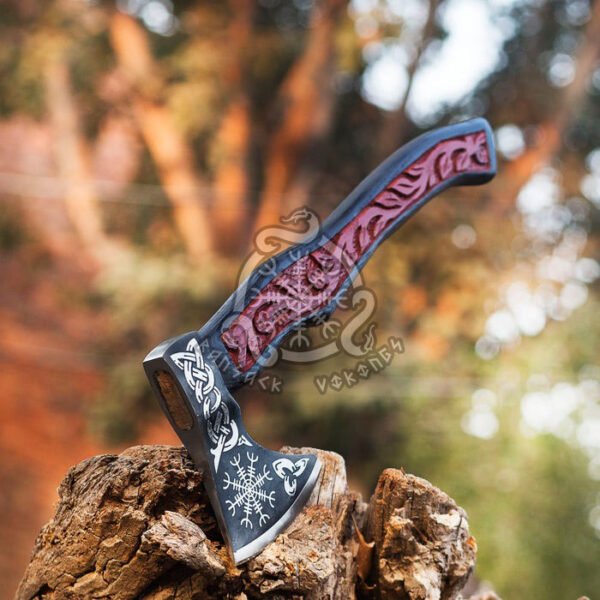
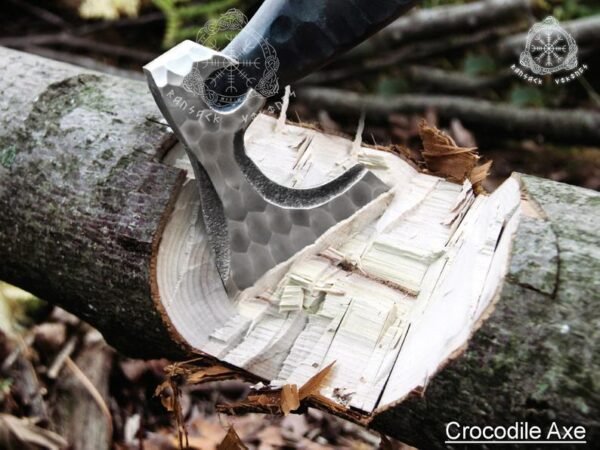
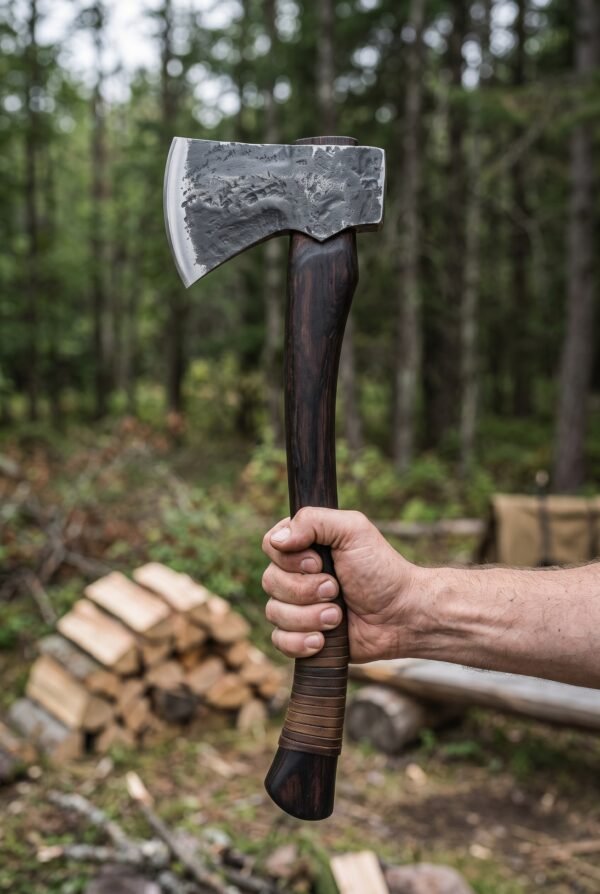
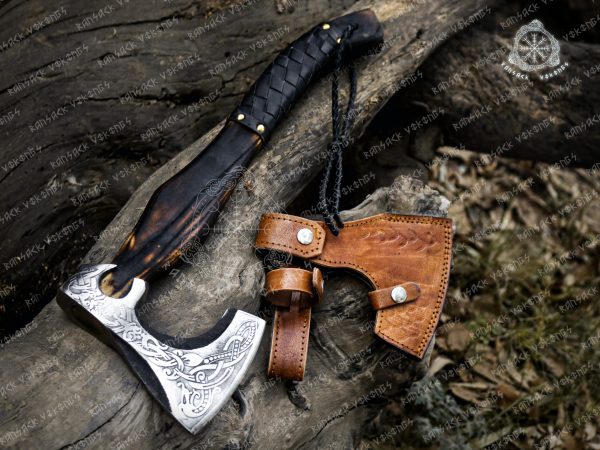
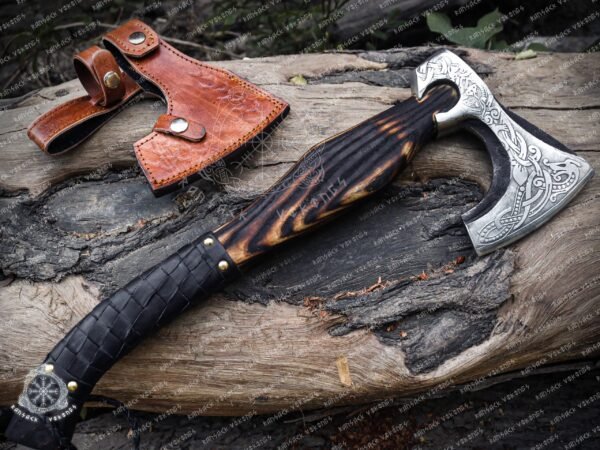
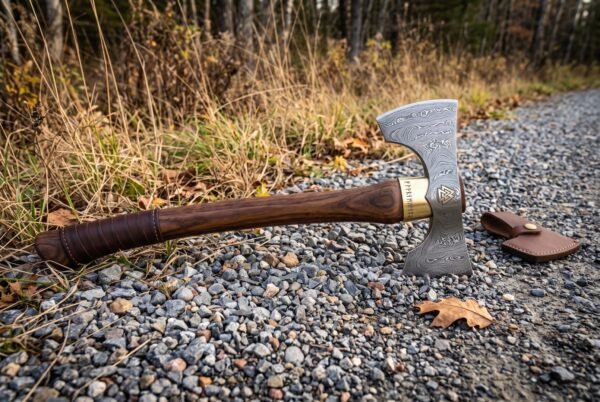
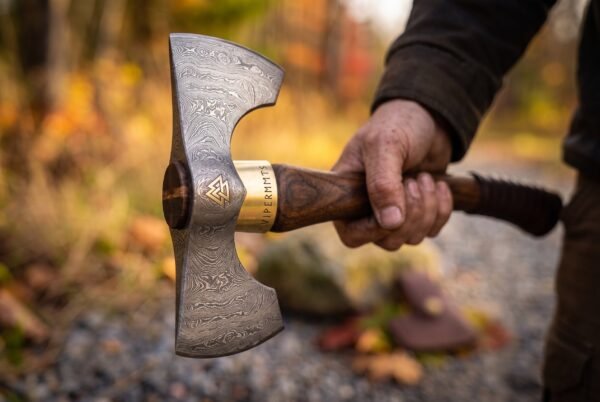
A one hand bearded hatchet with the whole head forged from pattern welded Damascus, 1095 and 15N20 folded and drawn until the layers run in tight contour rings across the cheek and around the beard. Above the eye the head rises into a tall upswept horn, a shape that turns up on Scandinavian and Eastern European axes and gives you a second working corner for hooking, picking and prising. Down the cheek runs a line of Elder Futhark spelling out the Ransack Viking name. The haft is dark walnut, curved, with a black leather grip wrap over its lower half and a small light rune inlaid near the swell of the butt, and the head is wedged through the eye with a hardwood pin.
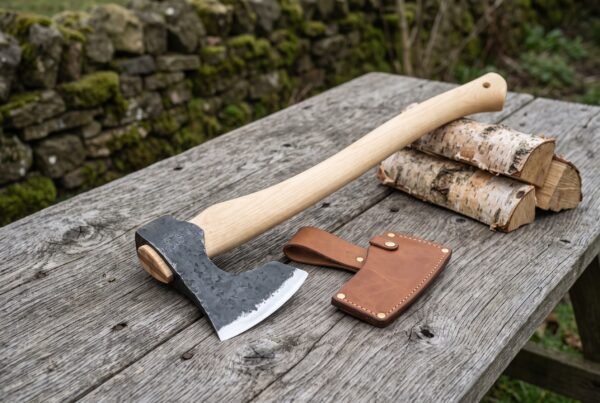
The billet is welded, drawn, forged, ground, heat treated, etched and hafted in a Czech Republic workshop. It ships with the black leather blade mask shown, which snaps closed over the edge. Why the beard is cut out of the blade at all is explained in what is a bearded axe.
Specifications
| Type | One hand bearded hatchet with an upswept horn |
|---|
| Head material | Damascus, 1095 and 15N20 pattern welded |
|---|
| Hardness | 58 to 60 HRC at the edge |
|---|
| Pattern | Contour rings running through the bar, not an etched surface print |
|---|
| Edge | Flared edge with a short beard below the eye |
|---|
| Engraving | Elder Futhark rune line down the cheek |
|---|
| Haft | Dark walnut, curved, wedged with a hardwood pin |
|---|
| Grip | Black leather wrap over the lower haft |
|---|
| Haft detail | Light rune inlay set into the butt swell |
|---|
| Mask | Black stitched leather blade mask with a snap strap |
|---|
| SKU | RK-1538 |
|---|
How to tell Damascus from an etched pattern
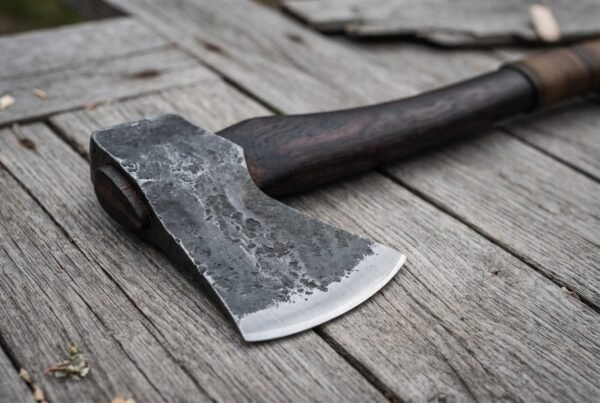
This head is genuinely pattern welded, and the way to prove it is to follow the pattern into the grind. On this axe the contour rings run down the cheek, turn the corner into the bevel, and reappear along the very edge, because you are looking at the cross section of a laminated bar. The bevel cuts through the layers at an angle, which is exactly why the rings tighten and spread the way they do near the edge. An etched surface design cannot do that. It is masked and bitten into the outside of a plain bar, so it stops dead at any surface that was ground after the etch, and it will not follow a curve into a bevel.
The bright and dark layers are 15N20 and 1095. They are close in carbon, but 15N20 carries about two percent nickel, and nickel will not darken in a ferric etch. Dip the finished head and the 1095 layers go grey while the nickel bearing layers stay bright. That contrast is the pattern, and it goes through the bar rather than sitting on it.
What the horn does
The upswept horn above the eye is not decoration and it is not a spike for fighting. On a working hatchet it gives you a narrow, strong corner well away from the cutting edge. You can hook it under a root, drive it into a stump to hang the axe, use it to lever a stubborn round apart, or set it against a log and pull a limb toward you. Because it sits above the eye it does that work with the mass of the head behind it rather than levering against the thin part of the blade, which is what breaks axes.
The beard below the eye does the usual job. It buys a long edge for very little steel and opens a gap behind the blade so you can choke up under the head for carving cuts. On a hatchet this size that grip is most of what you will actually use it for, since a one hand axe is a shaping and processing tool rather than a felling tool.
Hardness, and what you should not do with it
The edge is taken to 58 to 60 HRC. That is harder than we heat treat a battle axe, because this one is built to cut wood and hold an edge doing it rather than to survive impacts against shields and other steel. It will take a fine edge, it will carve cleanly, and it will hold through a long camp session.
The cost of that hardness is that it does not want abuse. Do not use it as a splitting wedge, do not baton it through knots, do not chop into ground where a stone or a nail may be waiting, and never strike the head with another steel hammer. A hard edge chips where a soft one rolls, and a chip is a grinding job where a roll is a two minute fix on a stone.
Engraving, runes and your own design
Use the rune converter on this page to turn a name, a date or a short phrase into Elder Futhark and we will cut it into the steel or the leather. If you would rather have a Viking pattern than a rune line, choose your own design in the engraving option above the add to cart button and tell us where it goes. Where a piece already carries an engraved design, your chosen engraving replaces it rather than sitting alongside it, so here your line takes the place of the rune line already on the cheek. If you would rather leave the head as it is, we can put your line on the leather mask instead. Full detail is on the engraving page.
Carry, display and mounting
The mask is made to be carried, so this hatchet lives happily in a pack or on a belt loop with the snap closed. If it is going on a wall, hang it on two pegs with the haft supported rather than dangling from the eye, and keep it out of direct sun so the walnut does not fade and shrink. Do not store it in a damp shed with the mask on, since leather holds moisture against the steel. Mask on for carrying, mask off for storage, and both will last.
Care
Damascus is carbon steel and the etch that makes the pattern visible is a controlled layer of oxidation, so it wants oil rather than polish. Wipe the head after use, dry it fully, and put a light film of mineral oil or camellia oil over the whole head including the horn. Never take a wire wheel or a coarse abrasive to the pattern, since that will flatten the contrast. Sharpen with a file and progressively finer stones, keeping the original bevel angle, and stop before the steel warms. Feed the leather mask twice a year and rub the walnut haft with boiled linseed annually. There is more in our guide to steel care. Sharpening starts with a file, and how to sharpen an axe takes it through to the strop.
Made in the Czech Republic
Every piece we sell is made by hand in the Czech Republic. The smiths there work the way the trade has been worked for a long time, heating and hammering the steel, taking the bevels down by eye, and fitting the handle and the leather one at a time. There is no automated line anywhere in it, so small differences from one piece to the next are normal and expected.
Ransack Viking is a United States company based in Chicago, Illinois. We bring the pieces in ourselves, inspect them on arrival and ship them from our own warehouse. If you add engraving, that is carried out here in the United States before your order goes out.
A note on handmade variation
This is hand made, not machine made or bulk produced, so what arrives will not be a pixel for pixel copy of the photograph. Every Damascus billet draws out differently, so the contour rings on your head will not match the one shown and no two are alike, and walnut runs from mid brown to almost black across a single plank. Grain, tone, hammer texture and exact profile vary because each one is worked by hand from natural materials. The dimensions, the material and the build are the same every time. The character is not.
Frequently asked questions
Is this genuine Damascus or an etched pattern?
Genuine pattern welded Damascus in 1095 and 15N20. You can see the layers turn into the bevel and run along the edge, which an etched surface pattern cannot do.
Is it a working axe or a display piece?
A working axe. It arrives sharp, at 58 to 60 HRC, and it is built for camp work, carving and processing wood. It is not a splitting axe and it is not a felling axe.
What do the runes say?
The line down the cheek renders the Ransack Viking name in Elder Futhark. If you order the engraving option, your own line replaces it.
Can I throw it?
We would rather you did not. A hard Damascus edge chips on a bad landing, and a wedged haft loosens under repeated impact. Use a purpose built throwing axe for that.
Will the pattern fade with use?
The pattern is structural and will not disappear, but the dark etch contrast can lighten on surfaces that get handled or polished. A fresh etch brings it back, and we will do that for you if you send it in.
How long before it ships?
Processing is one to two weeks because each head is welded and forged to order, then free shipping within the United States. Returns are accepted within seven days.
What is in the box
- Damascus bearded hatchet head in 1095 and 15N20, with an upswept horn
- Curved dark walnut haft with a black leather grip wrap and a rune inlay at the butt, wedged with a hardwood pin
- Elder Futhark rune line down the cheek, yours if selected
- Black leather blade mask with a snap strap
- Care card and lifetime warranty against defects
- Forged and finished in the Czech Republic
Explore the range
See more in Viking axes, battle axes, splitting and felling axes and hunting knives, or read the guides.
Near neighbours in the shop
Worth putting side by side with this is the Ragnar Viking axe, high carbon steel. In the same category sits the Twinfang Viking axe, high carbon steel. A near match for this one is the Emberbeard Viking axe, pattern welded Damascus.
For a different piece from the same family, look at the Grimhawk tomahawk. You can have this made your way instead on the custom Viking axe page.



This thing is a beast in the best way. Feels way more premium in person than the listing photos. This shop clearly takes pride in their work.