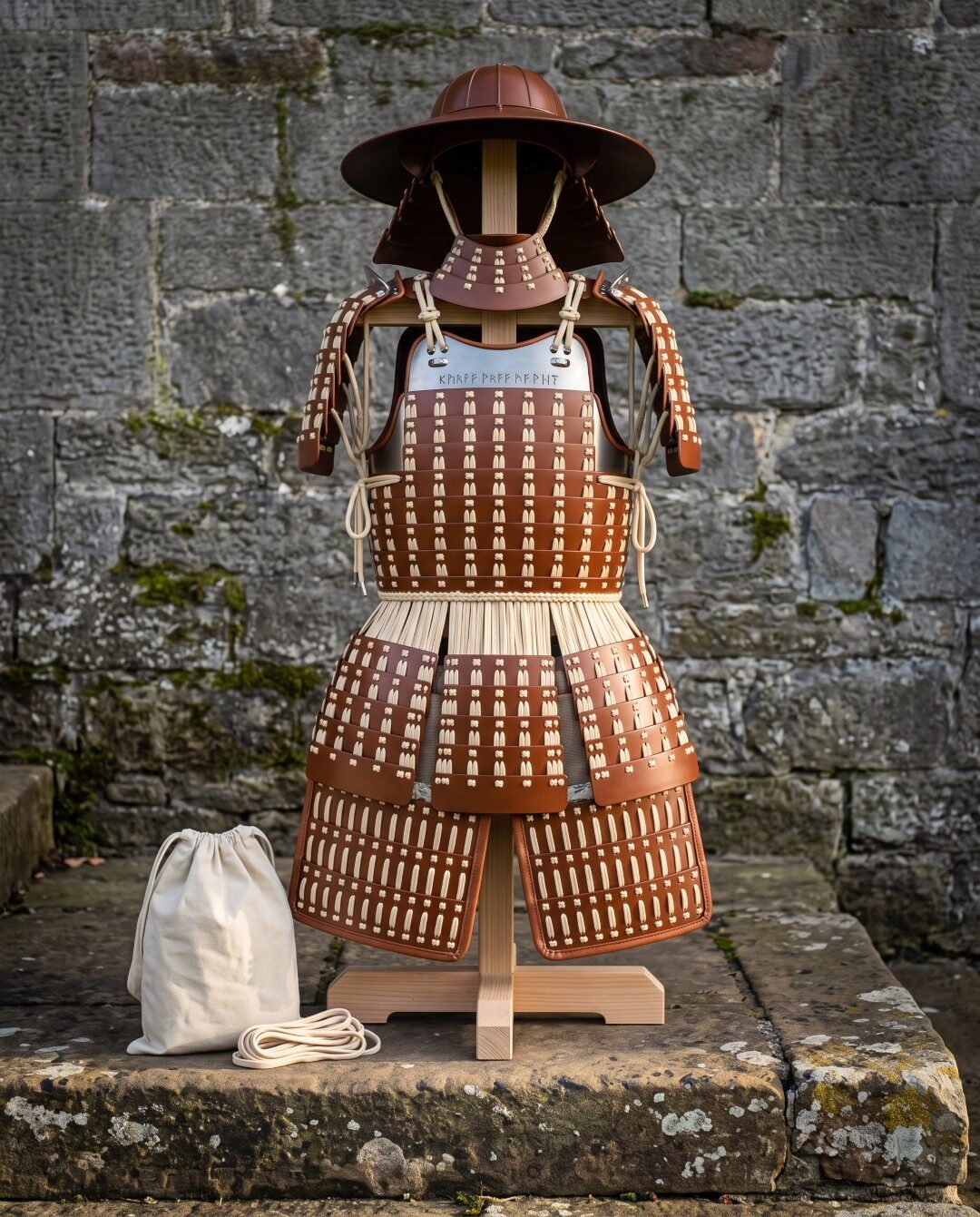
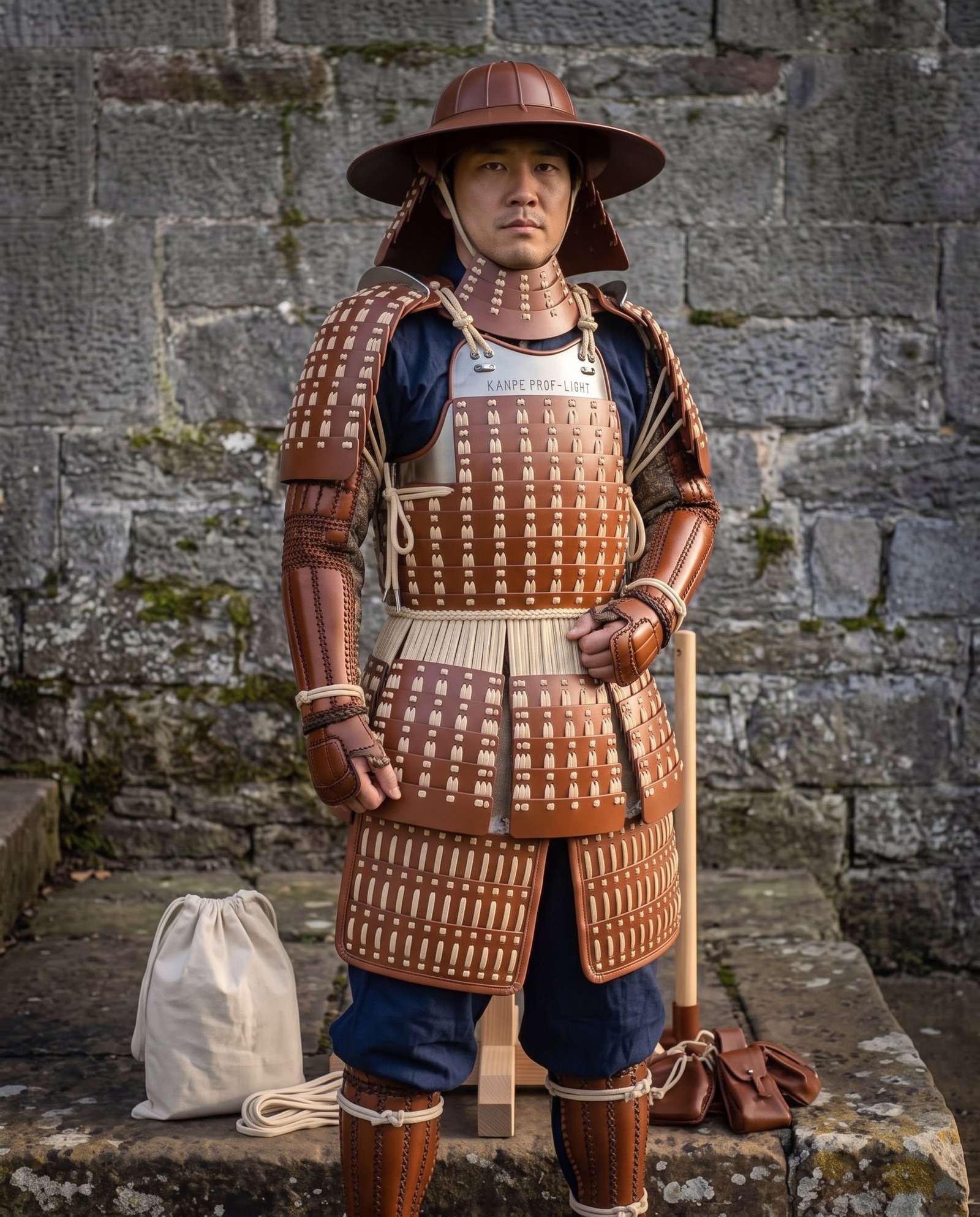
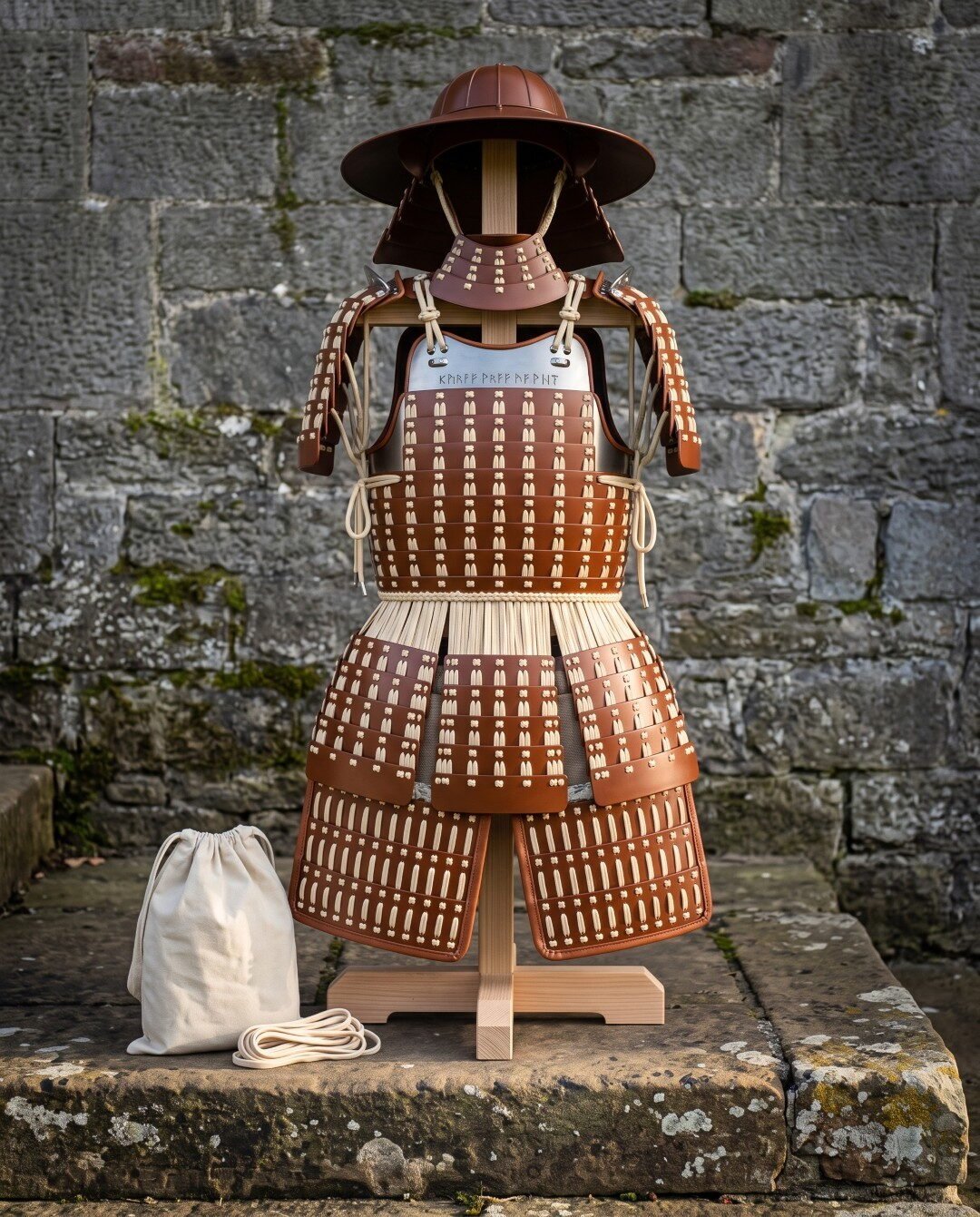
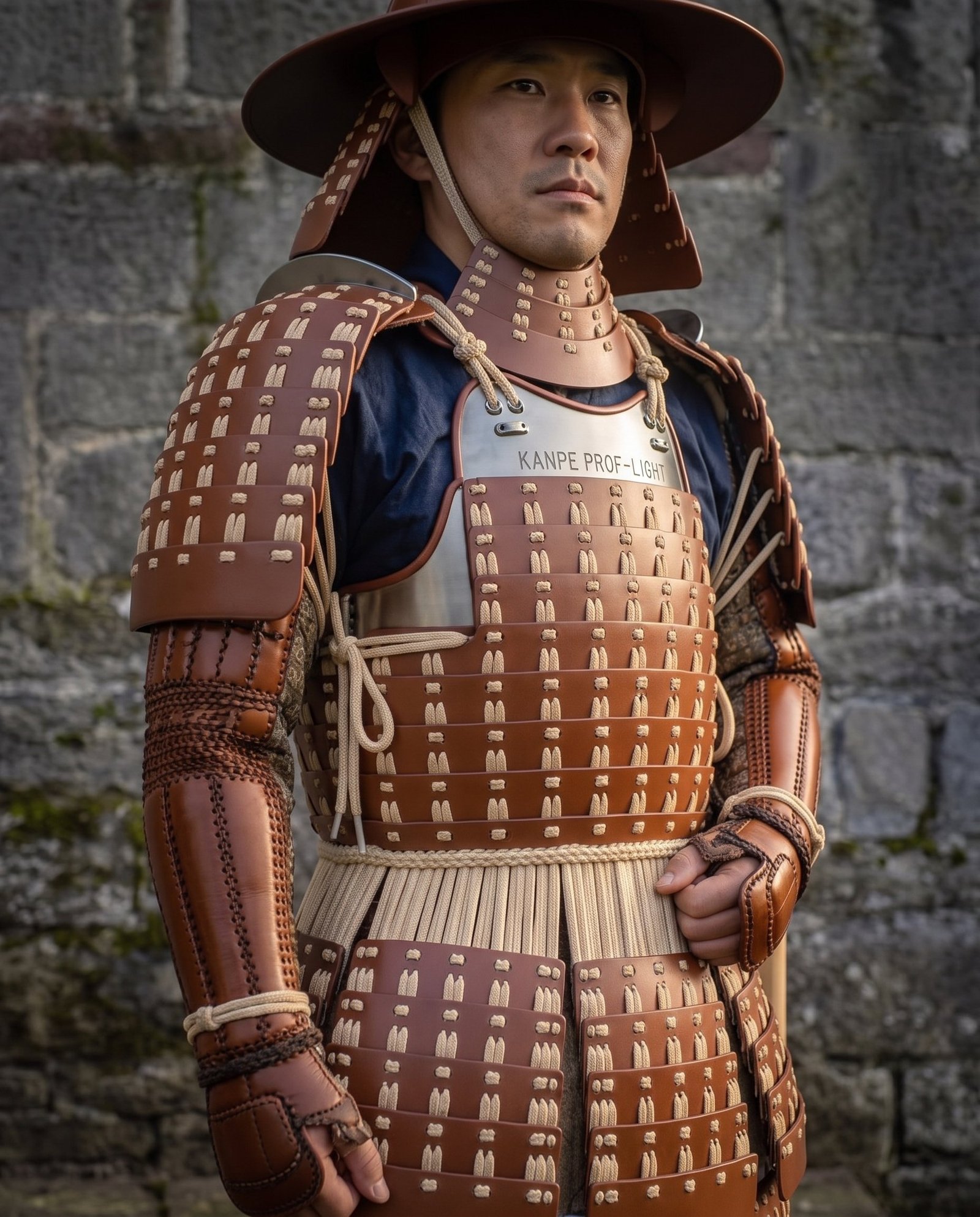
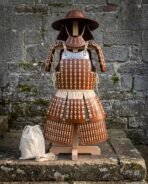
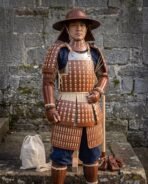
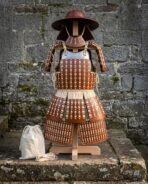
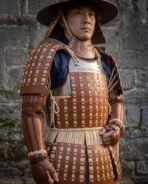
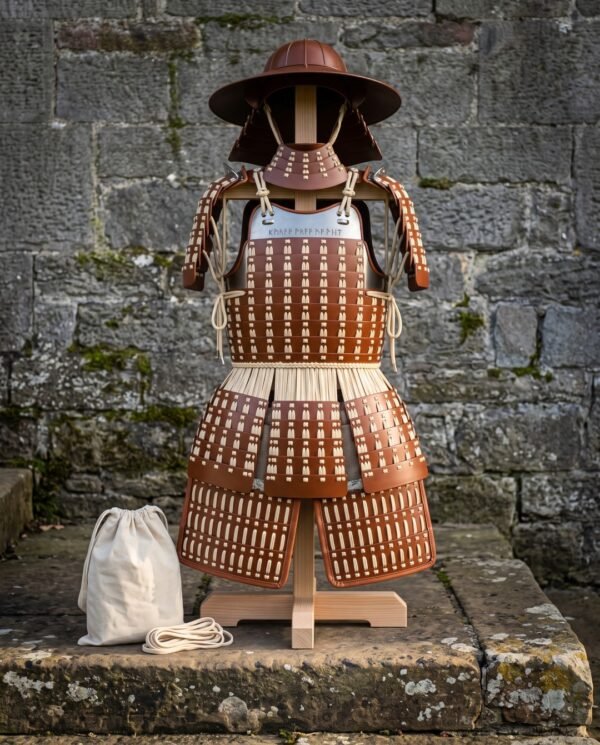
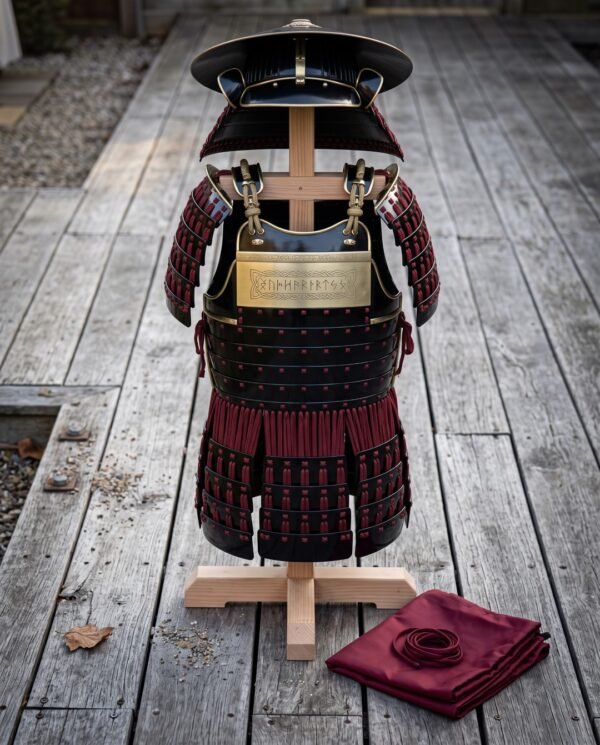
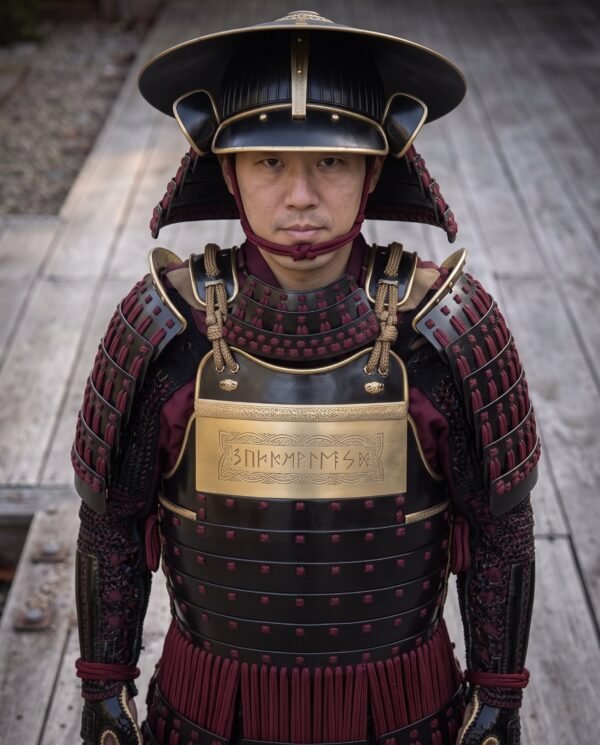
This is a lamellar armour built in the Japanese manner: solid horizontal leather lames, punched, lapped and laced row to row with cream cord, then assembled into a cuirass, a set of hanging skirt plates, shoulder guards, laced arm guards with hand covers, thigh guards and shin guards. Over it sits a wide brimmed helmet with a laced neck guard and a throat plate, and a bright steel plate across the upper chest carries an engraved rune line. It is a Japanese form rather than a Norse one, and we would rather call it what it is than force it into a Viking story.
The interesting thing about lamellar is that it is one of the oldest armour ideas on earth and it kept beating the alternatives for two thousand years across most of Asia. Small plates laced together give you something a solid breastplate cannot: the armour bends with the body at every row, so a man can ride, draw a bow and turn at the waist while wearing it. Japanese armourers refined the idea further than anyone, lacing individual scales called kozane into rows and then lacing the rows to each other in patterns that were as much a statement of family and rank as they were structural. Every piece here is cut, punched, laced and assembled in the Czech Republic. Scale and lamellar fail differently from mail, which we compare in chainmail versus plate versus lamellar.
Specifications
| Material | Solid tan leather lames, vegetable tanned, laced row to row with cream cord |
|---|
| Lame thickness | Approximately 2 mm, each row lapping the one below |
|---|
| Coverage | Wide brim helmet with laced neck guard and throat plate, cuirass, shoulder guards, laced arm guards with hand covers, hanging skirt plates, thigh guards, shin guards |
|---|
| Chest plate | Polished steel panel across the upper chest with an engraved Elder Futhark rune line |
|---|
| Skirt | Laced leather skirt plates hung from a cream cord suspension band |
|---|
| Size or fit | Standard adult, roughly a 36 to 44 inch chest, adjustable at the shoulder and waist cords |
|---|
| Weight | Approximately 25 lb complete |
|---|
| Fastening | Cream cord ties at the shoulders and sides, leather waist belt with buckles |
|---|
| SKU | RK-1556 |
|---|
How lamellar actually works
On this armour each row is a single solid leather lame, the form Japanese armourers called itazane, standing in for a row of separate scales. Each lame laps over the one below it, so a point arriving on the surface usually meets two thicknesses of leather, and the rows can still shift against each other as the body moves. A rigid plate stops a blow by being stronger than it. Lamellar stops a blow by being harder to catch square.
The lacing is doing the structural work, not the leather. Every lame hangs on cord through punched holes, and the cord is what transfers load from the struck row into the rows around it. Spread over enough cord, a hit that would dent a solid plate is absorbed across a hand sized area of armour. That is also the weakness of the design, and it is worth being honest about it: cut or rot the lacing and the whole panel comes apart. Japanese armourers knew this, which is why re lacing an old armour was routine maintenance rather than a repair.
The hanging skirt plates and the thigh guards exist because the cuirass has to stop at the waist for you to bend, so the lower body is covered by separate panels that swing free. That is the same problem the European fauld and tassets solve, arrived at independently.
Leather weight, lacing and the steel plate
The lames are vegetable tanned leather at roughly 2 mm, which is the weight that holds a punched hole without tearing and still lies flat in a lapped row. Vegetable tannage matters here for the same reason it matters in a formed mask: it takes and holds a shape, it burnishes at the edges, and it deepens rather than greys as it ages. The tan colour is dyed and burnished rather than pigment coated, so the tone varies a little across panels and will darken over the first year.
The lacing is a heavy cream cord, laced by hand row by row. There is no glue and no staple holding this armour together. It is entirely cord and knots, which is how it should be, and it means a broken run can be re laced rather than written off.
The polished steel plate across the chest is the one deliberately modern element. It is bright mild steel, engraved with a rune line, and it is there because it is ours rather than because a sixteenth century armourer would have put it there. Say the word and it comes off the spec or gets replaced with a plain plate.
Engraving, runes and your own design
Use the rune converter on this page to turn a name, a date or a short phrase into Elder Futhark and we will cut it into the steel or the leather. If you would rather have a Viking pattern than a rune line, choose your own design in the engraving option above the add to cart button and tell us where it goes. Where a piece already carries an engraved design, your chosen engraving replaces it rather than sitting alongside it. On this armour that means the chest plate carries your line instead of ours, and a tooled mark can also be set into the leather of the shoulder guards. More on the engraving page.
Fit and sizing
This is built to one standard adult size and adjusted with cord at the shoulders and a belt at the waist, which gives it a fair working range across roughly a 36 to 44 inch chest. Lamellar is more forgiving than plate because it drapes, but it is not infinitely adjustable, and a very broad chest will close the front panels short.
Measure over what you intend to wear underneath. Japanese armour was worn over a padded undergarment and this should be too, both for comfort and because the lacing knots sit against the body. Height matters for how the skirt plates and thigh guards hang; on a shorter wearer they will sit lower on the leg than in the photograph. The canvas drawstring bag, the coil of cream cord and the wooden display stand shown are studio props and are not included.
Care
Keep it dry, and if it does get wet, dry it slowly at room temperature rather than near a heater. Wet lacing shrinks as it dries and can pull a row tight or snap it. Feed the leather with a neutral conditioner two or three times a year, working around the lame edges where the cord passes. Check the lacing every season for fraying at the wear points, which are the shoulder cords and the top row of the skirt plates. Give the steel chest plate a wipe of light machine oil every month or two. Store it on a stand or laid flat rather than folded and stacked, because folded lamellar puts a permanent bend into the rows. Our notes on protecting steel are on the steel care page. Steel plates rust like anything else, so treat them as in caring for chainmail and steel armour.
Made in the Czech Republic
The work behind this piece happens in a Czech Republic workshop that has kept to the old methods. Steel is forged and heat treated by hand, the grind is taken down by eye rather than by machine, and the handle, fittings and sheath are cut and finished one at a time. Because of that, every piece carries small marks of the hand that made it.
Ransack Viking is a United States company. We import direct, check each piece when it reaches us, and ship from our Chicago, Illinois warehouse. Engraving is added here in the United States after arrival, so the piece you receive is finished to your order.
A note on handmade variation
This armour is hand made, not machine made or bulk produced. What arrives will not be a pixel for pixel copy of the photograph. Leather takes dye differently from hide to hide so the tan runs lighter or deeper, the lacing tension and the exact fall of the knots vary because a person tied every one of them, and the lame edges burnish with their own highlights. The coverage, the materials and the build are the same every time. The character is not, and on a piece with this much handwork the difference is easy to see.
Frequently asked questions
Is this historically accurate Japanese armour?
It is built in the lamellar tradition and follows the form closely, but it is not a museum reproduction of a dated original, and the engraved steel chest plate is our own addition rather than a Japanese feature. We would rather say that plainly.
Can I wear it, or is it display only?
You can wear it for events, photography, film work and non contact demonstration. It is not certified armour and it is not intended for anyone striking at you. Lamellar cord will cut, and a cut run means a panel comes apart.
How heavy is it?
Around twenty five pounds complete. That is genuinely wearable for a few hours because lamellar carries its weight on the shoulders and the waist belt together rather than hanging entirely from the shoulders.
What goes underneath?
A padded undergarment and long sleeves. The knots on the inside face sit against the body and become uncomfortable over a shirt alone. Padded trousers help under the thigh guards.
Does the display stand come with it?
No. The wooden stand in the photograph is a studio prop, as are the canvas bag and the loose coil of cord. The armour itself, with its own cords and waist belt, is what ships.
Can it be re laced if a cord breaks?
Yes, and that is one of the advantages of lamellar. Re lacing a run is normal maintenance rather than a repair. Contact us if you need cord that matches and we will send it.
What is in the box
- Wide brimmed helmet with laced neck guard and throat plate
- Laced leather lamellar cuirass with an engraved steel chest plate
- Pair of shoulder guards
- Pair of laced leather arm guards with hand covers
- Hanging skirt plates and a pair of thigh guards
- Pair of laced leather shin guards
- Leather waist belt and shoulder cords
- Care and warranty card
- Made by hand in the Czech Republic
Explore the range
See the rest of the scale and lamellar armour, the leather armour, the gambesons and brigandines, and the guides.
If this one is not it
In the same category sits the Crimsonlace lamellar armor. A near match for this one is the Nightscale lamellar armor. Closest to this in the range is the Moonhorn lamellar armor.
Fitting out further, the Nightplate plate armor belongs with it. Pick the steel, the length and the fittings yourself on the design your own page.






Did not expect this level of quality for the price. Already planning my next purchase from this shop.
My whole family was impressed when I unboxed it. Fit is excellent and the steel gauge feels genuinely protective. Highly recommend this one.
I collect stuff like this and this armor piece is on another level.