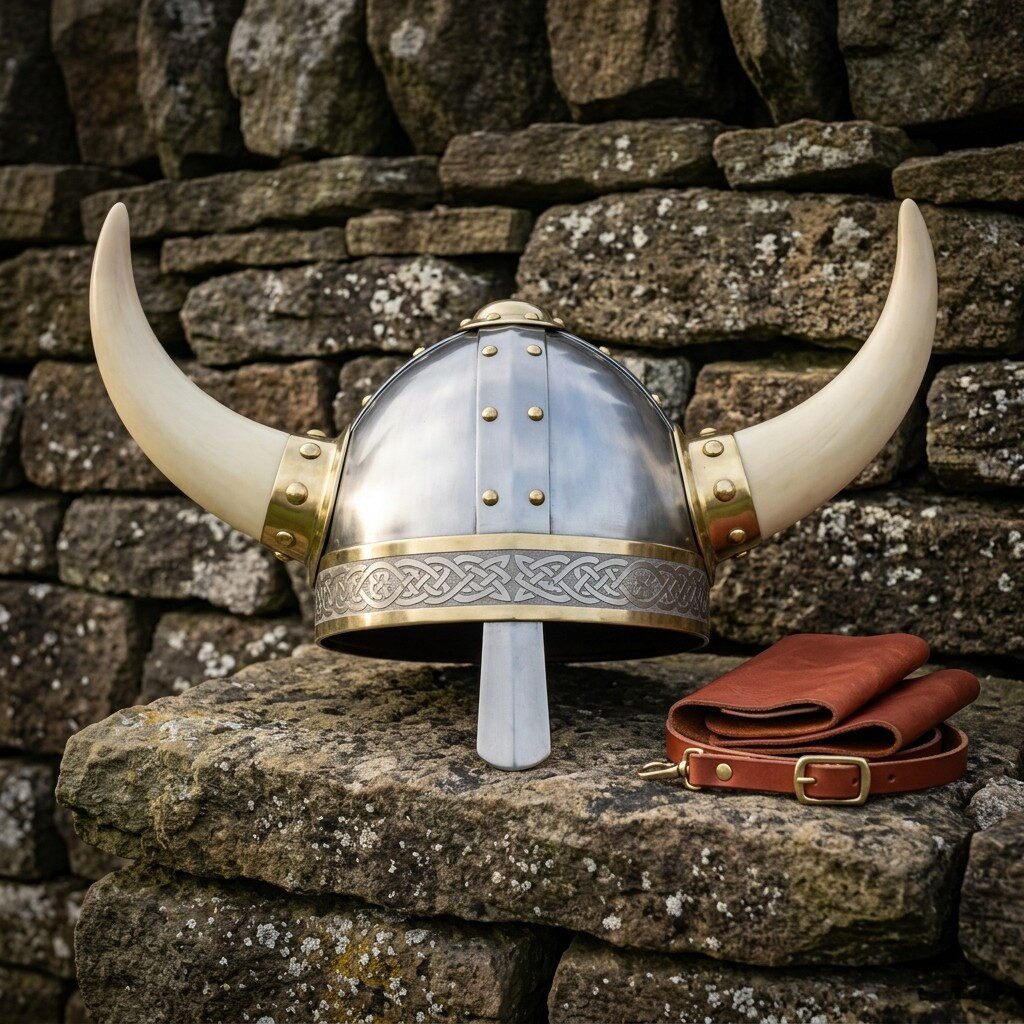
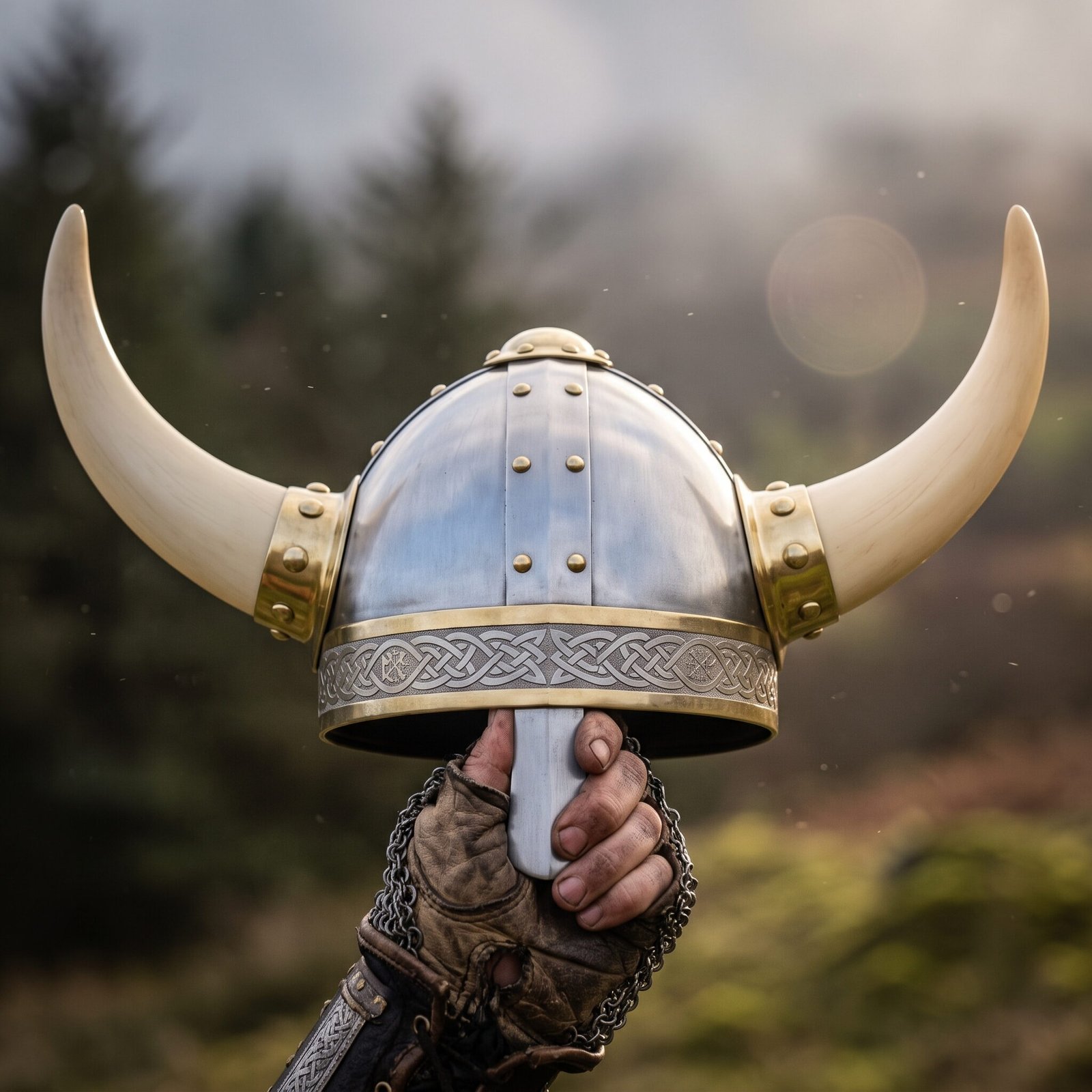
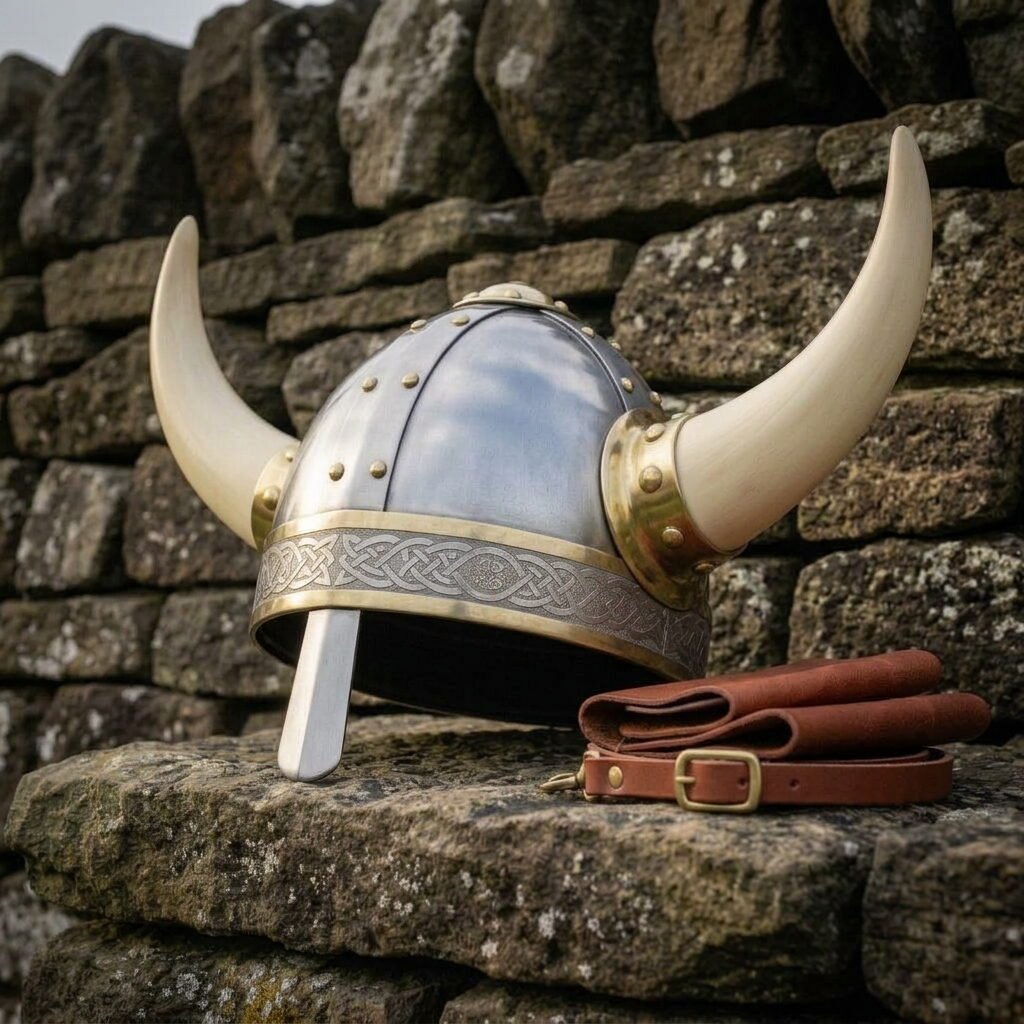
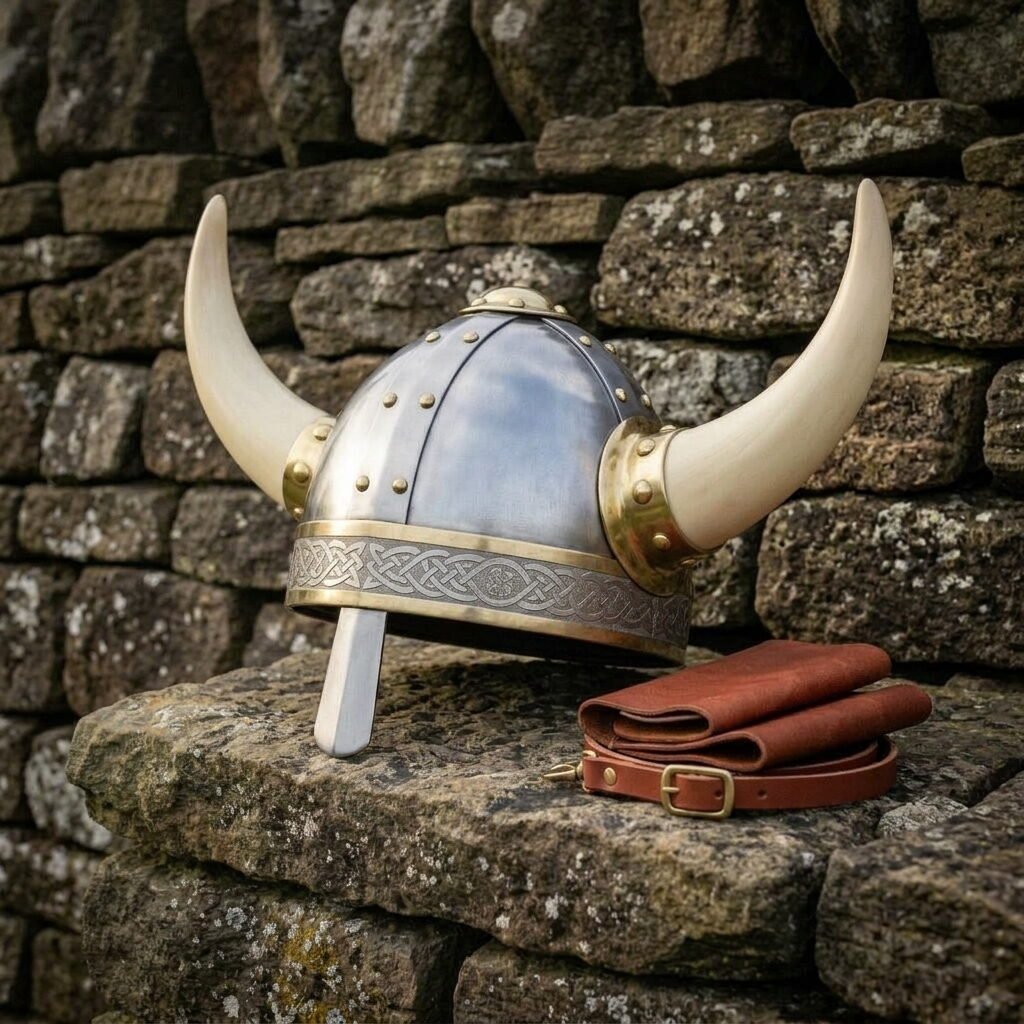
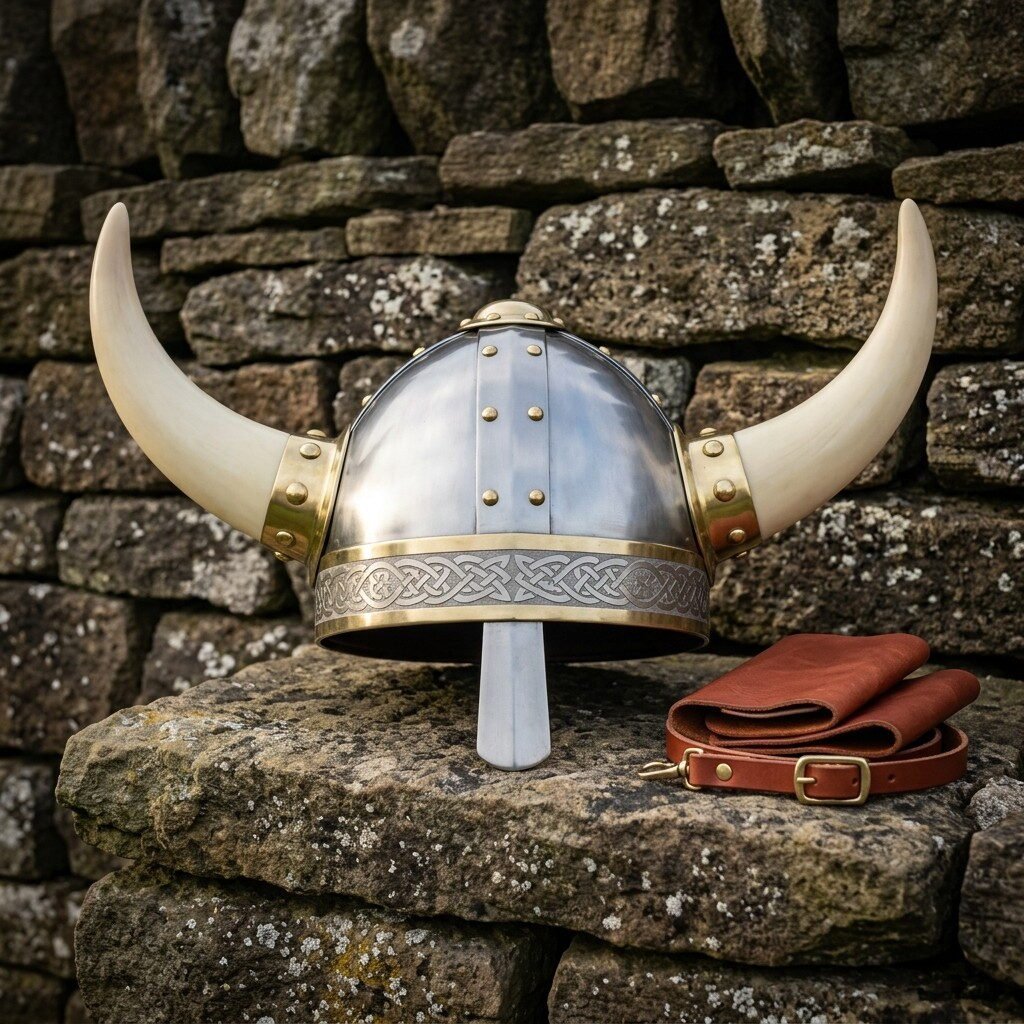
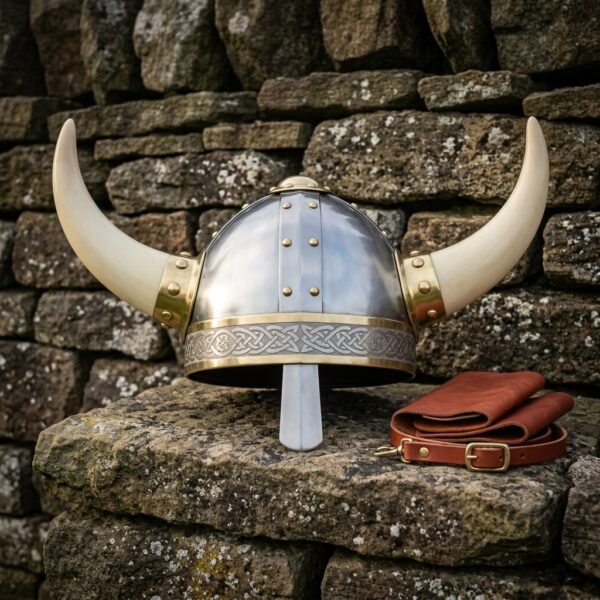
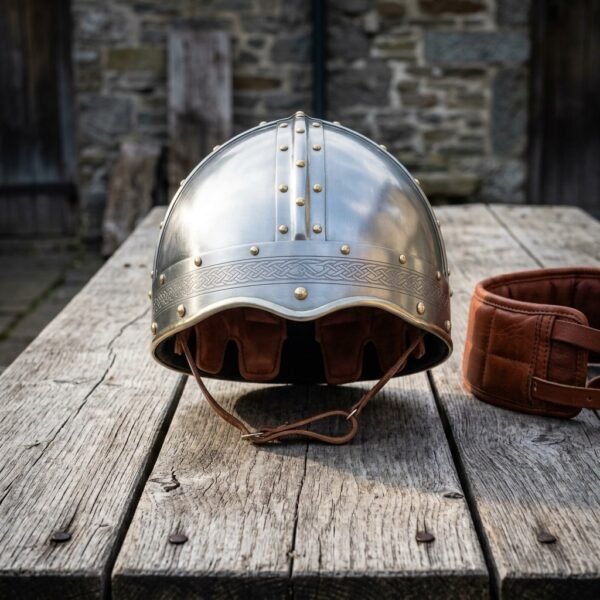
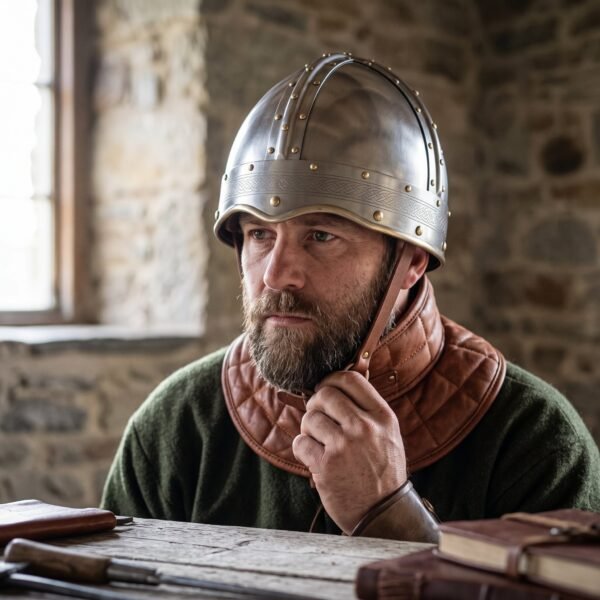
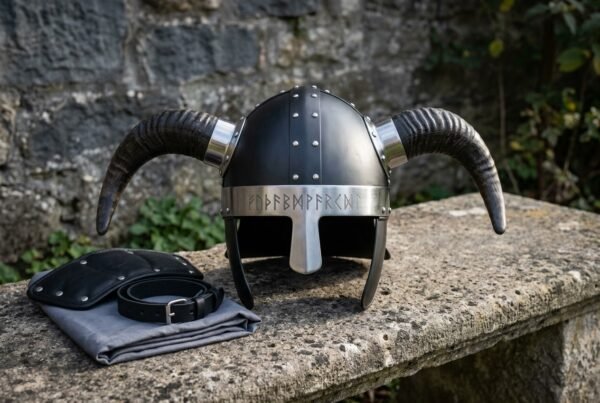
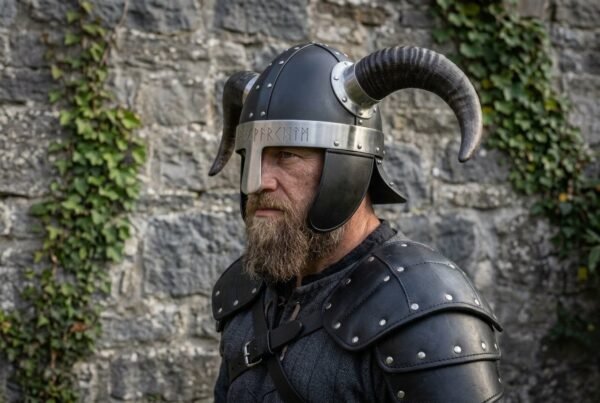
A riveted steel dome helm carrying a pair of pale horns on brass sockets at the temples. The bowl is built from shaped plates riveted together with brass rivet heads, capped with a brass boss at the apex, and finished with a broad steel browband engraved with running knotwork and edged top and bottom in bright brass. A straight nasal bar with a rounded end hangs from the browband at the centre front.
One thing first, because it matters and because the true story is better than the myth. No horned helmet has ever been excavated from a Viking Age warrior grave, ship burial or battlefield. Not one. The image comes almost entirely from Carl Emil Doepler, who designed the costumes for the first Bayreuth production of Wagner’s Ring cycle in 1876 and put horns on his Germanic characters, and from a generation of romantic painters who copied him. There are genuine horned helmets from northern Europe, such as the pair found at Viksoe in Denmark, but they are Bronze Age ceremonial pieces from around 900 BC, which is roughly a thousand years before the first longship reached Lindisfarne. This helmet is a costume and display piece and we sell it as one. It is raised, riveted, engraved and fitted in the Czech Republic. Norsemen did not wear horns into a fight, and where that picture came from is a short and slightly embarrassing story.
Specifications
| Item type | Horned dome helmet with nasal bar, costume and display piece |
|---|
| Material | Mild steel bowl with solid brass rivets, apex boss, browband edging and horn sockets |
|---|
| Gauge | 18 gauge, display and costume weight |
|---|
| Construction | Polished steel dome reinforced by riveted vertical bands with brass rivet heads, brass boss at the apex |
|---|
| Browband | Steel band engraved with running knotwork, edged top and bottom in brass |
|---|
| Nasal | Straight fixed nasal bar with a rounded end |
|---|
| Horns | Natural horn, pale cream, mounted in riveted brass sockets at the temples |
|---|
| Size or fit | Standard adult, roughly 22 to 24 inch head circumference |
|---|
| Weight | Approximately 5 lb with the horns fitted |
|---|
| Lining | Unlined as standard, wear over a padded cap |
|---|
| SKU | RK-1562 |
|---|
The parts that are real
Strip the horns off and what is left is a properly built helmet. The riveted plate construction is exactly what Norse and continental smiths actually used, and for a good reason: early iron came out of the bloomery in small pieces, and raising one unbroken bowl deep enough to cover a skull from a single billet is punishing work. Building the dome from shaped plates riveted together gets you the same helmet from stock a smith could realistically make, and it lets a damaged plate be drilled out and replaced instead of scrapping the whole helm.
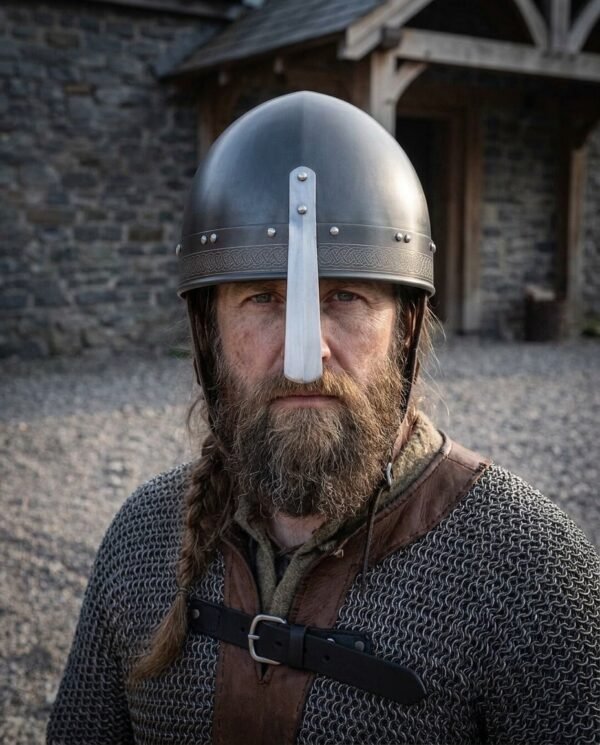
The nasal bar is real too, and it is the most genuinely Viking feature on the piece. Nasals appear on the surviving Gjermundbu helmet from Norway and across a wide band of eleventh century European helms, and they do something specific: a bar down the centre of the face stops a downward cut from sliding off the brow into the nose and eyes, which is the single most likely place for a blow to land on a man who is looking at you. It costs almost nothing in weight and vision and it protects the part of the face you cannot afford to lose.
The horns are the part that is not real, and it is worth saying why they would have been a bad idea. Anything projecting from a helmet is a lever. Grab a horn in a press of bodies and you can turn a man’s head for him, and a blow that catches a horn transmits straight into the neck instead of glancing away.
Steel, brass and horn
The bowl is 18 gauge mild steel, roughly 1.2 mm, which is the standard weight for a display and costume helmet. It holds its shape, it takes the polish, and it is light enough to wear through an evening. It is not combat armour and it should never be taken into any environment where someone is striking at your head.
The brass is solid rather than plated: the rivet heads, the apex boss, the two bands edging the browband and the horn sockets are all brass, and they will patinate to a warm gold over the years unless you polish them back. The knotwork across the browband is engraved into the steel and the ground is textured so the pattern reads at a distance.
The horns are natural horn, which means each pair differs in curve, in length and in the amount of cream and grey figure running through them. They are seated into the brass sockets rather than glued to the bowl, so a horn can be drawn and reseated if it ever works loose.
Engraving, runes and your own design
Use the rune converter on this page to turn a name, a date or a short phrase into Elder Futhark and we will cut it into the steel or the leather. If you would rather have a Viking pattern than a rune line, choose your own design in the engraving option above the add to cart button and tell us where it goes. Where a piece already carries an engraved design, your chosen engraving replaces it rather than sitting alongside it. On this helm that means the knotwork browband gives way to your rune line, which runs beautifully all the way round the head. See the engraving page.
Fit and sizing
Built to one standard adult size for roughly a 22 to 24 inch head circumference. Measure with a soft tape just above the eyebrows and around the widest part of the back of the skull before you order. Set it so the browband sits just above your brows and the nasal falls centrally down the bridge of your nose.
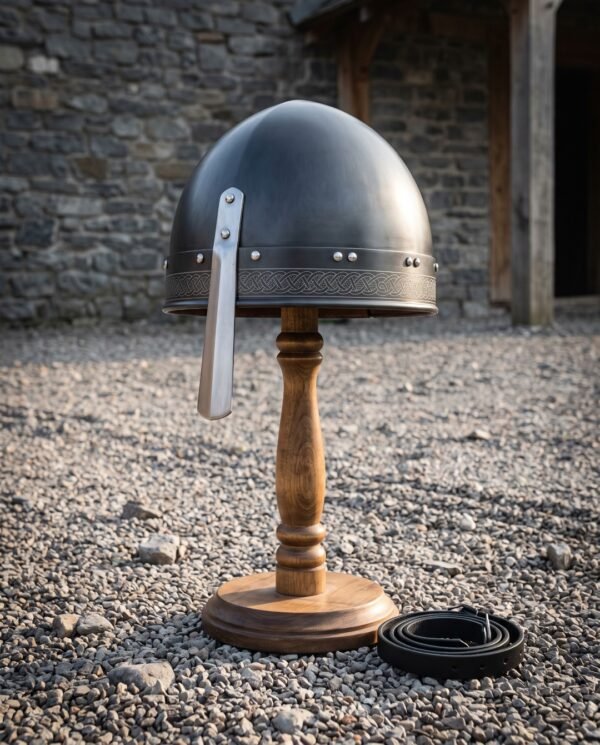
It is supplied unlined so you can pad it to your own head, and it should be worn over a padded cap. Padding is not a comfort extra: it is what stops the helmet rocking and what keeps the steel off your skull. Remember that the horns add width. This helmet is significantly wider than your shoulders and doorways, car doors and crowded rooms will remind you of that. The folded tan leather and the leather belt shown beside the helmet in the photograph are studio props and are not included.
Care
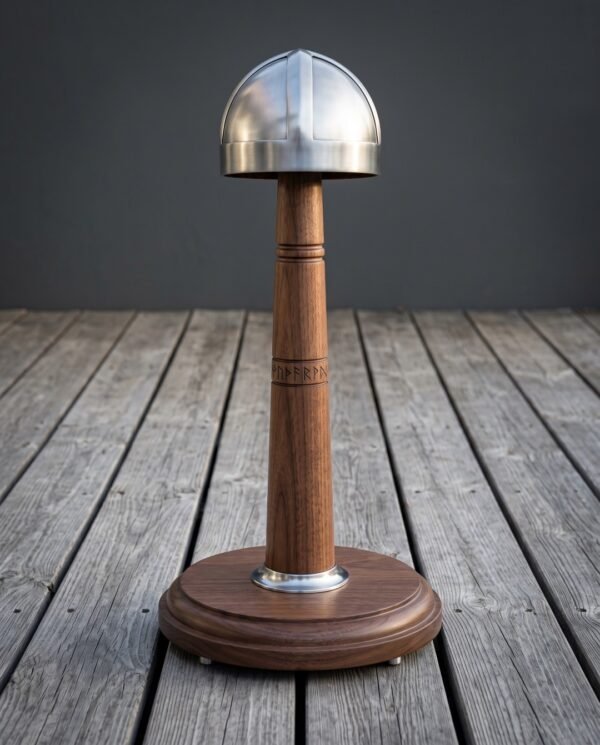
Wipe the steel dry after every wearing, because sweat is far harder on a helmet than rain and it collects inside the bowl where nobody looks. Give the steel a thin film of light machine oil or a metal wax every month or so. Polish the brass only if you want it bright; most owners let it warm up. Wipe the horns with a dry cloth and give them an occasional light rub of neutral wax, and keep them out of direct heat and prolonged sun, which dries natural horn and can craze the surface. Store the helmet upright on a stand with the horns clear of anything, never face down and never wrapped in plastic. Notes on protecting a steel finish are on the steel care page. Fit, steel gauge and the shapes worth avoiding are covered in buying a Viking helmet.
Made in the Czech Republic
This piece is made by hand in the Czech Republic, in a workshop that still works the old way. The steel is forged, ground, heat treated and finished by smiths who learned the trade from the people before them, and the wood, horn and leather are cut and fitted by hand rather than pressed out on a line. That is also why no two pieces come out exactly the same.
Ransack Viking is a United States company. We import these pieces ourselves, check every one when it lands and ship from our warehouse in Chicago, Illinois. Engraving is done here in the United States after the piece arrives, so your runes or your own design go on before it leaves for you.
A note on handmade variation
This helmet is hand made, not machine made or bulk produced. What arrives will not be a pixel for pixel copy of the photograph. The horns are natural material and every pair has its own curve, length, colour and figure, so yours will not match the ones shown. The dish of each plate is worked over a stake by hand, the rivet spacing is set by eye, and the engraved knotwork runs with its own rhythm around the band. The gauge, the dimensions and the build are the same every time. The character is not.
Frequently asked questions
Did Vikings really wear horned helmets?
No. Not a single horned helmet has come out of a Viking Age warrior context. The image was largely invented for the stage in 1876. The horned helmets that do exist from Denmark are Bronze Age ceremonial pieces around a thousand years older.
So why sell one?
Because it is a wonderful costume piece and people love it, and because we would rather sell it to you with the true story attached than pretend it is archaeology. Everything on it apart from the horns is built the way a real helm is built.
Can I wear it for reenactment?
For costume, parades, film work, photography and parties, yes. Serious reenactment groups will not accept a horned helmet as period kit, and no full contact group will accept it as head protection.
Are the horns real?
Yes, natural horn, seated in brass sockets rather than glued to the bowl. Every pair differs in curve, colour and length, which is the nature of the material.
Can the horns be removed?
They are seated in the sockets and can be drawn and reseated. The sockets stay on the helmet, so removing the horns leaves two brass mounts at the temples rather than a plain helm.
How long before it ships?
Processing is one to two weeks because each helmet is dished, riveted, engraved and horned to order. Shipping inside the United States is free and returns are accepted within seven days.
What is in the box
- One riveted 18 gauge steel horned helmet with a fixed nasal bar
- Pair of natural horns seated in solid brass sockets
- Engraved knotwork browband with brass edging bands and a brass apex boss
- Care and warranty card
- Forged and finished in the Czech Republic
Explore the range
See the rest of the Viking helmets, the medieval helmets, the Viking armour, and the guides.
Close to this one
Closest to this in the range is the Hornreave Viking helmet. If this one is not quite right, there is the Thornpeak Viking helmet. Also in this group is the Wyrmgaze Viking helmet.
If you are putting a set together, the Legionplume Greek helmet sits alongside it. Nothing here exactly right, build one to your own spec on the design your own page.


Showed up right on time and looked even better than the photos. Looks incredible with the rest of my reenactment kit. If you’re on the fence just get it. You won’t regret it.
Got this as a gift and now I want one for myself too. Fit is excellent and the steel gauge feels genuinely protective. Padding and straps make it comfortable to wear for hours. Exactly the look I wanted for my collection. Worth every penny.
This helmet is a genuine work of art. Padding and straps make it comfortable to wear for hours. Can’t recommend this enough.
Absolutely blown away by this helmet.
Got this as a birthday gift and the reaction was priceless. Looks incredible with the rest of my reenactment kit. Fit is excellent and the steel gauge feels genuinely protective. Padding and straps make it comfortable to wear for hours. Already telling my friends to check this out.