
Blog
What Is a Wakizashi? The Short Sword Beside the Katana

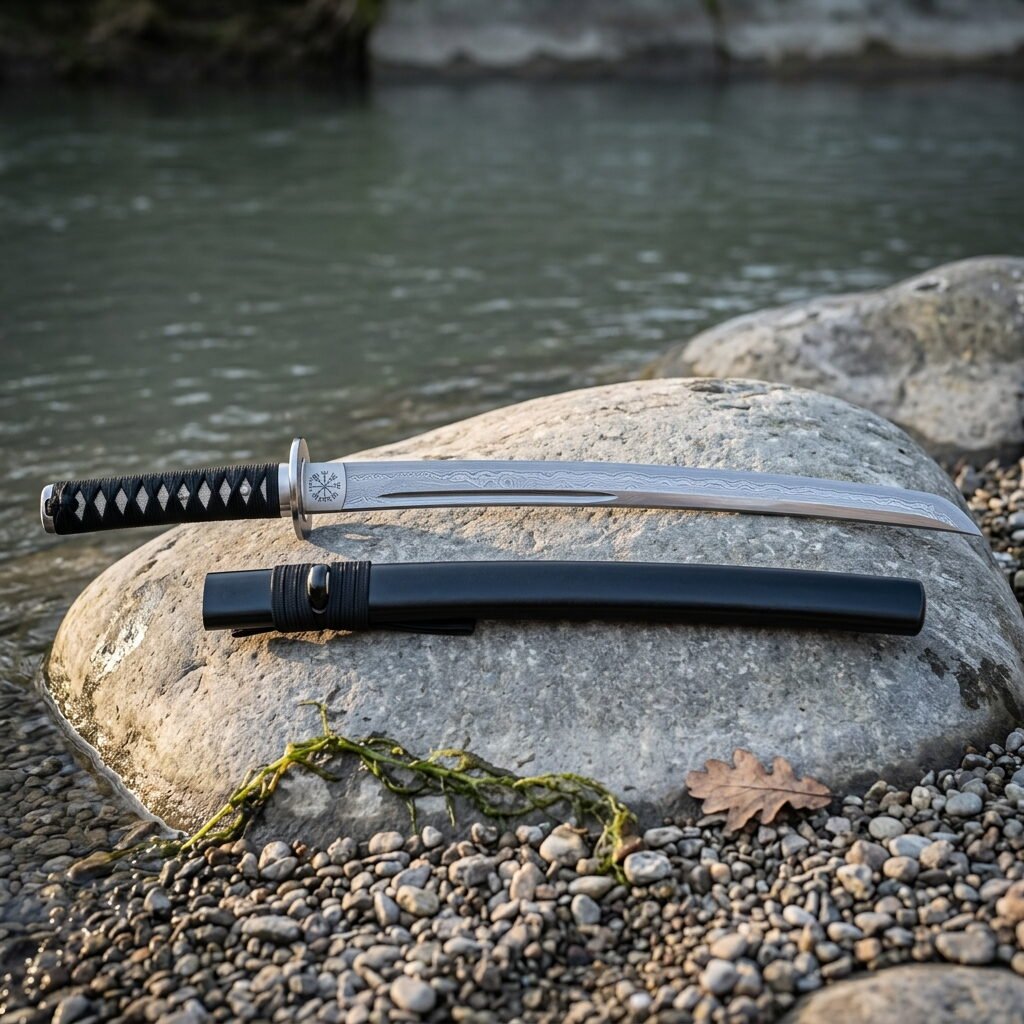
A wakizashi is a Japanese short sword with a blade between roughly 30 and 60 centimetres, about 12 to 24 inches. Anything longer is a katana, anything shorter is a tanto. The categories are settled with a ruler, not with a philosophy. Worn together with the katana it forms the daisho, the paired set that marked a samurai in the Edo period, and it was the blade kept on the body when the long sword was set aside.
The measurement that defines it
Japanese blade classification is a length rule, not a shape rule. The unit is the shaku, close to 30.3 centimetres. A blade under one shaku is a tanto. Between one and two shaku it is a wakizashi. Over two shaku it is a katana or, in older mountings, a tachi.
That is the whole distinction. A wakizashi and a katana can be forged by the same smith, in the same style, with the same grain and the same temper line, and differ only in that one is longer than sixty centimetres and the other is not. Collectors split the middle class further, calling the long end o wakizashi and the short end ko wakizashi, but those are descriptive conveniences rather than separate types.
The word itself means something like side inserted, describing how the sword was pushed through the sash at the waist. It says nothing about the blade at all, which has never stopped anyone.
The daisho and who was allowed to wear it
Daisho translates roughly as big and small. The pairing of a long sword with a short one becomes standardised during the Edo period under Tokugawa rule, when the shogunate tightened the rules on who could carry what. Wearing both marked you as a samurai. That was a legal status as much as a martial one.
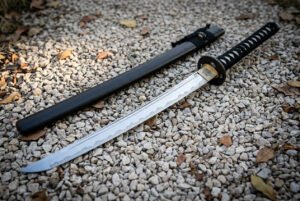 Moonwake Hand Forged 1095 Steel Wakizashi Short Sword | 26 Inch Overall with 18 Inch Blade | Clay Hardened Hamon and Brass Habaki | Japanese Collector Gift | RK-1757
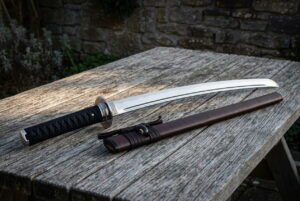 Reedcurve Hand Forged 1095 Steel Wakizashi Short Sword | 28 Inch Overall | Black Ribbed Grip and Brown Leather Saya | Japanese Sword Collector Gift | RK-1831
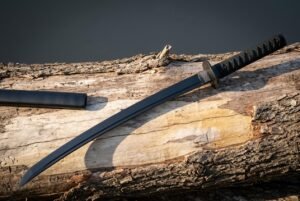 Shadowcurve Hand Forged 1095 Steel Black Wakizashi Short Sword | 28 Inch Overall | Blackened Curved Blade and Cord Wrapped Tsuka with Matching Saya | Collector Gift | RK-1897
The short sword had a wider social reach. Merchants, innkeepers and travellers of non samurai status could in various circumstances carry a wakizashi or a shorter blade for protection on the road, where carrying a long sword would have been an offence. So the wakizashi is the one Japanese sword that is not exclusively an aristocratic object.
Edo period etiquette accounts describe the long sword being surrendered or left on a rack at the entrance to a house, with the short sword staying on the person. That is why the wakizashi is often described as the indoor blade. It is a reasonable summary of a set of customs that varied by place, household and century, so treat it as a general pattern rather than a fixed rule.
How a wakizashi was made
The steel
Traditional Japanese blades begin with tamahagane, steel produced in a clay smelting furnace called a tatara from iron sand and charcoal. The output is uneven, so the smith breaks it up, sorts pieces by carbon content by eye and by fracture, and stacks the selected material into a billet. Folding and welding that billet repeatedly evens out the carbon and drives off slag, and it produces the surface grain, the hada, that collectors read like a fingerprint.
Folding is often described as a way of making the steel stronger. That is the wrong way round. It is a way of making inconsistent steel consistent. Start with modern homogeneous steel and folding adds pattern rather than performance, and a listing that boasts about its fold count is selling you arithmetic. The steel glossary unpacks the vocabulary you will meet on listings.
Clay, quench and the hamon
The feature that makes a Japanese sword recognisable is differential hardening. Before quenching, the smith coats the blade in a clay slurry: thin along the edge, thick over the spine and the body. In the quench the thinly coated edge cools fast and transforms into hard martensite while the thickly coated spine cools slowly and stays softer and tougher.
Two things follow. The blade gains or increases its curvature during the quench, because the transformed edge expands. And a visible boundary appears between the hard and soft zones, the hamon, whose shape depends on how the clay was laid on. A real hamon is a structural boundary you can see because the two zones polish differently. A printed or acid etched line is a picture of one.
Polishing and mounting
Polishing in the Japanese tradition is a separate profession. A togishi works through a long series of natural stones, and the job is to reveal the grain and the temper line as much as to sharpen. A badly polished blade of excellent make looks dull and lifeless, and the fault is never the smith’s.
The mounts, the koshirae, are their own world: the habaki collar that locks the blade in the scabbard, the tsuba guard, the tsuka handle with its ray skin and cord wrap, the menuki tucked under the wrap, and the saya scabbard in lacquered wood. On a proper daisho the fittings on the long and short sword are made to match.
How it was actually used
Close in and indoors. A sixty centimetre blade in a corridor or a low ceilinged room is a serious proposition where a long katana is fighting the architecture. The wakizashi is also the blade that stays with you when custom or law takes the long sword away, which makes it the practical last resort rather than the ceremonial spare.
Two handed use is possible on the longer examples but the grip is short, and most surviving technique for the short sword assumes one hand, often with the long sword in the other. Schools that teach paired use exist, though the two sword style is a minority tradition rather than the norm.
The wakizashi is also strongly associated in popular accounts with ritual suicide. The association is real in the literature, but it has been magnified out of proportion by film and fiction. The short sword’s ordinary job was defence at close range, which sells rather fewer tickets.
What survives
Unusually for historical arms, Japanese blades survive in enormous numbers and in excellent condition, because they were maintained continuously, remounted rather than discarded, and treated as heirlooms. Blades signed by smiths from the Kamakura period onward are still in circulation, held in Japanese collections, shrines and museums, and in private hands worldwide.
That continuity is why Japanese sword scholarship is so precise compared with, say, Norse or Frankish material. Signatures on the tang, documented lineages of smiths, and centuries of connoisseurship give a level of attribution that European archaeology can only dream of. It also means the market is full of genuine antiques, genuine modern art swords, and a very large volume of production pieces in between, not all of them described accurately.
What to look for if you are buying one
Decide first whether you want a display sword or a cutter, because the honest answers diverge sharply and most listings would rather you did not ask.
For any sword you intend to swing, the tang is the first thing to ask about. It should run the full length of the handle and be secured by bamboo or horn pegs, the mekugi, through holes in the tang and the grip. A short tang glued or threaded into a handle is a wall fitting. It will fail.
Second, ask what the temper line is. A genuine differential hardening produces a hazy, three dimensional boundary with structure inside it. An etched line is crisp, flat and identical along its length. Neither is dishonest as long as the seller says which one you are getting, and a through hardened monosteel blade can be a perfectly sound cutter without any hamon at all.
Third, check the fit. The blade should sit firmly in the saya with the habaki taking the load, not rattle. The handle wrap should be tight enough that nothing shifts under the palm. Draw and sheathe it a few times if you can.
Fourth, plan for maintenance before you buy. Carbon steel rusts, and a lacquered wooden scabbard traps moisture beautifully. Oil the blade, store it horizontally with the edge up, and do not leave it in the saya in a damp room. Our knife care guide covers the same principles at smaller scale, and they apply directly.
Finally, be sceptical of pattern claims. A rippled surface on an affordable blade is a forge welded layered pattern, not traditional tamahagane hada. Our piece on what Damascus steel is explains what that pattern actually is and how to read it.
What we sell
Our katana and Japanese swords range covers wakizashi individually and as part of matched daisho sets, alongside katana, tanto and ninjato, with the overall length, blade length and mounts stated on each listing so you can check the classification for yourself. House steel is plain 1095 run at 54 to 58 HRC. Where a piece is Damascus, it is 1095 and 15N20 forge welded and run at 58 to 60 HRC, which is a layered pattern rather than traditional folded tamahagane, and we say so on the page. The wider swords section puts these next to European and Middle Eastern blades if you are comparing traditions, the daggers range covers the shorter fixed blades, and the sword stands and displays section has racks sized for a pair. Ransack Viking is a US company in Chicago, Illinois. Every piece is handmade in the Czech Republic the old way, then imported, inspected and shipped from Chicago. Engraving is done in the US after arrival.
Where it sits against the other two lengths is set out in the three Japanese lengths compared, and the shortest of them is covered in the tanto.
Questions people ask
How long is a wakizashi?
The blade measures between one and two shaku, which is roughly 30 to 60 centimetres or about 12 to 24 inches. Below one shaku the blade is classed as a tanto and above two shaku it becomes a katana. The classification is purely a matter of length, so a wakizashi can share its shape, grain and temper line with a katana by the same smith. The ruler decides, not the romance.
What is the difference between a katana and a wakizashi?
Length, and nothing else in principle. A katana has a blade over two shaku, about 60 centimetres, while a wakizashi falls between one and two shaku. Both are curved, single edged and worn edge up through the sash. Worn as a matched pair with fittings made to go together, the two form the daisho that identified a samurai during the Edo period.
What is a daisho?
Daisho means big and small, and refers to a long sword and short sword worn together as a set, usually a katana with a wakizashi. The practice was standardised under Tokugawa rule and became a marker of samurai status. On a proper daisho the tsuba, handle wrap and scabbard finish on both swords are made to match, which is part of what makes a matched set desirable.
Why does a wakizashi have a hamon?
Because the blade is differentially hardened. The smith coats the sword in clay before quenching, thin at the edge and thick over the spine, so the edge cools fast and hardens while the body stays softer and tougher. The hamon is the visible boundary between those two structures. A real one has depth and haze in it, while an acid etched line is flat and uniform along its length, because it was drawn on rather than earned.
Could ordinary people carry a wakizashi in Japan?
In various circumstances, yes. Wearing the full daisho was restricted to the samurai class, but merchants, innkeepers and travellers of other statuses were at times permitted a short sword for protection on the road. That makes the wakizashi the least exclusive of the classic Japanese blades, and it is one reason so many survive in ordinary rather than aristocratic mountings.
How do I care for a wakizashi?
Treat it as carbon steel, because that is what it is. Wipe the blade down after handling, since fingerprints etch, and apply a light film of a suitable blade oil. Store the sword horizontally with the edge upward, and keep it out of the scabbard in humid conditions, because a lacquered wooden saya holds moisture against the steel and will start rust you cannot see until it is a problem.
If you are buying
If you are shopping rather than reading, the Riverstone Wakizashi and the Bonecrest Wakizashi are the nearest match. Also worth opening, the Cinderpine Wakizashi and the Tidefold Wakizashi.
The sword that stayed on
The wakizashi was the blade still on the body once the long sword was left at the door, and Europe kept a similar habit with the smallsword. The smallsword and spadroon guide covers the European side of it. The Skaldrun spadroon trainer is one way in, and the others are under smallswords and spadroons.
Shop the range
Moonwake Hand Forged 1095 Steel Wakizashi Short Sword | 26 Inch Overall with 18 Inch Blade | Clay Hardened Hamon and Brass Habaki | Japanese Collector Gift | RK-1757Reedcurve Hand Forged 1095 Steel Wakizashi Short Sword | 28 Inch Overall | Black Ribbed Grip and Brown Leather Saya | Japanese Sword Collector Gift | RK-1831Shadowcurve Hand Forged 1095 Steel Black Wakizashi Short Sword | 28 Inch Overall | Blackened Curved Blade and Cord Wrapped Tsuka with Matching Saya | Collector Gift | RK-1897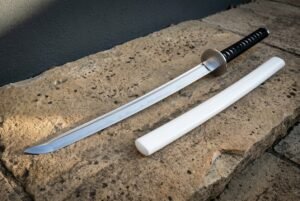 Snowfold Hand Forged 1095 Steel Katana | 38 Inch Overall | Visible Hamon and Antiqued Round Tsuba with Gloss White Saya | Japanese Collector Gift | RK-1899
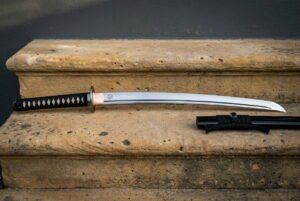 Inkwake Hand Forged 1095 Steel Katana | 36 Inch Overall | Rayskin and Cord Wrapped Handle with Black Lacquered Saya | Japanese Sword Gift | RK-1836
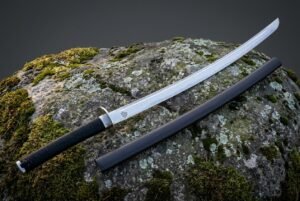 Valkcurve Hand Forged 1095 Steel Viking Katana | 40 Inch Overall | Valknut Etched Blade and Black Leather Wrapped Tsuka with Lacquered Saya | Norse Gift | RK-1900