Blog
Runestones: Who Raised Them, What They Say and Where They Stand


Runestones are memorial stones raised by families in Scandinavia, carved in the sixteen stave Younger Futhark. Most date from the eleventh century, most stand in Sweden, and the usual text names who paid for the stone and who is being remembered. That is the whole genre. Roughly three thousand survive, and a good number are still in the ground where they were set, unbothered by everything that has since been claimed about them.
They are not magical objects, and they are not chronicles. They are public statements about family, property and standing, made in stone because stone lasts.
What a runestone actually is
Take away the carving and you have a slab of granite or gneiss stood on end beside a road, a bridge, a crossing or a boundary. The carving is a band, usually shaped as a serpent or a beast whose body carries the text, with a filling ornament in the middle. It was cut with a chisel, then painted. Traces of pigment survive on a number of stones, and reconstructions using red, black and white are based on those traces rather than guesswork. A freshly raised stone was a painted notice board. The grey lichen covered slab you photograph today is a thousand years of weather, not a design decision.
Counts vary with the definition. Around six thousand runic inscriptions of all kinds are known from Scandinavia, on stone, bone, wood and metal. Of the standing memorial stones, something near three thousand, and the great majority are Swedish, with well over a thousand in the province of Uppland alone. Denmark and Norway have far fewer.
The alphabet on them
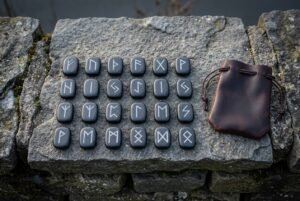 Fatecast Hand Made Engraved Slate Rune Set with 24 Elder Futhark Casting Stones | Complete Rune Row in Three Aettir | Leather Drawstring Pouch and Guide Card | RK-1695
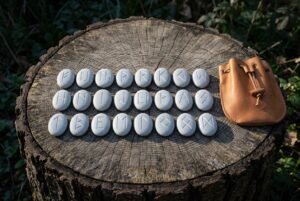 Stonecast Hand Made Elder Futhark Rune Set | 24 Engraved Casting Stones | Tumbled Stone with Tan Leather Drawstring Pouch | Norse Divination Gift | RK-1780
 Amberdraught Hand Made Valknut Drinking Horn and Oak Stand | Pale Natural Ox Horn | Solid Brass Rim Band with Tan Leather Belt | Norse Wedding Gift | RK-1685
Younger Futhark, not Elder
This trips up almost everybody, including a good number of people selling runes. The runes on Viking Age stones are the Younger Futhark, sixteen characters. The twenty four character Elder Futhark that fills modern jewellery and rune sets went out of use before the Viking Age began, around the eighth century. Younger Futhark has fewer signs than the language had sounds, so one rune can stand for several sounds, which is part of why reading these inscriptions is a specialist job.
Two main styles exist. Long branch runes, sometimes called Danish, have full height strokes and appear on formal monuments. Short twig runes, sometimes called Swedish and Norwegian, are quicker to cut and turn up more in everyday writing. A stripped down staveless variant is known from Halsingland in Sweden. Carvers mixed styles freely, and the labels are modern conveniences rather than national rules.
Why modern rune sets use the older row
Twenty four Elder Futhark staves map neatly onto sounds and give a longer set of names to work with, which is why the divination kits and the engraving fonts you see today are built on that row rather than the one actually carved on the stones. There is no deception in it as long as it is stated plainly, which is more than most sellers manage.
What the inscriptions say
The standard formula is short and repeats across hundreds of stones. Somebody had this stone raised in memory of somebody, described by relationship, sometimes with a line about how the person died or where. Then, often, a line about the carver.
Beyond that core you find a few recurring additions. Christian prayers appear as the eleventh century goes on, asking God or God’s mother to help the soul. Bridge and causeway building shows up repeatedly, with the stone recording that the sponsor made a bridge for the soul of the dead, which was a recognised act of charity. Travel appears: stones commemorate men who died in England, in Greece, meaning Byzantine service, in Serkland, meaning the Muslim east, and in Gardar, meaning the lands of the Rus.
Carvers signed their work. Opir left his name on a large number of Uppland stones. Asmund Kareson and Fot are other signed hands. Comparing signed stones to unsigned ones lets researchers attribute whole groups of monuments to a single workshop.
Who raised them, and why
The sponsor is the point of the text as much as the dead person is. A stone announces who inherited, which is a duller purpose than the merchandise suggests and a far more useful one. In a society without land registries, a public monument naming you as the son, the widow or the brother of the dead was a claim that stood in the open where neighbours could read it, and the names on them were not chosen at random. That explains the concentration in eleventh century Uppland, a period of conversion, of estates being reorganised, and of new families needing to make their position visible.
Women appear constantly, both as sponsors and as the remembered. The Hillersjo stone in Uppland is the clearest case: it sets out a chain of marriages, deaths and inheritances to explain how a woman named Geirlaug came to hold the property. That is a legal document cut into rock.
Stones worth knowing by name
Jelling, Denmark
Two stones stand at Jelling. The smaller was raised by Gorm the Old for his wife Thyrve. The larger was raised by their son Harald Bluetooth for both parents, and it claims that Harald won all Denmark and Norway for himself and made the Danes Christian. One face carries a large figure of Christ tangled in interlace. The site is a UNESCO World Heritage listing, and the big stone is often called Denmark’s birth certificate.
The Rok stone, Sweden
Raised in Ostergotland in the early ninth century by a man named Varinn for his son Vamodr, and carrying the longest known runic inscription, running to hundreds of characters over several faces. After the opening the text turns strange: cipher runes, riddles, a reference to Theodoric sitting on his horse. Interpretations differ sharply. Older readings treat it as heroic legend, a recent one connects it to fear of a failing sun and another great winter. No reading commands agreement, so anyone telling you the Rok stone has been cracked is running ahead of the evidence.
The Ingvar stones
A group of Swedish stones, around two dozen of them, commemorate men who went east with Ingvar the Far Travelled and did not come back. They are the closest thing runic memorials give us to a casualty list from a single failed expedition, and they line up with saga material about the same venture.
Where they stand now
Many are still at or near their original sites, beside old road lines and fords. Others were moved into church walls, used as building material in the medieval period, and recovered later during restoration. Swedish authorities catalogue them with signature numbers such as U for Uppland and Sm for Smaland, and a large share stand outdoors in the landscape, freely accessible.
Outside Scandinavia the richest single place is Maeshowe on Orkney, a Neolithic chambered tomb broken into by Norse visitors in the twelfth century who cut a set of inscriptions on the walls, including boasts about treasure and one carver’s note that he wrote with the finest runes. It is the largest group of runes outside Scandinavia. The Isle of Man has a distinctive series of runic crosses combining Norse text with Christian and mythological imagery.
The stones that are not real
The Kensington Runestone, dug up in Minnesota in 1898 with an inscription claiming a fourteenth century Norse party, is not accepted as medieval by runologists. The language and the rune forms are wrong for the claimed date. It is a nineteenth century object, and local affection does not move it back into the fourteenth.
What runestones do not tell us
They are not spell books. Sorting stones and casting them for guidance, in the way a modern rune set is used, has no Viking Age evidence behind it. Tacitus, writing about Germanic peoples in Germania around AD 98, describes cutting marks on strips of wood and drawing them for omens, but that is centuries earlier and it is not the system sold today. Modern rune divination took its present shape in the twentieth century through popular books. It can be a good practice on its own terms. It is simply not what the people who raised these stones were doing, which was closer to registering a deed than reading a fortune.
Bringing the lettering home
People who get interested in these monuments usually want either a stone of their own or their own words in runes. Our runestones and rune sets cover engraved slate plaques on hardwood bases and full Elder Futhark casting sets with a pouch, and each listing says plainly which row it uses. The Viking home decor range holds the carved chests, wall plaques and boards that go with them, and the engraved and personalised section is where you set your own text. Ransack Viking is a US company in Chicago, Illinois. Every piece is handmade in the Czech Republic the old way, then imported, inspected and shipped from Chicago. Engraving is done in the US after arrival, through the custom engraving page, so lettering and rune rows are cut here once the piece has landed and passed inspection. For the symbols people often want cut alongside a name, the guide to Viking symbols and their meanings sorts the genuinely old from the modern, and our piece on the Ulfberht inscription shows what lettering on Viking Age steel really looked like.
The alphabet itself is broken down in the Elder Futhark letter by letter, and the later staves people confuse with it are covered in the vegvisir and its origins. The tree carved on many of these stones is explained in Yggdrasil, the world tree.
Questions people ask
How many runestones are there?
Roughly three thousand standing memorial stones survive in Scandinavia, with the large majority in Sweden and well over a thousand in Uppland alone. If you count every runic inscription on bone, wood and metal as well, the figure is around six thousand. Exact numbers depend on what you choose to count as a runestone, which is why you will find confident and disagreeing figures wherever you look.
What do most runestones say?
Almost always the same thing: a named sponsor had this stone raised in memory of a named relative. Extras include how or where the person died, a Christian prayer for the soul, a note that the sponsor built a bridge or causeway, and sometimes the carver’s signature. They are memorials and inheritance claims. Nobody was cutting epics into granite at those rates.
Which runes are on them, Elder or Younger Futhark?
Younger Futhark, the sixteen stave row used through the Viking Age. The twenty four stave Elder Futhark had gone out of use by about the eighth century. Modern jewellery, engraving and divination sets nearly all use Elder Futhark instead, because it maps more cleanly onto the sounds of English. That is the wrong row for a Viking Age stone, and hardly anyone selling it says so.
Were runestones painted?
Yes. Pigment traces survive on a number of stones, which is why museum reconstructions show red, black and white filling the carved lines. A newly raised stone was a bright coloured public notice standing beside a road, not the weathered grey slab visitors see today.
Did Vikings use runes for fortune telling?
There is no evidence they cast rune stones the way modern sets are used. Tacitus describes Germanic lot casting with marked wood around AD 98, centuries before the Viking Age and in a different form. The practice sold today took shape in the twentieth century. It is a modern tradition wearing an old alphabet.
Can I get runes engraved on a piece?
Yes. Elder Futhark lettering is one of the standard options on the engraving page, along with plain text and uploaded line art. The cutting is done in the United States after the piece has arrived from the Czech workshop and passed inspection, so the finished item ships from Chicago with your text already on it.
What the shop carries
On the shelf in the same spirit, the Slatestave slate rune stone and the Thundermark slate rune plaque. Next to those, the Stavesong engraved Viking sword and the Runescar Viking Seax.
Shop the range
Fatecast Hand Made Engraved Slate Rune Set with 24 Elder Futhark Casting Stones | Complete Rune Row in Three Aettir | Leather Drawstring Pouch and Guide Card | RK-1695Stonecast Hand Made Elder Futhark Rune Set | 24 Engraved Casting Stones | Tumbled Stone with Tan Leather Drawstring Pouch | Norse Divination Gift | RK-1780Amberdraught Hand Made Valknut Drinking Horn and Oak Stand | Pale Natural Ox Horn | Solid Brass Rim Band with Tan Leather Belt | Norse Wedding Gift | RK-1685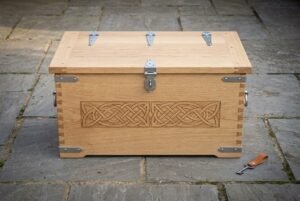 Oakhoard Hand Made Oak Viking Storage Chest | Carved Norse Knotwork Front Panel | Dovetailed Corners with Steel Strap Hinges and Lockable Hasp | Home Gift | RK-1632
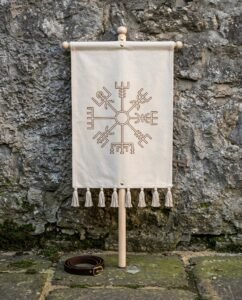 Waymark Hand Made Vegvisir Canvas Banner on an Ash Staff | 16 by 22 Inches | Heavy Cotton Canvas with a Turned Ash Cross Bar and Tassel Fringe | Norse Home Decor Gift | RK-1659
 Wardhold Hand Made Viking Storage Chest | Domed Lid in Dark Stained Solid Wood | Brass Straps and Studs with Helm of Awe Engraving | Norse Home Gift | RK-1781