
Blog
Viking Axe vs Medieval Axe: How the Shape Changed and Why

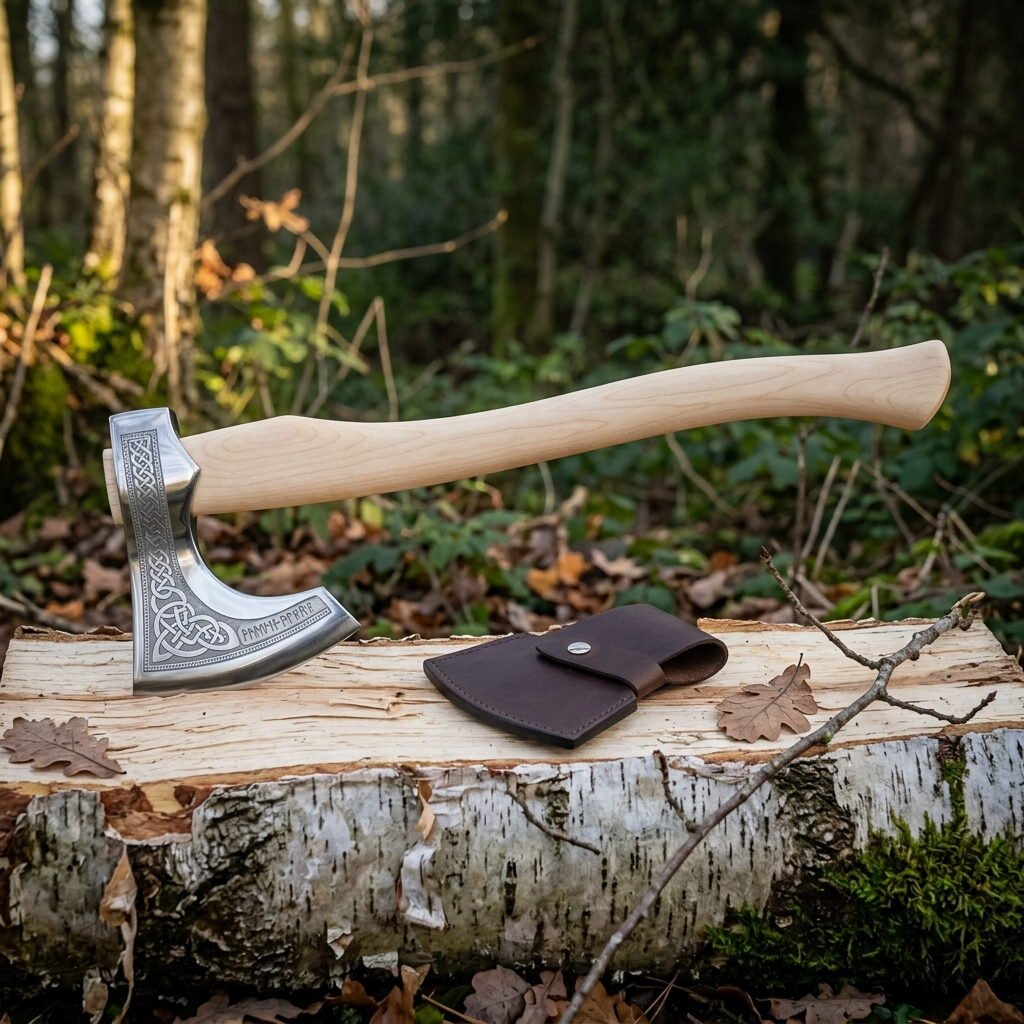
A Viking axe has a thin, wide, light head on a long haft, built to cut fast at a shield wall. A later medieval axe has a thicker, narrower head, often with a spike or hammer on the back and a shorter reinforced haft, built to punch through plate. The shape changed because armour changed, which is the whole story and takes about a sentence to tell. Pick the Viking form for looks and handling, the medieval form for weight and menace.
That is the difference in one paragraph. The detail is more interesting, because the two shapes overlap in time, share a lot of construction, and the transition between them tells you more about medieval warfare than either one does alone.
Quick comparison
| Viking axe | Medieval axe | |
|---|---|---|
| Head profile | Thin cheeks, wide flaring edge | Thicker cheeks, narrower edge |
| Head mass | Light for its size | Heavier for its size |
| Back of head | Usually plain, small butt | Often a spike, beak or hammer poll |
| Haft | Slim, plain wood, long on the two handed types | Shorter, thicker, sometimes with steel langets |
| Built to defeat | Mail, shields, unarmoured targets | Plate and articulated harness |
| Handling | Fast, tip light, easy to recover | Slower, head heavy, more committed |
| Period | Roughly eighth to eleventh century | Roughly thirteenth to sixteenth century |
| Best for | Norse impressions, camp use, wall display | Knightly impressions, heavy display pieces |
The Viking axe
The defining feature of a Viking Age axe head is how little iron is in it. Excavated heads are consistently thin through the cheeks, with the metal flared out into a broad cutting edge and drawn back into a small socket. Iron was expensive and hard to make in quantity, so the smith put steel where it did work and nowhere else. Nobody was showing off with material they could not spare. The result is a head that is far lighter than its outline suggests and that sits well forward on a long, slim haft.
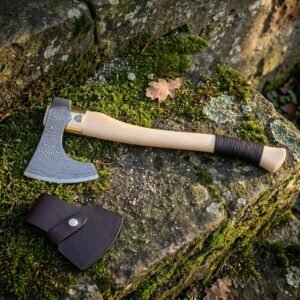 Wyrmskegg Hand Forged Damascus Steel Viking Bearded Axe | 19 Inch Overall with 4.5 Inch Cutting Edge | Norse Bushcraft Gift | RK-1211
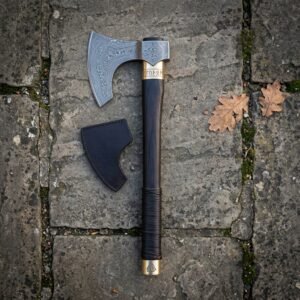 Ravenskegg Hand Forged Damascus Steel Ragnar Style Viking Bearded Axe | 20 Inch Overall with 5 Inch Cutting Edge | Norse Bushcraft Gift | RK-1216
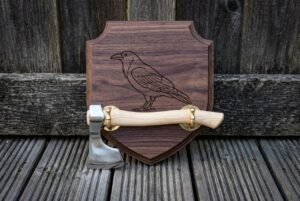 Rookhelm Hand Forged Bearded Axe on Walnut Raven Wall Plaque | 14 Inch Ash Haft and 5 Inch Cutting Edge | Solid Brass Mounting Brackets | Norse Wall Display Gift | RK-1712
What that shape does well
Speed is the first thing you notice. A light head on a long haft accelerates quickly, changes line quickly and recovers quickly after a miss. In a shield wall, where the useful strikes come over the rim and down at heads and shoulders, that speed is worth more than mass. The wide edge also means a broader window in which the strike lands correctly, which matters when everyone is pressed together and nobody has room to aim.
The bearded form takes this further. Drawing the lower corner of the edge down into a hook adds cutting length without adding iron, gives a hand somewhere to choke up for woodwork, and provides a hook that can catch a shield rim and drag it aside. Our guide to what a bearded axe actually is covers the shape in full.
Where it falls down
Thin cheeks are fragile against hard targets. A Viking Age head is built to cut flesh, mail and wooden shields, and it does that superbly. Put it against a solid plate cuirass and the edge deforms without achieving much. The long haft that gives it speed also gives an opponent something to grab or cut. And with almost no poll behind the eye, there is nothing to hit with in the other direction.
The long hafted type
The two handed Dane axe is the extreme version of this design: a very broad, very thin head on a haft that can run past four feet. Handled well it is devastating and it has enormous reach. Handled badly it leaves you entirely open, because both hands are committed and there is no shield, and the second half of that sentence is the part people forget. Our article on the Dane axe deals with how it was actually used and by whom.
The medieval axe
Move forward two or three centuries and the same category of tool looks different. The head is narrower across the edge and much thicker through the body. There is usually something on the back: a spike, a curved beak, or a flat hammer face. The haft is shorter, thicker, and on the better pieces it carries steel strips called langets running down from the head to stop the wood being cut through.
What that shape does well
Mass concentrated behind a short edge is what breaks armour. A narrower edge means higher pressure at the point of contact, and the thicker body means the head can take that impact repeatedly without deforming. The back spike or hammer turns one tool into two: cut with the edge against soft targets, punch with the spike against a helmet or a breastplate, hook with the beak to pull a rider off a horse or pull a foot fighter off balance.
This is the same logic that produced the mace and the war hammer, and the poleaxe is the point where all of it converges into a single pole mounted head with an axe blade, a hammer and a spike on one piece.
Where it falls down
It is slower. A heavier head on a shorter haft means every swing is a bigger commitment, and a miss costs more than it did two centuries earlier. It is also less useful outside combat. A Viking Age head with thin cheeks and a long edge splits kindling, shapes timber and butchers a carcass. A thick, narrow head with a spike on the back does none of those jobs well. And if your interest is Norse, a spiked poll immediately reads as the wrong century.
What actually changed, and when
The driver was armour. Through the Viking Age, mail over padding was the best a well equipped fighter was likely to have, and shields were wood. Both of those yield to a fast, wide cutting edge. From the thirteenth century onward, plate spread across the body: coat of plates, then breastplates, then full articulated harness by the fifteenth century. A wide thin edge stops being an answer to that, so heads got thicker, edges got shorter, and spikes appeared to concentrate force.
The change was not clean and it was not quick. Long hafted broad axes stayed in use in Scandinavia and around the Baltic well past the point when knights on the continent had moved to poleaxes, and plenty of ordinary fighting axes through the whole medieval period were essentially agricultural tools with no combat features at all, because a tool you already own is cheaper than one you do not. Our history of the Viking axe traces that continuity, and battle axe against bearded axe deals with the split within the Norse forms themselves.
How to tell them apart at a glance
Look at the back of the head first. A plain small butt behind the eye is early. A spike, beak or hammer face is late. That one detail settles most of the arguments people have about these things. Then look at the edge in profile: a Viking Age edge flares out well beyond the width of the socket, sometimes dramatically, and is thin enough that light passes through the flare in a photograph. A late medieval edge sits closer to the socket width and the metal stays thick almost to the edge. Haft length is the least reliable guide, since both periods used both short and long.
Which one to buy
For most people, the Viking form. It handles better, it costs less for the same quality of steel, it suits a wider range of uses, and it is the shape that reads as Norse to anyone looking at your wall. The bearded head in particular does more jobs than any other single axe profile: it cuts, it carves, it hooks, and it looks right on a belt, in a camp or on a mount above a fireplace.
Take the medieval form if your period is knightly, if you already own a Norse axe, or if the spiked back is specifically what you want. It is the more imposing display object of the two, and a heavy head on a short langeted haft has a presence that a light one does not.
What we carry
Our bearded axes follow the excavated Viking Age profile, with the drawn down lower corner and hafts from around 16 inches up to 34, several with rune cut or knotwork engraved collars. The battle axes section holds the larger fighting profiles including long hafted pieces and double headed forms, and Dane axes covers the two handed extreme. For later forms, medieval axes carries the thicker headed types, and the full Viking axe range brings all of it together with the camp and utility profiles. Plain heads are 1095 carbon steel hardened to 54 to 58 HRC; Damascus heads are 1095 and 15N20 forge welded and taken to 58 to 60 HRC. Every piece is handmade in the Czech Republic the old way, then imported, inspected and shipped from Chicago, Illinois. Engraving is done in the US after arrival.
Choose this if
Choose a Viking axe if you want speed and handling over mass, you are building a Norse or early medieval impression, you want a head that also does camp work, or you want the shape most people recognise.
Choose a medieval axe if your period is thirteenth century or later, you want a spike or hammer on the reverse, or you want the heaviest looking piece for a wall.
The recommendation
Buy a bearded Viking axe with a haft in the 19 to 24 inch range. That single piece covers more ground than anything else in the category: it is period correct across three hundred years, it is light enough to handle all day, it will split wood and shape timber if you ever want it to, and it mounts on a wall without dominating a room. A long hafted battle axe is the better second purchase, and the medieval type is a third, once you know that is where your interest sits.
For an axe that sits outside both traditions, see the real axe behind Leviathan. Whichever period you prefer, mounting it well is covered in our guide to displaying blades.
Questions people ask
Were Viking axes heavier than medieval axes?
No, the opposite, which catches almost everybody out. Excavated Viking Age heads are thin through the cheeks and light for their outline, because iron was expensive and the design put metal only where it cut. Later medieval fighting axes carry more mass in a narrower head to concentrate force against plate. The Viking head looks bigger in a photograph and weighs less in the hand.
Why do medieval axes have a spike on the back?
Because a cutting edge does little against plate armour. A spike or beak drives the same swing through a much smaller area, which raises the pressure enough to punch or dent steel, and it can hook a limb, a helmet rim or a rider. The same thinking produced the war hammer and, taken further, the poleaxe with axe, hammer and spike on one head.
Did Vikings use two handed axes?
Yes, the long hafted broad axe often called a Dane axe is well documented in both the archaeology and the written sources, and it stayed in use around the North Sea and the Baltic for centuries. It was a specialist choice rather than the standard, since using it means giving up a shield, and most fighters carried a shorter one handed axe and kept the shield.
What haft length should I choose?
For a one handed axe used with a shield, or for general handling and display, something between 16 and 24 inches suits most people. Between 24 and 34 inches gives you a two handed grip and real reach while staying manageable indoors. Past that you are into Dane axe territory, which needs floor space to handle and wall space to hang.
Is a Viking axe good for camp and bushcraft work?
The bearded profile is genuinely useful for it. The long lower edge gives you plenty of cutting length, and the beard lets you choke your hand up close behind the edge for controlled carving and shaping. A thin cheeked head also bites well into wood rather than wedging. A medieval head with a spiked poll is a poor choice for the same tasks.
Which shape looks better on a wall?
The Viking head wins on outline, because the flared edge and the bearded hook read clearly from across a room and the long haft gives the mount a strong diagonal. A medieval head with a back spike has more presence up close but needs more clearance from the wall and more thought about where people walk past it, which you tend to work out only once.
What the shop carries
In the shop right now, the Langhewer Viking war axe and the Moonpoll poleaxe. The Stormpoll poleaxe and the Stavebeard Viking axe sit next to them.
Shop the range
Wyrmskegg Hand Forged Damascus Steel Viking Bearded Axe | 19 Inch Overall with 4.5 Inch Cutting Edge | Norse Bushcraft Gift | RK-1211Ravenskegg Hand Forged Damascus Steel Ragnar Style Viking Bearded Axe | 20 Inch Overall with 5 Inch Cutting Edge | Norse Bushcraft Gift | RK-1216Rookhelm Hand Forged Bearded Axe on Walnut Raven Wall Plaque | 14 Inch Ash Haft and 5 Inch Cutting Edge | Solid Brass Mounting Brackets | Norse Wall Display Gift | RK-1712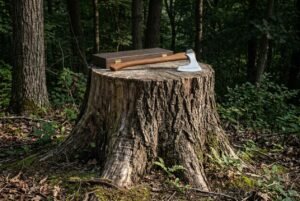 Walnutskeg Hand Forged 1095 Steel Bearded Axe | Rune Engraved Head | Hickory Haft with Carved Hardwood Presentation Box | Groomsman Gift | RK-1877
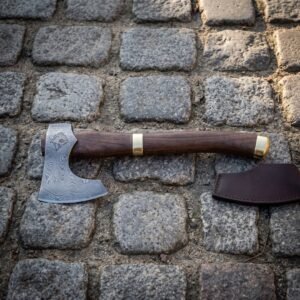 Grainbeard Hand Forged Damascus Bearded Axe with Etched Wolf Head | Walnut Haft, Brass Collar and Butt Cap | Brown Leather Edge Sheath | Norse Collector Gift | RK-2076
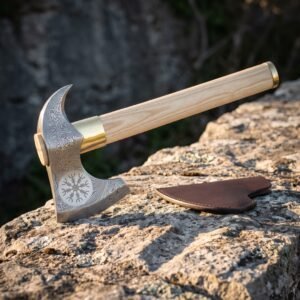 Brasshelm Hand Forged Damascus Steel Viking Bearded Axe | 19 Inch Ash Haft | Helm of Awe Etched Head with Brass Collar and Butt Cap | Norse Collector Gift | RK-2158