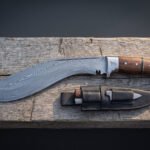
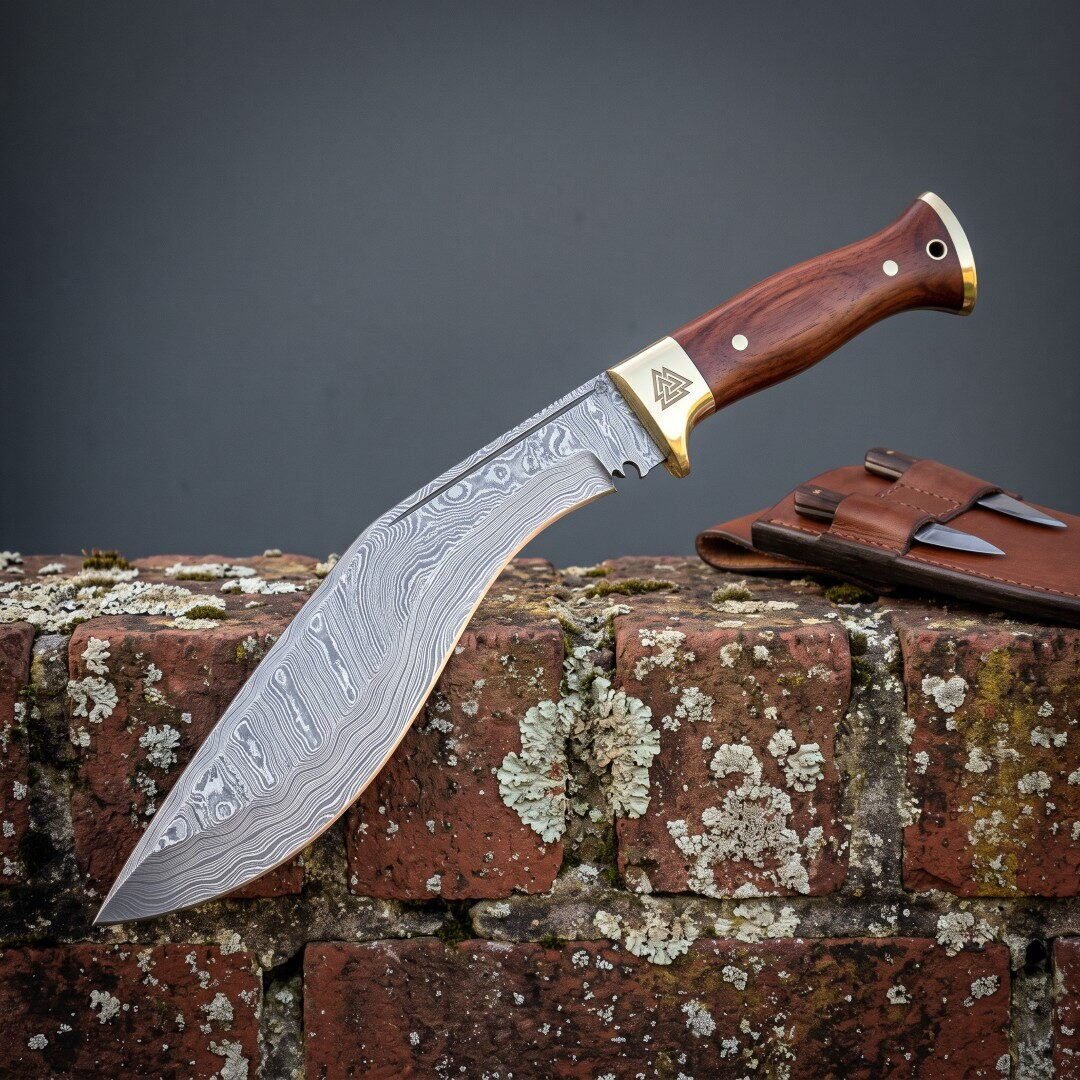
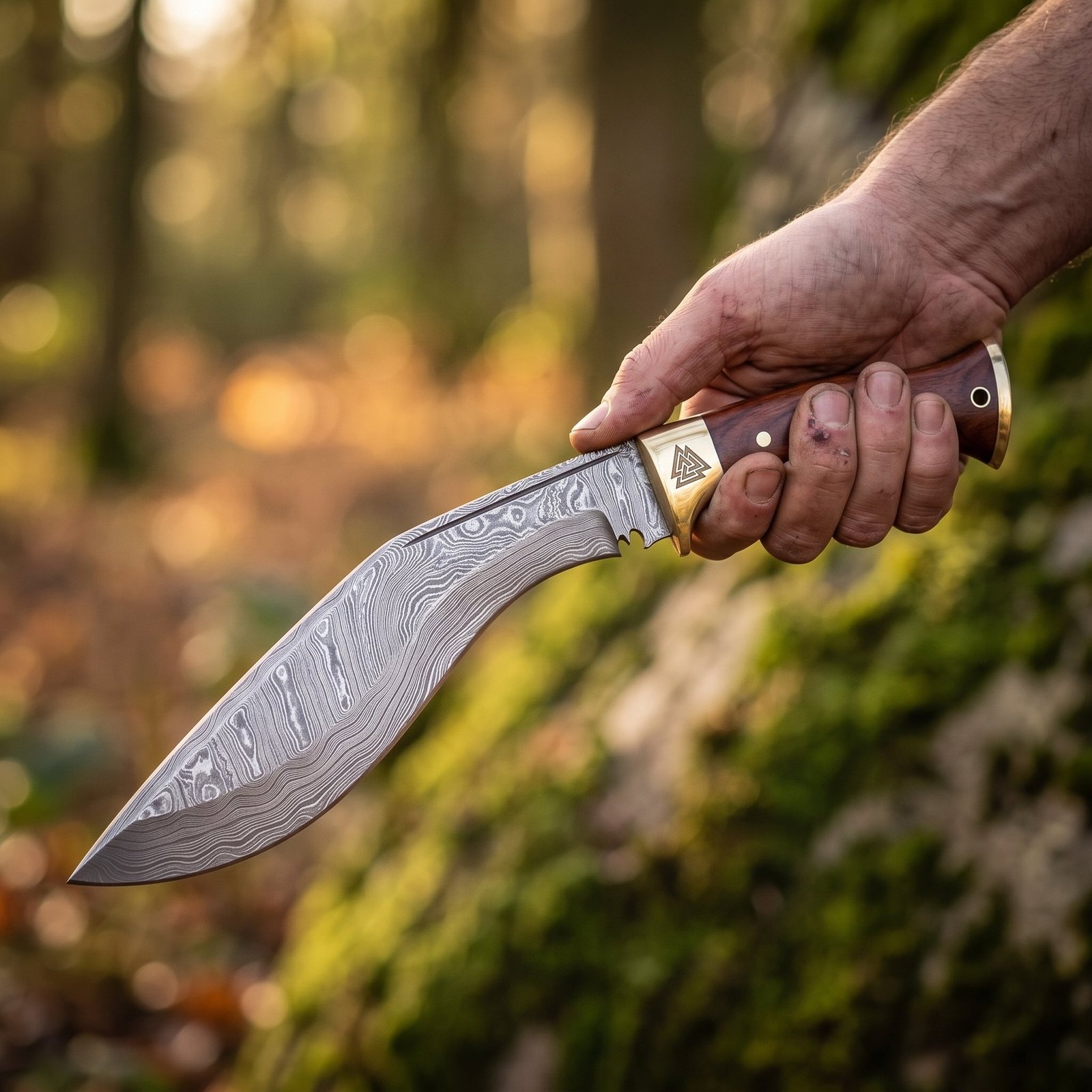
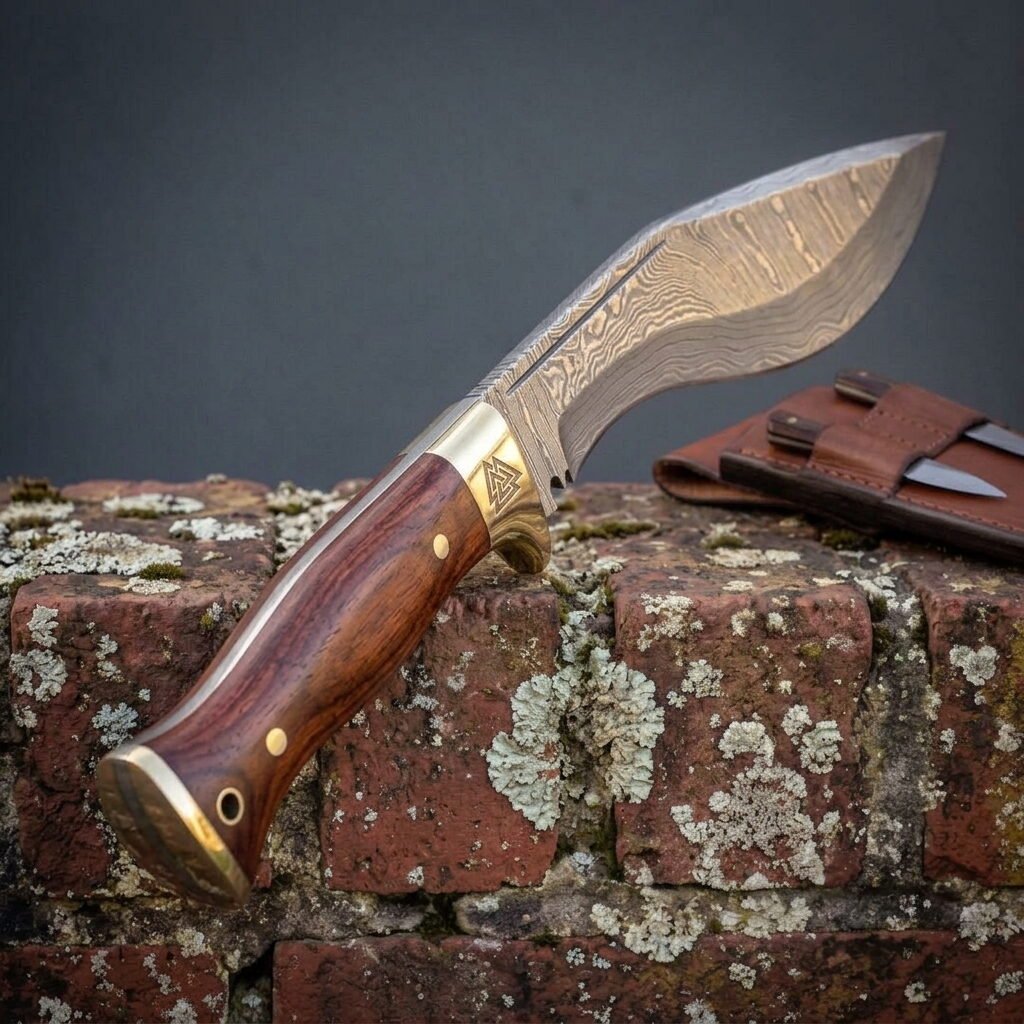
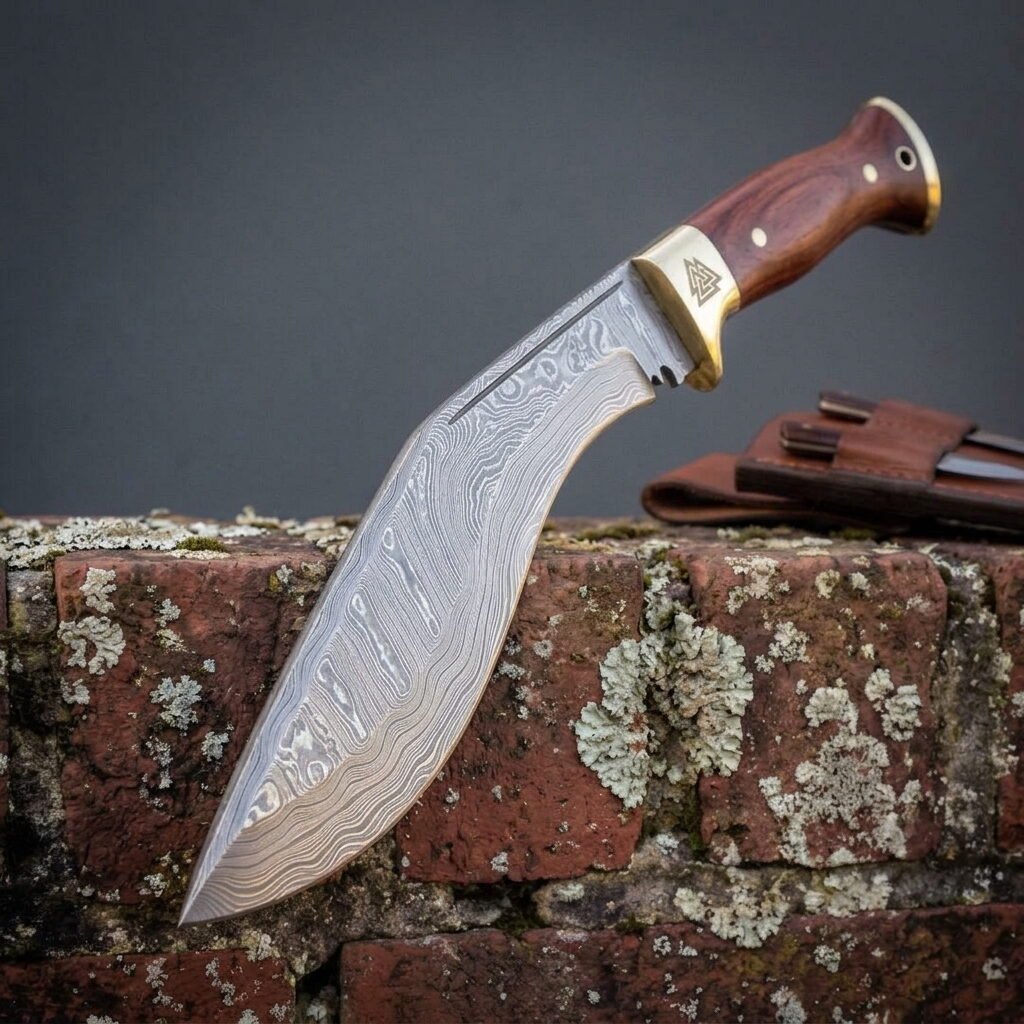
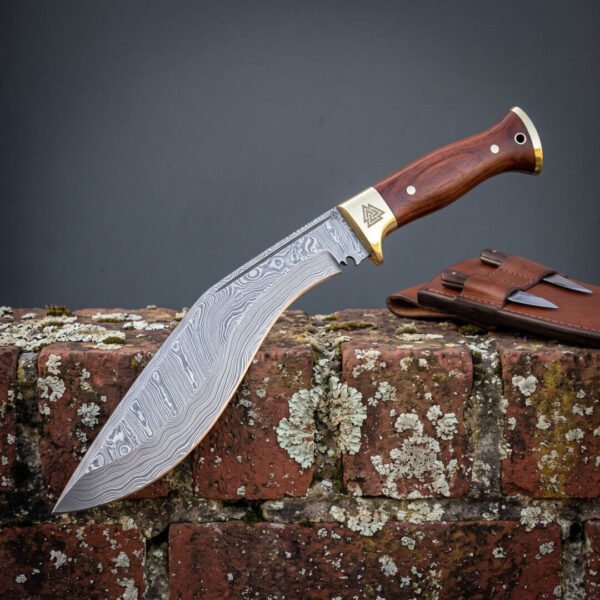
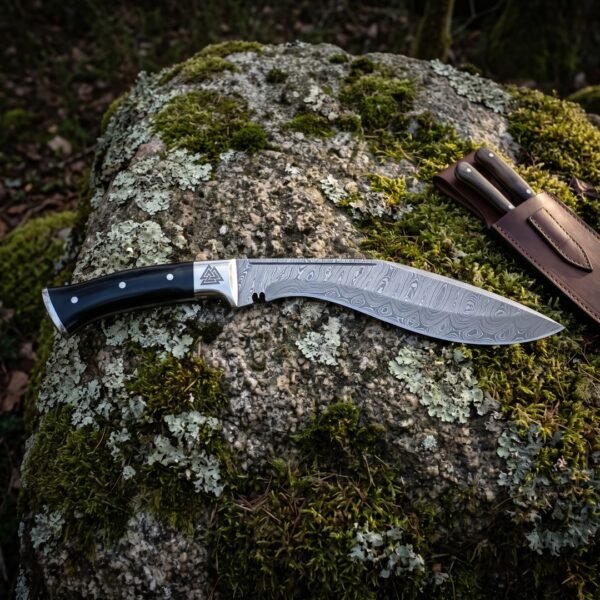
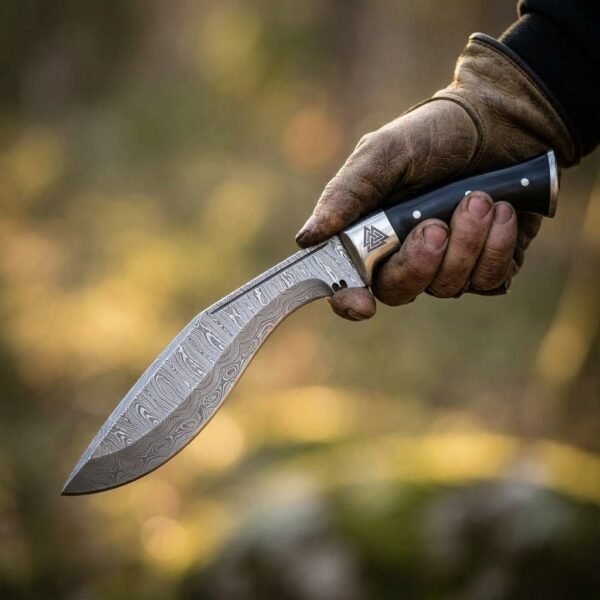
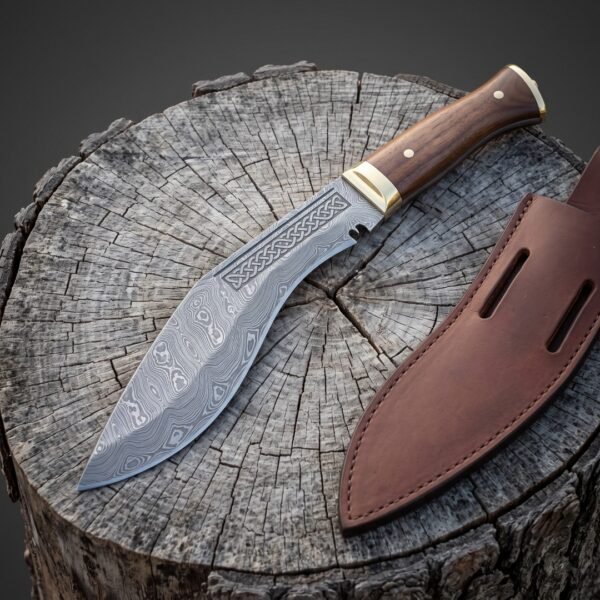
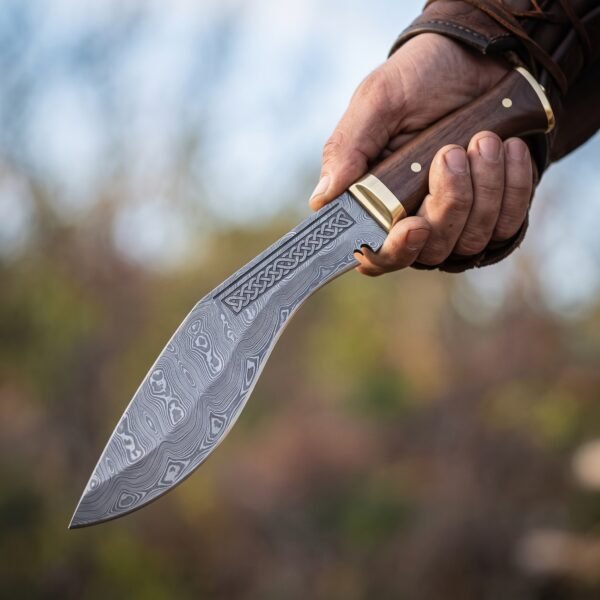
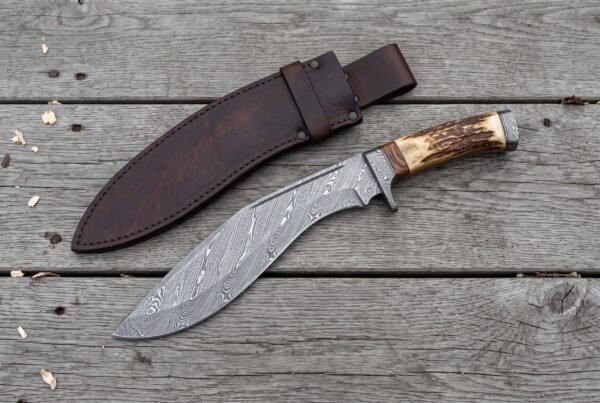
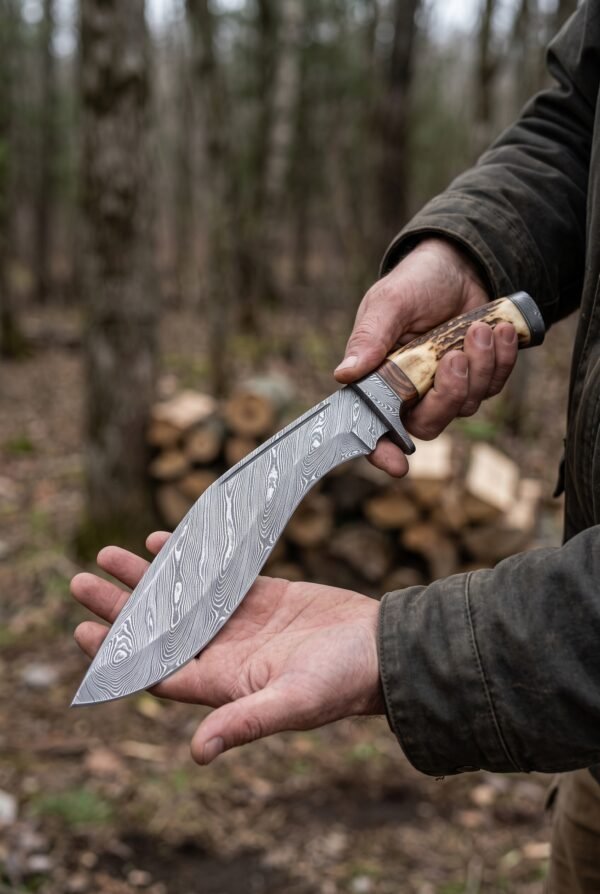
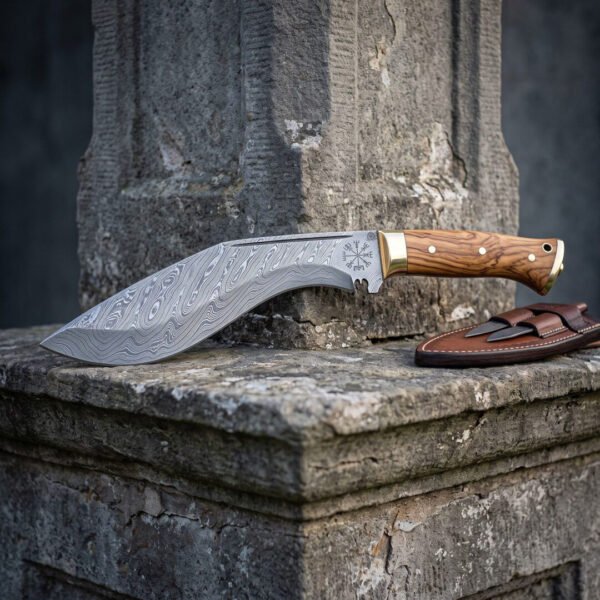
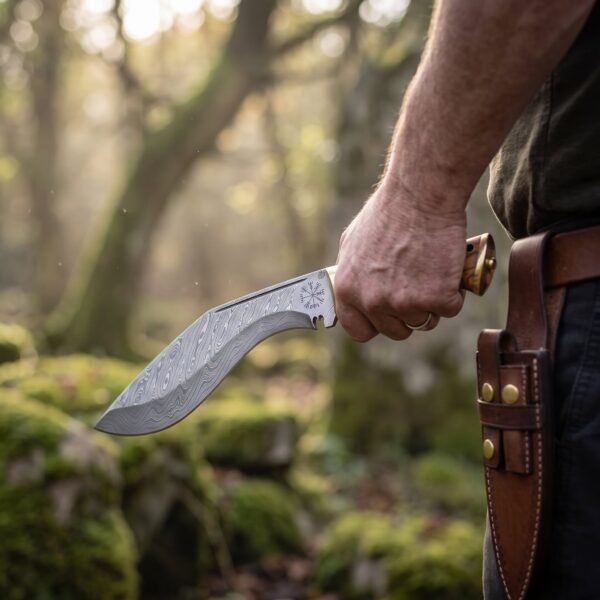
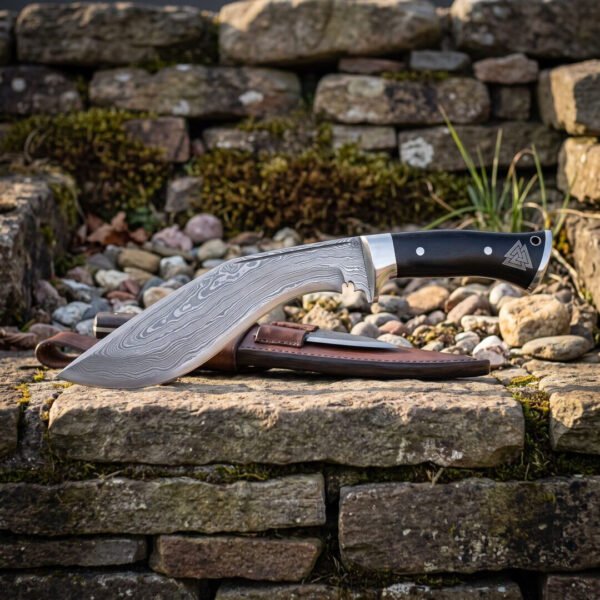
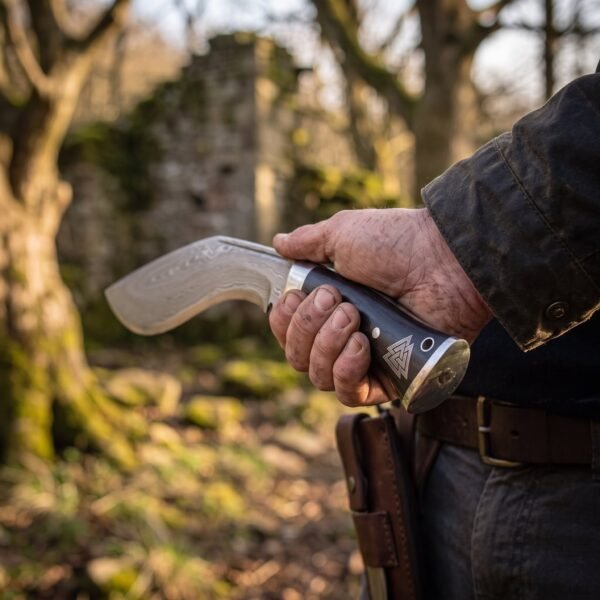
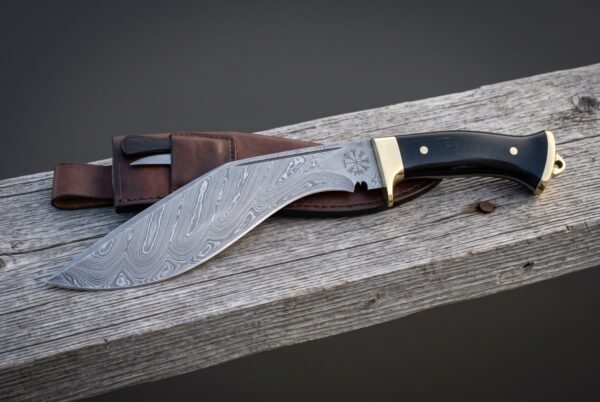
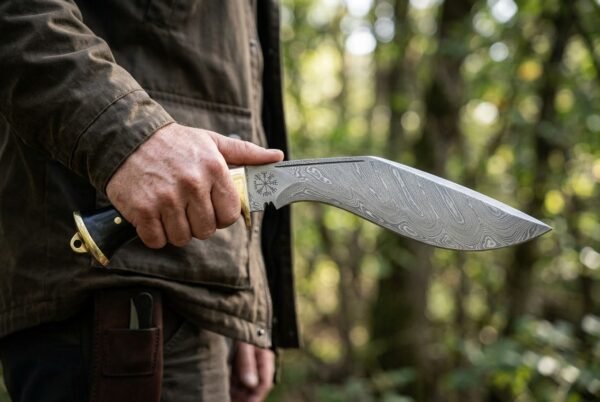
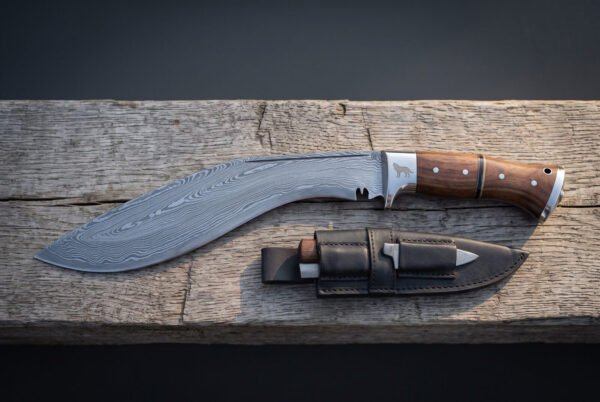
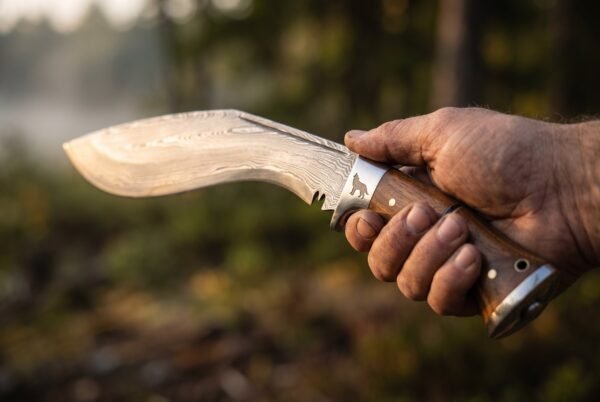
The Trineknot pairs a pattern welded Damascus kukri blade with a Norse hilt. The blade is broad, deeply recurved and etched to bring out a tight rolling pattern that widens across the belly where the steel was drawn thinnest. The fittings are the other half of the story. A heavy brass bolster carries an engraved Valknut, the rosewood scales are pinned through a full tang, and a brass butt cap closes the handle so the wood is capped in metal at both ends.
Kukris and Norse iconography are not historical bedfellows, and we are not going to pretend otherwise. What they share is a working logic. Both traditions built short heavy blades that chop, and both put their symbols where a hand would rest. This one is made by hand in the Czech Republic, imported and inspected by Ransack Viking, and shipped from our Chicago, Illinois warehouse in the brown leather sheath shown, complete with its two traditional companion blades.
A kukri cuts on the belly rather than the tip, which is the argument the kukri explained makes at length. That knot of three triangles is the valknut, and where the valknut appears comes down to a handful of picture stones. If you want a shorter belly for dressing game, the skinner knives cover that job.
Specifications
| Material | 1095 and 15N20 pattern welded Damascus, hardened to 58 to 60 HRC |
|---|
| Blade shape | Broad recurved kukri blade with a cho notch at the base of the edge |
|---|
| Overall length | Approximately 17 inches |
|---|
| Blade length | Approximately 12 inches along the curve |
|---|
| Handle | Approximately 5 inches, rosewood scales on a full tang, flared at the butt |
|---|
| Bolster | One brass bolster engraved with a Valknut |
|---|
| Pins | Two steel pins and a lined lanyard hole |
|---|
| Butt | Brass butt cap |
|---|
| Finish | Etched and polished Damascus with a bright ground edge |
|---|
| Sheath | Brown leather sheath with pockets for the karda and chakmak |
|---|
| Included | Kukri, karda, chakmak, leather sheath |
|---|
| SKU | RK-2106 |
|---|
Reading the Valknut on the bolster
The Valknut is three interlocked triangles, and it turns up on the Stora Hammars picture stones on Gotland, on the Tangelgarda stone and on the Oseberg ship burial. In almost every case it appears next to something to do with death, a burial, a sacrifice or a rider who is very probably Odin. The modern name is not the Viking one. Valknut is a nineteenth century Norwegian coinage meaning knot of the slain, and no source tells us what the carvers called it.
Geometrically it is more interesting than it looks. Draw it the way it appears at Stora Hammars and you get a unicursal figure, three triangles woven so that the line never truly ends. That impossibility, a shape that cannot be untied, is almost certainly the point, and it is the reason it sits well on a bolster where a thumb rests against it every time the blade is used.
Damascus steel and the rosewood handle
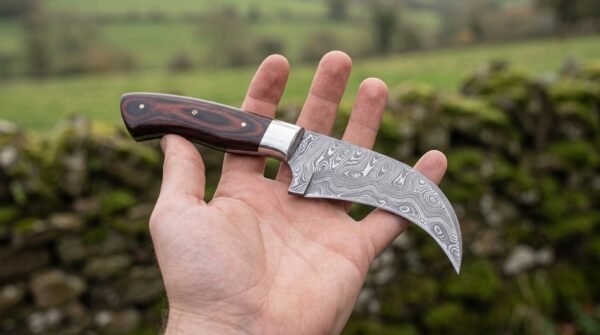
The blade is forge welded from alternating layers of 1095 and 15N20, folded to build the count, then ground and acid etched. The bright layers are the nickel bearing 15N20 and the dark ones are the 1095. On a recurved blade the pattern does something you do not get on a straight one. Because the smith has to move a great deal of steel to open out the belly, the layers stretch and crowd there, so the pattern is loose along the spine and tight through the curve.
Hardened to 58 to 60 HRC, this is a harder blade than the plain carbon kukri in our range, which suits Damascus better than monosteel because the layered structure carries the hardness without becoming glassy. It is still carbon steel and it is not stainless. Rosewood is dense and oily by nature, which is why it has been used for tool handles for centuries, and the brass bolster gives the front of the handle enough mass to sit the balance where a chopper wants it.
Engraving, runes and your own design
Use the rune converter on this page to turn a name, a date or a short phrase into Elder Futhark and we will cut it into the steel, the brass or the leather. If you would rather have a Viking pattern than a rune line, choose your own design in the engraving option above the add to cart button and tell us where it goes. Where a piece already carries an engraved design, your chosen engraving replaces it rather than sitting alongside it, so runes ordered for the bolster take the place of the Valknut. Brass takes engraving more cleanly than etched Damascus does, so the bolster and the butt cap are the best surfaces on this knife for a name or a date. Engraving is done here in the United States after the piece arrives. More at the engraving page.
Handling and balance
The brass bolster and butt cap pull the balance back a little compared with an all steel kukri, so the Trineknot feels more controllable in the hand and slightly less brutal in the swing. That is a fair trade for most owners, who use a kukri for camp chores rather than clearing bamboo all day. The recurve still delivers the wedge effect that makes a kukri bite, and the cho notch in front of the bolster stops a cut travelling back toward your fingers.
Choke up against the bolster for carving and food prep, drop back to the butt cap for chopping, and keep your grip relaxed. A tight grip on a forward heavy blade transmits shock into your wrist and does nothing for the cut.
Care
Damascus made from carbon steels will rust, and rust pits flatten pattern contrast, so wipe the blade after use and keep a thin film of mineral or camellia oil on it. Do not store it in the leather sheath for months, because leather holds moisture. If the pattern ever looks washed out, a light re etch with diluted vinegar followed by a full neutralise, dry and oil brings it straight back. Oil the rosewood once or twice a year and feed the sheath with leather balm. Brass will darken and a brass cloth restores it. Full detail is in our steel care notes.
Damascus wants oil more than plain steel does, because the etch that shows the pattern also opens the surface, and caring for a Damascus pattern covers what to use.
Made in the Czech Republic
This kukri is made by hand in the Czech Republic. Nothing about it is drop shipped from an importer catalogue by a company that has never seen the knife. Ransack Viking buys these outright, brings them into the United States, unpacks and checks each one for pin fit, edge quality and sheath stitching, and holds stock in our Chicago, Illinois warehouse. Forge welding, folding and grinding a Damascus blade is slow work, so allow one to two weeks of processing before your order ships. United States shipping is free, and the lifetime warranty against defects in forging, grind, heat treat and fittings has no end date and needs no receipt.
A note on handmade variation
Hand made is not machine made or bulk produced, so what arrives will not be a pixel for pixel copy of the photograph. Damascus never repeats. The pattern on your blade is a record of how one billet was worked and it will not exist on another. Rosewood grain and colour vary from scale to scale, brass polishes to slightly different tones, and the engraved Valknut sits a fraction differently on each bolster. The dimensions, the steels, the heat treat and the build are identical every time. The character is unique to yours.
Frequently asked questions
Is the Damascus genuine
Yes. It is forge welded from 1095 and 15N20 and the pattern runs all the way through the blade, which is why it continues over the bevels rather than stopping at them.
What is the Valknut supposed to mean
It is associated with Odin and with death in the surviving carvings. Nobody knows the name the carvers used for it, and anyone who tells you the meaning with certainty is guessing.
Can I actually chop with it or is it a display knife
It is a working chopper with a hardened edge and a full tang. Use it for camp work and yard work. Avoid prying, and avoid metal and stone.
What are the two small knives in the sheath
The karda is a utility knife for fine cutting, and the edgeless chakmak is used to straighten and burnish the main edge in the field.
Will the brass tarnish against the wood
Brass darkens naturally with handling. It does not harm the rosewood, and a brass cloth will bring the bolster back to bright whenever you like.
How long before it ships
One to two weeks of processing, then free shipping inside the United States, with returns accepted within seven days.
What is in the box
- Trineknot kukri with a 1095 and 15N20 pattern welded Damascus blade
- Rosewood scales, brass bolster with engraved Valknut and brass butt cap
- Karda utility knife and chakmak burnishing steel
- Brown leather sheath with pockets for both companion blades
- Lifetime warranty against defects in forging, grind, heat treat and fittings
- Hand made in the Czech Republic, shipped from our Chicago, Illinois warehouse
Explore the range
See the rest of the kukri knives, the wider Viking knives and the engraved and personalized pieces. Steel and sharpening reading is in the guides.
Also in this part of the catalogue
If this one is not quite right, there is the Wolfcurve kukri knife, 17 inches overall. Also in this group is the Palefang kukri knife, 16 inches overall. Sitting beside it in the catalogue is the Thundercurve kukri knife, 16 inches overall.
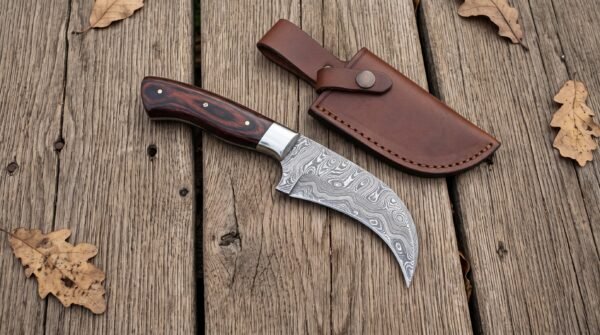
From the same corner of the shop, there is the Hollowfell hunting knife. Or start from a blank sheet on the custom hunting knife page.


Five stars isn’t even enough honestly. Leather sheath is thick and well stitched. Not the cheap stuff you usually get. So worth it.
Five stars isn’t even enough honestly. Fit and finish is museum quality. You can tell real craftsmen made this by hand. Can’t recommend this enough.
Got this as a gift and now I want one for myself too. Even the small engravings are crisp and clean. Edge retention has been great even after regular use. Fit and finish is museum quality. You can tell real craftsmen made this by hand. Shipping was fast and everything arrived well packaged.