
Blog
Fenrir, the Wolf Who Waits

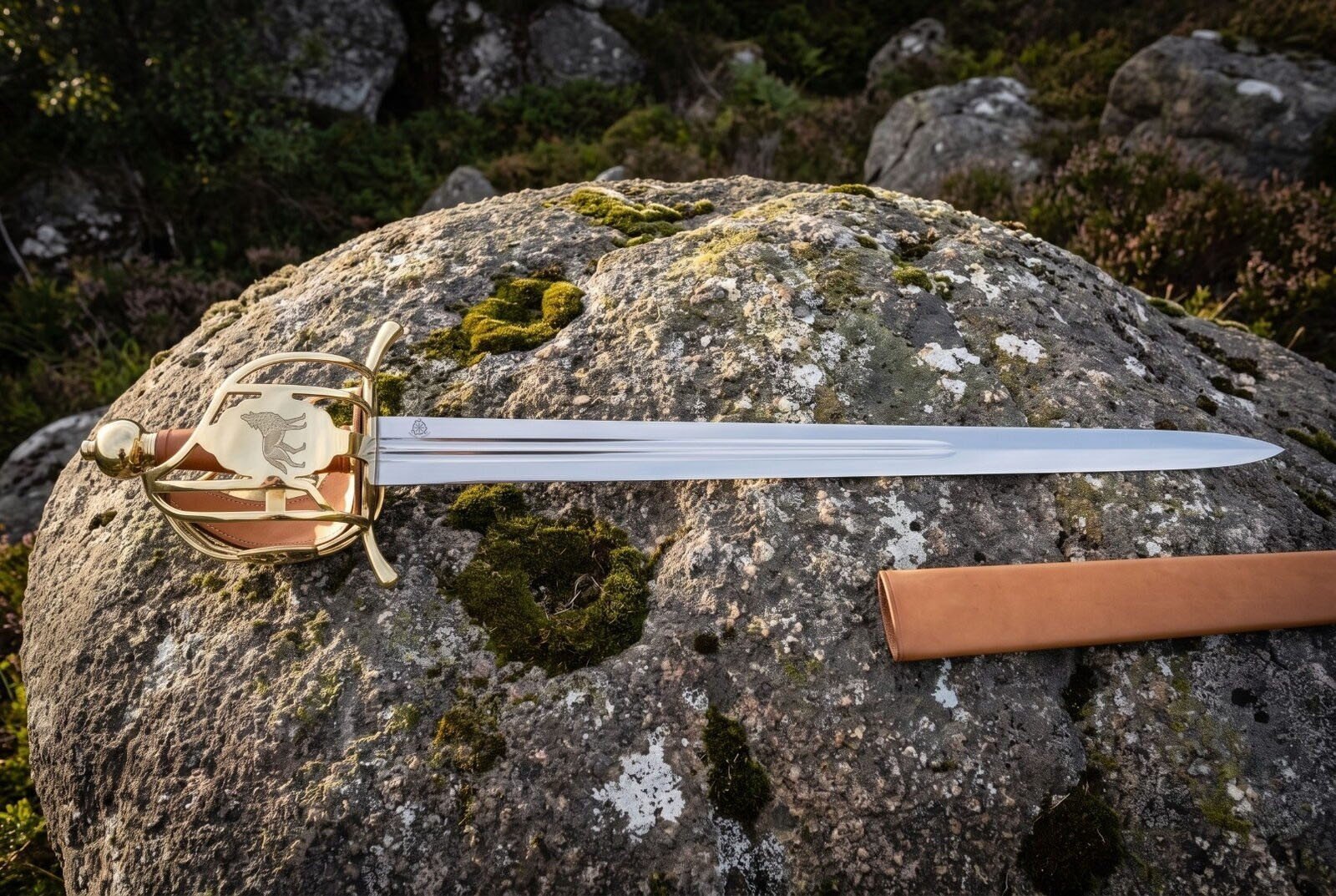
Fenrir is the wolf the gods raised in their own yard, bound with a ribbon, and lost to anyway. That is the shape of the whole story, and it is a better story than most because nobody in it comes out looking good.
What follows is what the surviving Norse sources actually say. That is a narrower thing than what the wolf has become since. The material comes from the Poetic Edda, from Snorri Sturluson’s Prose Edda of around 1220, and from a handful of carved stones, which is the whole toolkit described on the page about what Norse mythology actually is. Where those disagree, this page says so rather than picking the tidiest version and moving on.
Where the wolf comes from
Snorri sets out the parentage plainly in Gylfaginning. Loki fathered three children on the giantess Angrboda in Jotunheim: the wolf Fenrir, the serpent Jormungandr who lies in the sea around the world, and Hel, who keeps the dead that battle did not take.
The Poetic Edda never assembles that family so neatly. Voluspa and Vafthrudnismal know the wolf, know he is coming, and know roughly what he will do, but the tidy sibling group is Snorri’s arrangement of material that reached him already scattered. It is a useful arrangement. It is not a Viking Age creed. The fuller treatment of all three is in the guide to the children of Loki.
The name itself is straightforward. Fenrir means something close to fen-dweller, from the word for a marsh. He also appears as Fenrisulfr, Fenrir’s wolf, which is what most of the Old Norse actually says. Two other names attach to him. Hrodvitnir is fame-wolf. Vanargand belongs to the river Van, which the sources say ran from his jaws once the gods gagged him.
Raised in Asgard, which was the first mistake
Snorri says the gods knew from prophecy that Loki’s children would bring them harm, and dealt with each one differently. The serpent went into the sea. Hel went down to the world of the dead and was given authority there. The wolf they kept, in Asgard, where they could see him.
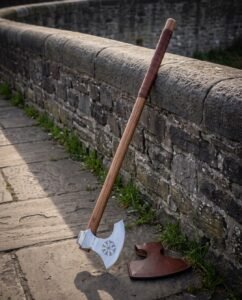 Wayfarrow Hand Forged Long Handled Viking Axe with Bearded Head & Etched Vegvisir | About 35 Inch Haft | Leather Grip Wrap and Fitted Leather Blade Cover | Norse Gift | RK-2204
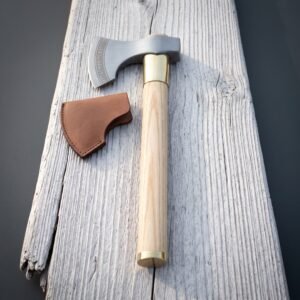 Runebite Hand Forged High Carbon Bearded Axe with Elder Futhark Engraved Cheek | Ash Haft and Brass Collar | Leather Blade Sheath | Norse Woodsman Gift | RK-2175
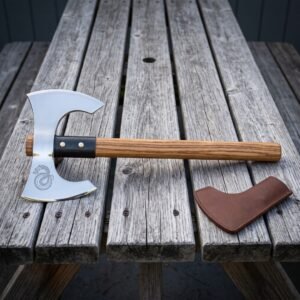 Wyrmhewn Hand Forged High Carbon Steel Viking Double Headed Axe | 19 Inch Oak Haft | Etched Coiled Serpent with Fitted Leather Head Cover | Norse Collector Gift | RK-2146
Only Tyr had the nerve to feed him. That single detail carries more weight than any amount of description. The gods have taken a prophesied disaster into their own hall and then found that almost none of them will go near it. The wolf grew fast, and the growing is the point at which the arrangement stopped being clever.
Three bindings
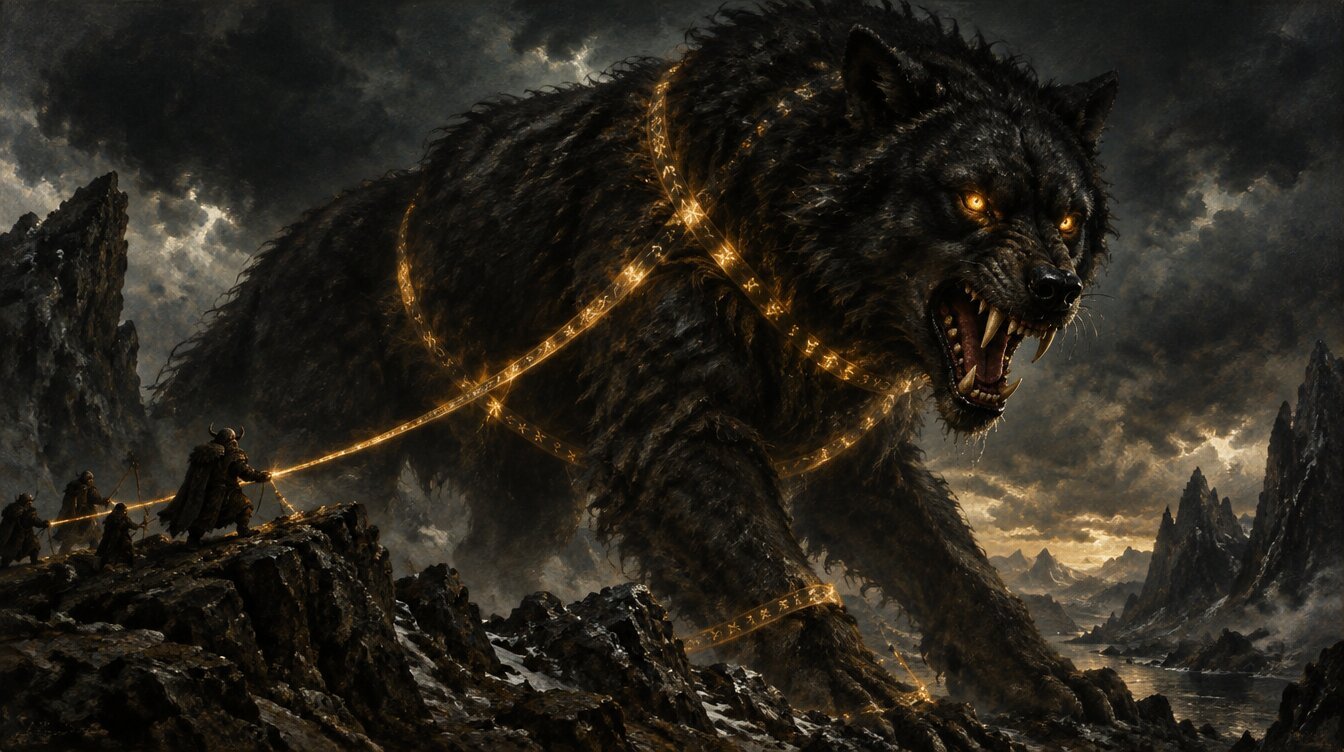
The gods decided to tie him up, and did not have the honesty to simply do it. Instead they turned it into a game and asked the wolf to test his own strength against a fetter. He agreed, because he was vain and because he could see no reason to refuse yet.
The first chain was Leyding. He kicked once and it came apart. The second was Dromi, half again as strong, and it took a harder effort and a longer struggle, but it broke too, and the phrase for slipping out of trouble by force is said to come from it.
Gleipnir
The third fetter was not made by gods. Odin sent Skirnir down to the dwarves, and what came back looked like a silk ribbon and weighed nothing at all. Snorri lists what went into it: the sound a cat makes when it moves, a woman’s beard, the roots of a mountain, the sinews of a bear, the breath of a fish, and the spittle of a bird. He then adds the joke, or the etiology, depending on how you read him. This is why none of those things exist any more. They were used up.
Gleipnir is a lovely piece of writing whichever way you take it. A rope of impossibilities holds the thing that no rope can hold, and it works precisely because it is not a rope.
The hand
The wolf was not stupid. He looked at the ribbon, worked out that either it was nothing, in which case there was no glory in breaking it, or it was something, in which case he was being cheated. So he set a price. One of the gods would put a hand in his mouth as a pledge of good faith.
Every god present looked at every other god present. Tyr put in his right hand. The fetter held, the wolf thrashed and could not move, the gods laughed, and Tyr lost the hand at the wrist joint that Old Norse calls the wolf-joint. Lokasenna has Loki throw this in Tyr’s face in verse, which tells us the episode was current in poetry and not simply Snorri’s invention.
The gods dragged the wolf to an island called Lyngvi in a lake called Amsvartnir, ran the cord through a slab of rock, and hammered it down. When he snapped at them they jammed a sword into his mouth, hilt against the lower jaw, point against the upper, so that he was propped open. That is what the river Van is: he has been drooling into it ever since. There is a fuller account of the cost to Tyr on the page for Tyr, the god who gave his hand.
What he does at the end
Voluspa and Vafthrudnismal both say the wolf gets loose. Snorri fills in the sequence. The bonds break, the sea rises because the Midgard serpent has come ashore, and Fenrir advances with his lower jaw against the ground and his upper jaw against the sky, which is either a marvellous image or a measurement, and fire runs from his eyes and nostrils.
He swallows Odin. That is the line that matters, and both Eddas agree on it. Vafthrudnismal has Odin ask, in disguise, what will kill him, and receive the answer to his face. Odin’s own son Vidar then avenges him. Vidar puts one foot on the lower jaw, takes hold of the upper, and tears the wolf apart. The foot is wearing a shoe made from every scrap of leather that every person has ever trimmed off a shoe and thrown away, which is why Snorri says a careful person should throw those scraps away properly. The mythology is doing housekeeping advice, and it is not embarrassed about it. The sequence in full is on the page for Ragnarok.
The wolves that chase the sun
Two more wolves run through the same material and get confused with Fenrir constantly. Skoll chases the sun, Hati chases the moon, and at the end they catch them. Grimnismal names them and calls Hati the son of Hrodvitnir, which is one of Fenrir’s names, so the poem does appear to make them his offspring.
Snorri complicates it by saying an old giantess in the Ironwood bore wolves and that the strongest of them is called Managarm, moon-hound, who fills himself with the flesh of the dying. Whether Managarm, Hati and Fenrir’s sons are three names for a smaller number of animals is not resolvable from what survives. Anyone who tells you the family tree with confidence has filled in the gaps themselves.
What the carvings show
Three pieces of Viking Age and immediately post-Viking Age stone are usually brought into this.
Thorwald’s Cross on the Isle of Man, tenth or eleventh century, shows a bearded figure with a spear pointing down, a bird at his shoulder, and his foot in the mouth of a beast. Odin, a raven, and the wolf, on a Christian cross slab, next to a panel that appears to show Christ. Whoever cut it was thinking about two ends of the world at once.
The Ledberg stone in Sweden, eleventh century, has a figure with his foot at the mouth of a four-legged animal, and below it a helmeted figure who has lost his legs. It is read the same way, with the usual caution.
The Gosforth Cross in Cumbria carries a man with a spear driving his foot into a monstrous head, which reads better as Vidar than as Odin. If that is right, the Vidar episode was known in a Norse settlement in northern England before any of it was written down in Iceland. The related stone carvings are covered further on the page about runestones and carved memorials.
What Fenrir is not
He is not a symbol that Viking Age people wore. There is no Fenrir amulet type in the way there is a hammer amulet type. Hammers survive in the hundreds. Wolf pendants sold as Fenrir today are a modern design decision, and a perfectly good one, but nobody dug them out of a tenth century grave. The genuinely attested motifs are set out in the guide to Viking symbols and what they meant.
He is also not a villain in the moral sense, which is where most retellings go wrong. Nothing in the sources says the wolf did anything before he was chained except grow and eat what Tyr brought him. He is punished entirely on the strength of a prophecy, by gods who then break their word to him. Whether the poets thought that was a problem is impossible to know. It reads like one.
And he is not the same figure as the wolf in the Marvel films, or in God of War, or in most video games that use the name. Those are adaptations, and there is no reason they should not be, but they are not evidence for anything.
Carrying the story
If you want the wolf on something you own, the honest route is engraving rather than a claimed antique design. Ransack Viking is a US company in Chicago, Illinois. The pieces are handmade in the Czech Republic, then imported, inspected and shipped from Chicago, and engraving is cut here after arrival. Plain 1095 runs 54 to 58 HRC, and Damascus of 1095 and 15N20 runs 58 to 60. US orders ship free and tracked with no import duty, and everything carries a lifetime warranty against defects. The relevant ranges are bearded axes, Viking knives and Norse pendants. The rest of the writing sits in the guides.
Questions people ask
Who is Fenrir in Norse mythology?
A monstrous wolf, son of Loki and the giantess Angrboda, raised by the gods in Asgard and then bound on an island with the magical fetter Gleipnir. At Ragnarok he breaks loose and swallows Odin, and Odin’s son Vidar tears his jaws apart in revenge. The account comes mainly from Snorri’s Prose Edda, with the outline confirmed in the older poems Voluspa and Vafthrudnismal.
What is Gleipnir made of?
Snorri lists six things in Gylfaginning: the sound of a cat’s footfall, a woman’s beard, the roots of a mountain, the sinews of a bear, the breath of a fish and the spittle of a bird. He then explains that this is why none of those things can be found any more, which is either a joke or a genuine folk etiology, and possibly both.
Why did Tyr put his hand in the wolf’s mouth?
Because Fenrir refused to be tested with Gleipnir unless a god pledged good faith, and Tyr was the only one willing. When the ribbon held and the wolf understood he had been tricked, he bit the hand off at the wrist. Lokasenna refers to the loss in verse, so the story was circulating in poetry well before Snorri wrote it down.
Does Fenrir kill Odin?
Yes, and the sources are consistent about it. Vafthrudnismal has Odin told to his face that the wolf will be his death, and Voluspa and Snorri both describe the swallowing at Ragnarok. Vidar avenges him immediately, either by tearing the jaws apart or, in the Voluspa version, by driving a blade into the wolf’s heart.
Are Skoll and Hati the sons of Fenrir?
Probably, but the sources are not clean about it. Grimnismal names Skoll and Hati as the wolves chasing the sun and moon and calls Hati the son of Hrodvitnir, which is a name for Fenrir. Snorri instead credits an old giantess in the Ironwood with bearing the wolves, and adds a third called Managarm. The family tree cannot be reconstructed with confidence.
Is Fenrir a real Viking symbol?
Not as an amulet or a worn design. Thor’s hammer pendants survive in large numbers from Viking Age graves and hoards, and nothing comparable exists for the wolf. What does survive is narrative carving, such as Thorwald’s Cross on the Isle of Man and the Gosforth Cross in Cumbria, which show scenes rather than emblems. Modern wolf pendants are a recent idea.
What does the name Fenrir mean?
It comes from the Old Norse word for a fen or marsh, so roughly fen-dweller. The sources more often call him Fenrisulfr, the wolf of Fenrir, and also use Hrodvitnir, fame-wolf, and Vanargand, the monster of the river Van. That river is said to be formed from the saliva running out of his propped-open jaws.
Was Fenrir worshipped?
There is no evidence of it. Place names carrying the names of Thor, Odin, Freyr and Ull are common across Scandinavia, and nothing similar attaches to Fenrir. He functions in the material as a doom rather than a recipient of offerings, which is not the same kind of figure at all.
Things you can actually hold
On the shelf in the same spirit, the Greyfang Gurkha kukri knife and the Fanghowl arming sword. Next to those, the Grainbeard bearded axe and the Palefang kukri knife.
Shop the range
Wayfarrow Hand Forged Long Handled Viking Axe with Bearded Head & Etched Vegvisir | About 35 Inch Haft | Leather Grip Wrap and Fitted Leather Blade Cover | Norse Gift | RK-2204Runebite Hand Forged High Carbon Bearded Axe with Elder Futhark Engraved Cheek | Ash Haft and Brass Collar | Leather Blade Sheath | Norse Woodsman Gift | RK-2175Wyrmhewn Hand Forged High Carbon Steel Viking Double Headed Axe | 19 Inch Oak Haft | Etched Coiled Serpent with Fitted Leather Head Cover | Norse Collector Gift | RK-2146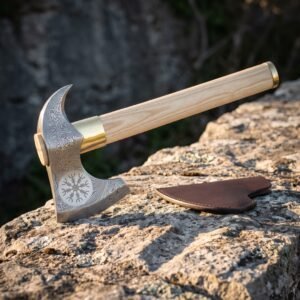 Brasshelm Hand Forged Damascus Steel Viking Bearded Axe | 19 Inch Ash Haft | Helm of Awe Etched Head with Brass Collar and Butt Cap | Norse Collector Gift | RK-2158
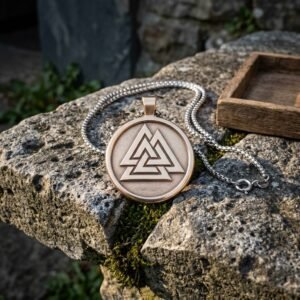 Kinbound Hand Made Bronze Tone Valknut Pendant with Raised Triple Triangle & 22 Inch Box Chain | Norse Memorial Gift | RK-1601
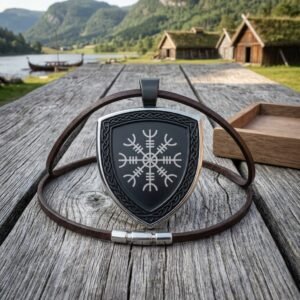 Awestave Hand Made Steel Helm of Awe Pendant with Blackened Shield Face, Knotwork Border & Brown Leather Cord | Norse Gift | RK-1640