Blog
Sleipnir: Odin’s Eight Legged Horse and What He Actually Does in the Mythology

What Sleipnir Is
Sleipnir is Odin’s horse. He has eight legs. That is not an embellishment or a poetic device. The Prose Edda says it plainly, and every visual depiction from the Viking Age onward shows the same thing: a horse with twice the normal number of legs, ridden by the chief of the Norse gods.
The name Sleipnir comes from Old Norse and means “the sliding one” or “the slippery one,” from the verb slippa (to slip, to glide). The name suggests speed and smoothness of movement, which fits a creature described as the fastest horse in existence, capable of carrying its rider between the worlds of the living and the dead without breaking stride.
Snorri Sturluson, writing in the Prose Edda around 1220, calls Sleipnir “the best of all horses.” Not the best of Odin’s horses. The best of all horses, anywhere, in any realm. That is the kind of statement Snorri makes when he wants no argument.
How Sleipnir Was Born
Sleipnir’s origin story is one of the strangest in Norse mythology, which is saying something for a tradition that includes a world tree, a wolf that eats the sun, and a ship made of dead men’s fingernails.
The story begins with a builder. After the war between the Aesir and the Vanir, the walls of Asgard lay in ruins. A mason arrived and offered to rebuild them, but his price was steep: the sun, the moon, and the goddess Freyja. The gods agreed on one condition. He had to finish the work in a single winter, with no help from any man. If he missed the deadline, he got nothing.
The builder had a stallion named Svadilfari, and the horse did the work of twenty men. As the deadline approached, it became clear the mason would finish on time. The gods panicked. Losing the sun, the moon, and Freyja was not an option. They turned to Loki, because Loki had been the one to suggest accepting the deal in the first place.
Loki shapeshifted into a mare. He lured Svadilfari away from the construction site. The stallion chased the mare into the forest. Without his horse, the builder could not finish the wall. He missed the deadline. Thor killed him when he revealed himself to be a giant.
Some time later, Loki returned with a foal. It was grey, it had eight legs, and it was Sleipnir. Loki had given birth to it. The trickster god of Norse mythology is Sleipnir’s mother, not his father. The Prose Edda does not linger on this point. It states it and moves on, which somehow makes it more unsettling.
Sleipnir Between Worlds
Sleipnir’s most important role in the mythology is as a boundary crosser. He carries Odin between realms, and the boundaries that stop every other creature do not apply to him. The most significant example is the ride to Hel.
In the Prose Edda, after the death of Baldr, Odin’s son Hermod volunteers to ride to the realm of the dead and bargain for Baldr’s return. He borrows Sleipnir for the journey. The horse carries Hermod down the road to Hel, through nine nights of total darkness, across the bridge over the river Gjoll (which is guarded by a maiden named Modgud), and over the gates of Hel itself, which Sleipnir clears in a single leap.
No other horse in the mythology makes this journey. The road to Hel is described as downward and northward, cold and dark, and the living do not normally travel it and return. Sleipnir makes the trip look routine. The eight legs that would be absurd on any ordinary animal become a visual marker of something that operates outside normal rules. Four legs for the world of the living, four for the world of the dead. That reading is modern, not medieval, but it captures why eight legs feel right for a horse that crosses every boundary.
Odin’s Riding
Sleipnir is inseparable from Odin’s identity as a traveller. Odin is not a throne god in the Norse tradition. He wanders. He rides between worlds gathering knowledge, visiting the dead, checking on the living, and preparing for Ragnarok. Sleipnir is the means by which he does all of this.
The Poetic Edda mentions Sleipnir in the Grimnismal, where Odin lists the greatest things in the cosmos: the best tree (Yggdrasil), the best ship (Skidbladnir), the best god (Odin, naturally), and the best horse (Sleipnir). He appears again in the Havamal, in connection with the runes. After Odin hangs himself on Yggdrasil for nine nights and takes up the runes, the poem lists the powers those runes grant. Sleipnir belongs to the same network of tools Odin uses to gain and deploy knowledge.
The Baldrs Draumar, a short poem sometimes included in the Poetic Edda, opens with Odin saddling Sleipnir and riding down to the realm of the dead to consult a dead seeress about Baldr’s fate. The poem treats the ride as neither difficult nor unusual. Odin saddles his horse and goes. That casualness is the point. For Odin and Sleipnir, moving between life and death is commuting.
Eight Legs in Art and Archaeology
Viking Age depictions of Sleipnir appear on runestones, most famously the Tjangvide stone and the Ardre VIII stone, both from Gotland, Sweden (8th to 10th century). These picture stones show a rider on an eight legged horse, sometimes arriving at what appears to be a hall, sometimes accompanied by figures that may represent valkyries or the welcoming dead.
The eight legs are always clearly shown. Whatever the carver intended, the extra legs were not optional. They are Sleipnir’s defining visual feature, the thing that separates him from every other horse in the mythology, and the carvers made sure you could count them.
Some scholars have connected the eight legged horse to funeral imagery. A coffin carried by four pallbearers has eight legs moving beneath it. Whether the Norse consciously made this connection is debated, but the overlap between Sleipnir’s role (carrying riders to the land of the dead) and the image of eight legs bearing something between worlds has been noted by multiple researchers, including the archaeologist Hilda Ellis Davidson.
Sleipnir and the World Tree
There is a connection between Sleipnir and Yggdrasil that runs deeper than both simply belonging to Odin. The name Yggdrasil itself means “Ygg’s horse,” and Ygg is one of Odin’s names (it means “the terrible one”). When Odin hangs himself on the world tree for nine nights, the metaphor is that he is riding it, the way a hanged man “rides” the gallows in Old Norse poetic language.
This means the world tree is, in a sense, Odin’s other horse. Yggdrasil connects the nine realms vertically. Sleipnir crosses between them horizontally. Between the two, Odin has access to every corner of existence. The horse and the tree are parallel systems for the same function: moving between worlds.
Sleipnir and Loki
The fact that Loki is Sleipnir’s mother creates one of the strangest family dynamics in any mythology. Loki, who will eventually cause Ragnarok and fight against the gods, gave birth to the horse that carries the chief of those gods. Odin rides his blood brother’s child into battle.
Loki’s other offspring are equally significant and equally monstrous: Fenrir the wolf (who will swallow Odin at Ragnarok), Jormungandr the world serpent (who will kill Thor), and Hel (who rules the dead). Sleipnir is the only one of Loki’s children who serves the gods rather than threatening them. The wolf is bound. The serpent is cast into the ocean. Hel is sent below. Sleipnir is ridden by Odin with pride.
Whether the Norse saw irony in this arrangement is impossible to know. The sources do not comment on it. But the structural fact remains: the creature that carries order’s champion across the cosmos was born from chaos’s champion, and nobody in the mythology seems bothered by this.
Why Sleipnir Matters
Sleipnir works in the mythology because he makes Odin’s role possible. Odin is the god who knows things, who goes where others cannot, who sacrifices comfort and safety for information. He needs a horse that can reach any destination, cross any barrier, and move between the living and the dead. Sleipnir is that horse.
The eight legs are not decoration. They are the visual shorthand for an animal that operates in a different category from everything else. Two extra pairs of legs is the Norse way of saying: this creature does not follow the rules that apply to normal horses, normal travel, or normal existence.
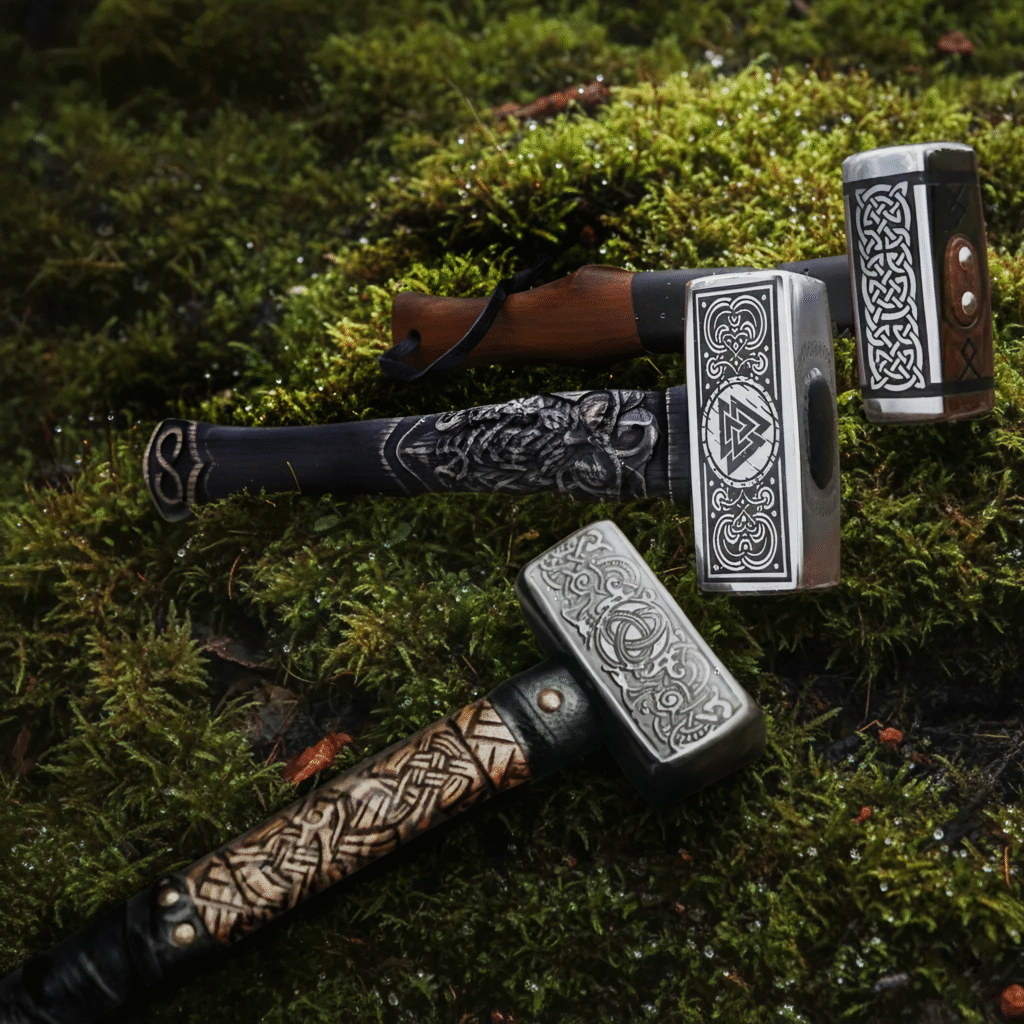
The same impulse to mark an object as extraordinary drove the Norse craft tradition. A hand forged axe with raven or wolf motifs or a Damascus steel blade with knotwork says the same thing the eight legs say: this was made to be more than ordinary.
For more on the Norse cosmos Sleipnir crosses, read our guides on Valhalla, Loki, the Valkyries, Heimdall, and Elder Futhark runes.
Frequently Asked Questions
How many legs does Sleipnir have?
Eight. Every source and every Viking Age depiction agrees on this. It is Sleipnir’s defining characteristic and the visual feature that separates him from every other horse in Norse mythology.
Who is Sleipnir’s mother?
Loki. The trickster god shapeshifted into a mare to lure the stallion Svadilfari away from a giant builder’s construction project, and later gave birth to an eight legged foal. The Prose Edda states this without elaboration.
Can Sleipnir travel to the land of the dead?
Yes. In the Prose Edda, Hermod rides Sleipnir to the realm of Hel to bargain for Baldr’s return. The horse clears the gates of Hel in a single leap. No other horse in the mythology makes this journey.
What does Sleipnir’s name mean?
It means “the sliding one” or “the slippery one,” from the Old Norse verb slippa. The name emphasizes speed and smooth movement, fitting for a horse described as the best and fastest in all the realms.
Is there a connection between Sleipnir and Yggdrasil?
Yes. Yggdrasil means “Ygg’s horse,” and Ygg is one of Odin’s names. The world tree connects the nine realms vertically while Sleipnir crosses between them. Both serve as vehicles for Odin’s movement through the cosmos.
The shop side of this
Carried in the shop, the Pathstave Norse sword and the Barrowlight Norse sword. The Longkeel Norse sword and the Ashgleam Viking spear sit with them.