Blog
What Is a Smallsword? And Where the Spadroon Fits

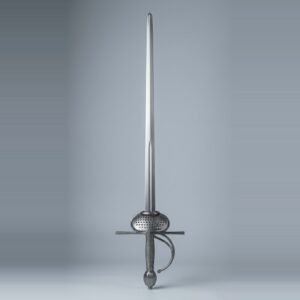
A smallsword is the light thrusting sword of the 18th century: 0.3 to 0.5 kg in the hand, a triangular hollow ground blade, a shell guard and a grip bound in wire. It is what the rapier turned into once everybody agreed that carrying 130 cm of steel to dinner was excessive. It is also the direct ancestor of the modern fencing foil, which is why smallsword fencers and sport fencers tend to recognise each other’s footwork within about ten seconds.
The spadroon is its cousin and arrives at roughly the same period from the other direction. Where the smallsword gave up cutting entirely, the spadroon kept a straight single edged blade that could cut, hung it in a light hilt, and tried to be both an officer’s sidearm and a duelling sword. Opinions on how well that worked have been strong for about two hundred years.
This guide covers both, because they sit next to each other in every catalogue and get mixed up constantly. If you are earlier in the process, read what HEMA actually is and how to choose your first HEMA sword first. If you know what you want, the smallswords and spadroons category is where these live.
What a smallsword actually is
Four features define it and all four have to be present.
The blade is triangular in section and hollow ground, which means each of the three faces is scooped out rather than flat. That is not decoration, it is engineering. Hollow grinding removes mass from the middle of each face while leaving the edges of the triangle as stiffening ribs, so you get a blade that is very light and still resists bending in the one direction that matters. The same trick appears on the modern epee for the same reason.
The weight is the part people do not believe until they hold one. Between 0.3 and 0.5 kg. That is lighter than most kitchen knives with a handle on them, and it changes everything about the tempo of the fencing.
The guard is a shell or a dish, sometimes plain, sometimes pierced, sitting over the hand with a pair of small arms of the hilt underneath. The grip is short, bound in wire, and finished with a pommel that is usually an urn or an olive shape. Because the sword is so light, the pommel is doing real balancing work rather than just holding the assembly together.
And here is the part that makes the smallsword unusual on a HEMA rack: heavy decoration is period correct. Everywhere else in this sport, ornament is a warning sign that the seller has been watching films. On a smallsword, chiselled hilts, blued and gilt panels and pierced shells are what the originals actually looked like, because this was a fashion accessory that also happened to kill people.
The colichemarde
The colichemarde is a smallsword blade variant worth knowing by name because you will see the word on listings and it describes something real. The forte, the third of the blade nearest the hand, is much wider than a normal smallsword forte, and then it steps down sharply to a thin thrusting section for the rest of its length.
The logic is straightforward. Parries happen near the hand, thrusts happen at the point, so put the metal where the parrying is and take it away everywhere else. The result is a blade that feels stiffer and more controlled in the bind than a plain smallsword blade of the same weight. The step is abrupt and slightly odd looking, and people either love it or think the sword has been in an accident.
The spadroon, and its reputation
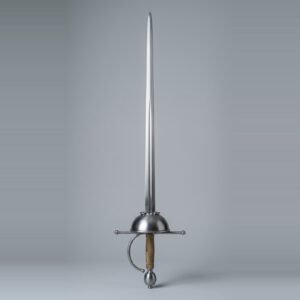
A spadroon is a light straight single edged sword, usually with a narrow groove rather than a broad fuller, hung in a simple hilt: a five ball pattern, an openwork shell, a knuckle bow, sometimes a stirrup. It is the officer’s sword of the late 18th and early 19th centuries across most of Europe.
It also spends a great deal of modern discussion being criticised, on the grounds that a sword trying to cut and thrust in a very light package ends up mediocre at both. There is something to that, and it is worth knowing before you buy so you are not surprised. It is also worth pointing out that the people making the criticism are usually comparing it to a purpose built cutting sword on one side and a purpose built thrusting sword on the other, which is a comparison almost nothing survives.
What a spadroon actually gives you is a fast, light, single edged sword with a hilt small enough to carry and enough edge to make cuts meaningful. If you fence the late sabre material or the British military systems of that period, it is the correct tool, and the fact that a forum disagrees does not change what the source says.
How these differ from a rapier
Length and mass, mostly. A rapier comes in around 1 kg with an average blade of 104 cm and Italian examples running past 115 cm. A smallsword is under half that weight with a blade short enough to wear without knocking furniture over. The rapier fights at long measure with the point held out; the smallsword fights closer, faster and with far more blade contact, because a blade that light can change line before your eye has finished processing the first one.
If you are weighing up the earlier and heavier end of the same tradition, rapier versus sidesword covers that comparison properly. If the curved end of the 18th and 19th century appeals more than the straight, the HEMA sabre guide is the one to read.
Hilt anatomy, without the jargon
Shell and dish
The plate over the hand. A dish is a shallow bowl, a shell is usually two lobes either side of the blade. Pierced versions cut weight out while keeping the surface that stops a point. On a sword this light, a few grams at the guard shift the balance noticeably, which is why so many originals are pierced.
Arms of the hilt
The two small loops under the guard, running from the block toward the blade. They are a holdover from the rapier, where you hooked a finger over the quillon, and on a smallsword they mostly serve to catch a blade that has slipped under the shell.
Grip and pommel
Short, wire bound, and shaped so the sword indexes in the hand without you looking. The wire is not there for grip alone, it is there because a smooth grip on a blade this light gives you no feedback on edge or point orientation. The pommel, urn or olive, sets the balance.
What fencing with one is like
Fast, and much more technical than it looks from outside. The whole game happens in a narrow band of distance with a great deal of blade contact: engagements, changes of engagement, disengages, beats. The smallsword is the origin of most of the vocabulary modern sport fencing still uses, and the material from the period is unusually clear and well organised because it was taught commercially to people who expected results.
The spadroon is broader. Cuts come back into the picture, so edge alignment matters again, and the hand positions borrow from both the smallsword and the early sabre systems. Most people who fence spadroon also fence sabre, and the two inform each other.
Steel, tips and safety
These trainers are 51CrV4 spring steel at 49 to 52 HRC, like the rest of the line. Spring steel is used because it bends and returns rather than taking a set or snapping, and on a blade this thin that property is not optional. A hard, brittle blade in a smallsword profile is a genuinely bad idea.
Stainless is the thing to avoid. It is chosen for decorative pieces because it needs no oiling, and it is too hard and brittle to take repeated impact. If a smallsword listing leads with stainless, it is a costume piece.
On tips, follow the ruleset of whatever event or club you are fencing at. The Berlin HEMA Cup gear requirements set the standard most people reference: permitted tips are spatulated or rolled, minimum 1.5 cm in diameter, and rounded tips are not allowed on rapier and sabre. We do not call any piece tournament legal without naming the ruleset, and you should be suspicious of anyone who does. HEMA tournament gear rules goes through the detail, and HEMA sword flex explained covers the flex side.
If you want something sharp for cutting rather than a trainer, that is a separate purchase and a separate risk profile. See blunt versus sharp training swords.
Which should you buy
Buy a smallsword if you want the 18th century thrusting material, if you already fence foil or epee and want to see where it came from, or if you simply want the lightest sword on the rack. It is also the easiest type here to keep training with as you get older, which is not a small consideration in a sport where people fence into their sixties.
Buy a spadroon if you want a single edged sword that cuts, if your club runs British military or late 18th century material, or if you want something that bridges toward sabre without committing to a curve.
Buy a colichemarde if you have handled a plain smallsword and wanted more presence in the bind. It is a refinement rather than a starting point, and it costs the same, so there is no penalty for choosing it if the handling appeals.
Where to see these
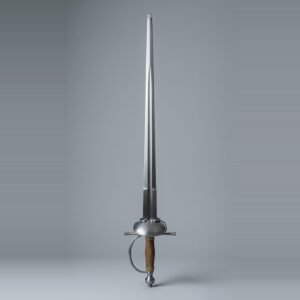
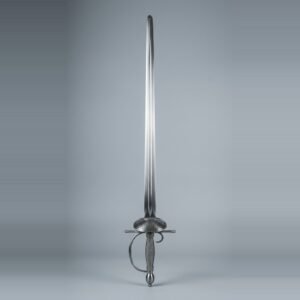
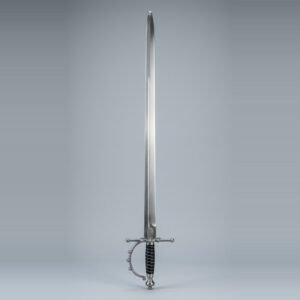
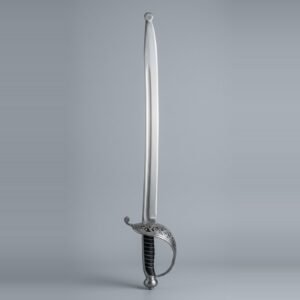
Four to compare. The Lindmoor smallsword has a plain oval dish, arms of the hilt, an urn pommel and a stepped forte, which is the colichemarde idea in its clearest form. The Hrafnstede smallsword takes the blackened route with a pierced oval shell and a dark wire grip over a hollow ground blade. On the spadroon side, the Skaldrun spadroon is the classic five ball hilt with a narrow groove and an urn pommel, and the Orlunde spadroon carries a pierced openwork shell with a ray skin and wire grip.
Every one is made by hand in the Czech Republic, inspected at our North Babylon, New York warehouse and shipped from there. Engraving is done in the United States after arrival, and this is the one family where an engraved hilt is period correct rather than fantasy. Options are on the engraving page.
Questions people ask
What is a smallsword?
A light thrusting sword of the 18th century weighing 0.3 to 0.5 kg, with a triangular hollow ground blade, a shell or dish guard and a wire bound grip. It replaced the rapier as the civilian sword of choice and became the direct ancestor of the modern fencing foil.
Is a smallsword the same as a foil?
No, but they are related closely enough that the confusion is fair. The foil began as a practice tool for the smallsword and kept the geometry while losing the historical hilt and the cutting edges the smallsword never had anyway. A smallsword is heavier, stiffer and has a guard built to actually stop a blade.
What is a colichemarde?
A smallsword blade with a notably wide forte that steps down sharply to a thin thrusting section. The wide part sits where parries happen and the thin part sits where it does not, which makes the blade feel more controlled in the bind without adding much weight.
Can you cut with a smallsword?
Not meaningfully. The blade is triangular in section with no real edge, so it is built for the thrust and nothing else. If you want a light sword that cuts as well, that is what the spadroon is for.
Why do people criticise the spadroon?
Because it tries to cut and thrust in a very light package and is not the best in the world at either job. That criticism is fair as far as it goes, and it is also the standard complaint about every compromise design ever made. If the material you fence assumes a spadroon, buy a spadroon.
Is decoration on a smallsword a warning sign?
Not on this one type. Elsewhere in HEMA, ornament usually means the maker is guessing, but the originals of this family were dress accessories with chiselled, pierced and gilded hilts. A plain smallsword is perfectly correct too, it just is not the only correct answer.
Are these suitable for a first HEMA sword?
They are if your club teaches this material, and they are not if it does not. The lighter weight makes them easy on the wrist and the arm, and the technical density makes them a genuinely rewarding study, but a sword nobody at your club can coach is an ornament.
Do they come with a scabbard?
Not in this range. Store the blade lightly oiled and horizontal rather than in a sealed sheath, where trapped damp will sit against the steel and cause problems you do not want on a thin blade.
Keep reading
The rest of the HEMA writing sits in the guides section, and the whole line is under HEMA swords.