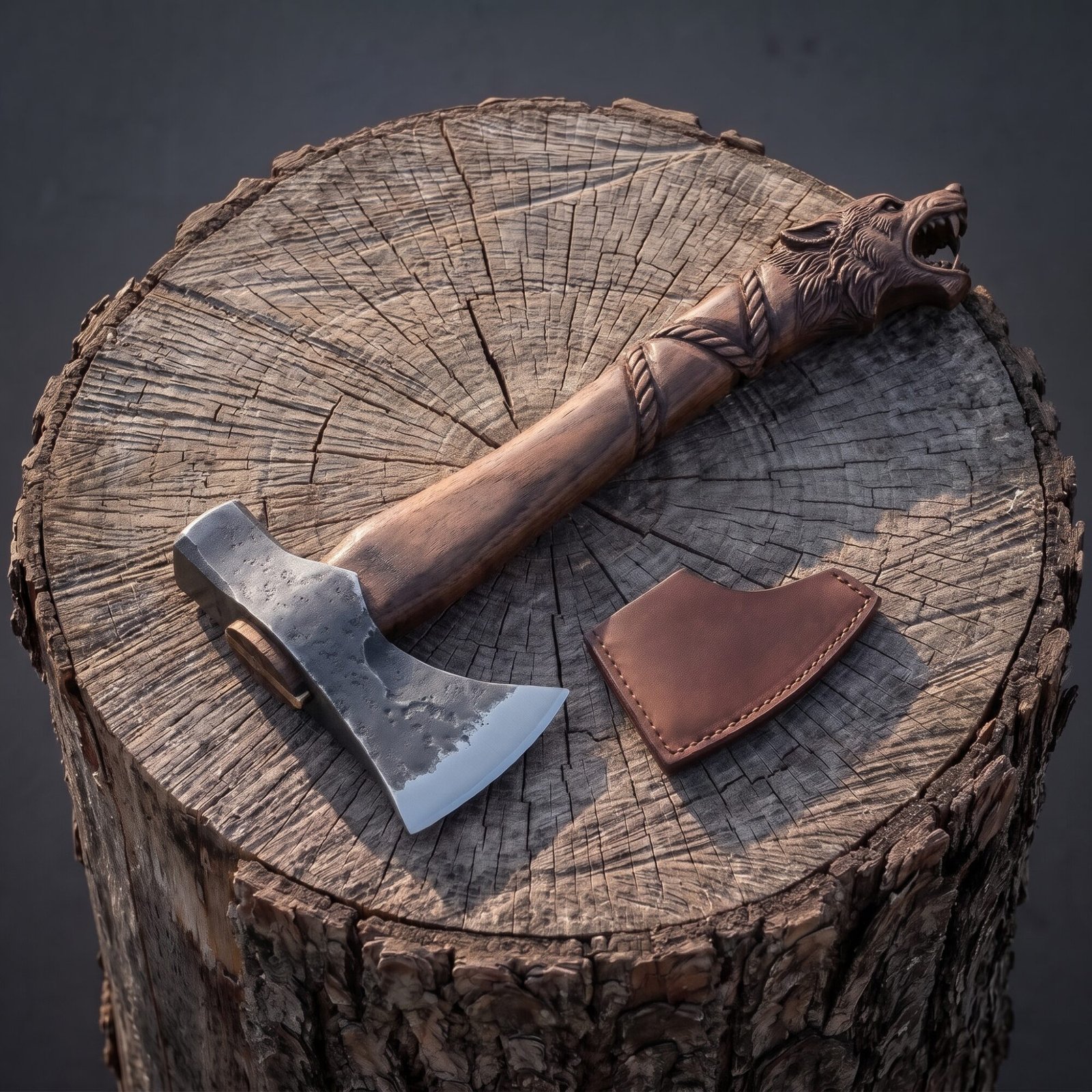
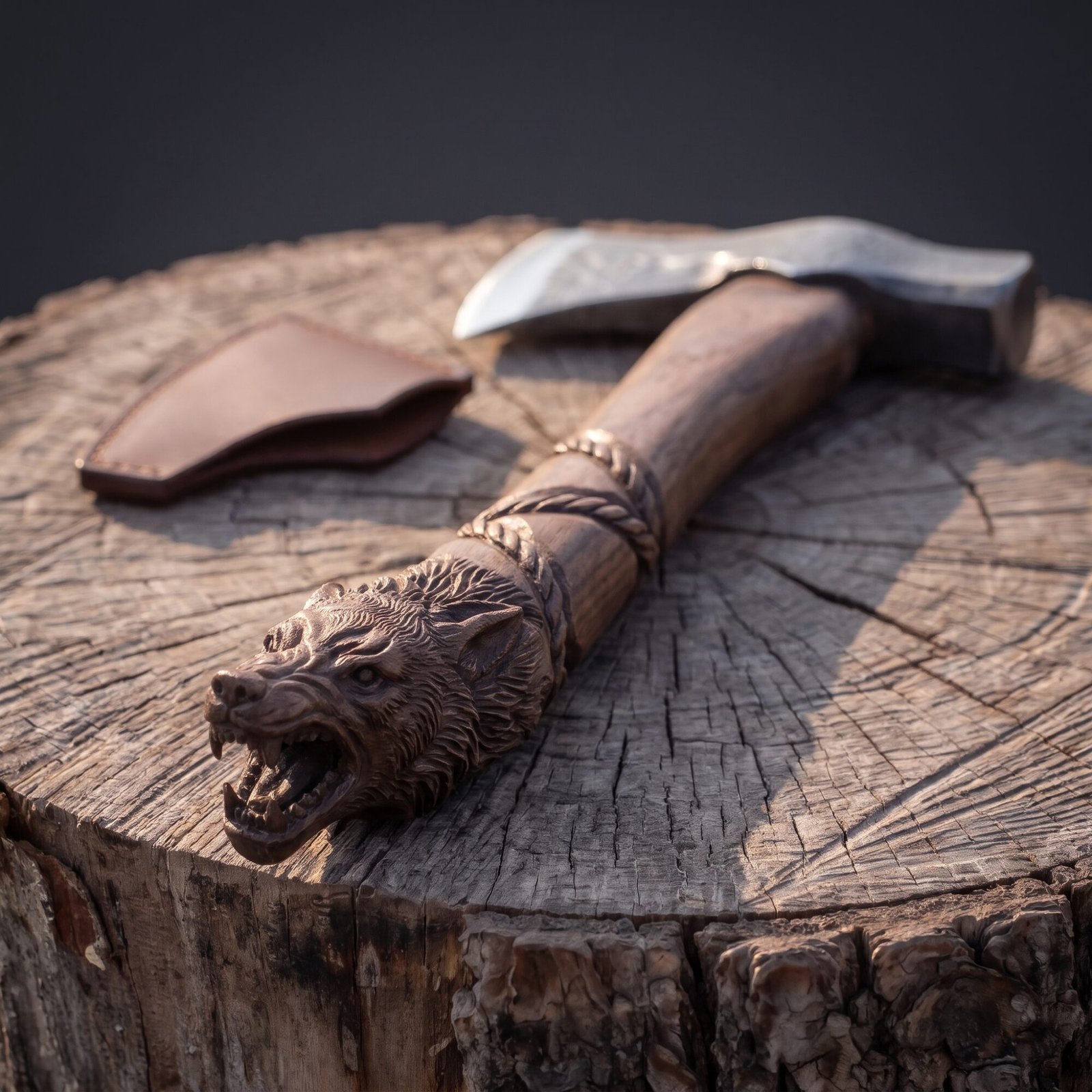
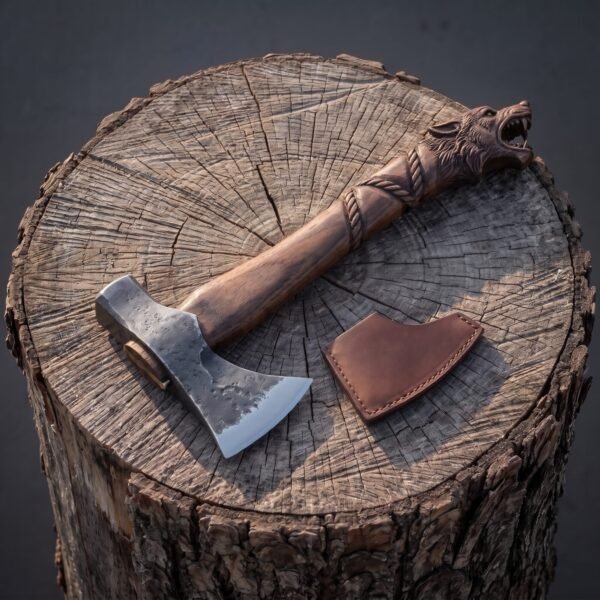
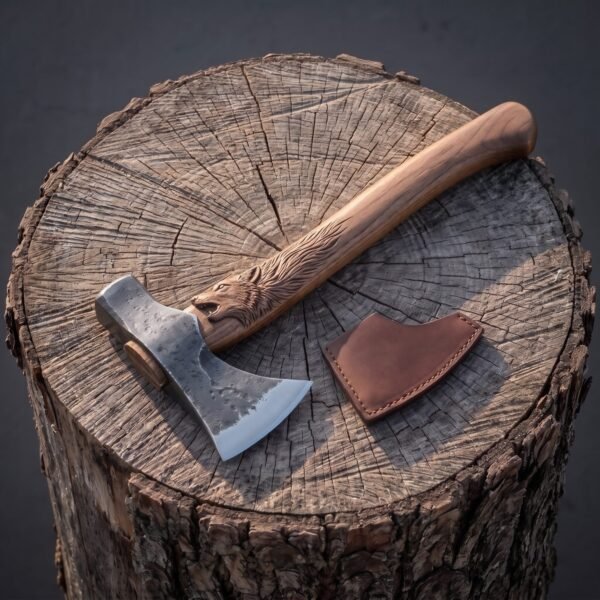
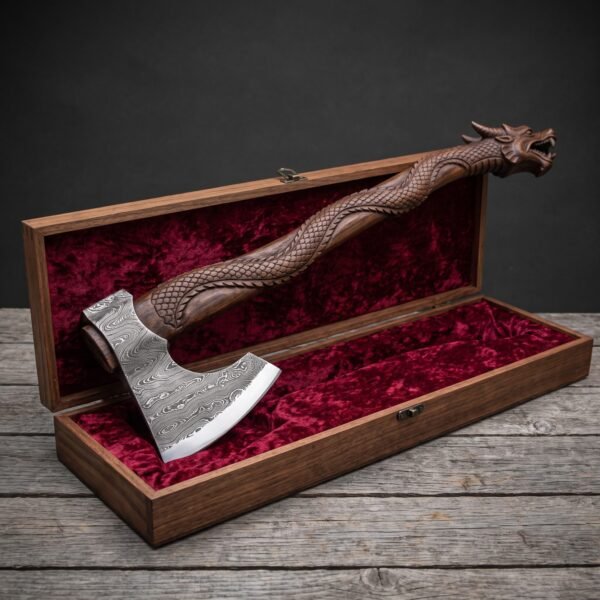
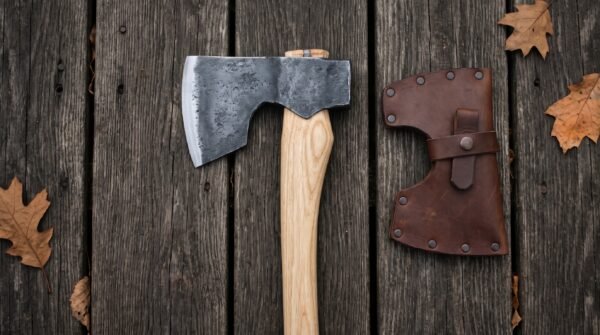
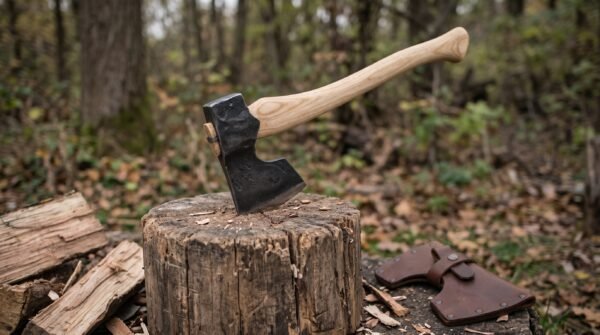
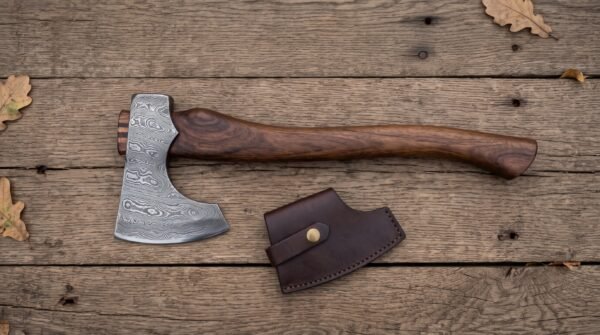
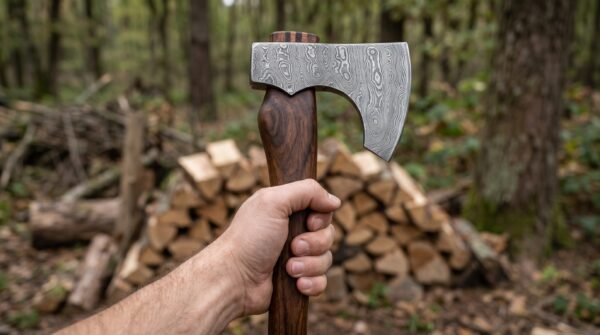
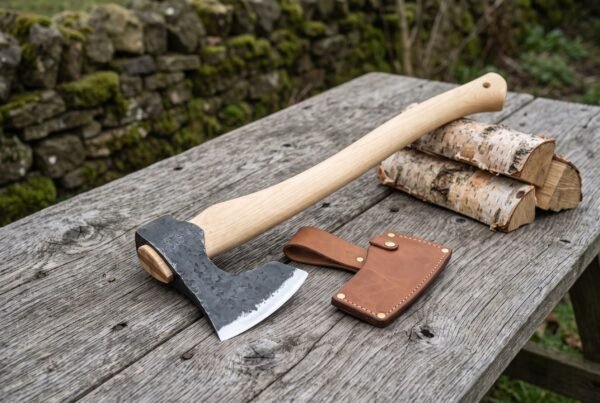
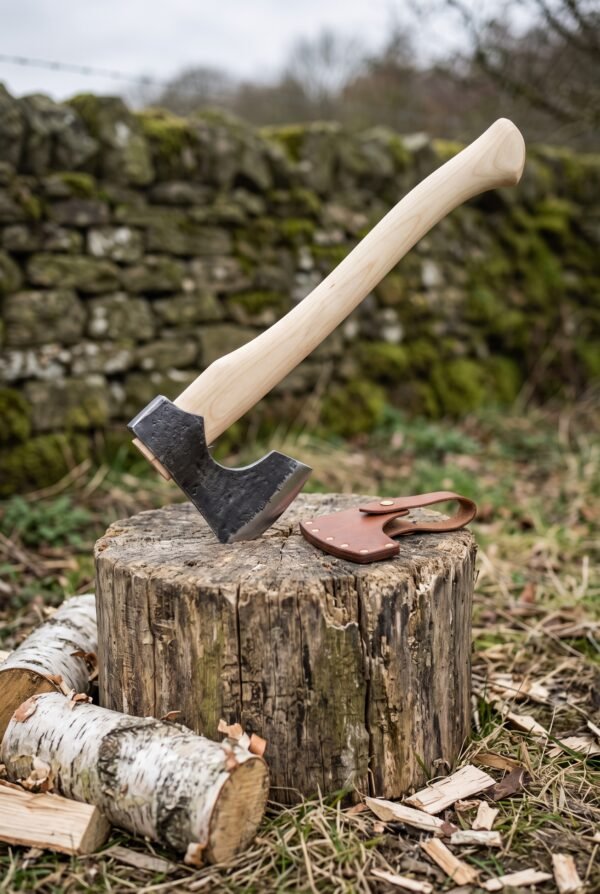
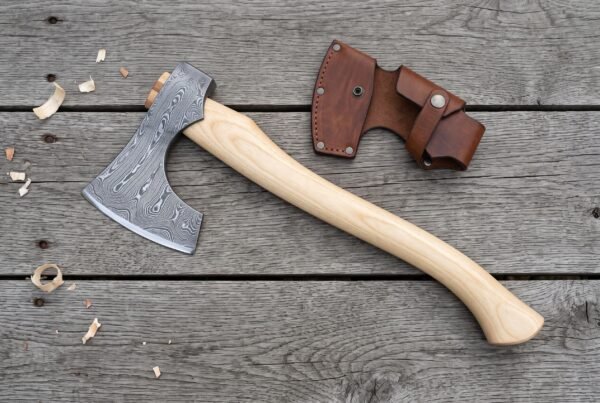
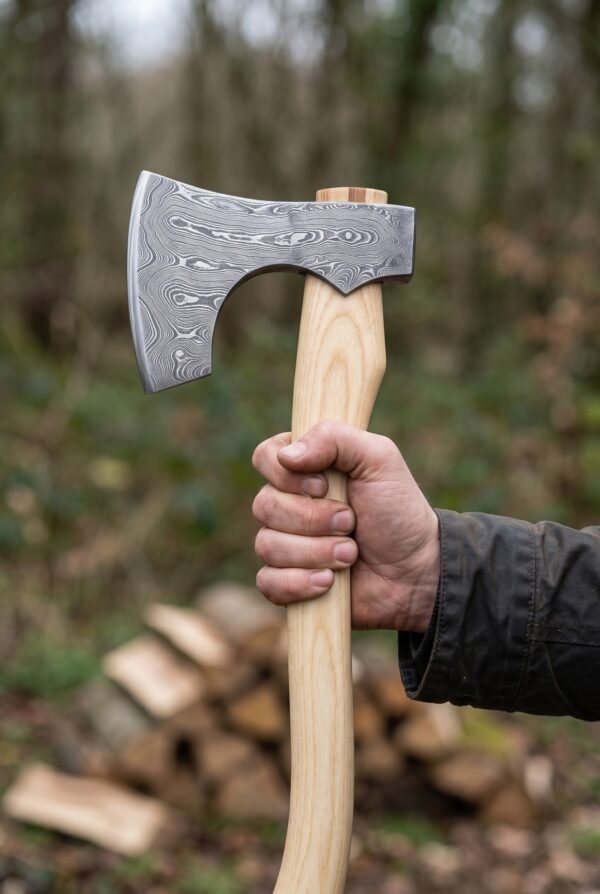
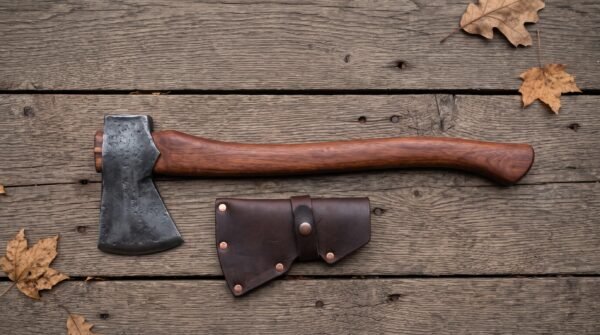
Fetterjaw is a hand forged Viking bearded axe about 20 inches long, and the end of its walnut handle has been carved into the head of Fenrir, the great wolf of Norse myth. His lips are drawn back off the fangs and his ears are flat to the skull, which is roughly the face you would expect from an animal that has just worked out what the gods are doing with that ribbon. Above the wolf, a twisted cord is carved three times around the grip. That is Gleipnir, the fetter that held him. The head is 1095 high carbon steel with a satin finish and a bright ground edge, and a brown leather edge cover comes with it.
The layout has a point. The wolf sits at the butt where your hand stops, and the binding sits where your hand closes, so every time you pick the axe up you are, in a small way, holding Fenrir down. If the myth is new to you, Fenrir, the wolf who waits tells the whole story, and the children of Loki puts him beside his brother and sister.
It is a real bearded axe with a carved handle, not a carving with a blade glued to it. It sits with our bearded axes and the wider range of Viking axes.
Specifications
| Head | Hand forged 1095 high carbon steel, 54 to 58 HRC |
|---|
| Head profile | Bearded Norse pattern with a short hooked beard, satin finish, bright ground edge |
|---|
| Overall length | Approximately 20 inches |
|---|
| Cutting edge | Approximately 5 inches |
|---|
| Handle | Walnut, oiled |
|---|
| Carving | Fenrir wolf head at the butt, carved twisted fetter three turns around the grip |
|---|
| Included | Brown leather edge cover |
|---|
| SKU | RK-2361 |
|---|
The carving: wolf head and fetter
The wolf head takes up roughly the last three inches of the handle. It is cut from the same walnut as the rest of the handle, so there is no glued on block and no joint to open up later. The carver roughs the shape out with a saw and gouges, then works the muzzle, the eye sockets and the fur with smaller knives. The fur lines run back from the brow and down the neck, following the grain rather than fighting it, which is why the detail stays crisp instead of tearing.
The open jaw is the delicate part. The fangs are left short and thick at the root, because a long thin tooth in walnut snaps the first time the axe is set down on a stone floor. The cord above the wolf is three turns of a twisted rope pattern sunk into the surface. It is shallow enough not to weaken the handle and deep enough to feel with your fingers, and in use it gives your lower hand a little extra purchase.
Fenrir and Gleipnir
In the Prose Edda, Snorri Sturluson tells how the gods raised Fenrir among them and watched him grow until they were afraid of him. They tried two iron chains, Laeding and Dromi, and he broke both. The dwarves then made Gleipnir from six things that do not exist: the sound of a cat’s footfall, the beard of a woman, the roots of a mountain, the sinews of a bear, the breath of a fish and the spittle of a bird. It looked like a silk ribbon. Fenrir smelled a trick and agreed to be bound only if one of the gods put a hand in his mouth as a pledge. Tyr did, the ribbon held, and Tyr lost the hand.
The story does not end well for anyone. At Ragnarok the fetter breaks, Fenrir runs free and swallows Odin, and Odin’s son Vidar kills him. That is why Fenrir turns up so often on Norse pieces. He is the thing held back for as long as it can be held back, which makes him a fair mascot for an axe. The Prose Edda was written in Iceland in the thirteenth century, after the conversion, so treat it as the fullest telling of the story rather than a record of what every Viking believed. Tyr’s side of it is in Tyr, the god who gave his hand.
The forged head
The head is 1095 high carbon steel, hardened and tempered to 54 to 58 HRC. That is softer than a knife on purpose. An axe edge meets knots, grit and the odd forgotten nail, and at this hardness it will dent or roll slightly and file back rather than chip out. The beard is short and hooked, which gives you a little more edge for the weight and a notch behind the edge to choke up into for fine cuts.
1095 is not stainless. It darkens with use and takes a grey patina, which helps protect it, and it will rust if it is put away wet. A little oil after use is the whole routine. The edge leaves the workshop sharp enough to work wood, with an axe bevel a touch thicker than a knife edge so it survives the first knot it meets.
Why walnut for a carved handle
Walnut is the carver’s choice here because it cuts cleanly across the grain, holds fine detail without crumbling and is dense enough to take a knock. Its dark brown colour also shows carving well. The deep cuts sit in shadow and the high points catch the light, which is why the detail reads from across a room. The handle is oiled rather than varnished, so it grips well in a damp hand and you can see the grain if you ever want to check it. At the eye, the growth rings should run roughly in line with the edge, which is the strong way to orient a handle.
Using it, and where the carving sits
Hold it below the cord for a full swing and the wolf head sits against the heel of your hand as a stop, which is the same job the swell does on a plain handle. Choke up under the head for carving and you are on smooth walnut. The head will split kindling, trim branches and shape a tent peg without complaint.
The honest note is that the carving is the reason to buy this axe, and repeated heavy chopping will wear the high points of the fur and the fangs over the years. Most owners use it for light camp jobs and keep it on a wall or a desk the rest of the time, and that is how we would use it too.
Who it suits
Fetterjaw suits someone who knows the Fenrir story and likes the idea of a wolf that is only just held. It makes a good gift for a reader of the sagas, a tattoo collector with a wolf already on the arm, or anyone who wants one carved axe that can still split the kindling on a camping weekend.
Engraving, runes and your own design
Use the rune converter on this page to turn a name, a date or a short phrase into Elder Futhark and we will cut it into the steel, the leather or the wood. If you would rather have a Viking pattern than a rune line, choose your own design in the engraving option above the add to cart button and tell us where it goes. Where a piece already carries an engraved design, your chosen engraving replaces it rather than sitting alongside it. The carved handle is never altered. On Fetterjaw the cheek of the head is plain, so a name or a short rune line sits best there, or on the smooth stretch of handle between the fetter and the head. Details are on the engraving page, and for a piece built from scratch there is the custom Viking axe page.
Care
Wipe the head dry after use and give it a thin coat of mineral oil, camellia oil or paste wax. If a spot of red rust appears, lift it with fine steel wool and oil the area. Touch up the edge with a file and a fine stone rather than a bench grinder, which can heat a thin edge enough to spoil the temper before you notice.
A carved handle needs one extra habit. Dust settles in the cuts, so now and then brush the carving out with a soft dry brush, then work a little boiled linseed oil or furniture wax into it with the same brush and wipe off whatever sits on the surface. Once or twice a year is enough to keep the wood rich in colour and stop it drying and checking. Keep the axe away from radiators and fireplaces, and never store it in the leather cover when either is damp. Our axe care guide covers sharpening and storage in more detail, and hanging swords and axes on a wall covers putting it up safely.
Made in the Czech Republic
Fetterjaw is made by hand in a Czech Republic workshop that forges, grinds and hangs its axes at the bench and carves its handles in the same building. The head is forged and hardened, the handle is shaped and carved, and the two are fitted to each other one axe at a time. Ransack Viking is a United States company. We check every axe for the hang, the wedge, the edge and the carving when it reaches us, and ship it from our Chicago, Illinois warehouse. Processing runs one to two weeks, at the longer end if you order engraving. Shipping inside the United States is free, returns run seven days, and the lifetime warranty covers defects in forging, grind, heat treat and fittings.
A note on handmade variation
Every handle is carved by hand, so the fur, the fangs and the fetter on yours will not match the photographs cut for cut. The walnut will have its own grain and colour, and the hammer marks on the head will fall in different places. The size, the steel, the layout of the carving and the build are the same on every axe. The small differences are what you are paying a carver for.
Frequently asked questions
Is it sharp when it arrives
Yes. It ships with a working axe edge that will cut wood out of the box. Keep the leather cover on it in transit and storage.
How soon will it ship
Processing takes one to two weeks while the axe is finished and checked, then it ships free inside the United States from Chicago, Illinois.
Is the wolf head a separate piece
No. It is carved from the same walnut blank as the handle, with no joint or glue.
What is the cord carved around the grip
Gleipnir, the fetter the dwarves made to bind Fenrir. It doubles as a grip aid for your lower hand.
Will the fangs break off
They are left short and thick at the root so they survive normal handling. Dropping any carved handle on stone can chip it, so set it down rather than letting it fall.
What is in the box
- One Fetterjaw bearded axe with a 1095 high carbon steel head
- Walnut handle with a carved Fenrir wolf head and fetter
- Brown leather edge cover
- Your rune line or chosen Viking design, if ordered
- Lifetime warranty against defects in forging, grind, heat treat and fittings
Explore the range
Close to this one in the carved handle run are the Wyrmjaw dragon jaw axe and the Gerifang wolf handle axe. See everything in Viking axes, bearded axes, engraved and personalised pieces, or read the guides.


Reviews
There are no reviews yet