A great helm in black is not a fantasy invention. Blackened harness was common, and it was common for the same reason it appears on so many surviving munition pieces: an oxide finish resists rust far better than bare polished steel, it needs nothing more than a wipe of oil to maintain, and it does not throw sunlight across a field. Bright armour was a statement of wealth because keeping it bright took a servant. Black armour was what you wore if you had to look after it yourself.
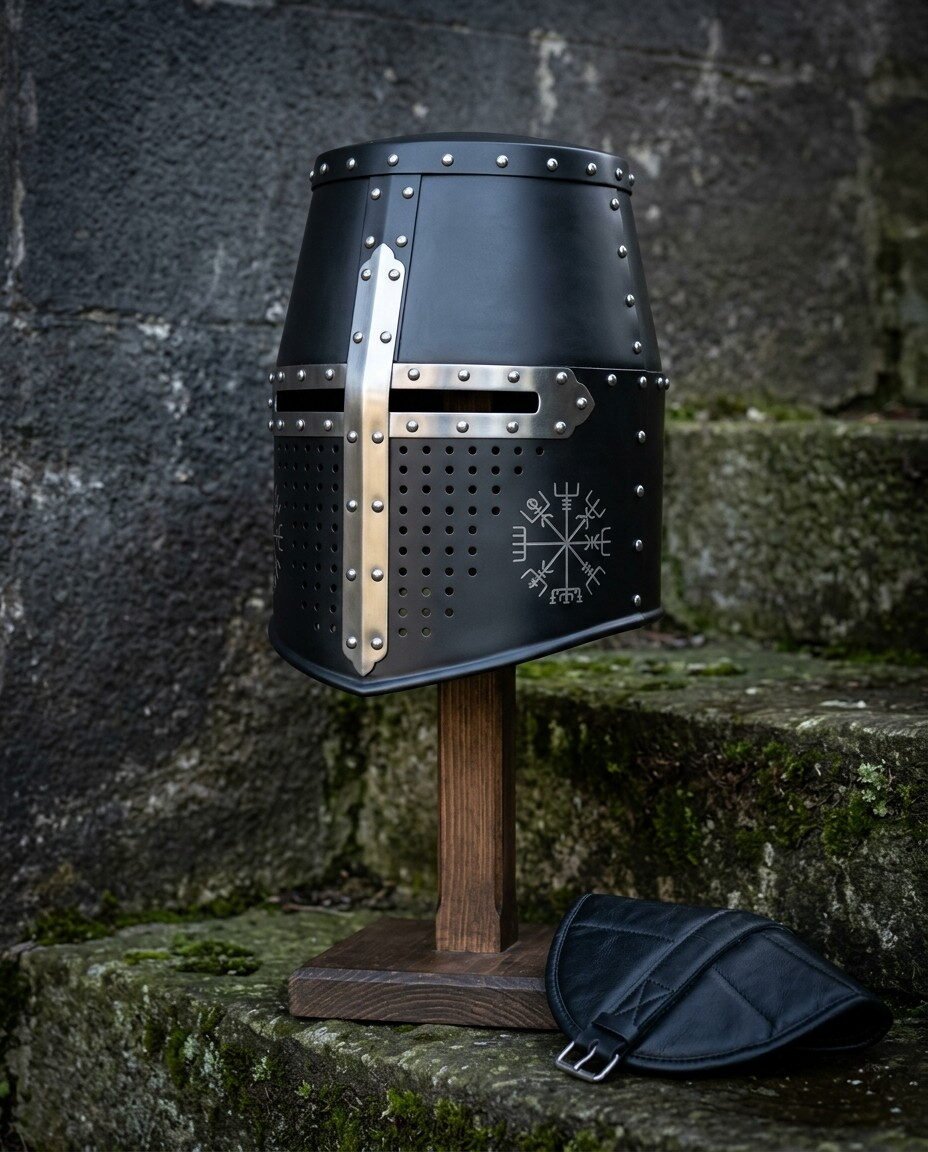
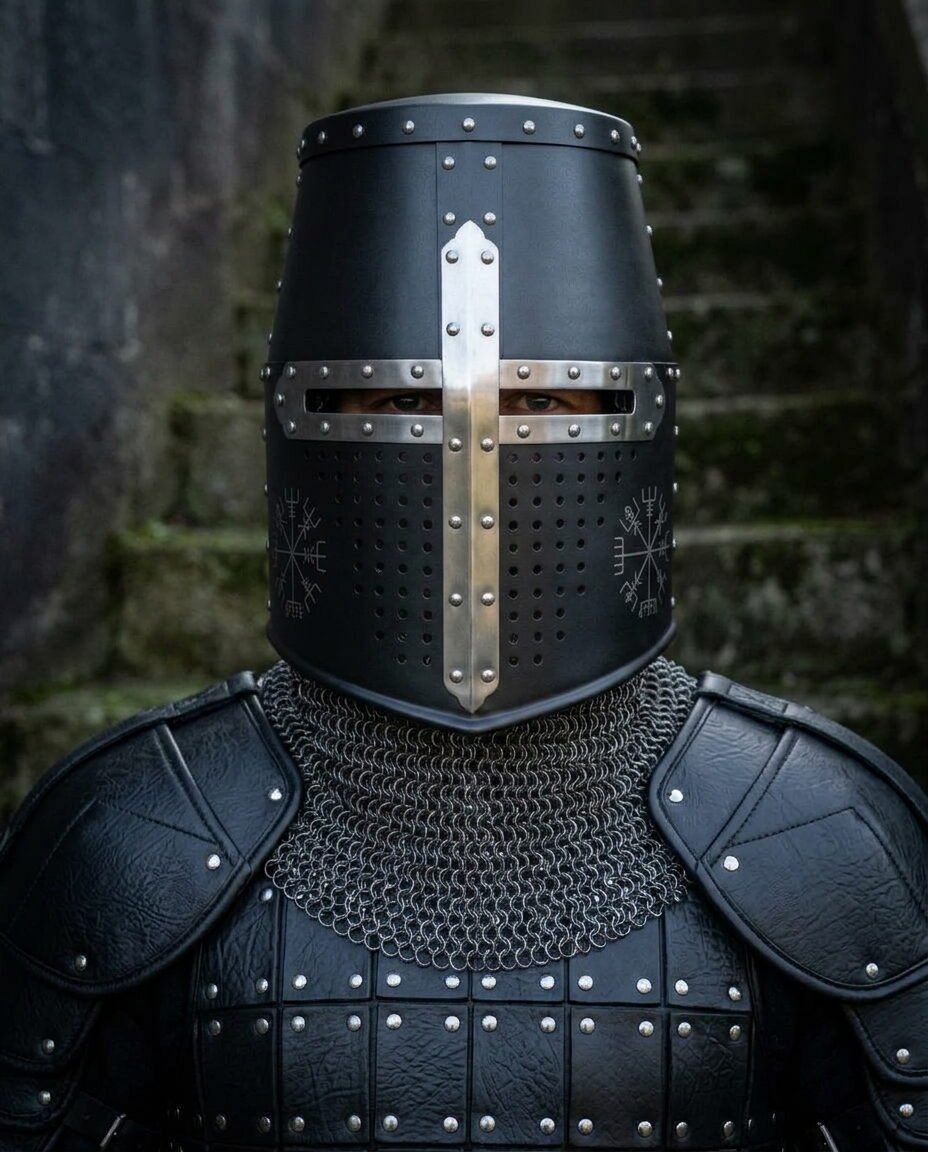
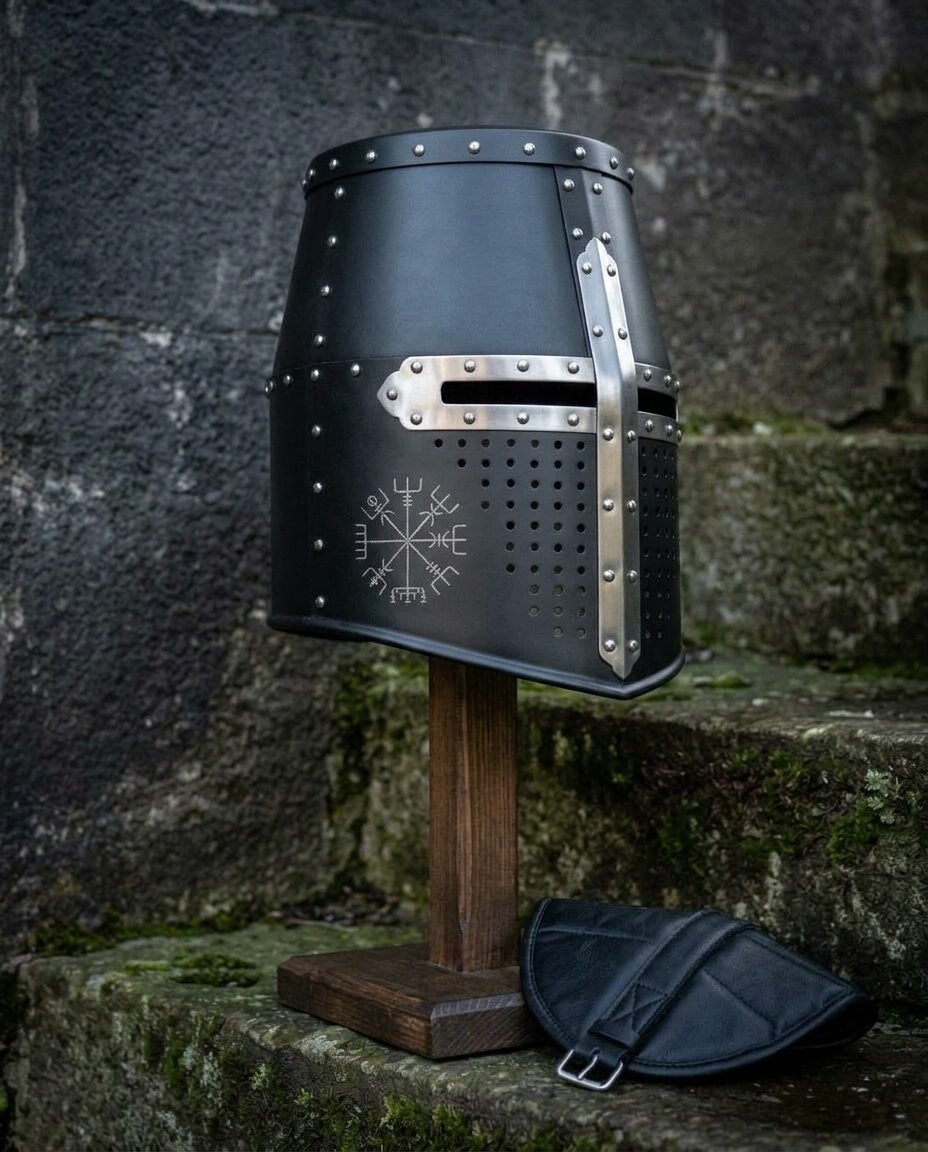
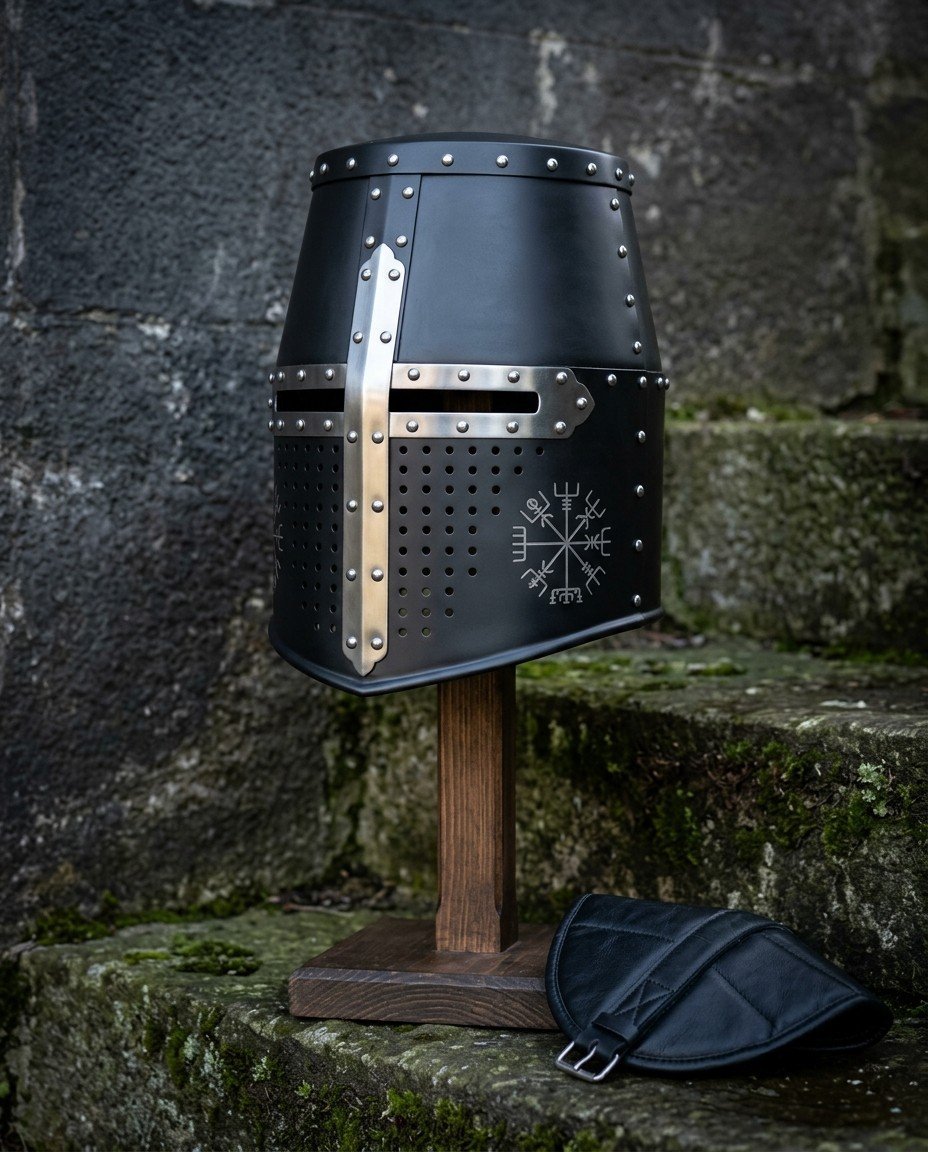
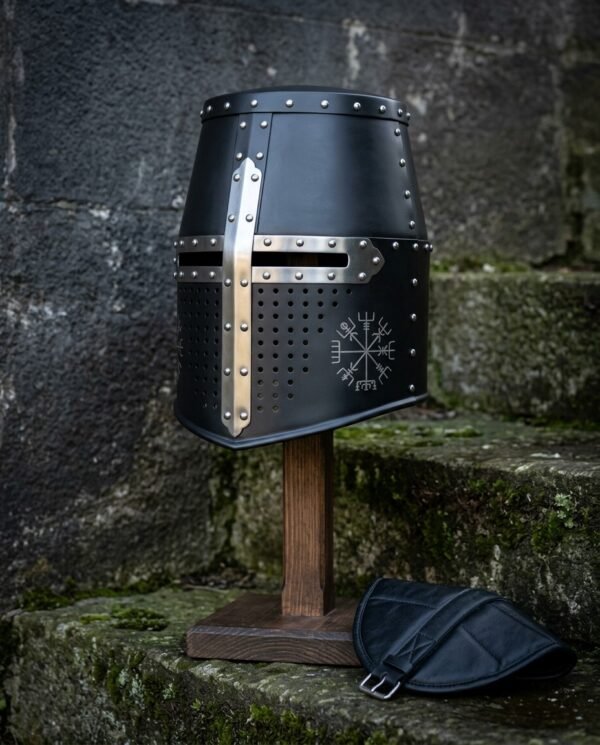
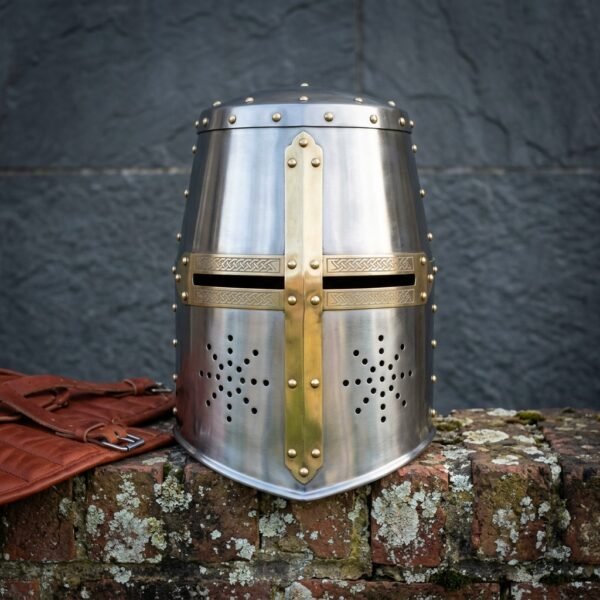
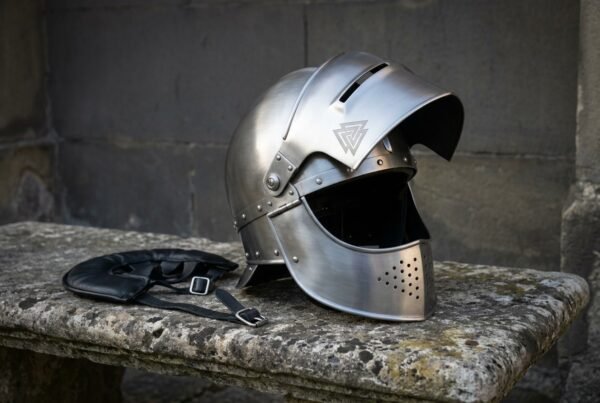
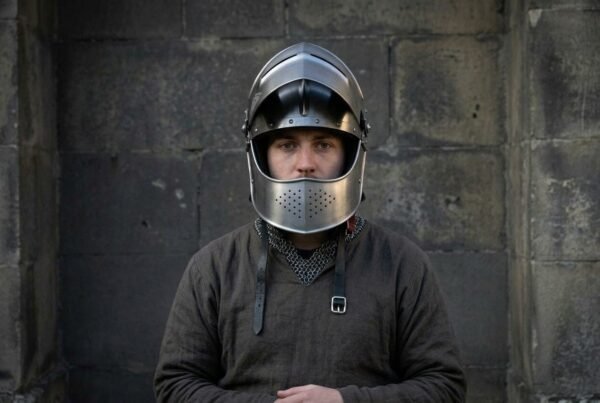
This helm is built in the Czech Republic from formed plates joined with domed rivets, blackened, and then fitted with a polished steel cross reinforce over the crown and face and a polished band across the brow. A Vegvisir compass is chased into each cheek, the vision slits run either side of the face reinforce, and the breath holes are punched in dense clusters on both sides. The wooden stand and the black padded cap in the photograph are studio props and are not included. Fit, steel gauge and the shapes worth avoiding are covered in our notes on buying a helmet.
Specifications
| Material | Mild steel plates, hand formed |
|---|
| Gauge | 16 gauge, approximately 1.6 mm |
|---|
| Type | Great helm, flat topped with a domed crown plate |
|---|
| Finish | Blackened oxide body with polished steel reinforces and rivets |
|---|
| Reinforce | Polished steel cross over the face, its arms running along the sight slits |
|---|
| Rivets | Domed steel rivets around the crown and along every plate and reinforce |
|---|
| Ventilation | Twin vision slits and dense punched breath hole clusters on both cheeks |
|---|
| Decoration | Chased Vegvisir compass on each cheek |
|---|
| Size | Fits a head circumference of roughly 22 to 24 inches over an arming cap |
|---|
| Weight | Approximately 6 lb 12 oz |
|---|
| Lining | Supplied without a fitted liner, sized to be worn over a cap or coif |
|---|
| SKU | RK-1483 |
|---|
Breath holes, sight slits and where a helm is weakest
Every hole in a helmet is a compromise between air and strength, and the placing of those holes is not decoration. Look at where the clusters sit: low on the cheeks, level with the mouth and jaw, not up near the temples. A closed steel box over the head fills with your own exhaled breath in seconds, and warm air rises, so ventilation put high in the helm does nothing at all. Put the holes level with the mouth and fresh air arrives where your lungs can reach it.
The sight slit is a straight structural cost. Cutting a long horizontal slot across the front removes precisely the material that would hold the face plate rigid, which is why a cross reinforce is riveted over it. The vertical bar bridges the gap above and below the slot, the horizontal band ties the front plates together, and the two together put back most of what the slot took away. On this helm the reinforce is left in bright polished steel against the blackened body, which shows the structure clearly instead of hiding it.
Be honest about what this is: a wearable display and living history helmet at 16 gauge, without a fitted suspension liner. It is not certified combat armour and mild steel at this weight is not full contact weight. Do not use it for steel on steel bouting.
Steel, gauge and the black finish
Sixteen gauge, roughly 1.6 mm, is the standard for a wearable helmet. It is heavier in the hand than an 18 gauge cuirass and that is correct, because a helmet carries all its weight on the neck and has to hold its shape when it meets a doorframe.
The blackening is an oxide grown on the steel itself, not paint or powder coat. That matters at the edges and around rivet heads, because a coating chips there and an oxide does not. The trade off is porosity: an oxide holds oil beautifully and rusts if you let it dry out. The reinforce is polished bright and left that way, which means the two finishes want different care and you should not take abrasive polish to the black.
Armour is described by gauge and by whether the stock is mild or spring steel. There is no hardened cutting edge on a helmet, so there is no hardness figure to quote, and anybody quoting one is selling you a number that does not apply.
Engraving, runes and your own design
Use the rune converter on this page to turn a name, a date or a short phrase into Elder Futhark and we will cut it into the steel or the leather. If you would rather have a Viking pattern than a rune line, choose your own design in the engraving option above the add to cart button and tell us where it goes. Where a piece already carries an engraved design, your chosen engraving replaces it rather than sitting alongside it, so the Vegvisir shown here gives way to your choice. Cut lines look particularly good on a blackened helm, because the graver takes the oxide off and leaves bright steel in the groove. See the engraving page.
Fit and sizing
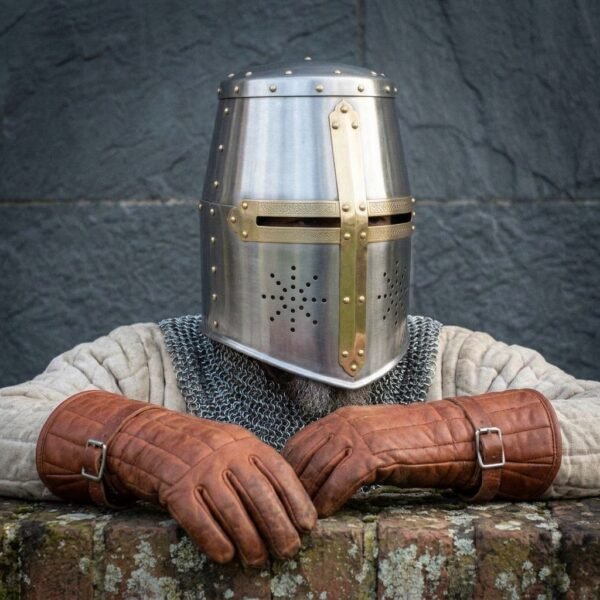
A great helm goes over padding, always. The standard build takes a head circumference of roughly 22 to 24 inches measured around the brow, with an arming cap or a mail coif taking up the difference. Worn on a bare head it will rotate and the sight slits will end up somewhere unhelpful.
Measure around your head just above the ears and the eyebrows, then add the thickness of whatever you intend to wear inside it. If you plan to wear a mail coif under the helm, which is how it was actually worn, say so, because a coif adds a genuine half inch or more all round and changes the build. Tell us your face length from brow to chin as well, since that sets where the sight slit falls relative to your eyes. If your measurements are outside the standard range, message us and we will build to your head.
Care
The inside of a helmet is where rust starts, because your breath condenses on cold steel and runs down. Wipe both faces dry after every wear and keep a light film of machine oil or paste wax on them, inside and out. Blackened steel wants oil more than bright steel does, not less.
Do not use abrasive polish or steel wool on the black surface, because it will cut straight through the oxide and leave a bright patch. If rust appears on the black, lift it with oil and a soft brass brush. The polished reinforce and rivets can be brought back with fine steel wool and oil, worked along the polish lines and kept off the surrounding black. Store the helm upright and open, never sealed in a bag and never with a damp cap inside it. Our notes on steel care apply here as well. Steel headgear wants the same care as mail, set out in caring for chainmail and steel armour.
Made in the Czech Republic
The work behind this piece happens in a Czech Republic workshop that has kept to the old methods. Steel is forged and heat treated by hand, the grind is taken down by eye rather than by machine, and the handle, fittings and sheath are cut and finished one at a time. Because of that, every piece carries small marks of the hand that made it.
Ransack Viking is a United States company. We import direct, check each piece when it reaches us, and ship from our Chicago, Illinois warehouse. Engraving is added here in the United States after arrival, so the piece you receive is finished to your order.
A note on handmade variation
This helm is hand made, not machine made or bulk produced, so what arrives will not be a pixel for pixel copy of the photograph. The blackened finish takes differently over hammer texture on every plate, rivet spacing shifts slightly, and the depth of the chased Vegvisir changes with the graver, because every helm is worked by hand from natural materials. The dimensions, the material and the build are the same every time. The character is not.
Frequently asked questions
Is the black finish going to chip?
No. It is an oxide grown on the steel rather than a coating, so there is nothing to flake at an edge or around a rivet. It will wear to grey on the high points over years.
Is the padded cap in the photograph included?
No. The cap and the wooden stand are studio props. The helm is sized to be worn over your own arming cap or mail coif.
Can I actually wear it?
Yes, over padding. It is intended for display, living history and costume. It is not certified combat armour and should not be used for full contact fighting.
How much can you see through it?
A clear horizontal band ahead of you and very little above or below. That is authentic and it is worth practising in before you wear it on uneven ground.
Will it rust?
Less than a bright helm if you keep it oiled, because the oxide holds oil well. It will rust if you store it damp or sealed in a bag.
How long does it take to ship?
Processing is one to two weeks because the plates are formed, riveted and blackened to order. Shipping inside the United States is free and returns are accepted within seven days.
What is in the box
- One hand formed riveted great helm, blackened
- Polished steel cross reinforce and brow band, fitted
- Chased Vegvisir compass, or your own engraving in its place
- Light protective oil coat applied before packing
- Care and storage card
- Forged and finished in the Czech Republic
Explore the range
See more in medieval helmets, plate armor, chainmail armor and engraved and personalized, or read the guides.
Compare it with these
Another in the same line is the Ridgehelm Medieval helmet. Next along the rack is the Duskwarden plate armor. For a straight comparison, see the Grimward plate armor.
The Ironvisor Viking helmet covers the other half of the same kit. Pick the steel, the length and the fittings yourself on the design your own page.




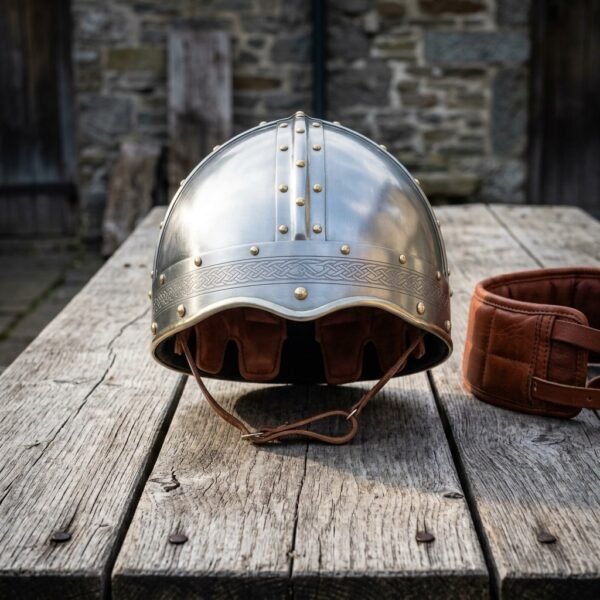




So happy I finally pulled the trigger on this one. Rivets and trim are all solid. Nothing feels flimsy. This is going straight into my display case.