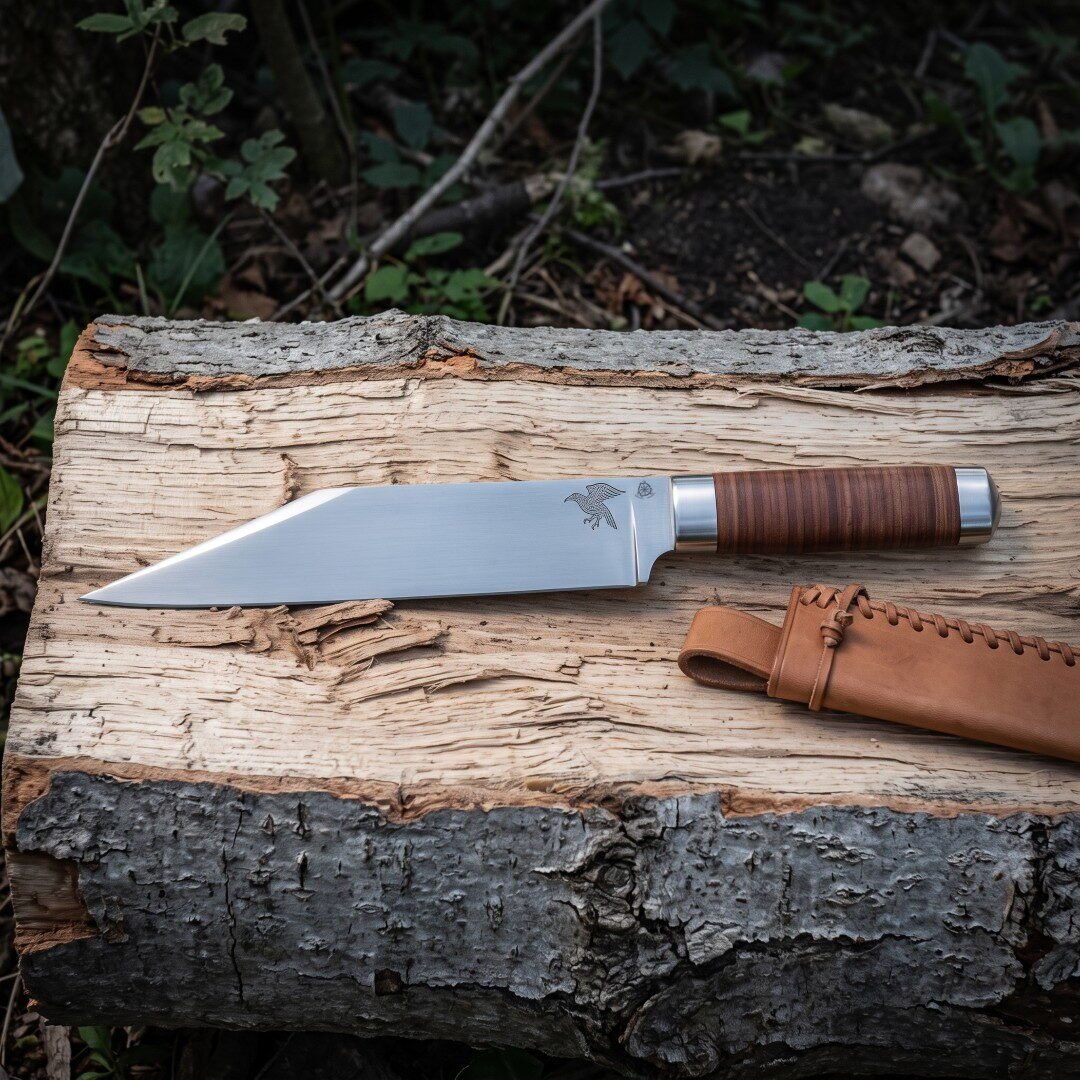
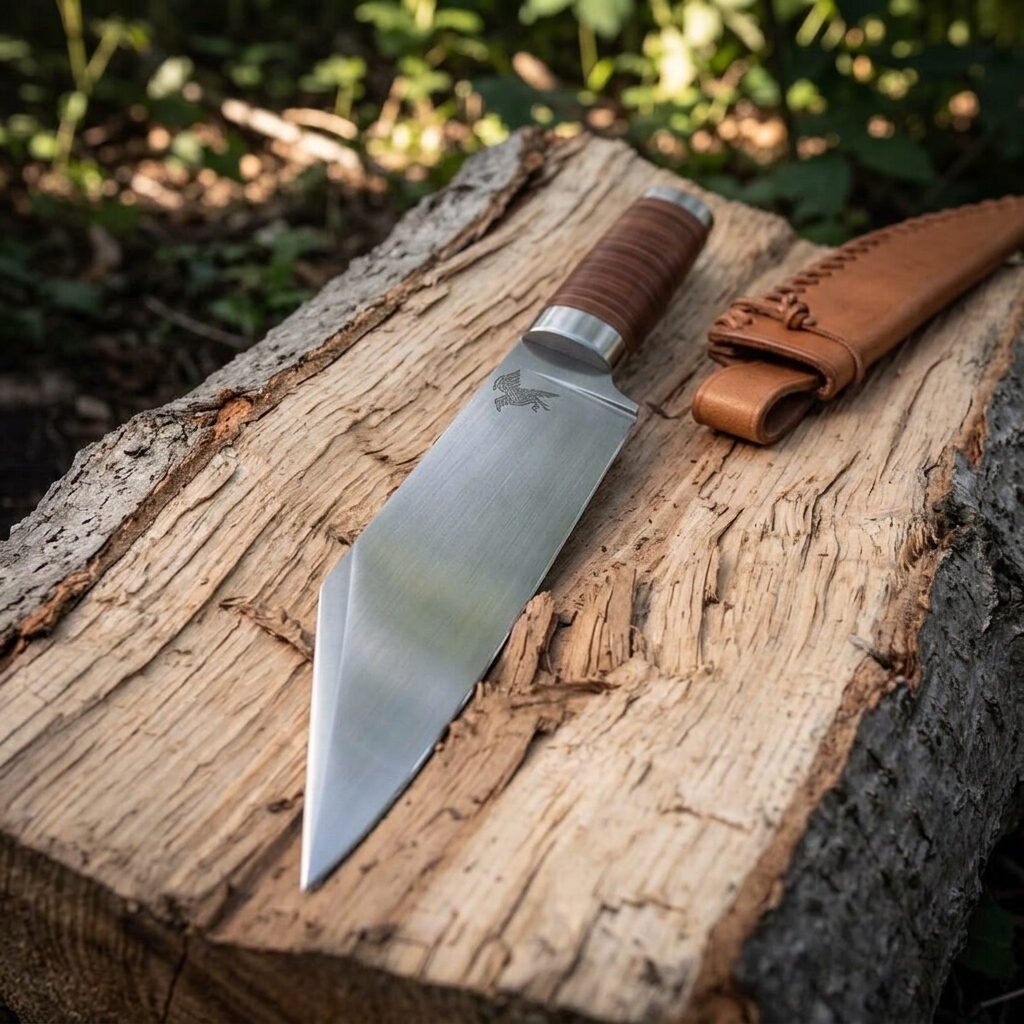
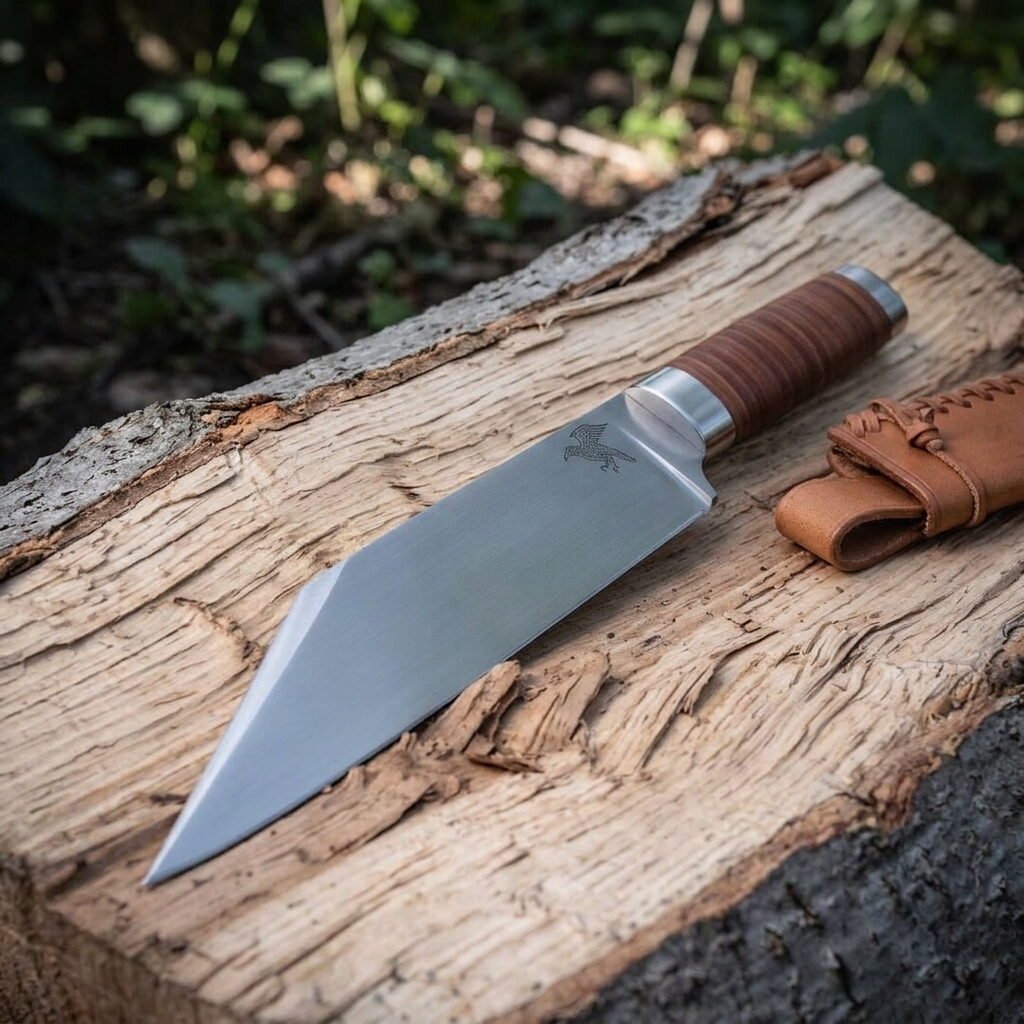
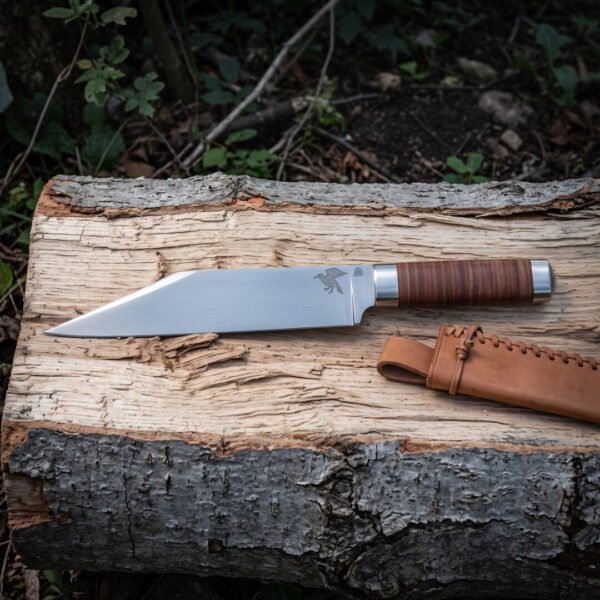
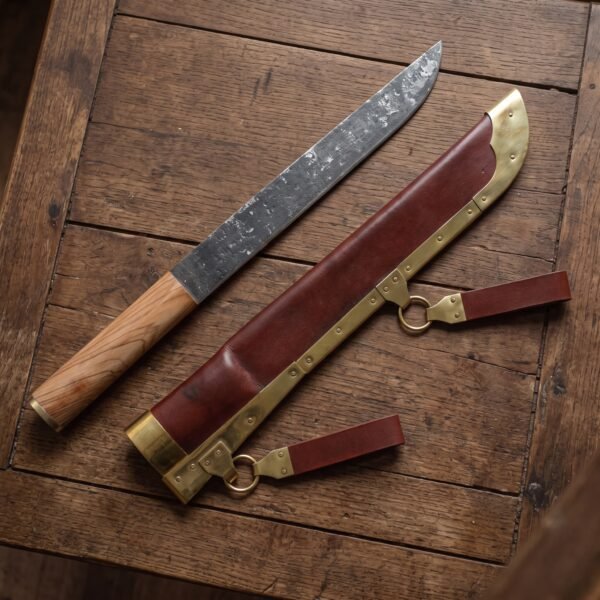
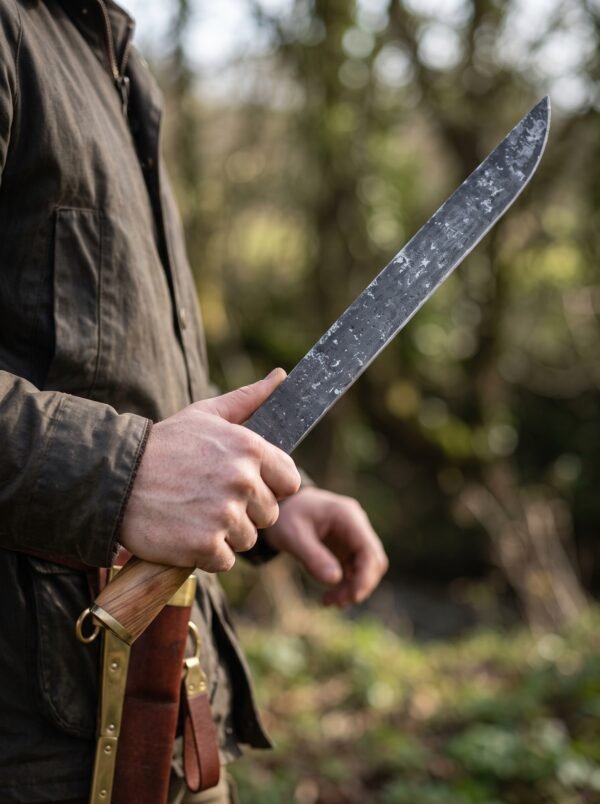
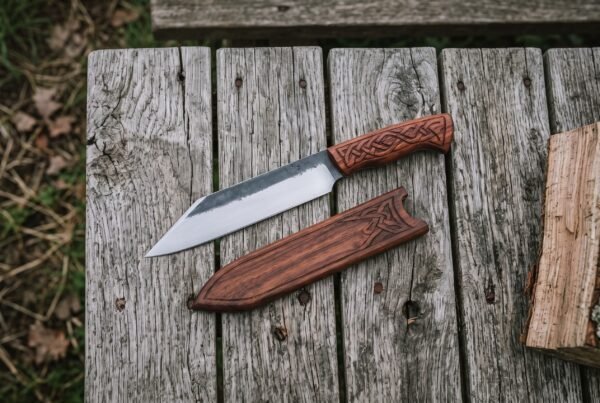
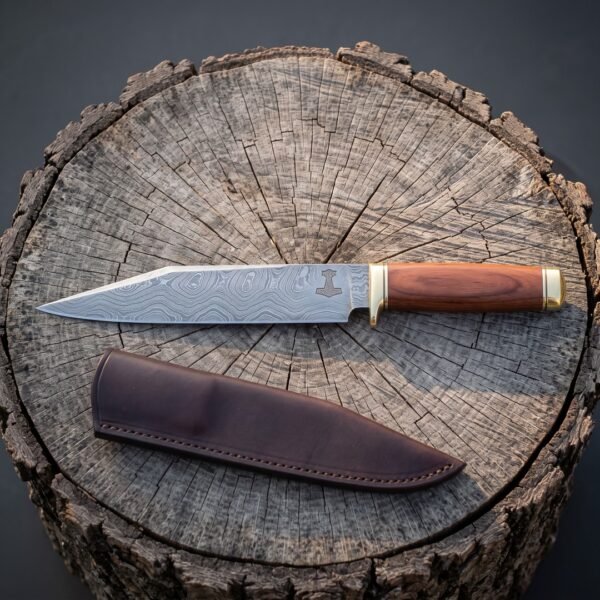
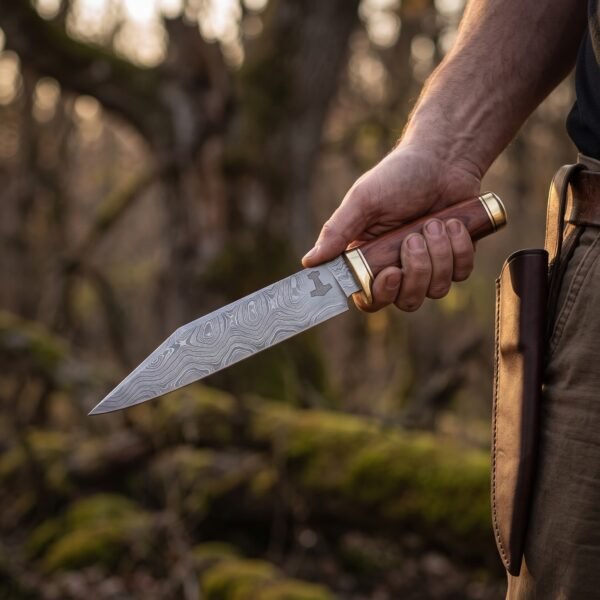
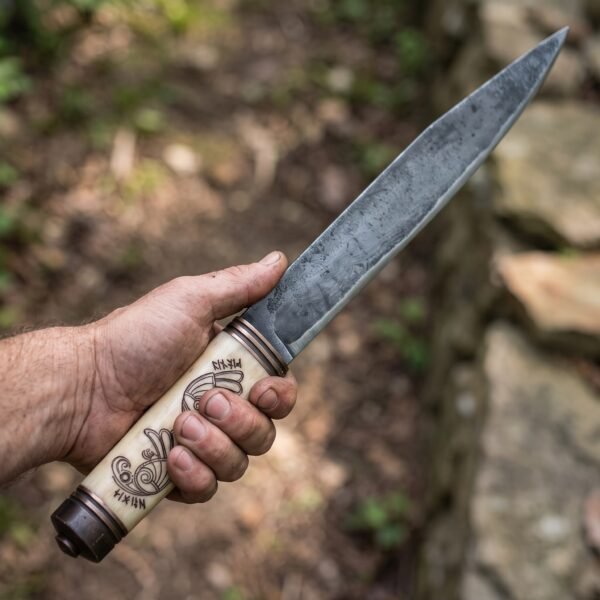
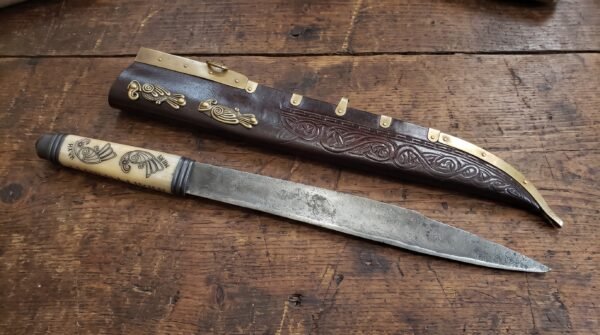
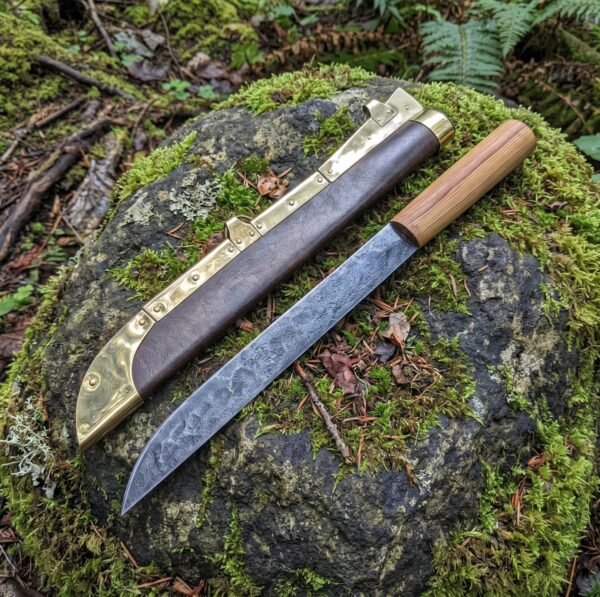
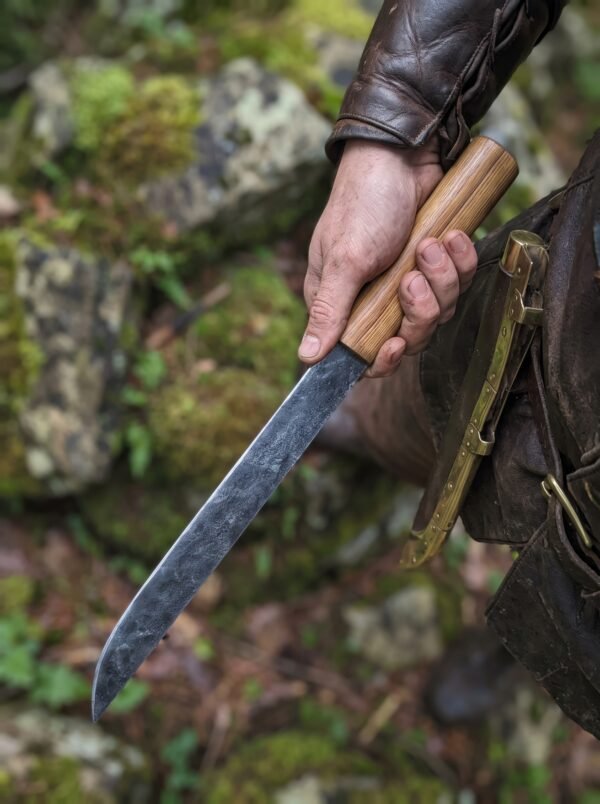
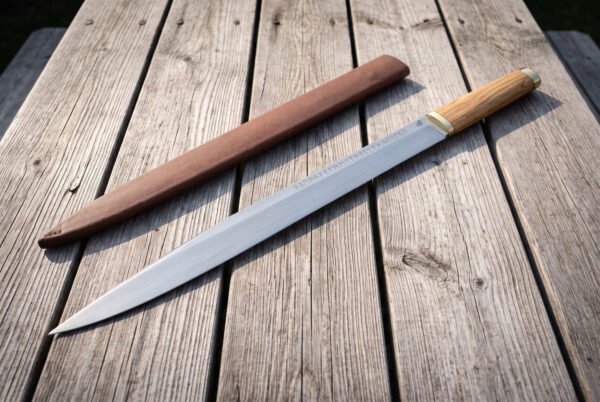
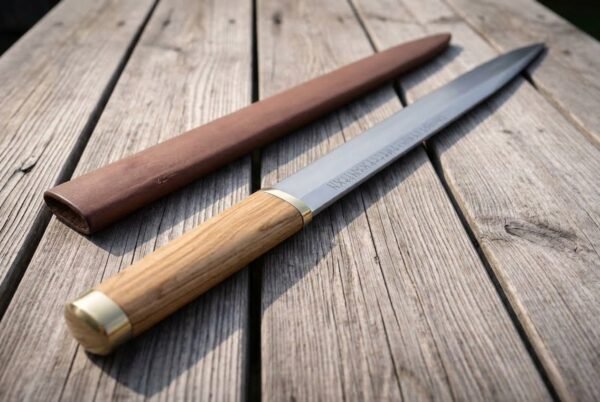
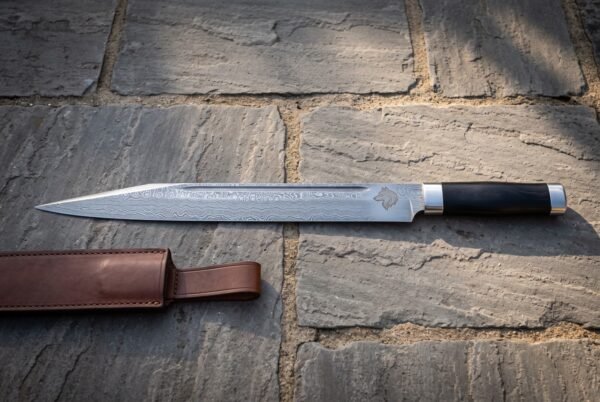
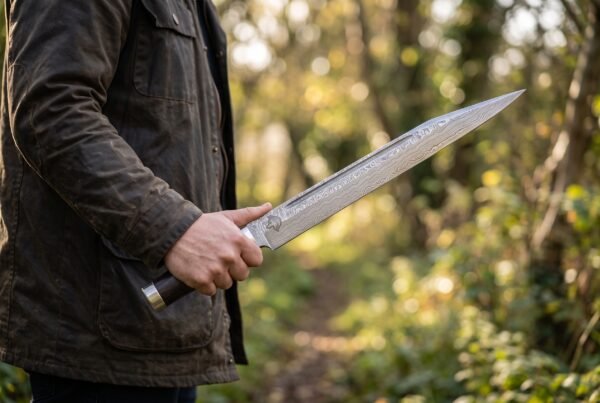
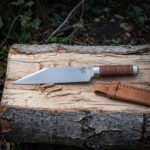
The Ravenspine is a broken back seax, the belt knife that everybody in the Norse and Anglo Saxon world carried and used for everything from carving meat to cutting rope. The spine runs dead straight from the handle and then breaks down in one sharp angle to meet the point, and the cutting edge below it is a long shallow curve. A raven is etched into the flat near the bolster. The handle is stacked leather washers over the tang, capped with polished steel, and it ships in a hand stitched tan leather sheath with a belt loop.
The seax is where the Saxons got their name, and it is the single most common iron object in early medieval graves in northern Europe. The most famous survivor is the Seax of Beagnoth, pulled out of the Thames in 1857, which carries the only complete Anglo Saxon runic alphabet ever found on an object along with the name of the man who owned it. That is the ancestor of every rune line we cut. Every Ravenspine is forged, ground, heat treated, handled and sheathed by hand in the Czech Republic. You will find it filed with the seax knives, along with the rest of the Viking swords.
Specifications
| Material | 1095 high carbon steel, hardened to 54 to 58 HRC |
|---|
| Overall length | Approximately 12 inches |
|---|
| Blade length | Approximately 7.5 inches, broken back profile |
|---|
| Handle | Approximately 4.5 inches, stacked leather washers with a polished steel cap |
|---|
| Fittings | Polished steel bolster and butt cap |
|---|
| Finish | Satin polished flat with an etched raven near the bolster |
|---|
| Tang | Full length through tang, nut tightened under the cap |
|---|
| Sheath | Vegetable tanned leather, hand stitched welt, belt loop |
|---|
| Included | Seax and leather sheath |
|---|
| SKU | RK-1758 |
|---|
Why the spine breaks like that
The angle in the spine is not a stylistic flourish, it is a compromise between two jobs. A knife with a straight spine running all the way to a fine point is good at piercing and weak at the tip. A knife with a deep curved belly is good at slicing and clumsy at anything needing a point. The broken back gets both. Drop the spine sharply near the end and you produce a point that sits on the centre line of the blade, which is the strongest place for a point to be, while leaving the whole length behind it as an uninterrupted slicing edge.
There is a second effect that only shows up in use. Because the spine stays full thickness right up to the break, you can put a thumb or the heel of the other hand on it for fine control work, splitting or scraping, without the blade folding away from you. That is why the profile survived for six hundred years across an enormous area and why it keeps reappearing in modern working knives under other names. Anglo Saxon examples from London are classified by the angle of that break, and the sharper the break, the later the knife tends to be.
The steel and the handle
Forged from 1095 high carbon steel and drawn back to 54 to 58 HRC. For a working belt knife that band is the useful one. It takes a hair splitting edge off a stone in a few minutes, it holds that edge through a day of real cutting, and if you hit a staple or a bone the edge rolls rather than chipping out, which you can fix with a steel instead of a grinder.
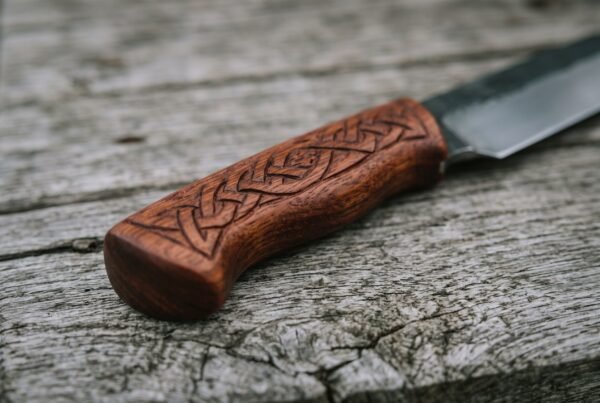
The handle is stacked leather, which is a genuinely old construction and better than it sounds. Discs of vegetable tanned leather are punched, threaded onto the tang, compressed hard under the butt cap, then turned and sanded to shape and sealed. The result grips better wet than wood does, absorbs shock, warms to the hand in cold weather, and takes on the shape of a particular hand over years of use. It is also repairable: if it ever compresses loose, the nut under the cap tightens it back up.
Engraving, runes and your own design
Use the rune converter on this page to turn a name, a date or a short phrase into Elder Futhark and we will cut it into the steel, the leather or the wood. If you would rather have a Viking pattern than a rune line, choose your own design in the engraving option above the add to cart button and tell us where it goes. Where a piece already carries an engraved design, your chosen engraving replaces it rather than sitting alongside it. On the Ravenspine that means a chosen design takes the place of the etched raven on the flat, and there is also room for a short rune line stamped into the leather sheath. Given what the Beagnoth seax carries, a name in runes on a seax is about as historically appropriate as personalisation gets. See the engraving page.
Handling and balance
Balance sits right at the bolster, which is where a working knife wants to be. The blade does not lead the hand and the handle does not drag it back, so the knife stays where you put it through a long carving job. The stacked leather handle is round in section rather than flat, which lets you rotate the blade in the hand for a change of cutting angle without breaking grip.
Cut with the belly for slicing, use the flat behind the break for chopping down onto a board, and keep the point for piercing rather than prying. This is a real forged knife with a real edge and it is meant to be used, on a camp, in a kitchen or at a reenactment, not to sit under glass. It is not a throwing knife and the point will take damage if it is used as a pry bar.
Care
1095 has no chromium in it. Wash the blade by hand, dry it immediately, and keep a light film of mineral oil or food safe camellia oil on the steel. Never put this knife in a dishwasher: the heat and the detergent will strip the leather handle and rust the blade in a single cycle. Store it out of the sheath for long periods, because vegetable tanned leather is slightly acidic and holds moisture against a blade left in it for months. Feed the sheath and the handle two or three times a year with a neutral leather conditioner. A patina will develop on the flat with use, which is normal and protective, and it is not rust. There is more detail on our steel care page.
Made in the Czech Republic
This piece is made by hand in the Czech Republic, in a workshop that still works the old way. The steel is forged, ground, heat treated and finished by smiths who learned the trade from the people before them, and the wood, horn and leather are cut and fitted by hand rather than pressed out on a line. That is also why no two pieces come out exactly the same.
Ransack Viking is a United States company. We import these pieces ourselves, check every one when it lands and ship from our warehouse in Chicago, Illinois. Engraving is done here in the United States after the piece arrives, so your runes or your own design go on before it leaves for you.
A note on handmade variation
Each of these is made by hand and not machine produced in bulk, so what arrives will not be a pixel for pixel copy of the photograph. Stacked leather handles are turned individually and no two carry the washer lines in the same rhythm, and the leather colour ranges from pale tan to a deeper russet depending on the hide. The angle of the break in the spine is filed by eye within a tight tolerance. Hammer texture, the depth of the raven etch and the tone of the sheath all vary. The length, the steel and the build are the same every time. The character is not. More on how a seax differs from a Bowie elsewhere on the site, along with the blade shapes guide.
Frequently asked questions
Is it sharp out of the box
Yes, it arrives shaving sharp. If you would rather have it dulled for display or for a household with children, say so in the order notes and we will roll the edge before it ships at no extra cost.
Can I use it in the kitchen
Yes, and it is very good at it. The long shallow belly slices cleanly and the flat spine takes a thumb for control work. Wash and dry it by hand straight away. It never goes in a dishwasher.
Is the sheath included
Yes. The hand stitched vegetable tanned sheath with a belt loop shown in the photograph is wet formed to this blade so it holds the knife by friction rather than needing a strap.
Will the blade rust
It will darken into a patina with use, which is protective and normal. It will only rust if it is stored wet or left in the sheath for months. Oil it and store it out of the leather.
Can I get runes on the blade
Yes. Use the rune converter on this page and we will cut your line into the flat in place of the raven, or stamp it into the sheath instead. A rune line on a seax has real precedent behind it.
How long does shipping take
One to two weeks of processing because the knife is made rather than picked from a shelf, plus a few days for engraving. Shipping in the United States is free and returns are accepted within seven days.
What is in the box
- Ravenspine broken back seax in 1095 high carbon steel
- Hand stitched vegetable tanned leather sheath with a belt loop
- Stacked leather handle with a polished steel bolster and butt cap
- Care sheet with sharpening, oiling and leather feeding notes
- Lifetime warranty against defects in forging, grind, heat treat and fittings
- Forged and finished in the Czech Republic
Explore the range
See the rest of the Viking seaxes, our Viking knives, the wider Norse arms, and the guides.
Close to this one
For a straight comparison, see the Knotsax Viking seax, 14 inches overall. Worth putting side by side with this is the Hornsax Viking seax, 12 inches overall. In the same category sits the Langfell Viking seax, forged from 1095.
From the same corner of the shop, there is the Talonvalk karambit knife. Nothing here exactly right, build one to your own spec on the custom seax page.

Got this as a birthday gift and the reaction was priceless. Great buy overall.
I collect stuff like this and this knife is on another level. Ransack Viking’s attention to detail is honestly unmatched. The stacked leather handle feels amazing and the balance is perfect. Great buy overall.
This knife is a genuine work of art. The stacked leather handle feels amazing and the balance is perfect. 10/10 would buy again. You can tell it’s real Czech blacksmith work and shipping from the States made delivery painless.
Knew this knife was special the second I opened the box. Shipping was fast and everything arrived well packaged.
Absolutely blown away by this knife. 1095 Steel blade holds a razor edge right out of the box. Weight and balance make it feel like a real functional piece not some cheap replica. Love it.
No regrets on this purchase at all. Even the small engravings are crisp and clean. This will be a family heirloom for sure. Ransack Viking’s attention to detail is honestly unmatched.
Bought this on a whim and it turned out to be one of my favorite purchases this year. Even the small engravings are crisp and clean. Shipping was fast and everything arrived well packaged. Ransack Viking is quickly becoming my go to shop for anything Norse themed.
Overall a good buying experience. Minor nitpicks aside, good quality piece.
Incredible craftsmanship on this one. 1095 Steel blade holds a razor edge right out of the box. Highly recommend this one.
This is exactly what I wanted and then some. Leather sheath is thick and well stitched. Not the cheap stuff you usually get. Worth every penny.