Blog
Viking Helmets: What They Actually Looked Like

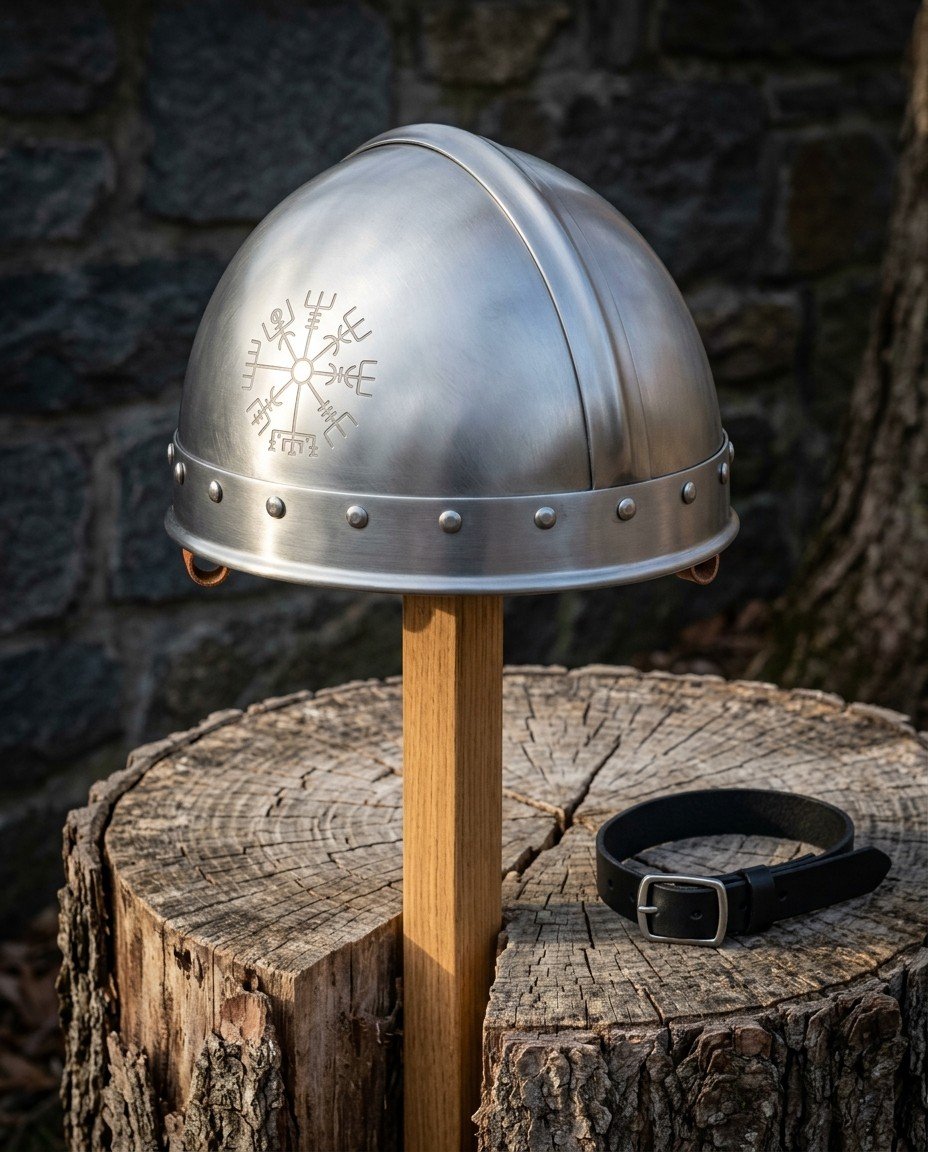
A Viking helmet was a rounded iron bowl, usually built from riveted panels, often with a nose bar and sometimes with a spectacle shaped guard over the eyes. It had no horns. Not one. Only one near complete Viking Age helmet has ever been found in Scandinavia, the one from Gjermundbu in Norway, and everything else is fragments and inference, which is a thin foundation for an entire costume industry.
Gjermundbu, the one helmet we have
In 1943 a farmer at Gjermundbu in Ringerike, Norway, turned up a rich tenth century burial. Among the finds was a corroded iron helmet that could be pieced back together. It is a rounded bowl assembled from panels held by riveted bands, with a nasal bar rising into a spectacle guard that shields the eyes and the bridge of the nose. Fragments of mail from the same grave are usually read as neck protection hung from the rim, though how it attached is a reconstruction rather than a certainty.
That is it. One helmet, from the whole of Viking Age Scandinavia. Every illustration you have seen of a Norse fighter in a spectacle helmet traces back through a chain of reconstructions to that single object. It is a good object and the reconstruction is careful, but the sample size is one, and any honest account of Norse headgear has to start by saying so.
The horns, and where they came from
 Pathmark Hand Forged Steel Shield Boss with Vegvisir Engraved Dome & Eight Hole Rivet Flange | Shield Building Gift | RK-1441
 Palewing Hand Made Norman Kite Shield | 40 Inch Height | Black and White Per Pale with Engraved Knotwork Panel and Riveted Rawhide Rim | Medieval Reenactment Gift | RK-1561
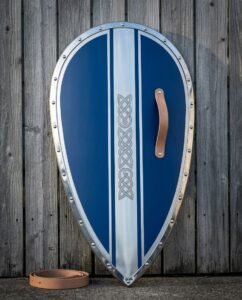 Kiteward Hand Made Norman Kite Shield | 48 Inch Tall Teardrop Face | Riveted Steel Rim with Celtic Knotwork Band and Leather Guige | Reenactment Gift | RK-1875
The nineteenth century invention
No Viking Age helmet with horns has ever been excavated. The image is a product of the romantic nineteenth century, and it has comfortably outlived every attempt to correct it. Costume designs for the first Bayreuth staging of Wagner’s Ring cycle in 1876 gave the Norse characters horned and winged headgear, and painters and illustrators of the same generation were doing the same thing independently. The look was so strong that it flowed straight into cartoons, sports mascots and film, and it has never left.
The Bronze Age helmets that muddy the water
Horned helmets do exist from Denmark. The pair found at Viksoe, sometimes spelled Veksoe, are bronze, dramatic and genuinely horned. They date to roughly 900 BC. That is around two thousand years before the first raid on Lindisfarne. They belong to Bronze Age ritual practice, not to Norse warfare, and using them to defend the horned Viking is like using a Roman helmet to argue about the Second World War.
Practically, horns are also a poor idea. They catch incoming blades, they give an opponent a handle, and they add weight where you least want it. A helmet is built to make things slide off, which is precisely what a horn stops it doing.
How helmets were built
Spangenhelm construction
The dominant early medieval method across northern Europe was to build the bowl from separate segments riveted onto an iron frame: a brow band running round the head, and bands arching over the crown. The panels fill the gaps. This lets a smith make a strong curved bowl out of small pieces of iron without having to raise a whole helmet from one plate, which is slow and demands more material and more skill. Gjermundbu is built on this principle.
One piece bowls
Raising a single plate into a helmet bowl is harder and needs a bigger sheet of good iron. It becomes more common later, and by the eleventh century the conical nasal helmet in the Bayeux Tapestry has largely taken over in western Europe. If you want a helmet that reads as late Viking Age or Norman rather than early Norse, a smooth conical bowl with a nose bar is the shape to look for.
Liners, straps and padding
Leather and textile rot, so almost nothing survives of what sat inside these helmets. What we can say is that an iron bowl resting directly on a skull is useless. There has to be a suspension liner, padding, or a thick cap underneath, because the point is to keep the metal off the head and let it deform. Rivet holes and edge perforations on surviving bowls are consistent with stitched liners, but the detail is reconstruction.
The wider family the Norse inherited
The Viking Age did not start from nothing. The centuries before it left behind some of the most spectacular helmets in European archaeology, and they set the pattern the Norse worked from.
The boat graves at Vendel and Valsgarde in Sweden, sixth to eighth century, produced crested helmets with face masks, cheek pieces and mail curtains, decorated with stamped foils showing warriors and beasts. The Sutton Hoo helmet from the early seventh century East Anglian ship burial belongs to that same tradition, and its reconstructed face mask is probably the single most famous object in Anglo Saxon archaeology.
The Coppergate helmet, found in York in 1982 during excavation of the Anglo Scandinavian city, is eighth century Anglian rather than Norse. It has a rounded bowl, a nasal, brass decorated eyebrows, hinged cheek pieces and a mail curtain at the back, and it survives in remarkable condition. Norse settlers took over that city within a century of the helmet being buried.
The other Viking Age fragments
Beyond Gjermundbu the record is scraps, and each one gets argued over.
A set of fragments from Tjele in Denmark includes a nasal with eyebrow plates, found with smithing tools, which supports the spectacle guard reconstruction. A decorated eyebrow piece from Lokrume on Gotland points the same way. A corroded iron bowl from Yarm in North Yorkshire, long sitting unremarked in a local museum, was published in a 2020 study arguing for a Viking Age date and construction closely comparable to Gjermundbu. Further east, scattered fragments turn up along the Rus trade routes.
Put together, the fragments support the picture Gjermundbu gives: riveted panel bowls, brow bands, nose bars, and in some cases spectacle guards. They do not support horns, wings, skull faces, or any of the other things the internet is confident about.
Did every Viking have a helmet?
Almost certainly not. Iron was expensive and helmets take a lot of skilled work, which is why a film raiding party is always better equipped than the archaeology. Graves that contain a helmet are rare and wealthy. Most men who went raiding probably had a shield, a spear or an axe, and nothing on their heads at all, or something in leather or thick cloth that has left no trace.
That last point deserves care. Leather caps get asserted constantly and there is essentially no direct evidence for them in the Norse record, because leather does not survive. Saying they probably existed is reasonable. Saying they were standard is not, and the confidence tends to rise with the price of the cap. The same wealth gradient shows up across the rest of the kit, which is why Viking shields and spears are common finds while mail and helmets are not.
What to look for if you are buying one
Work out first whether you want a wall piece, a costume piece or something you will actually wear under contact.
Gauge is the number that matters most. For display, 18 gauge steel is fine and keeps the weight down. For reenactment and any kind of contact, 16 gauge or heavier is the usual requirement, and many groups will not let you on the field below that. Ask for the number before you buy, because nobody has ever successfully judged gauge from a photograph.
Check how the parts are joined. Real rivets through the bands and panels are what you want. Spot welds ground flat and dressed to look like rivets are a shortcut, and tack welded seams crack the first time the bowl takes a real hit. Run a finger inside the bowl: a properly riveted helmet has rivet heads you can feel.
Look at the liner and the strap. A helmet sold with no liner is not finished, whatever the listing says. You need suspension or padding and a chin strap that actually holds the bowl in place, because a helmet that rotates on impact is worse than none.
Finally, decide which century you are dressing for. A spectacle helmet reads tenth century Norse. A plain spangenhelm cap works across a wide span. A conical nasal reads late eleventh century or Norman. A great helm or a full face mask does not belong in a Viking impression at all, however good it looks on the shelf. The engraved bands and rune rings you see on modern helmets are decoration rather than documented finds, and if you want to know which marks are genuinely period, our guide to Norse symbols and their meanings is the place to start.
What we sell
Our Viking helmet range covers spangenhelm caps, nasal helmets, spectacle helmets in the Gjermundbu manner and full face pieces in the Sutton Hoo tradition, with gauge stated on each listing so you can match it to what you need. We also sell horned helmets, and we are straight about them: they are costume and display pieces, not history. If you want later periods, the medieval helmets section runs to great helms and kabuto, and the broader Viking armour range covers mail, bracers and shields. Pair a helmet with a hand axe from the Viking axes range and you have most of a working impression. The background to those axes is in our piece on Viking axe history. Ransack Viking is a US company in Chicago, Illinois. Every piece is handmade in the Czech Republic the old way, then imported, inspected and shipped from Chicago.
The horns are the part everyone asks about, and we deal with them in the horned helmet myth. For choosing a modern one, see buying a Viking helmet that fits.
Questions people ask
Did Viking helmets really have horns?
No. Not one horned helmet has ever been excavated from a Viking Age context. The image comes from nineteenth century romanticism, including the costume designs for the first Bayreuth production of Wagner’s Ring cycle in 1876. The genuinely horned bronze helmets from Viksoe in Denmark date to roughly 900 BC, about two thousand years too early to have anything to do with Norse raiders.
What did a real Viking helmet look like?
A rounded iron bowl built from panels riveted to a brow band and crown bands, usually with a nose bar. The Gjermundbu helmet adds a spectacle shaped guard across the eyes, and mail from the same grave is generally read as neck protection. No horns, no wings, no face mask. Later in the period the smooth conical bowl with a single nasal becomes the common western European shape.
How many Viking helmets have been found?
One near complete example from Scandinavia, the Gjermundbu helmet found in Norway in 1943. Everything else is fragments: a nasal and eyebrow set from Tjele in Denmark, a decorated eyebrow piece from Lokrume on Gotland, a corroded bowl from Yarm in North Yorkshire published in 2020, and scattered pieces along the eastern trade routes. That thin record is why reconstructions disagree, and why anyone describing the Viking helmet in the singular is guessing.
Did all Vikings wear helmets?
Very unlikely. Iron was costly and helmets take a lot of skilled work, so the graves that contain one are rare and rich. Most men who went raiding probably carried a shield and a spear or axe and had nothing protecting their heads. Leather caps are often assumed, but leather does not survive in the ground, so that remains a reasonable guess wearing the costume of a fact.
What gauge steel should a helmet be?
It depends on what you are doing with it. For display and photography, 18 gauge is plenty and keeps the helmet light on the head. For reenactment or any form of contact, 16 gauge or heavier is the normal standard and many groups enforce it. Ask for the number before buying, because thickness is impossible to judge from a product photograph.
Is the Sutton Hoo helmet a Viking helmet?
No. It comes from an early seventh century Anglo Saxon ship burial in East Anglia, over a century before the Viking Age begins, and it belongs to the same crested and masked tradition as the Swedish helmets from Vendel and Valsgarde. It is a magnificent object and reproductions of it are popular, but wearing one in a Norse impression puts you a century early and in the wrong country.
The shop side of this
Ready to ship, the Kinhelm Viking nasal helmet and the Wyrmgaze Hoo Viking helmet. The Vendelgaze Viking spectacle helmet and the Cairnhelm Viking Spangenhelm cap are the other two.
Shop the range
Pathmark Hand Forged Steel Shield Boss with Vegvisir Engraved Dome & Eight Hole Rivet Flange | Shield Building Gift | RK-1441Palewing Hand Made Norman Kite Shield | 40 Inch Height | Black and White Per Pale with Engraved Knotwork Panel and Riveted Rawhide Rim | Medieval Reenactment Gift | RK-1561Kiteward Hand Made Norman Kite Shield | 48 Inch Tall Teardrop Face | Riveted Steel Rim with Celtic Knotwork Band and Leather Guige | Reenactment Gift | RK-1875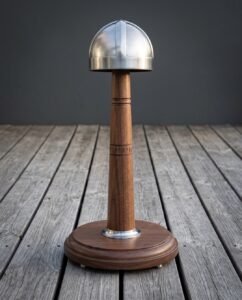 Cairnhelm Hand Forged Steel Viking Spangenhelm Cap | 16 Gauge Mild Steel | Four Panel Dome, Brow Band and Runed Walnut Display Stand | Norse Collector Gift | RK-1458
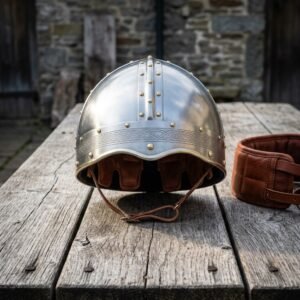 Brassbrow Hand Forged Steel Viking Spangenhelm | 16 Gauge Riveted Dome | Engraved Steel Browband and Brass Rivets with Suede Liner and Chin Strap | Norse Reenactment Gift | RK-1559
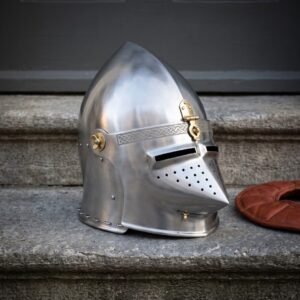 Grimbeak Hand Forged Mild Steel Pig Faced Bascinet Medieval Helmet | 18 Gauge Hounskull Visor | Brass Hinges and Knotwork Brow Band | Knight Reenactment Gift | RK-1495