
Blog
Damascus vs High Carbon Steel: Which Blade Should You Buy?

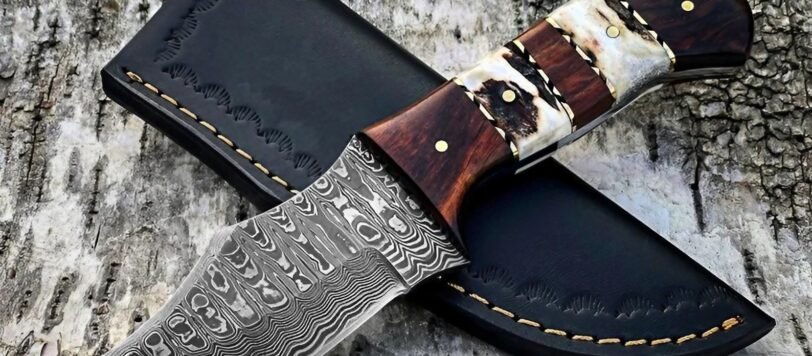
Start with the thing most shops will not tell you. Damascus here is high carbon steel with a pattern welded into it. It is 1095 and 15N20 forge welded together, and both of those are high carbon steels. So the real choice is plain 1095 or patterned 1095. It does not cut better. It looks better, costs more and wants the same care, and anyone telling you otherwise is selling something. Buy plain 1095 if the blade will work. Buy Damascus if you want the pattern.
That is the answer. The rest of this page explains why it is true, what the small real differences are, and which one to pick for what you are buying a blade for.
The short comparison
| Plain 1095 | Damascus, 1095 and 15N20 | |
|---|---|---|
| What it is | A single high carbon steel | Two high carbon steels forge welded in layers |
| Hardness here | 54 to 58 HRC | 58 to 60 HRC |
| Look | Plain grey, takes a satin or a polish | Layered pattern brought out by etching |
| Edge holding | Good | Slightly better, because of the higher hardness |
| Toughness | Slightly better, more forgiving of knocks | Still tough, but harder means less forgiving |
| Sharpening | Fast on any stone | Fast on any stone, no special kit needed |
| Rust | Rusts if left wet | Rusts if left wet, and the etch can lighten over years |
| Price | Lower | Higher, because of the labour in welding and finishing |
| Buy it for | Working blades, camp, first purchase, hard use | Display, gifts, collecting, anything you want to look at |
Why the question is framed wrong
“Damascus vs high carbon steel” is the search people type, and it treats the two as opposites. They are not. High carbon steel is a category, meaning steel with enough carbon in it to harden properly, roughly 0.6 percent and up. Damascus is a construction method: take two or more steels, stack them, forge weld them into a solid billet, fold or manipulate the layers, then etch the finished blade so the layers show.
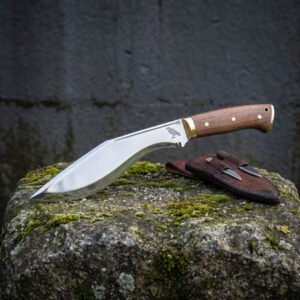 Brasscrow Hand Forged High Carbon Kukri with Walnut Scales | Raven Etched Full Tang Blade | Brass Bolster and Brass Pins | Leather Sheath | Norse Camp Gift | RK-2171
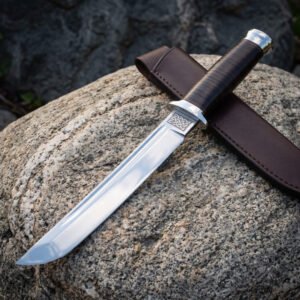 Knotguard Hand Forged High Carbon Tanto Knife with Stacked Leather Handle | Knotwork Engraved Ricasso and Steel Guard | Fullered Blade and Leather Sheath | Everyday Carry Gift | RK-2180
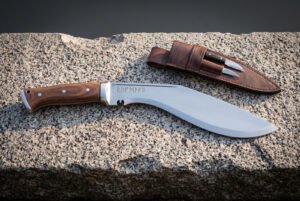 Runehollow Hand Forged High Carbon Kukri with Elder Futhark Engraved Blade | Rosewood Scales and Steel Bolster | Leather Sheath and Two Companion Knives | Norse Gift | RK-2184
What makes the pattern visible is contrast in the etch. 1095 carries around one percent carbon and very little else. 15N20 carries a little less carbon plus about two percent nickel. Acid darkens the 1095 and leaves the nickel bearing 15N20 bright. That is the whole trick. Both layers are high carbon, both harden, both take an edge, and the finished blade behaves like a high carbon blade because that is exactly what it is.
So when a listing sets Damascus against high carbon steel as though they were rivals, the honest translation is “high carbon, arranged in a pattern, which cost more to make”. If you want the full process from billet to etch, read what Damascus steel actually is. The steel glossary covers the grades and terms in plain language.
Plain 1095
1095 is one of the oldest and most used blade steels there is. High carbon, no alloying to speak of, and it does exactly one thing very well: it hardens deeply and takes a very fine edge. Every one of our plain blades runs at 54 to 58 HRC, which is a deliberate choice. That range is hard enough to hold an edge through a day’s work and soft enough that if you hit something you should not have, the edge rolls rather than chips.
What plain 1095 does well
Sharpening. A simple carbon steel gives up metal fast on a stone. You can take a dull 1095 blade back to shaving sharp with a coarse and a fine stone in a few minutes, in the field, with no diamond plates. For anyone who actually uses a knife this matters more than any other property.
Toughness. At the lower end of that hardness range, 1095 bends before it breaks. A camp knife made from it survives batoning and being dropped on stone. Damascus is not fragile, but plain is the more forgiving of the two.
Price. There is one steel and no welding step, so a plain blade costs less to make and less to buy. If you want the most blade for the money, this is where it is.
What plain 1095 does badly
It rusts. Fast, if you let it. Fingerprints will mark it overnight in a humid room. This is the trade for the easy sharpening, and it applies to Damascus too, so it is not a reason to pick one over the other.
It looks like steel. That is fine on a working knife and disappointing on a wall. A satin finished 1095 blade is handsome in an understated way and it will not stop anyone in their tracks.
Damascus, 1095 and 15N20
Our Damascus is 1095 and 15N20 forge welded and finished at 58 to 60 HRC. Layer counts vary by piece, and a high number on a listing is a boast rather than a measurement. The billet is welded at heat, drawn out, folded or cut and restacked, and the pattern comes from how the smith moved those layers before grinding. Ladder, raindrop and twist are all different ways of disturbing flat layers before the final grind cuts through them.
The pieces made this way sit across the shop. There is a 1095 and 15N20 Damascus tag that collects them, and a plain 1095 tag for the other half of the range, which is the fastest way to compare two versions of a similar piece.
What Damascus does well
It looks extraordinary. This is the honest reason to buy it and there is nothing wrong with that reason. A well etched pattern under a light does something no plain blade does, and on a gift or a display piece that is the entire job.
Edge holding, slightly. At 58 to 60 HRC our Damascus sits a couple of points harder than our plain blades, and a couple of points of hardness does buy a little more time between sharpenings. It is a real difference and it is a small one. You would notice it over a season of use, not over an afternoon.
It holds value with collectors. A piece with a clean weld and a well brought out pattern stays desirable in a way a plain blade does not.
What Damascus does badly
It costs more, and the extra buys appearance. Forge welding is slow, it fails sometimes, and the finishing and etching add hours. That is a fair reason for the price. It is not a reason to expect better cutting.
The pattern is a surface. The layers run through the blade, so a light sharpening will not remove it, but heavy grinding, aggressive polishing or a power buff will take the etch off and leave a grey blade. If the contrast fades over years, the fix is a re etch, not a new knife.
It is not the ancient Damascus of the crusades. That was Wootz, a crucible steel from a different tradition, and nobody sells it today. Pattern welding is the European technique, it is genuinely old, and it is what modern Damascus means. Anyone claiming otherwise is repeating a legend. Our post on real vs fake Damascus steel gives you the checks to run before you spend.
What about stainless, and the other grades
You will see plenty of other steels elsewhere, most of them well advertised. Stainless grades like 440C add chromium so the blade resists rust, which is useful in a kitchen or on a boat, and they generally give up some ease of sharpening in exchange. Tool steels like D2 sit in between, holding an edge a long time and fighting you on a stone. Powder steels chase edge retention hard and price accordingly.
All of those are legitimate steels and none of them are what this shop uses. Everything here is plain 1095 at 54 to 58 HRC or 1095 and 15N20 Damascus at 58 to 60 HRC, because the pieces are hand forged in the traditional way and those steels are what that process does best. If you specifically need a blade you can leave wet, buy stainless from someone who makes it, and enjoy sharpening it less easily.
Choosing by what you will do with it
Display
Damascus, without hesitation. A wall piece has one job and pattern does it. Look for a blade with a broad flat, since the pattern reads better across a wide surface than along a narrow one, and keep it out of direct sun and away from a radiator.
Reenactment
Plain 1095. It is closer to what people actually carried, it takes knocks better, and nobody at an event wants to explain why their pattern welded blade got scuffed. Pattern welding was real in the Viking Age, but the surviving high status pieces are a minority of what was carried.
Camp and bushcraft
Plain 1095, and it is not close. You will baton it, drop it, sharpen it on whatever you have and put it away damp more often than you should. Buy the tougher, cheaper steel and spend the difference on a better sheath. Our Viking knives range has plain blades in most patterns.
Kitchen
Either, with a warning. Both steels rust and both will stain from onions, tomatoes and citrus. That patina is harmless and some cooks are quietly proud of it. If you want a blade that stays bright with no attention, this is the one use where a stainless knife from elsewhere genuinely serves you better. If you are happy to wipe and dry after every use, our chef knives in either steel will out cut most of what is in a domestic drawer.
Hunting and skinning
Damascus earns its place here more than anywhere outside display. A skinning blade does long, fine, repeated cuts, which is where a couple more points of hardness show. The Damascus skinner knives group is built around that, and there are plain versions of the same shapes if you want the tougher option.
Gifts
Damascus. A gift is judged in the first three seconds out of the box and pattern wins that every time. Add engraving, which is done in the US after arrival, and the piece becomes specific to the person.
Care, which is the same for both
Neither steel is stainless. Both need the same short routine: wipe the blade after use, dry it properly, put a thin film of oil on it, and store it out of a leather sheath. Leather holds moisture and the salts left from tanning will pit a blade left inside for months.
If rust does appear, it comes off with oil and a fine abrasive without much drama. On a Damascus blade, work gently and avoid the temptation to polish the whole flat, because that is what removes the etch. The knife care guide covers oils, storage and rust removal in detail.
Buy this one if
Buy plain 1095 if the blade will be used, you want the toughest and cheapest of the two, you sharpen your own knives, you are buying your first piece from us, or you are building reenactment kit.
Buy Damascus if the piece is for display, it is a gift, you collect, you want the small edge holding advantage on a skinning or kitchen blade, or you simply want the pattern and are happy to pay for the hours that put it there.
Do not buy Damascus if someone has told you it cuts better, stays sharp forever or is stronger than ordinary steel. None of that is true, and a shop that says it is has told you something about itself.
If Damascus wins for you, the field range is in our Damascus hunting knife shortlist and the kitchen range in the best Damascus chef knives.
Questions people ask
Is Damascus steel high carbon steel?
Yes. Our Damascus is 1095 and 15N20 forge welded together, and both are high carbon steels. The pattern comes from acid etching, which darkens the 1095 and leaves the nickel bearing 15N20 bright. A Damascus blade behaves like a high carbon blade because that is what it is, arranged in layers.
Does Damascus hold an edge better than 1095?
Slightly, and mostly because of hardness rather than pattern. Our Damascus is finished at 58 to 60 HRC and our plain 1095 at 54 to 58. Those few points buy a little more time between sharpenings, and no more than that. Plain 1095 is more forgiving of knocks and easier to bring back on a stone.
Will the pattern wear off?
Not from normal use or sharpening, because the layers run through the blade rather than sitting on it. What can fade is the etch that makes the contrast visible, usually after heavy polishing or years of handling. A blade in that state can be etched again rather than replaced, which is a great deal cheaper.
Does Damascus rust?
Yes, the same as any carbon steel. Nickel in the 15N20 does not make the blade stainless. Wipe it after use, dry it, keep a thin film of oil on it and store it outside its leather sheath. Do that and a Damascus blade will outlast you without trouble.
Is modern Damascus the same as the ancient stuff?
No. Historical Damascus usually means Wootz, a crucible steel with a pattern that comes from carbide banding rather than layers, and the method for it was lost. What is sold today is pattern welding, an old European technique of forge welding different steels together. Both are real, but they are different things, and only one of them is on sale anywhere.
Which should I buy first?
Plain 1095, if you are buying something to use, and Damascus if you are buying something to look at or to give. Most people who own several pieces have both, and they usually started with a plain working blade before adding a patterned one for the wall.
If nothing on the shelf is quite right, build a custom Damascus knife and choose the pattern, the profile, the handle material and the sheath.
On the shelf
Ready to ship, the Amberoak Tanto and the Inlayspire dagger knife. The Steelpommel dagger knife and the Palefang kukri knife are the other two.
Neither, if you plan to spar
For a sword that gets hit for a living, the answer is a third steel. HEMA trainers are 51CrV4 spring steel at 49 to 52 HRC, as in the Myrkvald blunt longsword, and nylon or steel trainers covers whether you need steel at all yet. More of them sit under HEMA longswords.
Shop the range
Brasscrow Hand Forged High Carbon Kukri with Walnut Scales | Raven Etched Full Tang Blade | Brass Bolster and Brass Pins | Leather Sheath | Norse Camp Gift | RK-2171Knotguard Hand Forged High Carbon Tanto Knife with Stacked Leather Handle | Knotwork Engraved Ricasso and Steel Guard | Fullered Blade and Leather Sheath | Everyday Carry Gift | RK-2180Runehollow Hand Forged High Carbon Kukri with Elder Futhark Engraved Blade | Rosewood Scales and Steel Bolster | Leather Sheath and Two Companion Knives | Norse Gift | RK-2184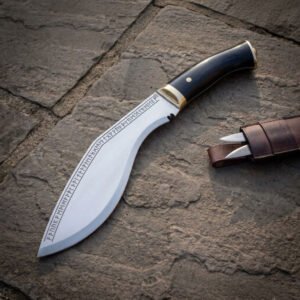 Runecurve Hand Forged High Carbon Steel Kukri Knife | 16 Inch Overall Length | Black Horn Handle with Brass Bolster and Butt Cap | Rune Etched Gift | RK-2147
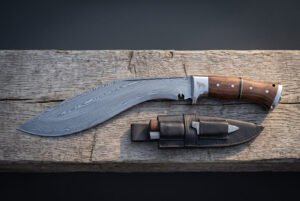 Wolfcurve Hand Forged Damascus Kukri Knife | 17 Inch Overall | Rosewood Scales and Steel Bolster with Etched Wolf, Black Leather Sheath and Two Companion Blades | Hunting Gift | RK-2107
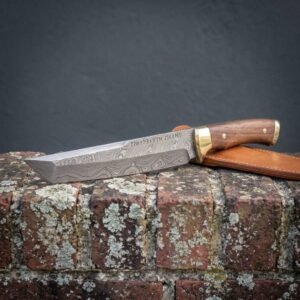 Runespine Hand Forged Damascus Tanto Knife with Walnut Scales & Etched Elder Futhark | About 12 Inches Overall | Brass Bolster and Tan Leather Sheath | Norse Gift | RK-2207