
Blog
Fenrir, Jormungandr and Hel: The Children of Loki

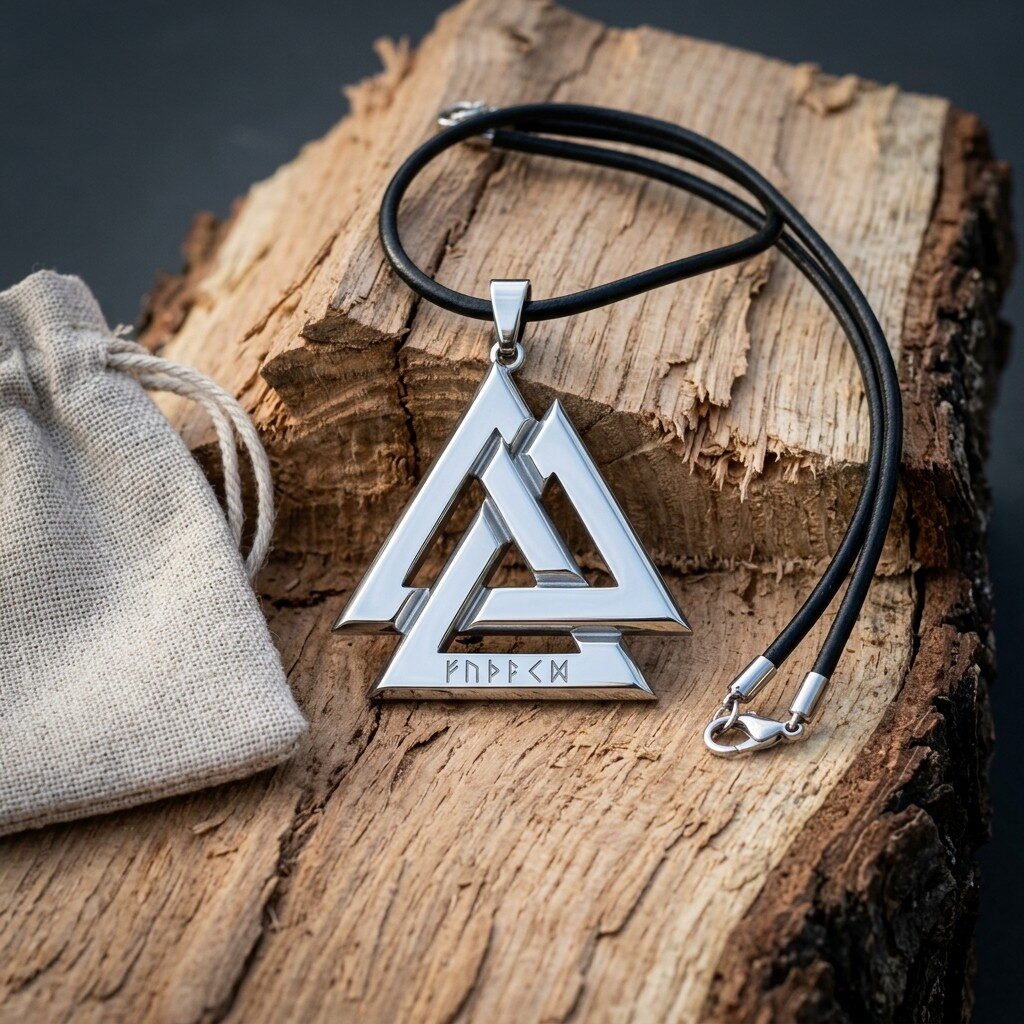
Fenrir the wolf, Jormungandr the serpent that lies in the sea around the world, and Hel who rules the dead are three children born to Loki and the giantess Angrboda. Snorri Sturluson set them out as a family in the Prose Edda around 1220. The gods dealt with each one by removal: bound, thrown into the ocean, sent underground. None of which worked.
All three come back at Ragnarok, and all three are involved in killing a god. That structure is the point of the story, and it pays to separate the parts that are old from the parts Snorri tidied into shape.
Where the family comes from
Snorri’s Gylfaginning gives the tidy version, which is why everyone quotes it. Loki fathered three children on Angrboda in Jotunheim, the gods learned through prophecy that trouble would come from them, and Odin had them fetched. He threw the serpent into the deep sea, sent Hel down to Niflheim with authority over nine worlds, and kept the wolf at home where the gods could watch him.
The older poetry is thinner and less organised. Voluspa knows the wolf and it knows the serpent, but it does not lay out a family tree. Hyndluljod refers to Loki begetting the wolf on Angrboda. Grimnismal names wolves chasing the sun and the moon without naming a father. Nobody before Snorri collects the three of them into a set of siblings and gives them a single origin story. That does not mean he invented the material. It means the arrangement is his, and reading the poems will not reproduce it.
Fenrir
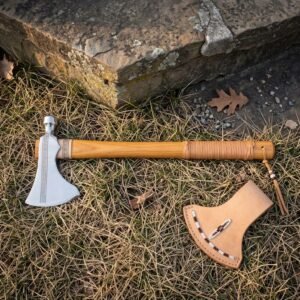 Hickoryhawk Hand Forged High Carbon Steel Native American Style Tomahawk | Collector Reenactment and Display Gift | RK-1201
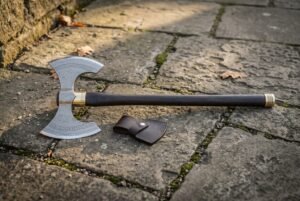 Langhewer Hand Forged Damascus Double Bit Viking War Axe | 28 Inch Overall with 6 Inch Cutting Edge | Norse Battle Collector Gift | RK-1213
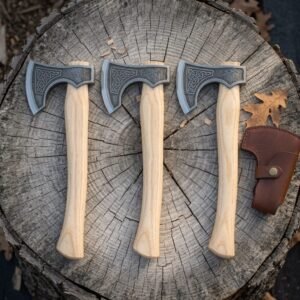 Thrimhawk Hand Forged High Carbon Steel Viking Throwing Axe Set of 3 | 15 Inch Overall with 3.5 Inch Cutting Edge Each | Axe Throwing Gift | RK-1214
Raised among the gods
The wolf grew up in Asgard, and only Tyr had the nerve to go near him with food. He kept growing. Once the gods understood what they were feeding, they decided to bind him, and they made a game of it so he would not refuse.
The first fetter was called Leyding. Fenrir let them put it on, braced once, and it broke. The second was Dromi, twice as strong, and the gods talked him into trying it for the fame of breaking it. He kicked, the chain shattered, and the phrase to get loose out of Leyding or to strike out of Dromi entered the language.
Gleipnir
Odin sent a messenger to the dwarves in Svartalfheim, and they made a cord out of six things that do not exist: the sound of a cat’s footfall, the beard of a woman, the roots of a mountain, the sinews of a bear, the breath of a fish and the spittle of a bird. That is why, Snorri adds, cats make no noise when they walk and women have no beards. Gleipnir came out soft and smooth like a silk ribbon.
They took the wolf to an island called Lyngvi in a lake named Amsvartnir. Fenrir looked at the ribbon, suspected a trick, and said he would only allow it if one of them put a hand in his mouth as a pledge of good faith. Tyr did it. When the cord held and the wolf could not break it, the gods laughed, and Tyr lost the hand. Snorri notes that nobody else was willing.
They ran a cord called Gelgja through a slab named Gjoll, sank it deep, and hammered a rock called Thviti over the top. When Fenrir snapped at them they wedged a sword upright in his jaws, hilt in the lower gum and point in the palate. He howls, and the river called Van runs from his mouth.
The end of it
At Ragnarok Fenrir breaks loose, and Voluspa and Snorri agree on what happens next. He swallows Odin. Odin’s son Vidar kills him at once, either by tearing the jaws apart while standing on the lower one, in Snorri’s telling, or by driving a blade into the heart, in the poem. It is the closest thing to justice the story offers. Snorri also names Skoll and Hati as wolves of this kin who finally catch the sun and the moon, though the older poem simply names them without the family connection.
Jormungandr
The serpent was thrown into the sea and grew until it circled Midgard and could bite its own tail. Its name means roughly the huge staff or the mighty band, and it is also called the Midgard serpent.
Thor meets it twice before the end. In Hymiskvida, and again in Snorri’s retelling, Thor goes fishing with the giant Hymir, rows further out than Hymir wants to go, baits a hook with the head of an ox and hauls the serpent up to the side of the boat. Snorri has Thor’s feet drive through the hull and brace on the sea floor. Just as Thor lifts his hammer, Hymir panics and cuts the line, and the serpent sinks back. This is one of the most popular scenes in Norse art. It is carved on the Altuna stone in Uppland, where you can see the fisherman’s foot going through the boat, and on a slab at Gosforth in Cumbria.
The other meeting is a joke at Thor’s expense. At Utgarda-Loki’s hall he is challenged to lift a grey cat off the floor and manages to raise one paw. Afterwards his host admits the cat was the serpent, and that the company watched in alarm as Thor pulled part of the world loose.
At Ragnarok the serpent comes ashore blowing venom over sea and sky. Thor kills it and walks nine paces before the poison drops him. The pairing is old and fixed: nothing in the sources lets either of them survive the other.
Hel
Hel is both a person and a place, and the sources handle that unevenly. Snorri gives her a body: half of her is flesh coloured and half is black, and her expression is grim. Odin sent her into Niflheim and gave her authority over the dead who die of sickness and old age, as against those chosen from the battlefield. Her hall is Eljudnir. Snorri names her dish Hunger, her knife Famine, her servants Ganglati and Ganglot, and her threshold Stumbling Block, which reads more like a poet listing than an old cult belief.
The road there is described in the Baldr story. Hermod rides Sleipnir nine nights down dark valleys, crosses the river Gjoll on a bridge roofed with gold, and is questioned by the guardian Modgud, who tells him that five troops of dead men crossed the day before and made less noise than he did alone. He leaps the gate, finds Baldr in the seat of honour, and Hel agrees to release him if every thing in the world will weep for him. One giantess, Thokk, refuses, and Baldr stays.
This is the part usually left out. In older poetry, hel is very often just a direction, the place under the earth where the dead are, without a personality attached. A number of scholars think the character Snorri describes is a literary development rather than something Viking Age people prayed about, and that the vivid details of her household are his craft. Others point out that Voluspa already speaks of her halls. The English word hell is not borrowed from her name; both come down from the same older Germanic root through separate lines.
Hel is not depicted as a torturer. The medieval Christian idea of punishment is not in the Norse material, whatever the album covers suggest. It is a cold hall, a long road and a closed gate.
Loki’s other children
The three are not the whole list. Loki turned himself into a mare, distracted the stallion Svadilfari, and gave birth to Sleipnir, the eight legged horse Odin rides. With his wife Sigyn he had two sons, and in the punishment after Baldr’s death one of them is turned into a beast and kills the other, whose guts become the binding that holds Loki under the dripping serpent. Sigyn holds a bowl to catch the venom, and when she turns to empty it the drops fall on his face, and the earth shakes.
Wearing the old figures
These three turn up constantly in engraving requests, usually a wolf on a blade or a serpent running the length of a haft. Our Norse arms range covers the axes, spears and hammers that these scenes were carved on in the first place, the Viking knives section holds the seax patterns that give a wide flat area for etching, and the Norse pendants carry knotwork, valknut and beast designs on chains and cords. Blades run plain 1095 at 54 to 58 HRC, or Damascus of 1095 and 15N20 forge welded at 58 to 60 HRC, which the steel and hardness page explains. Ransack Viking is a US company in Chicago, Illinois. Every piece is handmade in the Czech Republic the old way, then imported, inspected and shipped from Chicago, as the country of origin page sets out. Engraving is done in the US after arrival, so a wolf head, a name or a rune row is cut here once the piece has landed and passed inspection. If you are choosing a shape, our notes on the history of the seax and on Viking symbols and their meanings are the useful starting points.
What these three are waiting for is set out in Ragnarok and how it ends, and their father and his rivals are introduced in the Norse pantheon.
Questions people ask
Are Fenrir, Jormungandr and Hel really siblings?
In Snorri Sturluson’s Prose Edda, yes, all three born to Loki and the giantess Angrboda. The older Poetic Edda poems know the wolf and the serpent but never set the three out as a family with one origin. The grouping is Snorri’s arrangement of material that reaches him in scattered pieces, and it has been repeated ever since as though it were older.
What was Gleipnir made of?
Six things that do not exist: the sound of a cat’s footfall, the beard of a woman, the roots of a mountain, the sinews of a bear, the breath of a fish and the spittle of a bird. Snorri says the dwarves used them up in the making, which is why cats walk silently and women have no beards.
Why did Tyr put his hand in the wolf’s mouth?
Fenrir suspected the ribbon was a trick and demanded a pledge of good faith before he would let it on. Snorri says none of the gods would offer a hand until Tyr did. When the cord held and the wolf found he could not break free, he bit down, and Tyr lost the hand at the wrist, which is what a pledge of good faith costs when it was never meant.
Did Thor ever catch the Midgard serpent?
He got it to the side of the boat. In Hymiskvida and in Snorri’s version, Thor baits a hook with an ox head, hauls the serpent up, and the giant Hymir cuts the line in fright before the blow lands. The scene is carved on the Altuna stone in Sweden and on a slab at Gosforth in England.
Is Hel the same as the Christian hell?
No. The Norse hall is cold and quiet rather than a place of punishment, and it receives people who died of sickness and old age rather than sinners. The English word and the Norse name descend from the same older Germanic root along separate lines, which is why they look alike and get confused constantly.
Does Loki have other children?
Yes. He gave birth to Sleipnir, Odin’s eight legged horse, after taking the shape of a mare. He also had two sons with his wife Sigyn, and their deaths supply the binding used on him after Baldr is killed. Sigyn stays beside him holding a bowl under the venom that drips on his face.
From the shop
If you want a piece that carries this, the shop has the Wolfmark Seax knife and the Serpentward display sword. The Wolfcrown longsword and the Wyrmhewn Viking bearded axe are in the same corner.
Shop the range
Hickoryhawk Hand Forged High Carbon Steel Native American Style Tomahawk | Collector Reenactment and Display Gift | RK-1201Langhewer Hand Forged Damascus Double Bit Viking War Axe | 28 Inch Overall with 6 Inch Cutting Edge | Norse Battle Collector Gift | RK-1213Thrimhawk Hand Forged High Carbon Steel Viking Throwing Axe Set of 3 | 15 Inch Overall with 3.5 Inch Cutting Edge Each | Axe Throwing Gift | RK-1214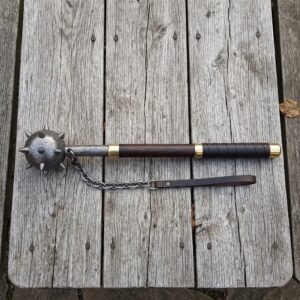 Stormlink Hand Forged Damascus Steel Flail | 29 Inch Overall with a 3 Inch Head | Damascus Spiked Ball Head on a Patterned Fore Shaft | Reenactment Collector Gift | RK-1357
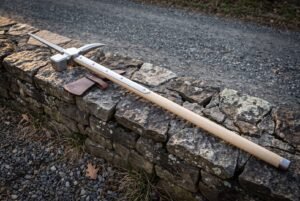 Ashmaul Hand Forged High Carbon Steel Polehammer | 52 Inch Overall with a 9 Inch Head | Reenactment Display Gift | RK-1358
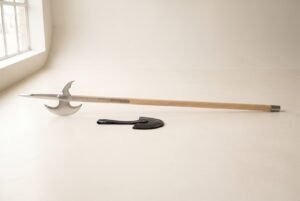 Ashwarden Hand Forged High Carbon Steel Medieval Halberd | 62 Inch Overall with a 17 Inch Head | Reenactment Display Gift | RK-1364