
Blog
How to Choose a Viking Axe: Head, Haft and What It Is For

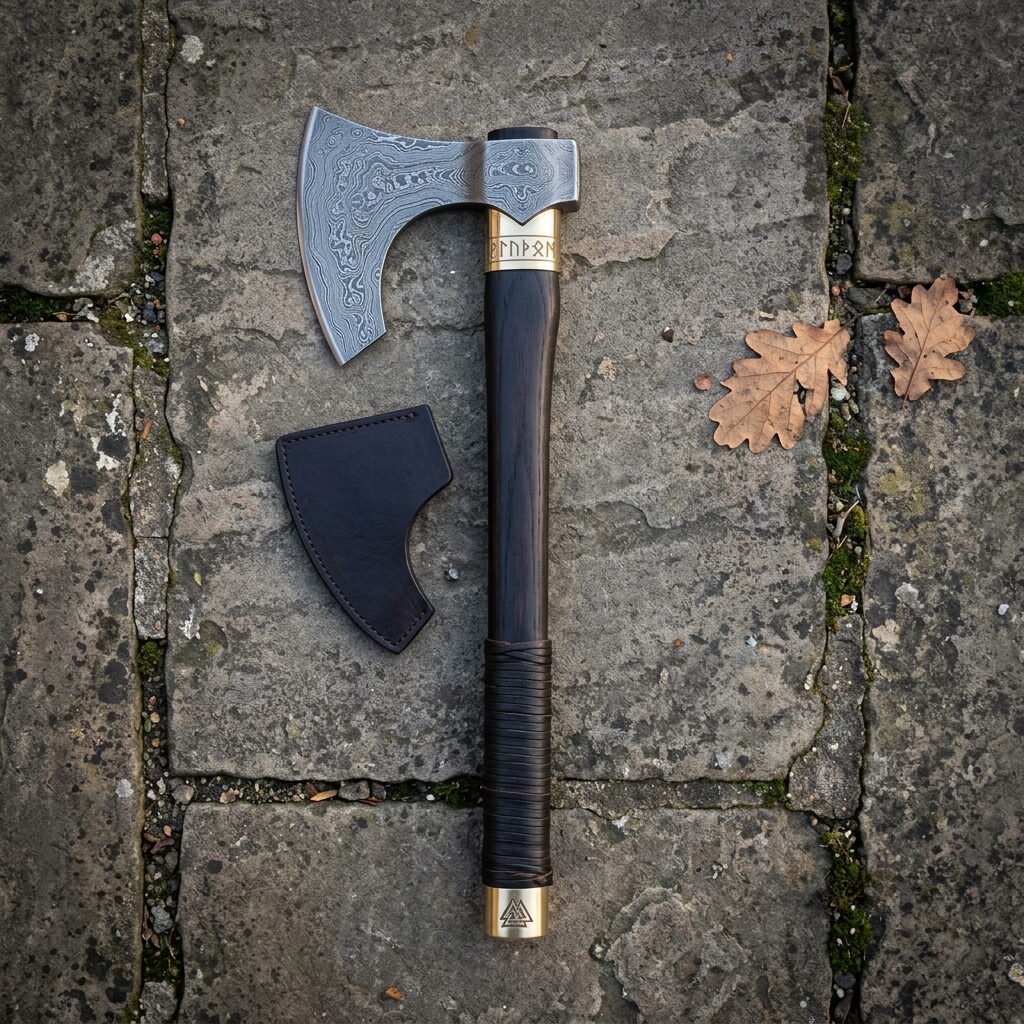
For most buyers the right Viking axe is a bearded head on a haft of about 19 to 24 inches, hand forged in carbon steel, with a leather blade cover. That size hangs well, carries easily, photographs beautifully and is comfortable in one hand. Go longer only if you want a two handed Dane axe for the wall, and go heavier only if you actually intend to cut wood. Most Dane axes never meet anything tougher than a picture hook.
Axes are the easiest Norse piece to buy well and the easiest to buy badly, because two axes that look near identical in a listing photograph can differ enormously in the parts you cannot see. Here is what separates them.
What the axe is for
Answer this first. Every later decision follows from it, and buyers who skip it end up with a piece that does one job adequately and the rest poorly.
Display
An axe on a wall is doing visual work. What matters is the profile of the head, any etching, and the grain of the haft. Balance and edge geometry are irrelevant, whatever the listing says about them. A large head on a long haft has presence, but check your wall space before ordering anything over about 30 inches.
Reenactment and living history
Groups have kit standards, and axes get scrutinised harder than swords because a head coming loose is the classic accident. Expect requirements around head security, edge blunting and haft material. Ask for the written rules before you buy. Many groups require a driven wedge rather than a friction fit.
Bushcraft, camping and actual use
If the axe is going to hit wood, head weight, steel and haft become load bearing decisions rather than aesthetic ones. You want a genuinely hardened head, a haft with straight grain, and a fit tight enough that nothing moves. A camp axe of 19 to 24 inches handles kindling and limb work; splitting rounds needs a heavier head on a longer haft.
Gifting
Axes make good gifts because they need no sizing and no explanation. A bearded head with knotwork etching, a leather cover and a gift box lands well without the recipient knowing anything about steel. Engraving lifts it further, since a name or a date turns a stock piece into something specific.
The head
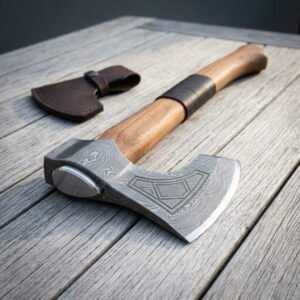 Grainwhorl Hand Forged Damascus Bearded Axe | 1095 and 15N20 Pattern Welded Head | Walnut Haft with Leather Collar and Stitched Edge Sheath | Norse Woodsman Gift | RK-1803
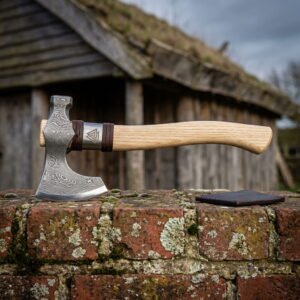 Knotwarden Hand Forged Damascus Valknut Axe | Pattern Welded Head with Hammer Poll | Engraved Valknut Collar and Curved Ash Haft | Norse Collector Gift | RK-1804
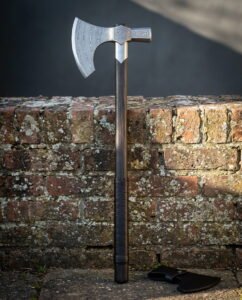 Stormcleft Hand Forged Damascus Bearded Axe with Hammer Poll | 28 Inch Overall Length | Engraved Head and Leather Wrapped Hardwood Haft | Norse Woodsman Gift | RK-1811
Shape, and what a beard is for
A bearded axe has the lower part of the cutting edge extended downwards, hanging below the eye where the haft passes through. The beard gives a long cutting edge without much added weight, and leaves a hollow behind it where a hand can choke up close to the blade for fine work. It is the shape most people picture as a Viking axe, and what a bearded axe is covers the history.
A battle axe head is broader and more symmetrical, often with pronounced horns top and bottom, and reads as more aggressive on a wall. A Dane axe is the large two handed pattern with a wide crescent bit on a long haft, a display piece rather than a tool. A splitting head is thick, wedge shaped and heavy, built to burst wood fibres apart. If you are torn between the first two, battle axe against bearded axe lays out the difference.
Steel and hardness
A hand forged axe head should be carbon steel, and the maker should say which. Plain 1095 at 54 to 58 HRC is a sensible range for an axe: hard enough to hold an edge, soft enough that the bit deforms rather than shatters on a knot. Damascus heads, 1095 and 15N20 forge welded and etched, run harder at 58 to 60 HRC and are bought for the pattern. Both rust, so both want oil.
Be wary of any axe head sold as stainless. Stainless alloys cheap enough for a cast axe head are not tough enough for one, and such an axe is a decoration whether the listing says so or not. If steel names are unfamiliar, our steel glossary is short and plain.
Weight
Head weight drives how an axe feels. A light head under about a pound and a half is quick, easy to carry all day and fine for kindling and display. A middleweight head handles camp work. Past two and a half pounds you have a splitting head, and on a short haft it is unpleasant because your wrist takes the load your elbow should. Match head weight to haft length rather than picking either alone.
Edge and etching
A working axe wants a convex edge, thicker behind the bevel than a knife would be, so it takes shock without folding. A display axe can be blunt and often should be, particularly if it will hang where a child can reach. Etched panels on the cheek are decoration and nothing more, and at the depths makers normally cut them they do not affect strength.
The haft
Length
Length is the decision buyers most often get wrong, usually upwards. Under about 16 inches you have a hatchet: one handed, packable, limited reach. From 19 to 24 inches is the sweet spot for a one handed Norse axe, which is what most people should buy. From 28 to 34 inches you are into two handed territory and the piece becomes a wall or reenactment item. Past that sits the Dane axe, which takes a lot of room.
Wood and grain
Hickory and ash are the standard for working hafts because they flex without splitting. Rosewood and walnut look better and are common on display pieces. What to check is grain direction. On a good haft the grain runs along the length, roughly parallel to the edges, with the end grain lines in the same plane as the blade. Grain running across the haft is a break waiting to happen under use, though harmless on a piece that will only ever hang.
How the head is held on
This is the safety question. A Viking style head is hung by driving the haft through the eye from below and wedging it, so swinging tightens rather than loosens it. Look for a visible wooden wedge in the top of the eye, ideally with a metal cross wedge through it. Some makers pin the head. Some rely on friction and glue, which is fine for display and not for use. If you will swing it, check the wedge before the first session and again after a few, because new hafts settle.
Finish and grip
An oiled haft grips better than a varnished one and can be refreshed with linseed oil. Leather wrapping at the neck protects the wood from overstrike, the glancing blow that lands the haft rather than the head into the target.
Traps and how to spot them
A loose head is the first and worst. If you can rock the head against the haft, do not swing it. That is usually fixable with a new wedge, but know before you buy whether the seller wedges properly.
Cast heads are the second. A cast head has a grainy, slightly pitted surface, often with a faint parting line around it, and is usually advertised without a named steel or hardness. Cast heads chip and crack. Forged heads show hammer texture or a ground finish, and the maker names the steel.
Printed pattern is the third. Acid etched surface patterns get sold as Damascus constantly. Real forge welded pattern shows through the bevel and into the eye; a print stops at the surface. Our guide on real against fake Damascus shows the tells.
The fourth is the museum claim. No modern axe is an authentic Viking artefact and no maker holds a licence to a historical pattern. Pieces are inspired by finds, and anything claiming more is overselling. For the real archaeology, Viking axe history covers what was dug up.
The fifth is size in photographs. An axe shot alone against a plain background gives no scale, and buyers regularly receive something much smaller than they pictured, which is not an accident. Read the stated overall length and cutting edge length, and hold a tape measure against a doorframe before you order.
What to spend
Prices move, so these are ranges rather than numbers. At the bottom you find cast or unbranded heads on soft hafts. They are decorations, and no harm in that if it is what you want. The next band up is where hand forged carbon steel heads on properly wedged hardwood hafts begin, with a leather cover included, and it covers most sensible purchases.
Above that you pay for Damascus billets, deeper engraving, better hafts and gift packaging. A Damascus bearded axe always costs more than the same shape in plain 1095, because the billet takes many more hours. At the top sit large two handed pieces and heavily decorated collector axes.
Add a little for consumables: a puck stone or file, and a bottle of oil. Both extend the life of the piece.
What I would buy
A hand forged 1095 bearded axe head of moderate weight on a 19 to 24 inch hardwood haft, wedged with wood and a metal cross wedge, with a fitted leather blade cover. That covers a wall, a camp and a gift, and it is comfortable to hold, which matters more than people expect. If it is going on a wall and nowhere else, spend the extra on a Damascus head or on engraving rather than on length.
If it is going into a wood pile, buy a splitting head as well and keep the Norse axe for the wall. One tool that does both jobs does neither well.
Our own range sits mostly in that band. The bearded axes are the largest group, with broader battle axes for a heavier look and the wider Viking axes category to see everything together. Spare handles and hafts are stocked separately, since a haft is the part most likely to need replacing in ten years. Heads are plain 1095 at 54 to 58 HRC, or 1095 and 15N20 forge welded Damascus at 58 to 60 HRC. Ransack Viking is a US company in Chicago, Illinois. Every piece is handmade in the Czech Republic the old way, then imported, inspected and shipped from Chicago, and engraving is done in the US after arrival. Our roundup of the best Viking axes is the shorter read if you want picks rather than principles.
Once the axe arrives, two jobs keep it right, putting an edge back on it and clearing rust off the head before it takes hold. If the axe is for a target rather than a wood pile, see throwing axes for beginners.
Questions people ask
What haft length should I choose?
For a one handed Norse axe, 19 to 24 inches suits nearly everyone. It gives enough reach to swing properly, stays light enough to carry on a belt, and fits a standard wall mount. Under 16 inches becomes a hatchet with limited reach. Over 28 inches means two hands, and past that you are into Dane axe territory, which is a display and reenactment piece rather than a camp tool.
Can I sharpen a display axe and use it?
Sometimes, but check the head fit before you check anything else. A display axe often has the head held by friction and glue rather than a driven wedge, and that will loosen under impact. If the head is properly wedged and the steel is named and hardened, sharpening is straightforward with a file and a puck stone. If the listing names no steel, treat the axe as decoration and leave it on the wall.
How do I know the head will not fly off?
Look at the top of the eye. You should see the end grain of the haft filling it completely, with a wooden wedge driven in, and often a small steel cross wedge through that. Grip the head and try to rock it against the haft; there should be no movement at all. Recheck after the first few sessions of use, because a new haft compresses slightly and settles.
Is Damascus worth it on an axe?
For looks, yes, and that is a legitimate reason to buy one. Forge welded 1095 and 15N20 gives a visible layered pattern across the cheek of the head that plain steel cannot match, and it holds an edge well at 58 to 60 HRC. For a tool that will meet knots, frozen wood and the occasional stone, plain 1095 at 54 to 58 HRC is the more forgiving choice and costs less. Buy Damascus for the wall, plain carbon for the woodpile.
How should I store and care for a carbon steel axe?
Keep it dry, keep the leather cover off during long storage so damp does not sit against the bit, and wipe the head with a light oil every couple of months. Rub linseed oil into the haft once or twice a year, especially at the neck and the end grain. If the axe lives outdoors or in a garage, check both more often, since temperature swings drive moisture into the wood.
What is the difference between a Viking axe and a tomahawk?
Different traditions and different builds, whatever the gift shops suggest. A Viking axe head is forged with a wrapped or punched eye and a bit that widens into a beard or broad edge, hung so the haft wedges from below. A tomahawk head is smaller, usually with a tapered eye, and the haft slides in from the bottom and holds by friction so it can be knocked off for transport. We compare them properly in Viking axe against tomahawk.
If you would rather have one made to your own spec, build a custom Viking axe and choose the head profile, the steel, the haft timber and the haft length.
Where to see these
Closest to this in the shop, the Hammerbeard bearded axe and the Runebite bearded axe. Alongside them, the Whorlbeard bearded axe and the Knotcleave bearded axe.
Shop the range
Grainwhorl Hand Forged Damascus Bearded Axe | 1095 and 15N20 Pattern Welded Head | Walnut Haft with Leather Collar and Stitched Edge Sheath | Norse Woodsman Gift | RK-1803Knotwarden Hand Forged Damascus Valknut Axe | Pattern Welded Head with Hammer Poll | Engraved Valknut Collar and Curved Ash Haft | Norse Collector Gift | RK-1804Stormcleft Hand Forged Damascus Bearded Axe with Hammer Poll | 28 Inch Overall Length | Engraved Head and Leather Wrapped Hardwood Haft | Norse Woodsman Gift | RK-1811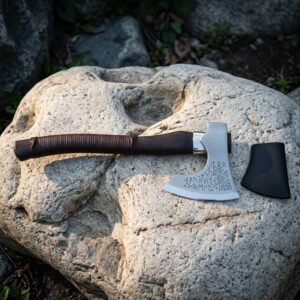 Stavebeard Hand Forged 1095 Steel Viking Axe | 19 Inch Walnut Haft | Rune and Stave Etched Head with Black Leather Cover | Norse Camp Gift | RK-1844
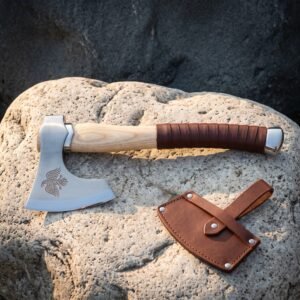 Ravenhaft Hand Forged 1095 Steel Raven Axe | 15 Inch Ash Haft | Etched Raven Head with Leather Wrapped Grip and Snap Closure Sheath | Norse Gift | RK-1918
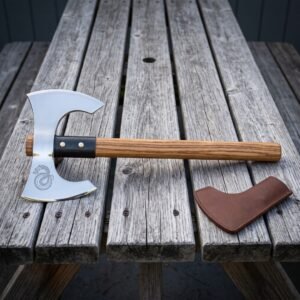 Wyrmhewn Hand Forged High Carbon Steel Viking Double Headed Axe | 19 Inch Oak Haft | Etched Coiled Serpent with Fitted Leather Head Cover | Norse Collector Gift | RK-2146