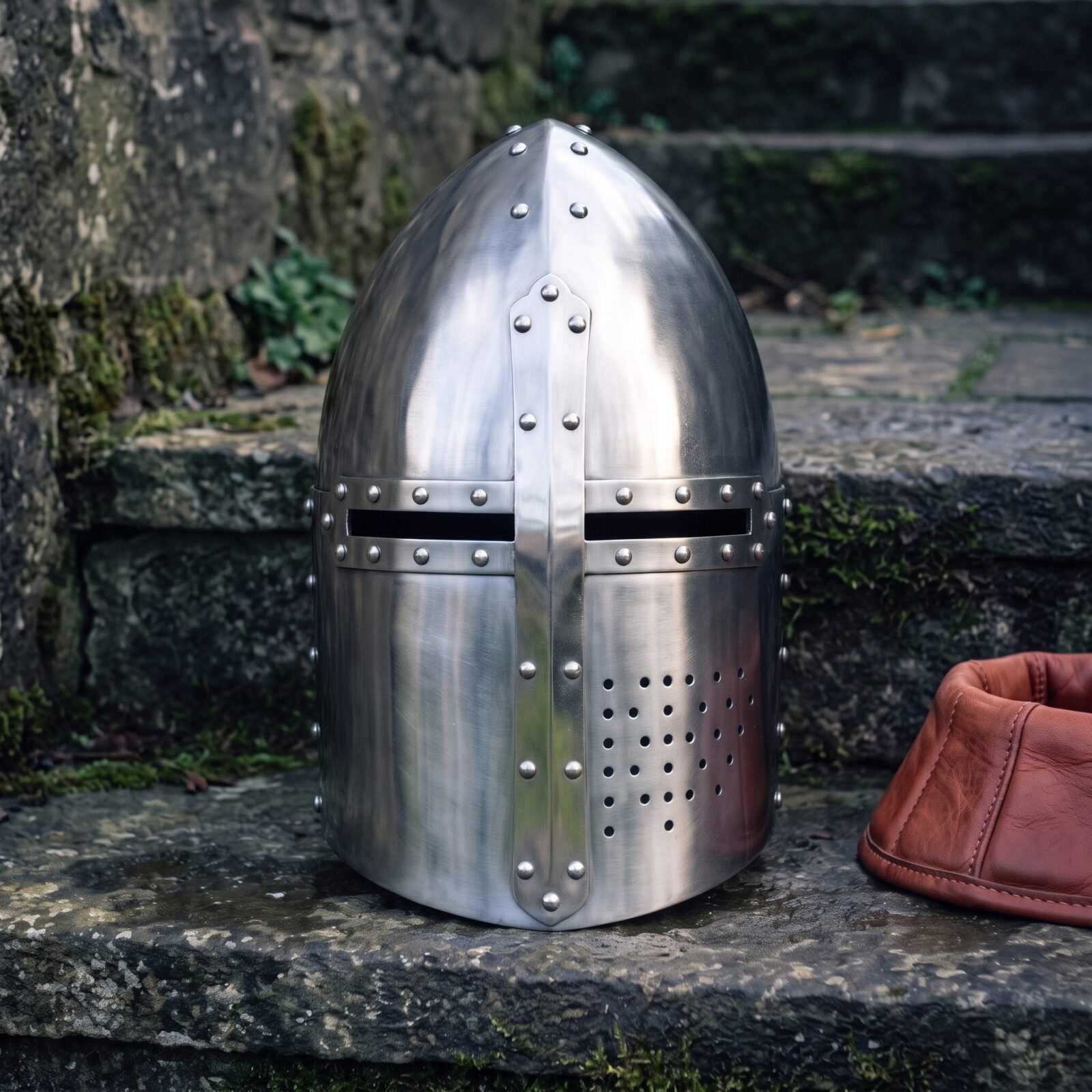
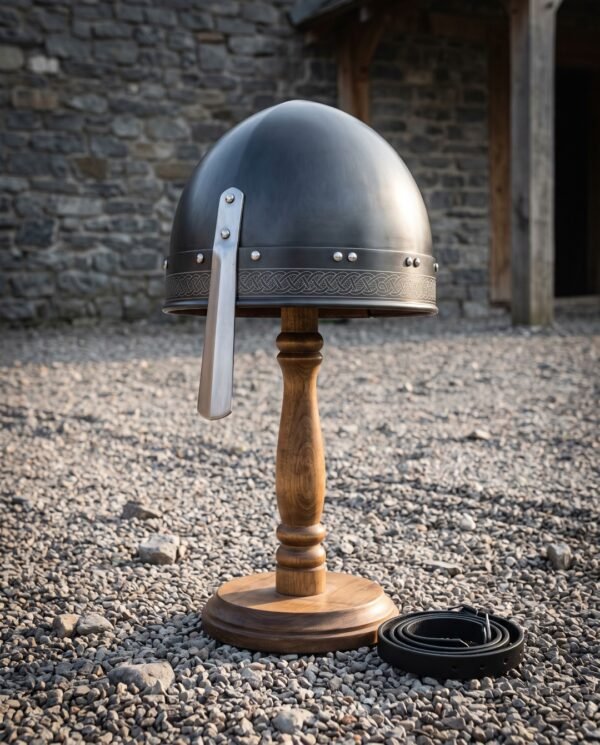
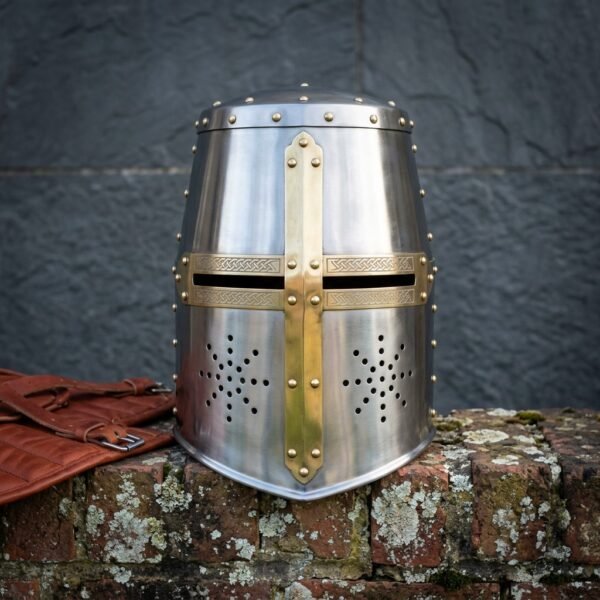
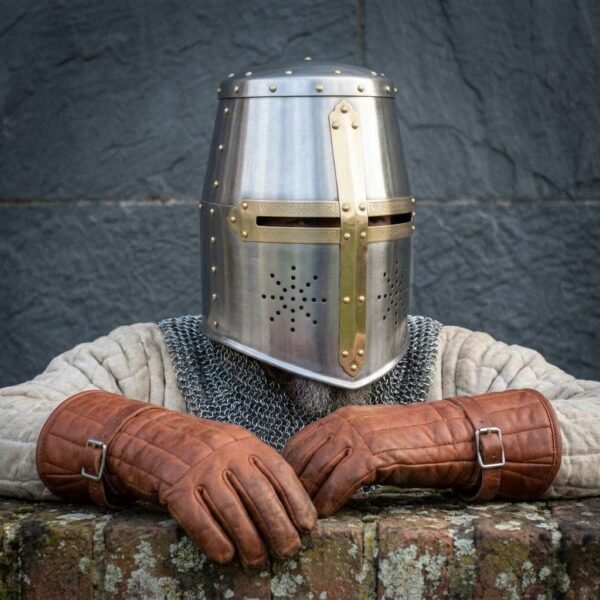
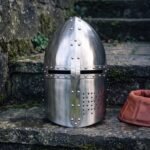
A sugarloaf great helm in bright polished steel, the tall pointed helmet that knights wore over their mail at the end of the thirteenth century and through the fourteenth. The body rises from a wide base to a rounded point at the crown, the shape that gave it the name, after the cones that sugar was sold in. Across the front runs a riveted brow band with a narrow eye slot, a riveted strip runs down the centre of the face, and a block of small drilled breaths sits on the lower right cheek. The plates are joined with domed rivets, and a padded leather liner is included.
It is made from 18 gauge mild steel, about 1.2 mm, and it is sized to fit a head of roughly 22 to 24 inches round with the liner in place. It is a display, costume and reenactment display helmet. It is not rated for combat of any kind.
The full range of knightly helmets is under medieval helmets, and if you are kitting out for a faire or a show, Renaissance faire and reenactment kit has a sensible list. Chainmail vs plate vs lamellar explains what went underneath a helm like this.
Specifications
| Style | Sugarloaf great helm with pointed crown |
|---|
| Material | Mild steel, polished bright |
|---|
| Gauge | 18 gauge, approximately 1.2 mm |
|---|
| Construction | Riveted plates with domed rivets, riveted brow band and central face strip |
|---|
| Vision | Narrow horizontal eye slot across the brow band |
|---|
| Ventilation | Drilled breath holes on the lower right side of the face |
|---|
| Fit | Approximately 22 to 24 inch head circumference with liner |
|---|
| Liner | Padded leather liner, included |
|---|
| Use | Display, costume and reenactment display. Not rated for full contact combat. |
|---|
| SKU | RK-2385 |
|---|
How the great helm grew a point
Around the year 1200, knights in Western Europe began closing in the front of their helmets. The open conical helmet with a nose guard, the kind seen on the Bayeux Tapestry, gave way to a flat topped cylinder that covered the whole face, with slits to see through and holes to breathe through. That was the first great helm. It protected the face far better than a nasal helmet, and with a padded cap and a mail hood underneath it made a knight’s head very hard to hurt.
The flat top had a weakness. A blow from above landed square on it and drove straight down. Over the course of the thirteenth century helmet makers began raising and rounding the crown, and by the last decades of the century the top had become a tall rounded point. A sword or mace coming down on it now struck a slope and glanced off to one side rather than landing full. Modern collectors call this shape the sugarloaf, and German writers call it the Zuckerhut, which means the same thing.
In the early fourteenth century the sugarloaf helm was the standard top layer for a fully armoured knight in much of Europe. Underneath, many knights now wore a small close fitting steel cap, the early bascinet, so that if they took the great helm off between fights they still had steel on their head. Eventually the bascinet grew a visor of its own, and the great helm moved out of the battle line and into the tournament.
The eye slot and the breaths
A great helm is a compromise between seeing and being safe. The eye slot on this one is a single narrow horizontal opening along the brow band. It gives a reasonable view straight ahead and almost nothing up or down, which is exactly what wearing one was like. Knights tilted their heads forward to look ahead and lifted them at the last moment, so the slot moved up and away from an incoming point.
The breaths are drilled on one side only. Historical helms very often had them on the right side, on the reasoning that a right handed opponent’s lance or sword would come mostly from the other side and the left side was better left solid. It also leaves the helm with a slightly lopsided face, which is one of the small details that make it look right.
The riveted strip down the centre stiffens the face where the two front plates meet, and the brow band does the same across the slot. On real helms these strips were the parts that took the most knocks.
Wearing it
Put the liner in first and try the fit before you go anywhere. The helm should sit on the liner, not on your head, and it should not rock when you nod. If it does, more padding at the crown will settle it. A great helm is not like a modern helmet. It sits on its padding over the top of your head rather than wrapping closely round your skull, and you look out of a slot rather than an open face.
Expect it to be warm and to muffle sound. Expect your field of view to shrink to a band in front of you. That is all part of the experience, and it is why a squire was a useful person to have. Take it off between photos, drink water, and do not try to drive, cycle or walk stairs in it.
This is a display, costume and reenactment display helmet. It has not been made or tested for combat, sparring, steel fighting or any kind of impact, and it must not be used for those.
Helm, crest and surcoat
A knight in a great helm had a problem. With his face covered, nobody could tell who he was. That is one of the reasons heraldry grew so quickly in the same years the great helm spread. Coats of arms painted on the shield and stitched onto the surcoat told friends and enemies who was inside the steel, and by the end of the thirteenth century many knights also wore a crest on top of the helm for tournaments: a carved and painted figure, a pair of wings or horns, or a fan of material, sometimes with a mantling of cloth hanging down the back.
If you want to dress this helm for a show, a fabric mantling tied round the base of the point is the simplest period touch, and it stops the steel glaring in sunlight. A crest is a bigger project, usually built from leather, cloth and light wood so it does not add much weight.
Engraving, runes and your own design
Use the rune converter on this page to turn a name, a date or a short phrase into Elder Futhark, or choose your own design in the engraving option above the add to cart button and tell us what you want and where it goes. Where a piece already carries an engraved design, your chosen engraving replaces it rather than sitting alongside it. On this helm the best places are the brow band, either side of the eye slot, or the back plate low down near the rim. A heraldic charge or a family motto suits it well. More on the engraving page.
Displaying it
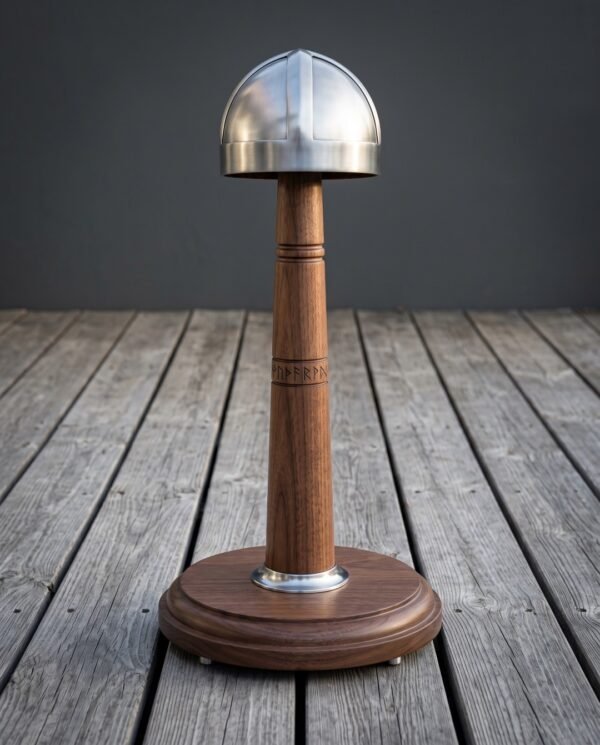
A sugarloaf helm looks best a little above eye level, so you see the point against the wall. A helmet stand or a wooden head form keeps it upright and lets air under it, which helps against rust. On a shelf, put a folded cloth underneath so the rim is not ground on the wood every time it is moved.
It pairs naturally with a heater shield and a knightly sword. The Crosswatch heater shield is the right shape for the period, and how to display swords and axes has more on arranging a wall.
Care
Polished mild steel rusts if it is left damp or covered in fingerprints. After handling, wipe the outside with a soft cloth and a few drops of light machine oil or mineral oil, then buff off the excess. Do the inside every few months too, and keep the liner out of the helm if it has got damp so it can dry.
If small spots of rust appear, take them off with very fine steel wool and a little oil, working in the direction of the existing polish lines, then oil again. Do not use household metal polish that leaves a residue in the rivet heads.
Leather liners like a little conditioner once a year. More on looking after steel in our steel armour care guide.
Made in the Czech Republic
This helm is made by hand in the Czech Republic. The plates are cut, raised and shaped by hand, then riveted together and polished. Every helm is checked before it is boxed for clean rivets, a smooth rim and a liner that fits. It ships from our Chicago, Illinois warehouse. Processing takes one to two weeks, and engraved orders sit at the longer end because the layout is agreed with you first. Shipping inside the United States is free. Returns are accepted for seven days. The lifetime warranty against defects in the forming, riveting and fittings has no end date and needs no receipt.
A note on handmade variation
This helm is made by hand, not machine made or bulk produced, so what arrives will not be a pixel for pixel copy of the photograph. Hammer marks under the polish vary from helm to helm. The point of the crown is raised by hand, so its exact height and curve differ slightly. Breath holes are drilled to a pattern but placed by hand. The size, the gauge and the build are the same every time.
Frequently asked questions
Can I fight in it?
No. It is a display, costume and reenactment display piece made from 18 gauge mild steel. It is not rated for combat, sparring or impact.
Will it fit me?
It fits a head of roughly 22 to 24 inches round with the liner in. Measure round your head just above the eyebrows. If you are at the top of that range, take some padding out of the liner. If you are at the bottom, add some.
Is a liner included?
Yes, a padded leather liner.
Why is it called a sugarloaf?
Sugar used to be sold as tall cones called sugarloaves, and the pointed crown of the helm has the same shape.
Can I see out of it?
Straight ahead, yes, through the eye slot. Up, down and to the sides, not much. That is how great helms were.
How is it shipped?
Free within the United States from Chicago, Illinois, boxed with padding round the point.
What is in the box
- One hand made polished steel sugarloaf great helm, 18 gauge
- Padded leather liner
- Engraving where ordered
- Care card for the steel and the leather
Explore the range
See the rest of the medieval helmets, the plate armor and the arming swords that go with it. Gifts for reenactors has more ideas.
Close to this one
For a great helm in heavier 16 gauge steel with a brass cross reinforce, see the Grimward great helm. For a blackened finish there is the Duskwarden great helm.





Reviews
There are no reviews yet