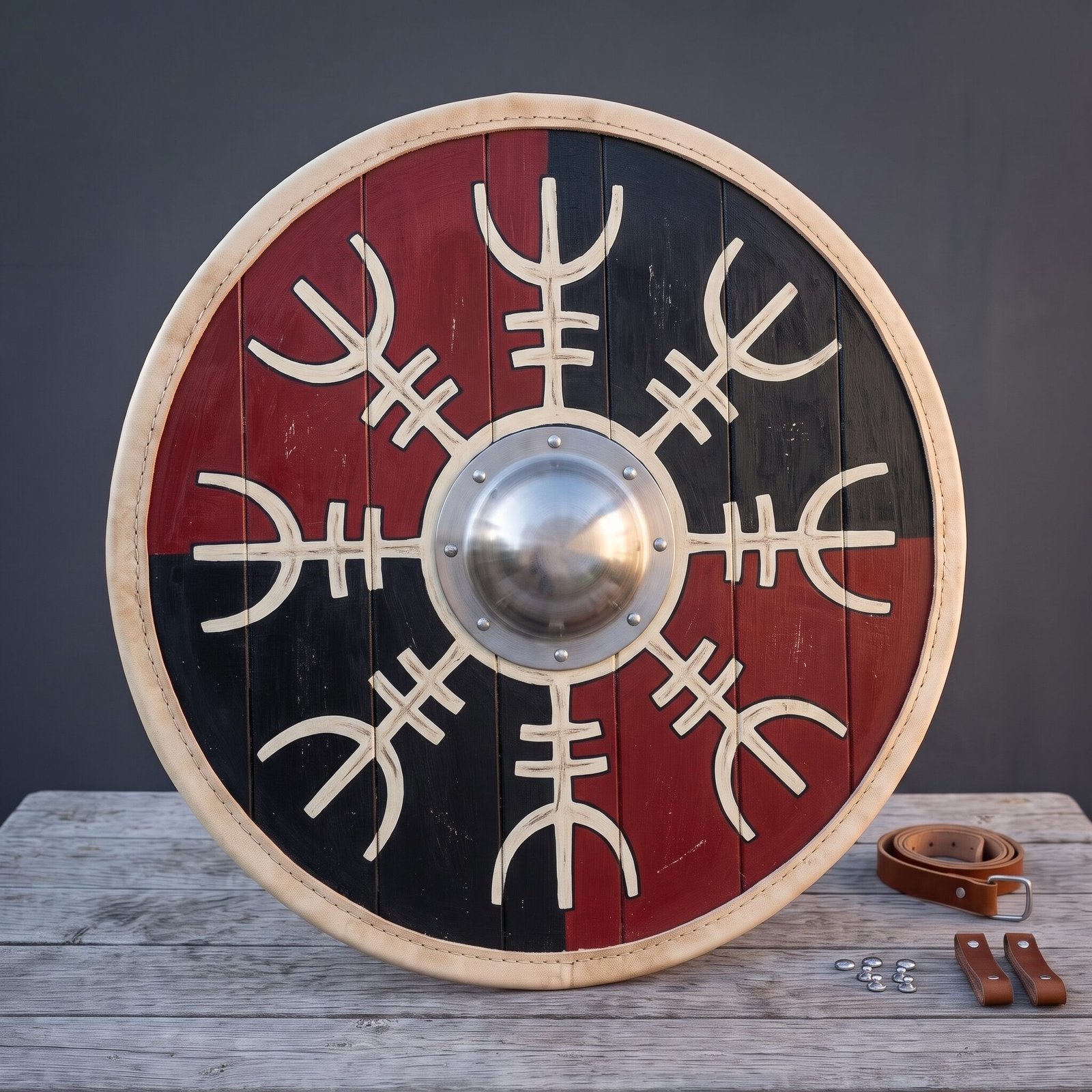
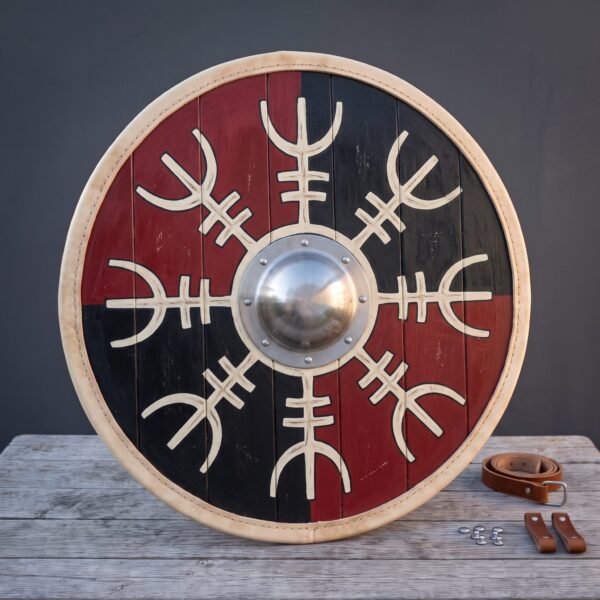
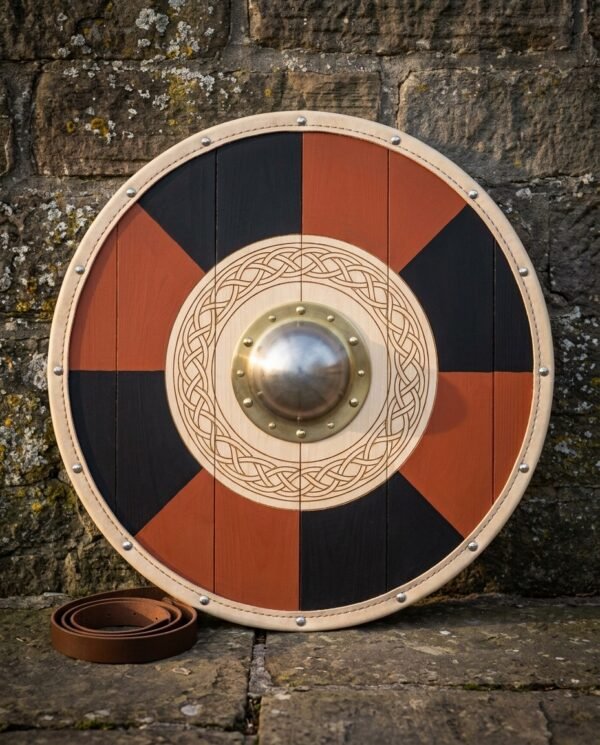
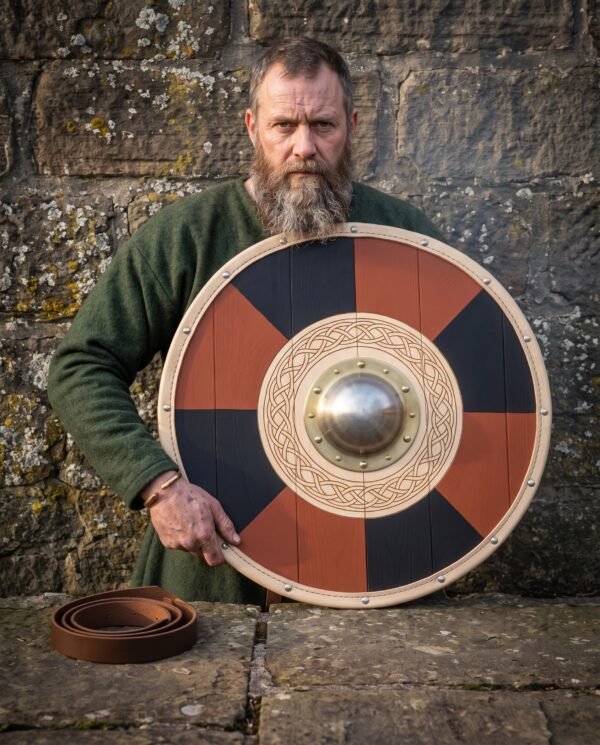
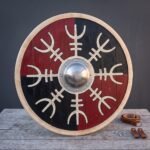
Quarterhelm is a hand made Viking round shield painted in two colours, deep red and black, laid out in four quarters around the boss. Over the top, crossing every quarter, is a bone white Helm of Awe with eight forked arms. The boss is polished steel and the edge is bound in pale stitched rawhide. It is 24 inches across, and it is the loudest of our Helm of Awe shields by some distance.
Red and black is a combination that carries across a room, a field or a parking lot at a reenactment weekend. Putting a pale symbol over it gives the eye something to settle on, and because the arms cross from red into black and back again, the symbol looks slightly different in each quarter. On a wall it reads as a bold piece of graphic work. In a shield line it reads as somebody you can find again after the photos.
The shield is planked, painted, bound and bossed by hand in a Czech Republic workshop and shipped from our Chicago, Illinois warehouse. The strap, grip and rivets come loose in the box. For the same symbol in black on plain wood, see the Awemark Helm of Awe shield.
Specifications
| Material | Wooden planks butted and glued edge to edge, about 12 mm thick, hand painted face |
|---|
| Diameter | 24 inches |
|---|
| Design | Face quartered in deep red and black, bone white Helm of Awe painted over all four quarters |
|---|
| Boss | Plain polished steel dome, riveted through the flange over the centre hole |
|---|
| Rim | Pale rawhide edging, hand stitched around the circumference |
|---|
| Fittings supplied | Leather arm strap with steel buckle, leather hand grip, shield rivets |
|---|
| Grip type | Centre grip behind the boss, in the Viking age manner |
|---|
| Intended use | Display, wall mounting, costume and light reenactment |
|---|
| SKU | RK-2323 |
|---|
Two colours, four quarters
Dividing a round shield into segments is one of the most popular patterns in Viking reenactment, and it is easy to see why. It is simple to lay out, it works in any pair of colours and it reads clearly at a distance. The evidence for quartered shields in the Viking age itself is thinner than the number of them at modern events would suggest. Surviving shields and picture stones show plain colours more often than divided ones. We call this a display design with a reenactor’s look, and we think that is the honest description.
The colours themselves are well grounded. Red pigments such as red ochre were cheap and widely used, and black came easily from soot and charcoal. Shields painted black and yellow were found with the Gokstad ship, and red turns up again and again in the sagas, where a red shield hoisted on a mast meant war. Red and black together is about as Norse a pairing as you can get without arguing with anyone.
The Helm of Awe on top
The symbol is the Aegishjalmur, the helm of awe or helm of terror. Its name comes from the Fafnir story, where the dragon wears it to keep everyone at a distance. The eight armed drawing comes from later Icelandic manuscripts of magical staves, where it is described as a sign to put fear into enemies and protect the bearer. A shield is a sensible place for it, since that is roughly a shield’s job description too.
On Quarterhelm the symbol is painted in bone white rather than pure white. Pure white against red and black can look harsh and a little modern. Bone white is softer and reads more like old paint, while still standing well clear of both background colours. There is a short write up of the symbol in Viking symbols and their meanings.
How it differs from our other Helm of Awe shields
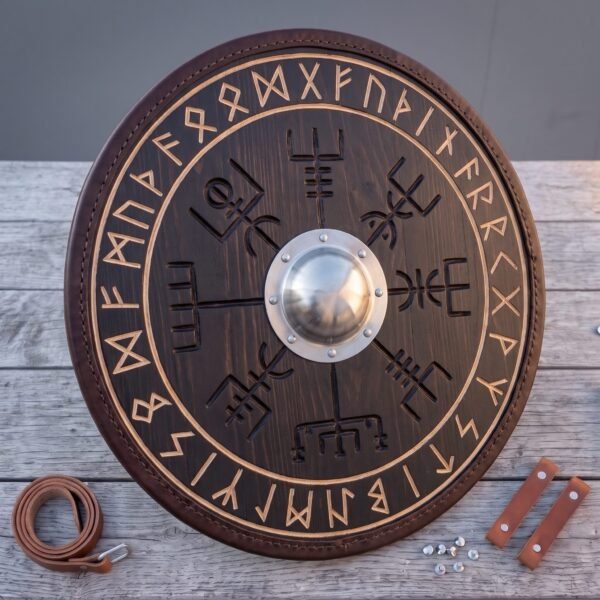
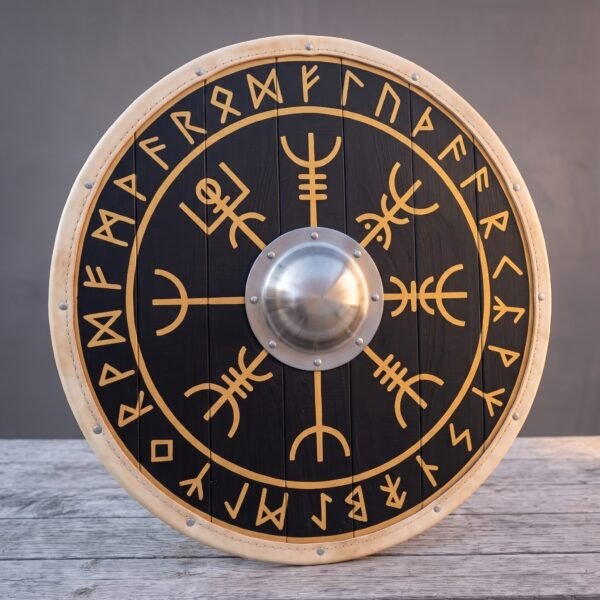
We make the symbol three ways and we did that deliberately, because people want it for different rooms and different reasons. Awemark keeps it black on bare natural wood, calm and warm. The Stavecut shield carves it into dark stained planks with no paint at all. Quarterhelm is the colourful one, built to be seen. Pick by the wall, or by the person.
It is also the least expensive of the three, because a painted face takes less bench time than carving and the quartered ground goes on quickly.
Hanging it on a wall
At 24 inches across, Quarterhelm fits over a fireplace, a sideboard, a bed or a desk without crowding the wall. Hang it so the boss sits roughly at standing eye level, or a little higher over furniture. Side light from a window or a lamp shows the surface far better than a ceiling light directly above, which flattens everything it touches.
Use two strong picture hooks or a pair of brackets that catch the rim at the left and right, so the weight is shared and the shield cannot rock. A French cleat screwed to the back also works if you are happy drilling into the planks. Please do not hang it from the arm strap. Leather stretches slowly for months and then gives up all at once, usually at night.
Keep it away from radiators, heating vents and the wall above a wood stove. Warm dry air blowing across planks year after year is the quickest way to open the joints. Strong colours fade faster in direct sunlight, so a wall that does not get the afternoon sun is kinder to the red. For sizes and placement across the range, read choosing a shield for display.
The planks, the boss and the rim
Under the finish this is the same build as a Viking age board shield. The face is several planks glued edge to edge rather than one sheet of board, which is why the joints show through. The middle is cut through for the hand and covered by the steel boss, riveted through its flange. The edge is bound in pale rawhide that goes on wet and tightens as it dries, holding the plank ends together.
That build is why the shield can be carried as well as hung. With the strap and grip fitted it works on a centre grip, held in the fist behind the boss the old way. It suits costume events, photo shoots and light living history. It is not made for full contact combat, where groups set and inspect their own board, rim and boss standards, and we would rather say so now than after a weekend at a reenactment field. Our guide to Viking shields covers the history of the build.
Engraving, runes and your own design
Use the rune converter on this page to turn a name, a date or a short phrase into Elder Futhark and we will cut it into the steel boss. If you would rather have a Viking pattern than a rune line, choose your own design in the engraving option above the add to cart button and tell us where it goes. Where a piece already carries an engraved design, your chosen engraving replaces it rather than sitting alongside it. The boss on Quarterhelm is plain polished steel, so a rune line or design sits at the centre where the four quarters meet and the eight arms begin. See the engraving page for how it works.
Care
Dust the face with a soft dry cloth. Leave polish, sprays and anything with solvent well away from the paint, which is hand applied and sealed but not armour. Keep the shield indoors and dry, because wood, paint and rawhide all dislike long damp spells.
Give the steel boss a thin film of light oil or paste wax once or twice a year. If a rust spot appears, lift it with fine steel wool and a drop of oil, then wax again. The steel care page has the details.
For reenactors and costume
A lot of people buy a quartered shield because they want to be recognisable at an event. Red and black does that job well. If you are building a kit, the shield goes with plain wool tunics in natural, red or dark colours and looks right next to a bearded axe or a spear. For ideas by period, our guide to gifts for reenactors is a good place to start.
Bear in mind that a painted shield used at events will pick up scuffs and dents. That is how it should look after a season, and a little honest wear on a red and black face looks much better than on a pale one.
Made in the Czech Republic
Quarterhelm is made by hand in a Czech Republic workshop. The planks are cut and glued, the face is sanded and sealed, the quarters are laid out and painted, the symbol is marked and painted over them, the rawhide is soaked and stitched, and the boss is fitted last. Ransack Viking is a United States company. We check each piece when it reaches us and ship it from our Chicago, Illinois warehouse.
A note on handmade variation
Each shield is painted by hand from the same layout. The quarters may fall slightly off the plank joints, and the arms of the symbol will match the photographs closely without being identical stroke for stroke. Size, colours and build are the same each time.
Frequently asked questions
Are the quarters exactly even
They are laid out with a rule from the centre, so they are close to even, but they are painted by hand rather than masked by machine.
Can I choose different colours
This listing is red and black. If you want another pair of colours, contact us before ordering and we will tell you what the workshop can do.
Is a quartered shield historically accurate
Divided shields are very common in reenactment, but the evidence for them in the Viking age is limited. We sell this one as a display and costume piece.
Can I carry it
Yes, for costume, photos and light reenactment. The strap and grip ship loose. It is not built for full contact fighting.
Can I put a name on it
Yes. The plain boss takes a rune line or a chosen design through the engraving option on this page.
How long does it take to ship
Processing is one to two weeks because each shield is built and finished to order, then shipping is free within the United States. Returns are accepted within seven days. Custom boss engraving adds a few days.
What is in the box
- One 24 inch planked Viking round shield painted in red and black quarters with a bone white Helm of Awe, rawhide bound
- Plain polished steel dome boss, riveted in place
- Leather arm strap with buckle and leather hand grip, supplied loose
- Set of shield rivets for fitting the strap and grip
- Made in the Czech Republic
Explore the range
See more in round shields and viking shields. For four Norse signs on one face, see the Fourmark Norse symbols shield.



Reviews
There are no reviews yet