
Blog
What Is Damascus Steel? How Pattern-Welded Blades Are Made

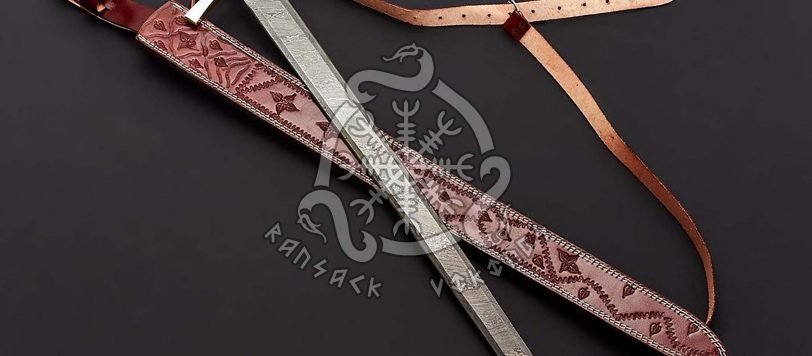
Damascus steel is blade steel with a layered pattern forged into it rather than printed on it. Two or more steels, most often 1095 high-carbon steel and 15N20 nickel-alloy steel, are forge-welded into a single billet, then folded, twisted and hammered until the billet holds dozens or hundreds of alternating layers. Dip the finished blade in acid and the two steels darken at different rates, so the layered structure rises to the surface as the signature pattern. Most of the confusion about Damascus comes from the people selling it rather than from the steel itself. A properly made pattern-welded blade is more than decoration: it combines the edge-holding of high-carbon steel with the toughness and bright contrast of nickel steel. This guide is the starting point for everything Damascus on this site, with links out to the Damascus knife collection where they belong.
Two Different Things Called “Damascus”
Part of the confusion around Damascus steel is that the name describes two completely different materials separated by centuries.
Historical wootz Damascus
The original Damascus blades, traded through the Syrian city of Damascus from roughly the 3rd century onward, were forged from wootz, a crucible steel produced in India and Sri Lanka. Wootz was smelted in sealed clay crucibles, and its pattern came from bands of carbides that formed inside the ingot itself, not from layering. Wootz blades earned a legendary reputation for holding a keen edge, and the precise production process was lost by the 18th century as ore sources and trade routes changed. Metallurgists have studied and partially reproduced wootz in laboratories, but the historical process itself remains a closed chapter. That has never stopped a listing from implying otherwise.
Modern pattern-welded Damascus
What is sold as Damascus steel today is pattern-welded steel: separate steels stacked, heated to welding temperature, and hammer-forged into one solid piece. This is not a shortcut or an imitation of wootz. Pattern welding is its own ancient technique, used by Viking-age smiths in Northern Europe to build sword and axe cores long before the name “Damascus” was attached to it. Modern smiths simply revived and refined the method. When this article says Damascus, it means pattern-welded steel unless noted otherwise.
The name stuck to the pattern, not the process. When later smiths welded layered steel and etched it, the surface looked similar enough to old wootz that the name was borrowed. A modern Damascus knife has nothing to do with medieval Syria; its quality depends on the two steels inside it and the smith who welded them.
How Pattern-Welded Damascus Is Made, Step by Step
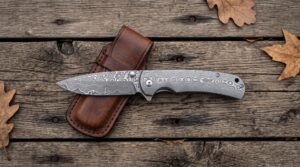 Leafcarry Hand Forged Damascus Folding Pocket Knife with Damascus Steel Handle Ready for Engraving & Cowhide Leather Sheath | Everyday Carry Collector Gift | RK-375
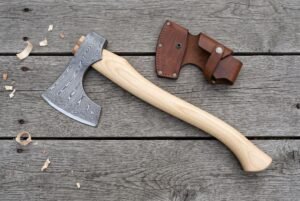 Palefrost Hand Forged Damascus Viking Bearded Axe | 19 Inch | Birch Wood Handle with Leather Blade Cover and Gift Box | Norse Collector and Wedding Gift | RK-351
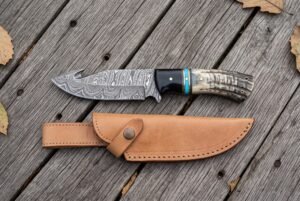 Hornreaver Hand Forged Damascus Gut Hook Hunting Knife with Buffalo Horn and Ram Horn Handle and Turquoise and Brass Spacers | Hunting Gift | RK-360
1. Building the billet
The smith stacks alternating bars of two steels, typically 1095 and 15N20, into a block called a billet. The two steels are chosen because they behave almost identically in the forge and in heat treatment, but etch to different shades: 1095 turns dark gray to black, while the nickel in 15N20 resists the acid and stays bright. The bars are cleaned to bare metal first, because any scale, oil or rust trapped between layers becomes a flaw in the finished blade.
2. Forge welding
The billet is heated to a bright yellow welding heat, fluxed to keep oxygen off the mating surfaces, and hammered so the layers fuse into a single solid piece of steel. In plain terms, the steel is brought to the point where the surfaces are almost sticky, then squeezed together fast before they can cool or oxidize. A clean forge weld leaves no seams, voids, or inclusions. This step separates sound Damascus from blades that later delaminate, which is the word for layers peeling apart along a weld that never fully took. It is also the step nobody can show you in a photograph, which is why the maker matters more than the specification.
3. Folding and pattern development
The welded billet is drawn out, cut, restacked, and welded again. Each fold multiplies the layer count: a nine-layer starting stack folded four times exceeds 100 layers. The smith can then manipulate the layers, twisting the bar, grinding depressions, or pressing patterns into the surface, to create styles such as random, ladder, twist, and raindrop.
4. Forging the blade and heat treatment
The patterned bar is forged into a blade shape, normalized to relieve stress, hardened by quenching, and tempered to the working hardness. Because 1095 and 15N20 share similar heat-treatment behavior, the finished blade hardens evenly across every layer.
5. Grinding and acid etching
After grinding and polishing, the blade is etched in a mild acid bath, usually ferric chloride. The acid bites the high-carbon layers and leaves the nickel layers proud and bright, revealing the pattern in full contrast. The etch is the final proof of real pattern-welded construction: the pattern is in the steel, not printed on it.
Folding and Layer Counts: What the Numbers Mean
Layer count is the number most often quoted on a Damascus listing, and it is the number that means the least. A billet that starts with nine alternating bars has nine layers. Fold it once and weld it, and it has eighteen. Fold again, thirty-six. Four folds take that stack past one hundred. No smith sits down and counts layers. They count folds and multiply, exactly as you just did.
A long edge shows the result best, which is why the pattern reads so clearly on a hand forged katana.
What folding actually does is make the pattern finer. Nine thick layers etch as bold, wide stripes. Two hundred thin layers etch as a tight, busy grain. More layers do not make the steel harder, tougher or sharper. Hardness comes from the carbon content and the heat treatment, and both steels had that before the first fold.
So a listing that announces “512 layers” is describing the density of the pattern and nothing else. It is a texture setting quoted as though it were a performance figure. A well-welded blade at 100 layers will outlast a badly welded blade at 500. A folded billet that was overheated or left with a bad weld inside it is a worse blade than a plain bar of 1095, no matter what the layer count says.
Why 1095 and 15N20 Pair So Well
You could in theory weld almost any two steels together. The 1095 and 15N20 pairing has become the standard for a few plain reasons.
Every piece made from that pair is gathered under 1095 and 15N20 Damascus.
They forge at the same temperatures. Both are simple carbon steels at heart, and 15N20 is essentially a carbon steel with a couple of percent nickel added. They reach welding heat together and move under the hammer together. Steels with very different alloy content tend to weld badly because one is ready before the other.
They harden together. Both respond to the same quench and the same tempering temperature, so every layer in the finished blade ends up at close to the same hardness. Weld a hardenable steel to one that will not harden and you get a sandwich of hard and soft stripes that wears unevenly at the edge.
They etch differently, and that is the whole point. The nickel in 15N20 resists ferric chloride, so those layers stay bright while the plain 1095 goes dark. And the nickel does real work beyond looks: it adds toughness, meaning resistance to chipping and cracking, so the bright layers act as a kind of shock absorber inside the blade.
On hardness itself: the plain 1095 blades on this site are heat treated to 54 to 58 HRC on the Rockwell C scale, which is the range that suits a hunting or camp knife that has to take abuse and still be easy to touch up on a stone. The Damascus blades, welded from 1095 and 15N20, run a little harder at 58 to 60 HRC. That extra hardness holds an edge longer, and the nickel layers keep the blade from becoming brittle at that level. If you want a plain-words explanation of terms like HRC, normalizing, quench and temper, there is a separate steel glossary being built for exactly that, so this guide will not repeat all of it.
The Etch: Where the Pattern Appears
A freshly ground Damascus blade looks like any other polished steel. The pattern is there, but it is invisible until the surface is etched. The usual etchant is diluted ferric chloride. The blade is cleaned so no fingerprint oil blocks the acid, then submerged for anywhere from a few minutes to half an hour depending on the strength of the bath and how deep the smith wants the relief.
Two things happen at once. The 1095 layers are eaten away slightly and turn dark. The 15N20 layers are barely touched and stay at the original surface height, bright and silver. The result is both a color pattern and a tiny topography you can feel with a fingernail. After etching the blade is neutralized in baking soda solution, rinsed, dried and oiled at once, because a freshly etched surface is very eager to rust.
One consequence for an owner: the pattern lives in the top few thousandths of an inch, so years of sharpening and polishing will slowly wear it faint near the edge. That is a sign the knife has been used rather than a defect, and a blade can be re-etched to bring the pattern back.
Wootz vs Pattern-Welded Damascus at a Glance
| Feature | Historical wootz Damascus | Modern pattern-welded Damascus |
|---|---|---|
| Origin of pattern | Carbide banding inside a single crucible steel ingot | Alternating layers of two different steels |
| Typical steels | High-carbon crucible steel (wootz) | 1095 high-carbon + 15N20 nickel alloy |
| Production status | Historical process lost; studied in labs | Actively made by smiths worldwide |
| Pattern visibility | Subtle, revealed by polishing and light etching | Bold, revealed by acid etching |
| Corrosion resistance | Low, high-carbon steel | Low to moderate, needs basic care |
Common Damascus Patterns and How They Are Made
Every pattern is the same layered bar manipulated a different way before the final forging.
Random is the natural result of folding and forging with no extra manipulation. The layers wander as the hammer moves the steel, and no two blades match.
Ladder is made by grinding parallel grooves across the bar, then forging the surface flat again. The layers below the grooves are pushed up to the surface as rungs of tight curves.
Raindrop uses round dimples instead of grooves. Each dimple becomes a ring of concentric circles once the bar is forged flat.
Twist is made by heating the bar and twisting it like a rope, then forging it flat. The layers show as a chain of stars and swirls. Twist bars stacked side by side make the serpent-like cores seen on some Viking-age swords.
Is the Pattern Just Cosmetic?
Honest answer: mostly, yes, and that is fine. A pattern-welded blade of 1095 and 15N20 performs like a very good high-carbon blade because that is what it is. The layering does not make it magically stronger than its component steels, and claims that Damascus is sharper or harder than any modern steel are marketing rather than metallurgy. What the construction does give you is a blade where every layer hardens properly, the nickel layers add measurable toughness, and no two blades look alike. Buy it because you want to look at it. That is a perfectly good reason, and it is the honest one most of the time. If you want to weigh Damascus against a rust-proof alternative, our guide to Damascus steel vs stainless steel covers that trade-off in depth.
What Damascus Steel Is Used For Today
Pattern-welded steel shows up anywhere a blade is meant to be used and admired. Common applications include hunting knives that need a hard, keen edge for field work, chef knives where the pattern makes a daily tool feel special, and larger forged pieces such as Viking axes and swords that echo the original Northern European pattern-welding tradition. The same layered steel is also shaped into rings, pendants and beads, which you can see in the Damascus steel jewelry collection; the pattern shows just as well on a ring as on a blade. Because the base steels are high-carbon, all of these need a wipe-down and a light coat of oil after use, a small price for a blade with this much character.
How the Damascus on This Site Is Made
Ransack Viking is a US company based in Chicago, Illinois. The blades themselves are not made in Chicago. Every piece is handmade in the Czech Republic by smiths working the old way, with a forge, a hammer and an anvil, using the 1095 and 15N20 pairing described above. Finished pieces are imported to Chicago, where each one is inspected before it ships. If you order engraving, that work is done in the US after the blade arrives. We say this plainly because origin is one of the first things a serious buyer asks about, and a vague answer is a warning sign anywhere in this trade.
Caring for a Damascus Blade, in Brief
Damascus asks for a little more attention than a stainless kitchen knife and a good deal less than people fear. After use, wipe the blade, dry it fully, and put a thin film of mineral oil on it. Keep it out of the sink and the dishwasher, and do not store it long term inside a leather sheath, which holds moisture against the steel. Sharpen it as you would any high-carbon knife. The full routine, including what to do about a rust spot that has already started, is in the knife care guide.
What to Look For When Buying
A genuine pattern-welded blade should name its steels (1095/15N20 is the standard pairing), show a pattern that continues over the spine and edge rather than sitting only on the flats, and come from a maker who stands behind the forge welds. Be cautious of blades described as Damascus that are suspiciously cheap, laser-etched with perfectly repeating patterns, or claimed to be stainless with no steel designation. A quick test: run a fingernail across the flat. A real etch has a faint texture; a printed or laser-marked pattern is glass smooth. It takes two seconds and settles the question faster than any product description will. A real Damascus blade is a piece of hand work, and the pattern is the maker’s signature.
Whether the pattern is worth paying for against a plain carbon blade is settled in Damascus against high carbon steel, and how to spot an etched imitation is in real against fake Damascus. Construction matters as much as the billet, which is the argument in full tang against partial tang.
Questions people ask
What is Damascus steel in simple terms?
Damascus steel is blade steel with a visible layered pattern. Modern Damascus is made by forge-welding two steels, usually 1095 high-carbon and 15N20 nickel steel, folding them into many layers, and etching the finished blade in acid so the layers show as a flowing pattern. It is a working blade steel first and a decorative one second, and it needs the same care as any high-carbon knife.
Is modern Damascus the same as ancient Damascus?
No. Ancient Damascus blades were forged from wootz, a crucible steel whose pattern came from internal carbide bands, and that exact process was lost centuries ago. Modern Damascus is pattern-welded from layered steels, a different and equally old technique used by Viking-age smiths and still practiced today. The two share a name and a watery look, and nothing else.
How many layers does Damascus steel have?
Most pattern-welded blades fall between roughly 100 and 500 layers, built up by repeatedly folding a smaller starting stack. More layers make a finer, tighter pattern and nothing else. Weld quality and heat treatment decide whether the blade is any good, and a clean 100-layer blade will outlast a badly welded 500-layer one. Treat the layer count as a description of the surface, not a score.
Does Damascus steel rust?
Yes, and anyone who tells you otherwise is describing stainless. Damascus made from 1095 and 15N20 is high-carbon steel, so it will rust if left wet or stored dirty. Wipe the blade dry after use, apply a light coat of oil, and keep it out of a leather sheath for long storage. Treated that way it will stay clean for decades, and a small rust spot can usually be removed with fine abrasive and oil.
Why do smiths use 1095 and 15N20 together?
The two steels forge-weld cleanly and respond to the same heat treatment, so the finished blade hardens evenly across every layer. Just as important, they etch differently: 1095 turns dark and the nickel-bearing 15N20 stays bright, which is what makes the pattern visible. The nickel also adds toughness, so the blade resists chipping a little better than plain 1095.
Is Damascus steel strong?
A well-made pattern-welded blade is as strong as the quality high-carbon steels inside it, which is more than enough for hunting, kitchen, and outdoor use. It is not indestructible, and it is not superior to every modern steel, whatever the listing says. Its real advantages are a hard, keen edge, good toughness from the nickel layers, and an appearance no two blades share.
For one built to your own measurements, build a custom Damascus knife and choose the pattern, the profile, the handle material and the sheath.
Where to see these
Ready to ship, the Clawshade Karambit knife and the Foldcurve kukri knife. The Copperskin skinner knife and the Trailwood tracker knife are the other two.
Shop the range
Leafcarry Hand Forged Damascus Folding Pocket Knife with Damascus Steel Handle Ready for Engraving & Cowhide Leather Sheath | Everyday Carry Collector Gift | RK-375Palefrost Hand Forged Damascus Viking Bearded Axe | 19 Inch | Birch Wood Handle with Leather Blade Cover and Gift Box | Norse Collector and Wedding Gift | RK-351Hornreaver Hand Forged Damascus Gut Hook Hunting Knife with Buffalo Horn and Ram Horn Handle and Turquoise and Brass Spacers | Hunting Gift | RK-360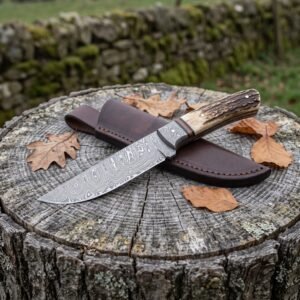 Scorpio Hand Forged Damascus Skinner Knife with Stag Antler Handle and Buffalo Horn and Walnut Spacers and Damascus Bolster | Deer Skinning Gift | RK-338
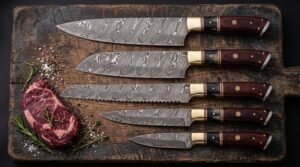 Hornsmith Hand Forged Damascus 5 Piece Chef Knife Set with Buffalo Horn and Pakka Wood Handles and Brass Bolsters and Mosaic Pin & Leather Sheath | Chef and Kitchen Gift | RK-378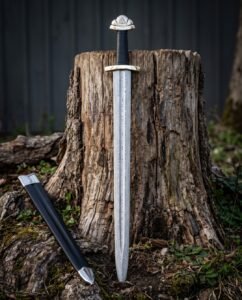

5 thoughts on “What Is Damascus Steel? How Pattern-Welded Blades Are Made”
Comments are closed.