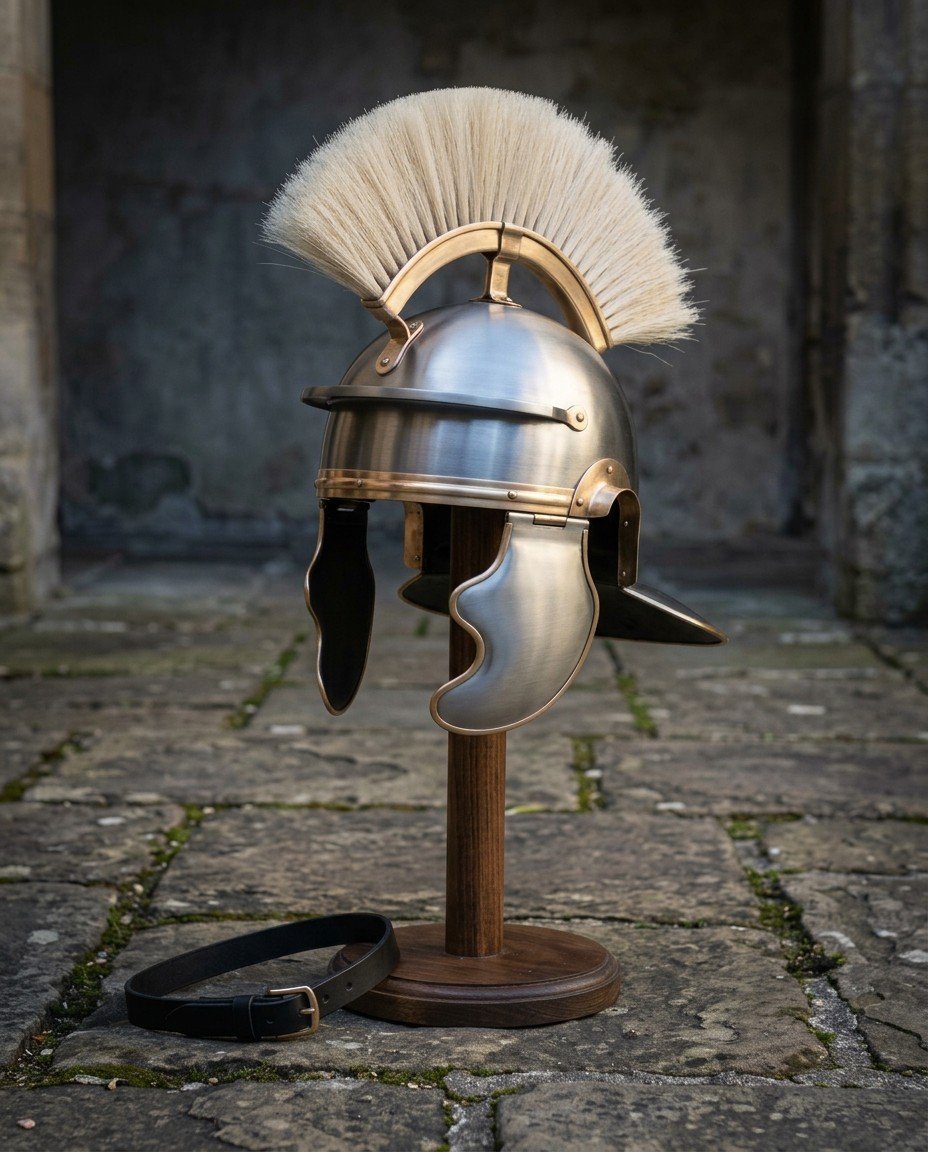
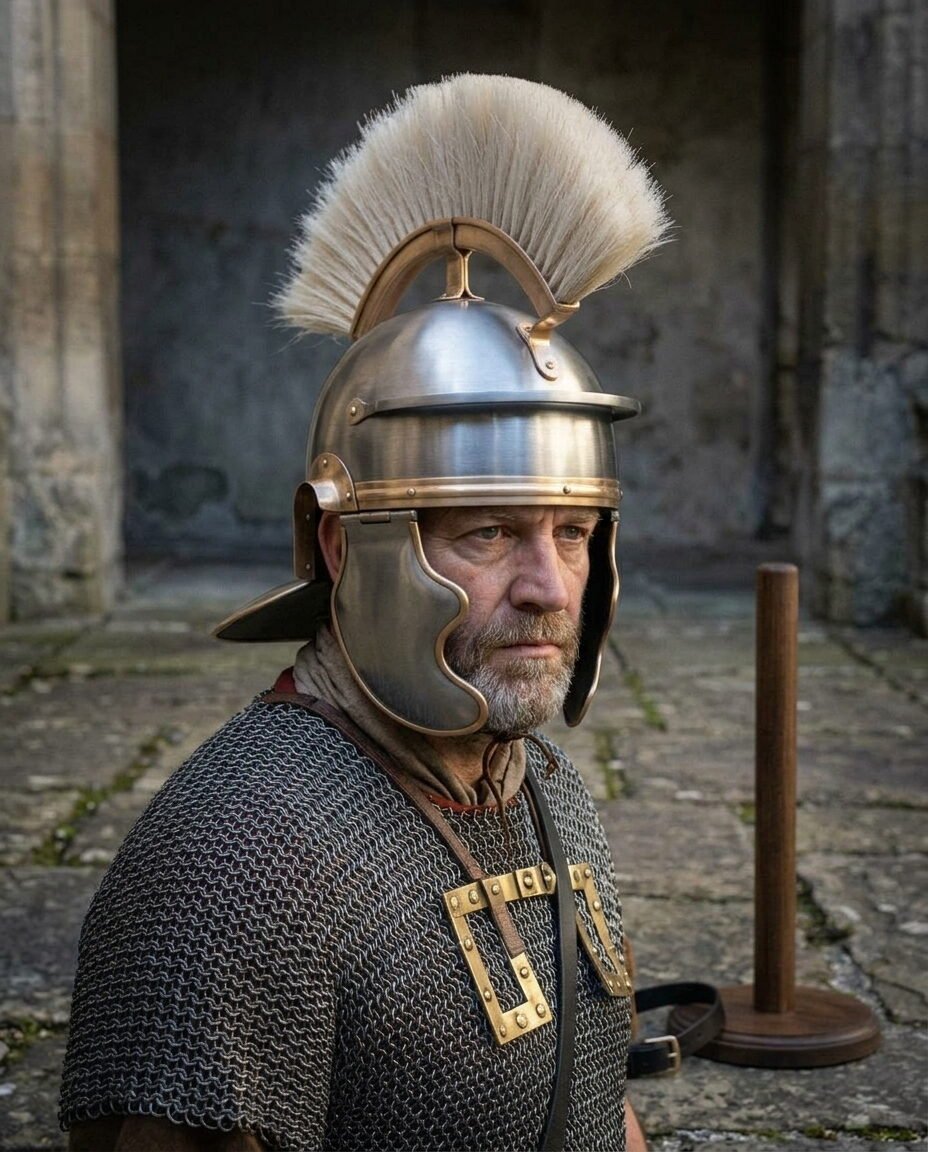
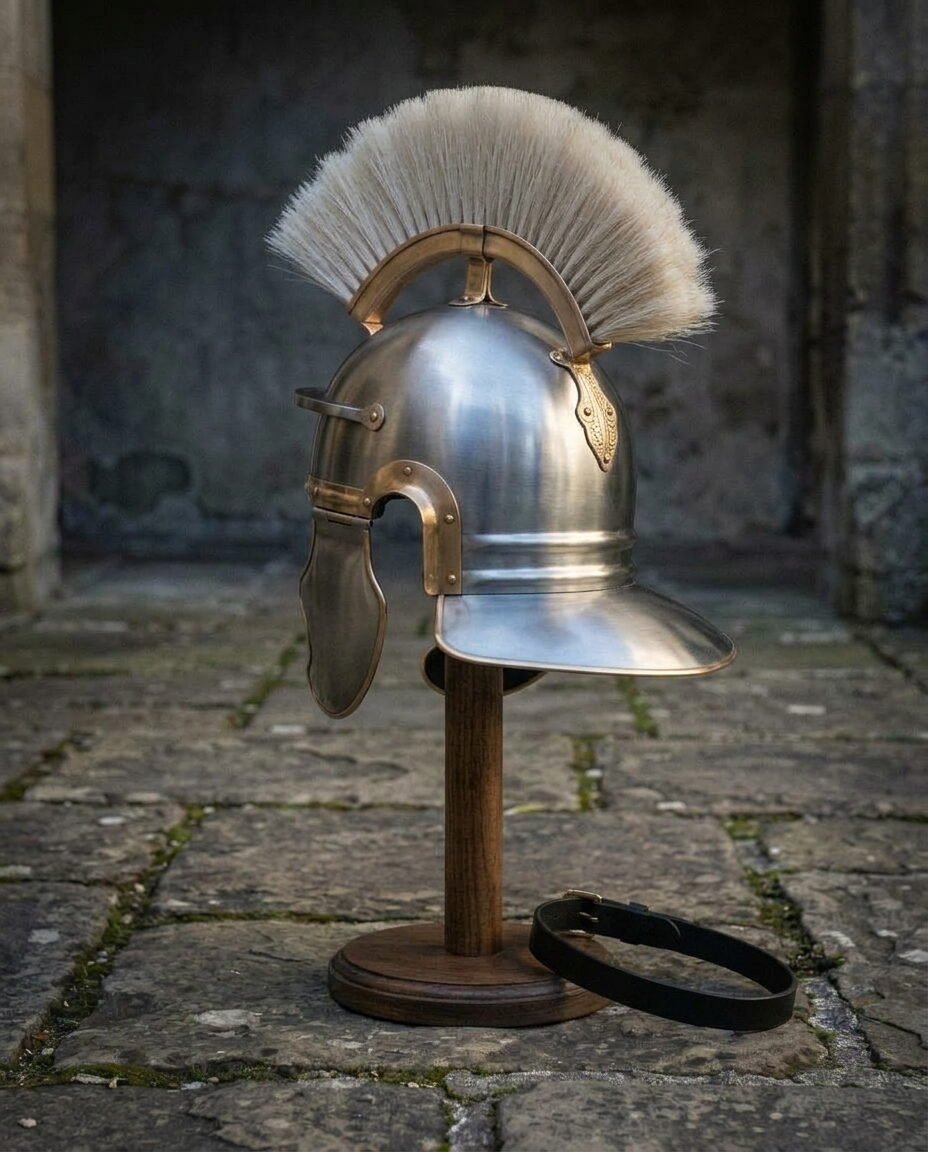
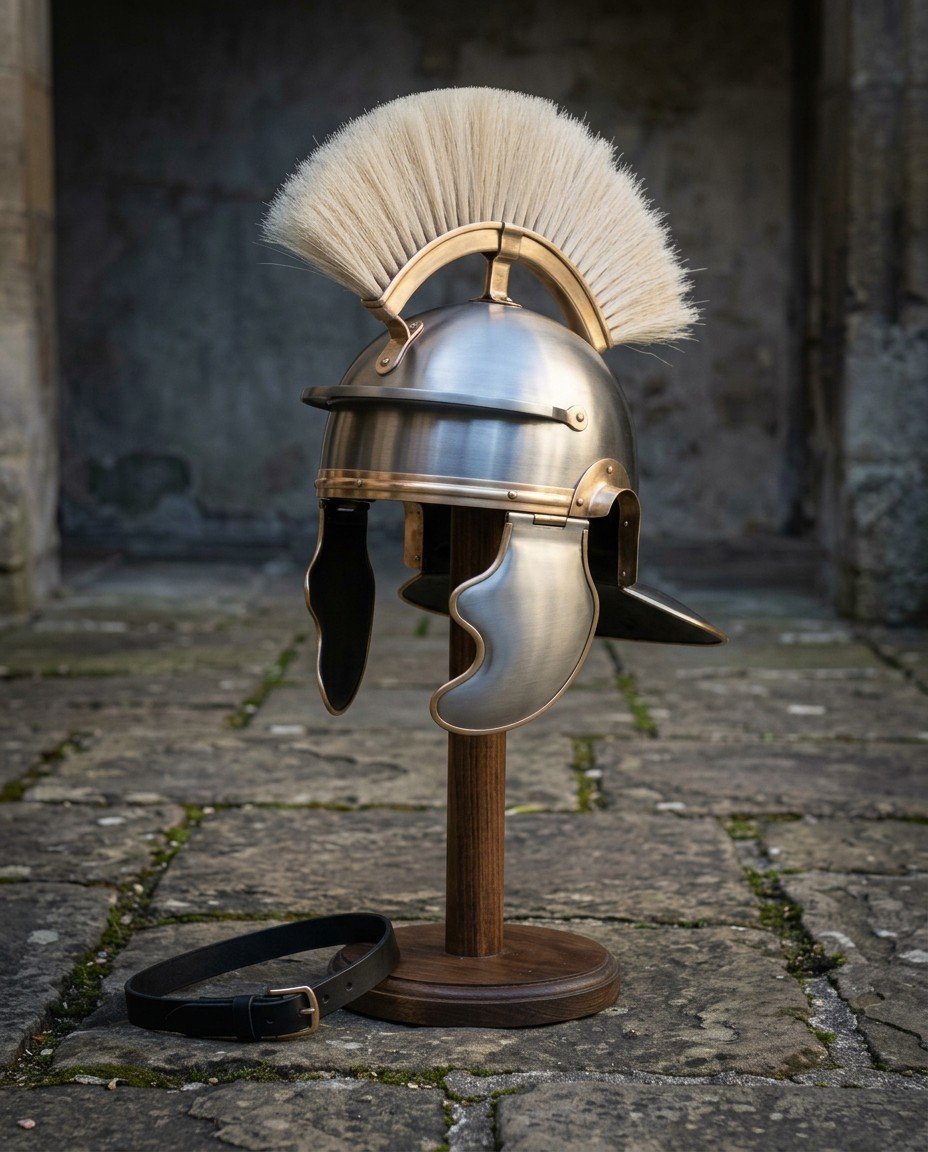
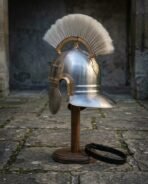
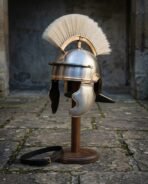
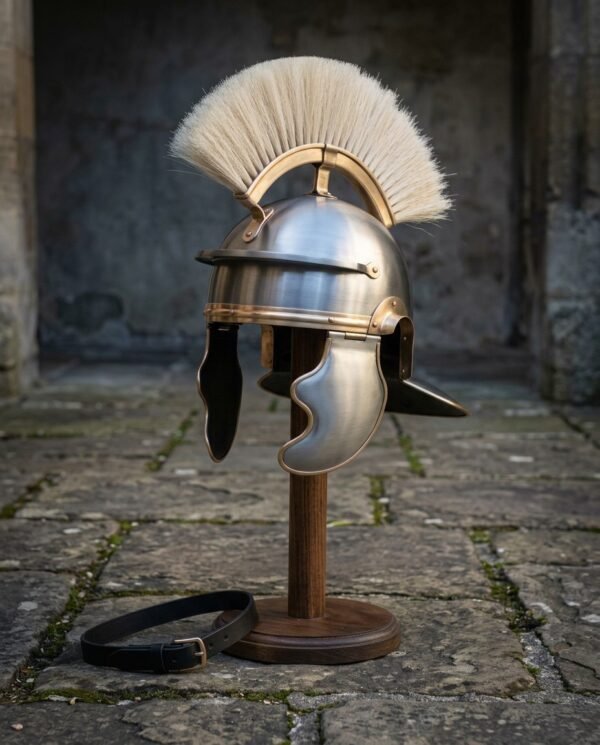
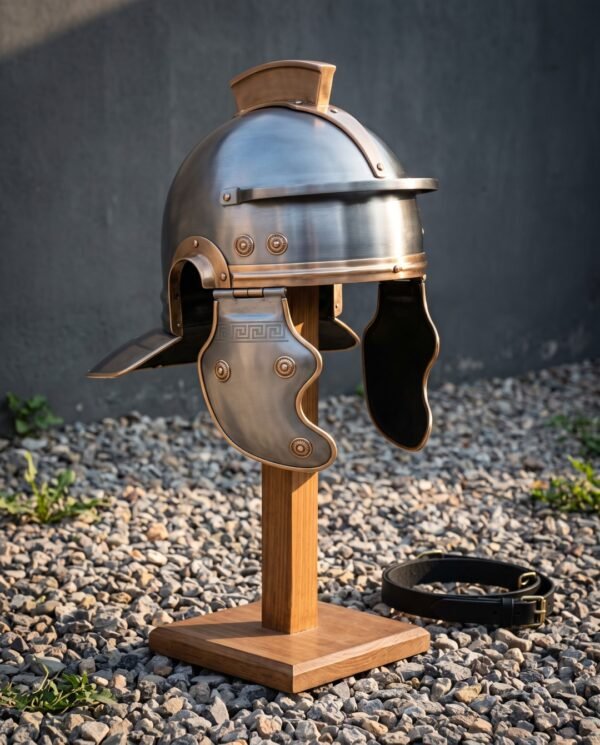
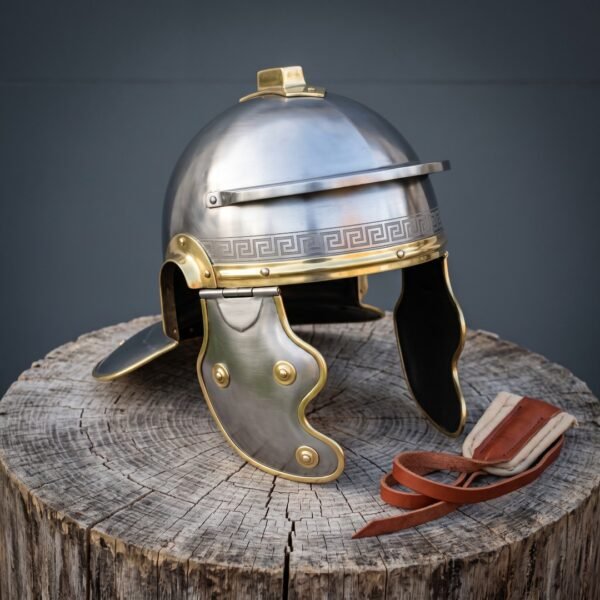
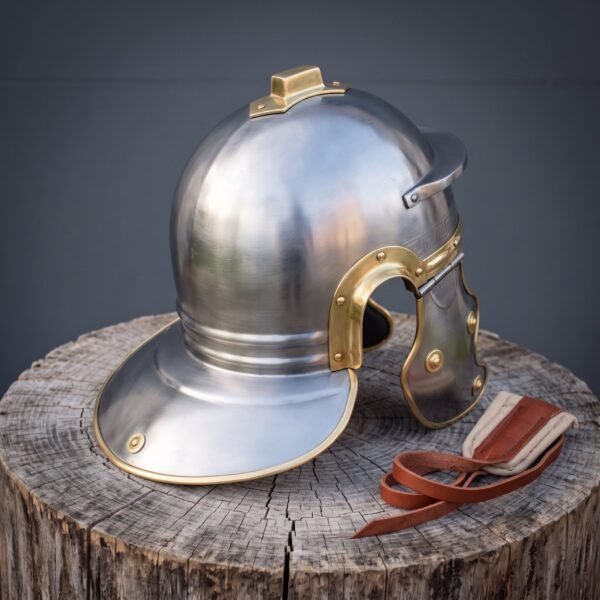
Legionplume is a Roman helmet of the Imperial Gallic pattern, the type worn by the legions through the first and early second centuries. The bowl and the brow reinforce are steel, the ear guards, the crest holder and the trim are brass, the neck guard sweeps back and down from the rear of the bowl, and a pair of hinged cheek pieces swing forward to close on the jaw. A natural cream horsehair crest is carried on an arched brass crest holder mounted front to back along the crown, and a black leather chin strap is supplied with it.
The crest runs front to back along the crown, which is how a legionary wore one, mostly for parades. A centurion was marked out by a crest set side to side instead, so his own men could pick him out from behind in formation, which makes this the ranker version rather than the officer one. Every Legionplume is raised, trimmed, brazed, riveted and crested by hand in the Czech Republic. Free shipping inside the United States, one to two weeks processing, seven day returns, and a genuine lifetime warranty against defects in the build and the fittings, with no end date and no receipt needed. Roman and Greek kit sat alongside mail and plate in the same centuries, compared in chainmail versus plate versus lamellar.
Specifications
| Item type | Roman Imperial Gallic helmet |
|---|
| Material | Mild steel bowl, brow reinforce and neck guard with solid brass fittings and trim |
|---|
| Gauge | 18 gauge mild steel |
|---|
| Pattern | Imperial Gallic, with a steel brow reinforce, brass ear guards and a swept neck guard |
|---|
| Crest | Natural cream horsehair set front to back on an arched brass crest holder |
|---|
| Trim | Brass band around the bowl, brass edging on the cheek guards and the neck guard |
|---|
| Cheek guards | Steel with brass edging, hinged at the brow band and leather lined |
|---|
| Chin strap | Black leather strap with a buckle |
|---|
| Finish | Brushed satin steel against warm solid brass |
|---|
| Size and fit | Made to a stated head circumference in inches |
|---|
| Intended use | Display, costume, parade and light reenactment, not full contact steel |
|---|
| SKU | RK-1460 |
|---|
What every part of a legionary helmet is for
The Imperial Gallic is one of the best resolved pieces of military equipment in the ancient world, because so many were thrown into rivers and bogs and came out again in good condition. Every feature on it answers a specific problem.
The wide neck guard sweeping down from the back is there because the man behind you in a formation is throwing a pilum over your head and the man in front of you is not covering your neck. It slopes rather than hangs so a downward blow slides off rather than catching. The brow reinforce, that projecting steel bar across the front of the bowl, exists because the standard attack against a shielded man is a downward chop at the head, and it takes that chop on a doubled thickness of metal rather than on the thin bowl.
The cheek pieces are hinged rather than fixed so the helmet can be lifted on and off over the ears, and they are cut away around the eye and the mouth so the wearer keeps vision and can be understood when shouting. The ear guards, the small brass cutouts at the temples, are shaped so that the cheek piece cannot swing back into the ear. And the crest box lifts the plume clear of the steel so a blow that lands on the crest does not transmit straight into the bowl.
Steel, brass and horsehair
The bowl and neck guard are mild steel at 18 gauge, brushed to a satin finish. Mild steel is the right material for armour and it is not blade steel. It dents rather than shattering, which is the behaviour you want around a head. Eighteen gauge is the standard display and light reenactment weight across the trade, and that is exactly what this helmet is for. It is not certified combat armour and full contact groups will want a heavier bowl and their own inspection.
The brass is solid rather than plated, so it takes a warm patina over years instead of flaking. Brass against steel is the correct period combination and it is also practical, because brass is easy to form to a curve and easy to keep bright.
The crest is natural horsehair rather than synthetic fibre, left in its undyed cream, and it is set into the brass box in a dense fan. Horsehair carries a body and a swing that synthetic will not, and it also settles rather than frizzing when it gets damp. It can be combed out with your fingers.
Engraving, runes and your own design
Use the rune converter on this page to turn a name, a date or a short phrase into Elder Futhark and we will cut it into the steel or the leather. If you would rather have a Viking pattern than a rune line, choose your own design in the engraving option above the add to cart button and tell us where it goes. Where a piece already carries an engraved design, your chosen engraving replaces it rather than sitting alongside it. On this helmet the brass band around the bowl and the chin strap leather are the natural places for a line, and Latin lettering can be cut instead of runes if you ask for it. Full detail is on the engraving page.
Fit and sizing
Measure the circumference of your head with a soft tape, level, just above the ears and around the widest part of the back of the skull, and order to that figure. If you fall between sizes, order up, because a helmet can be padded down and cannot be made larger.
Roman helmets sit differently from medieval ones and it is worth knowing before it arrives. The bowl should sit low, with the brow reinforce just above the eyebrows and the neck guard clear of your shoulders when you look up. If it perches high on the crown, it will rock. The cheek pieces should close on the jaw with the chin strap tied under them, not around them, which is how Roman reliefs consistently show it done.
Care
Wipe the steel down after wearing and dry the inside of the bowl properly, because sweat does more damage to a helmet than rain ever will. Put a light film of oil or paste wax on the steel once it is dry. The brass will patina, which most people want. If you prefer it bright, polish it two or three times a year and keep the polish off the steel. Comb the crest out with your fingers rather than a brush, and let it dry naturally if it gets wet rather than putting it near heat. Store the helmet upright rather than resting on the crest. Feed the cheek piece lining and the chin strap with a neutral leather conditioner. Our steel care page covers oiling and rust removal. Care is the same as for any steel armour, covered in caring for chainmail and steel armour.
Made in the Czech Republic
This piece is made by hand in the Czech Republic, in a workshop that still works the old way. The steel is forged, ground, heat treated and finished by smiths who learned the trade from the people before them, and the wood, horn and leather are cut and fitted by hand rather than pressed out on a line. That is also why no two pieces come out exactly the same.
Ransack Viking is a United States company. We import these pieces ourselves, check every one when it lands and ship from our warehouse in Chicago, Illinois. Engraving is done here in the United States after the piece arrives, so your runes or your own design go on before it leaves for you.
A note on handmade variation
This helmet is hand made and not machine made or bulk produced, so what arrives will not be a pixel for pixel copy of the photograph. The rise of the bowl, the sweep of the neck guard, brass tone, rivet placement and the exact density and fall of the horsehair crest all vary because each one is worked by hand from natural materials. The dimensions, the material and the build are the same every time. The character is not.
Frequently asked questions
Why does the crest run front to back?
Because that is how a legionary wore a crest, mostly on parade. A crest set side to side marked a centurion, so his men could find him from behind in formation.
Is the crest real horsehair?
Yes, natural undyed horsehair set into the brass crest box. It hangs and swings differently from synthetic fibre and settles rather than frizzing when damp.
Can the crest be removed?
The crest box is mounted to the bowl and the helmet is supplied as one piece, so it is not intended as a quick change fitting. Ask us before ordering if you want a detachable arrangement.
Can I wear it for full contact reenactment?
No. At 18 gauge this is display, parade and light reenactment weight. It is not certified combat armour and heavy fighting groups will want a thicker bowl.
How should the chin strap be tied?
Under the cheek pieces rather than around them, which is how Roman reliefs show it and which stops the cheek pieces flapping when you move.
How long does it take to ship?
One to two weeks, because the bowl is raised and the helmet is fitted and crested to your size. Shipping inside the United States is free.
What is in the box
- One Imperial Gallic Roman helmet in 18 gauge mild steel with solid brass fittings
- Natural horsehair crest set front to back on an arched brass crest holder
- Hinged, leather lined cheek guards
- Black leather chin strap with a buckle
- Care, crest and oiling notes
- Forged and finished in the Czech Republic
Explore the range
See more in Roman and Greek helmets, medieval helmets and kite shields and bucklers, or read the guides for how Roman kit was assembled.
Other pieces in this group
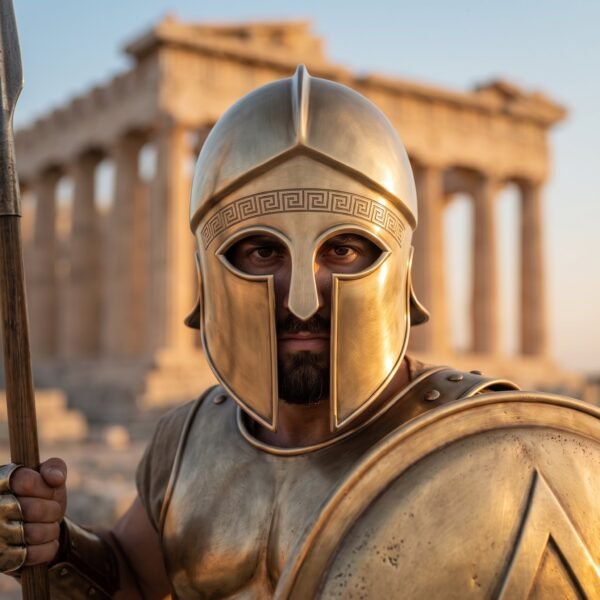
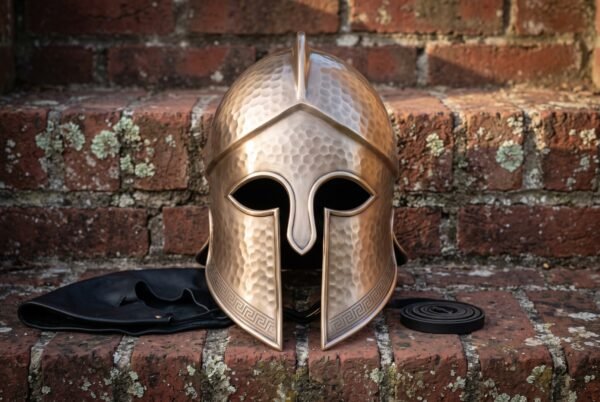
In the same category sits the Bronzecrest Greek helmet. A near match for this one is the Aegiscrest Greek helmet. Closest to this in the range is the Coppercrest Greek helmet.
Fitting out further, the Grimbeak Medieval helmet belongs with it. Nothing here exactly right, build one to your own spec on the design your own page.


Solid helmet. Glad I ordered it. Fits well though I had to adjust the straps a bit. Good solid build. Finish could be a touch more even. Would still tell others to give this a try.