
Blog
The Steel Glossary: 1095, 15N20 and What Forge Welding Actually Is

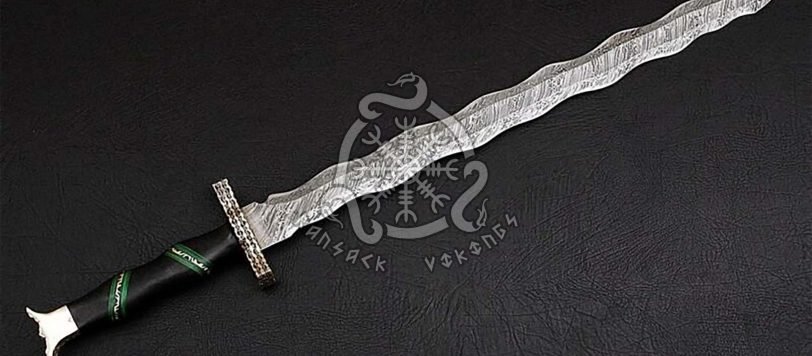
This glossary covers the terms you will meet shopping for a hand-forged knife: the two steels inside every blade we sell, what forge welding is, what the hardness numbers actually mean, and the words sellers reach for when they would rather not be specific. Read the first section for the short version, then use the entries below like a dictionary.
The Two Steels We Use, and What Forge Welding Is
Every knife and Viking piece we sell is handmade in the Czech Republic the old way, then imported, inspected and shipped from Chicago, Illinois. Two steels go into those blades and nothing else.
Plain 1095. A high carbon steel with about 0.95 percent carbon and almost no other alloying. It hardens well, takes a keen edge and sharpens easily on ordinary stones. Our plain 1095 blades run 54 to 58 HRC on the Rockwell C scale.
The pieces we make from it without pattern welding are listed under 1095 high carbon steel.
Damascus, made of 1095 and 15N20. Our Damascus is pattern welded steel: bars of 1095 and 15N20 stacked, heated to welding temperature and hammered into one solid billet, then folded and drawn out until the blade carries many alternating layers. After grinding, an acid etch turns the 1095 dark and leaves the nickel bearing 15N20 bright, which is where the pattern comes from. Our Damascus blades run 58 to 60 HRC.
Forge welding is the process that makes Damascus possible. Steel heated to a yellow, near white heat and struck under flux will bond to steel of a similar heat. There is no glue and no seam. Done cleanly, the layers become one piece of metal that shares the properties of both steels. The quality of a Damascus blade lives in those welds and in the heat treatment that follows. It does not live in the layer count or the pattern, whatever the listing photograph is implying.
The rest of this page defines the terms in alphabetical order, with numbers first.
Glossary of Knife Steel Terms
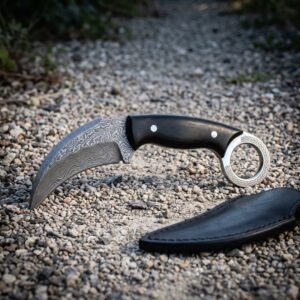 Clawshade Hand Forged 1095 and 15N20 Damascus Karambit Knife with Ebony Handle & Knotwork Engraved Finger Ring | Everyday Carry Gift | RK-1496
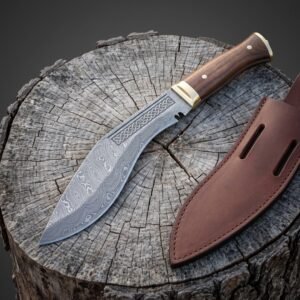 Foldcurve Hand Forged 1095 and 15N20 Damascus Kukri Knife with Rosewood Handle & Brass Fittings | Camp Chopper Gift | RK-1564
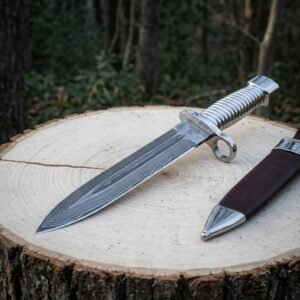 Ringspike Hand Forged Damascus Bayonet Dagger | 1095 and 15N20 Blade | Fluted Steel Grip Ring Guard and Leather Sheath | Collector Gift | RK-1871
1095
A plain carbon steel. The “10” marks the plain carbon family and the “95” gives its carbon content, roughly 0.95 percent. That much carbon lets it quench to high hardness and form the fine, keen edge that made 1095 a staple of hunting and field knives for over a century. It is easy to sharpen and predictable in the forge. With essentially no chromium it rusts without care, and at full hardness it prefers cutting to prying. In an etched Damascus blade, 1095 oxidizes quickly in the acid and forms the dark bands of the pattern. On its own, as in our plain 1095 blades, it is hardened to 54 to 58 HRC.
15N20
A carbon steel with about 0.75 percent carbon and around 2 percent nickel. It was produced for decades for industrial band saw blades, a job that demands steel able to flex without cracking. The nickel does two things that matter in Damascus. It adds toughness and shock resistance, and it resists the etching acid, so 15N20 stays silver bright while the 1095 beside it goes dark. Without a nickel steel in the stack a pattern welded blade would etch to a nearly uniform gray and the contrast would vanish.
| Property | 1095 | 15N20 |
|---|---|---|
| Carbon content | About 0.95% | About 0.75% |
| Key alloying element | None (plain carbon) | About 2% nickel |
| Character in the blade | Hardness and edge retention | Toughness and crack resistance |
| Color after acid etch | Dark gray to black | Bright silver |
| Historical use | Knives, springs, general tooling | Industrial band saw blades |
| Corrosion resistance | Low | Low (slightly better) |
Carbon steel
Steel whose main hardening element is carbon, with few other alloys. “High carbon” usually means roughly 0.6 percent carbon or more. Classic knife examples are 1075, 1084 and 1095. These steels harden well, take an edge quickly on ordinary stones and are tough. Their weakness is corrosion. They rust without basic care and darken with use into a gray patina. Both of our house steels are carbon steels, so every blade we sell wants a wipe and a film of oil after use. Our knife care guide covers that routine in full.
D2
A cold work tool steel with roughly 1.5 percent carbon and about 12 percent chromium, developed for industrial dies that stamp and cut other metals. In a knife that chemistry gives long edge retention through a dense structure of chromium carbides, and better rust resistance than plain carbon steel. It is not stainless. Much of the chromium is tied up in carbides rather than free in the steel, so D2 falls short of the free chromium needed to qualify, and it will still stain and spot if left wet. Those same carbides make it slow to sharpen on ordinary stones, and its toughness is moderate, so thin edges can chip rather than roll.
We do not use D2. It is a sound steel for a factory folding knife that will be sharpened rarely, but it does not forge weld into Damascus with our steels, it does not sharpen the way a hand-forged carbon blade should, and it is not part of the traditional way our blades are made.
Damascus (pattern welded steel)
Modern Damascus is pattern welded steel: two different steels forge welded into one billet, then folded or restacked until the blade contains many alternating layers. The standard pairing, and the one we use, is 1095 with 15N20. After grinding, an acid bath reveals the layers as the flowing figure Damascus is known for. Every billet folds differently, so no two hand-forged Damascus blades carry the same pattern.
Historic Damascus was something else. The blades sold in the city of Damascus were made of wootz, a crucible steel whose recipe was lost around the 18th century. Pattern welding is a different and equally old technique, used by Viking age smiths for swords and seaxes. Two separate crafts ended up sharing one name, and the marketing has never troubled itself to untangle them. You can see the standard on our Damascus knives, and our guide to real versus fake Damascus shows how to tell forged layers from a printed pattern.
Edge retention
How long an edge keeps cutting before it needs a touch up. It is set mostly by hardness, by the steel’s carbide content and by the edge geometry. A harder blade holds an edge longer but is more brittle. D2 and some stainless steels hold a working edge longer than 1095 because of their carbides, and they take longer to sharpen for the same reason. Our Damascus at 58 to 60 HRC holds an edge well for hunting, kitchen and camp work and comes back to sharp in minutes on a stone. Layer count does not change edge retention at all, however often it turns up in a product description.
Forge welding
Joining two pieces of steel by heating them to welding temperature and hammering them together so the surfaces bond into one solid piece. Flux, usually borax, keeps scale from forming and floats impurities out of the joint. Pattern welding is forge welding done repeatedly on a stack of alternating steels, and it needs two steels that reach welding heat in the same range and move under the hammer at similar rates. 1095 and 15N20 are near cousins apart from the nickel, so they weld cleanly and fold without tearing. Mixed stacks of carbon steel and stainless fight the smith at every weld, which is one reason cheap “stainless Damascus” should make you suspicious.
Hardening and tempering
Two steps that turn soft, workable steel into a blade. Hardening means heating the finished blade to its critical temperature, where the steel’s structure changes, then cooling it fast in a quench. Straight out of the quench the steel is at its hardest and also brittle enough to crack. Tempering follows: the blade is reheated to a much lower temperature and held there, which gives up a little hardness in exchange for toughness. The tempering temperature is where a maker chooses the final hardness. For our blades that lands at 54 to 58 HRC for plain 1095 and 58 to 60 HRC for Damascus. 1095 and 15N20 respond to nearly the same heat treatment, so the whole blade ends up in the same working range instead of having soft bands.
High carbon vs Damascus
This comparison trips people up because modern Damascus is high carbon steel. A 1095 and 15N20 Damascus blade is chemically almost the same material as a plain 1095 blade, just built as a layered composite instead of a single bar. So the honest differences are these:
The choice matters most on a long blade, so it is worth settling before you pick a medieval sword replica.
- Edge and sharpening: close to a tie. Both take the same fine edge and sharpen the same way. Layering does not make a blade sharper.
- Toughness: a slight nod to Damascus, because the nickel bearing 15N20 layers resist cracking. That is balanced by the risk of a bad weld opening on a poorly made blade.
- Rust: identical. Both want the same wipe and oil.
- Looks: Damascus arrives with a pattern no other blade shares. Plain carbon steel earns its character slowly through patina.
- Price: Damascus costs more because it contains more labor. Repeated welding heats, folds, grinding and etching are all hand work you can see.
Choose plain 1095 for performance per dollar and a blade you will never worry about scratching. Choose Damascus when you want the same class of performance in a piece that also serves as a keepsake. Our Viking knives are offered in both.
HRC and the Rockwell C scale
Rockwell C is the standard hardness test for knife steel. A diamond cone is pressed into the steel under a set load and the depth of the dent gives a number. Higher is harder. The low 50s describes a tough, softer blade that rolls its edge rather than chipping and sharpens fast. The high 50s is where most working knives sit. Past 60 the steel gets harder to sharpen and more likely to chip. The number is only meaningful with a steel attached to it. Our plain 1095 runs 54 to 58 HRC and our 1095 and 15N20 Damascus runs 58 to 60 HRC. Our page on the steel we use and how hard it is explains why we give a range rather than a single figure and what we will not claim.
Layer count
The number of alternating layers in a Damascus blade. A smith usually starts with a stack of 7 to 15 bars, then folds or restacks it until the blade carries anywhere from under 100 to several hundred layers. Lower counts give bold, broad patterns. Higher counts give fine, tight ones. That is the whole effect. Cutting performance does not change with the count, because the chemistry and heat treatment are the same at 100 layers as at 400. Every extra welding cycle is also another chance for a flaw, so a clean 200 layer blade beats a sloppy 1,000 layer one every time. Choose the layer count with your eyes. Choose the maker with your head.
Nickel
The alloying element that gives 15N20 its toughness and its bright color after etching. Nickel refines the grain, improves crack resistance and does not react much with the etching acid. Without a nickel steel in the stack there would be no contrast to see.
Patina
The gray to dark blue film that forms on carbon steel with use, from contact with food acids, blood, sap and air. It is a thin, stable oxide layer, not rust, and it gives the steel a little protection. A blade with an even patina is a blade that is being used and cared for. Red or orange spots are rust and should be dealt with right away.
Pattern etch
The acid bath that reveals the layers in a Damascus blade. The ground blade is cleaned and degreased, then immersed in or wiped with dilute ferric chloride or hot vinegar. The 1095 darkens and stands slightly lower, the 15N20 stays bright and stands slightly proud. That difference in height is why you can feel faint ridges on a real Damascus blade with a fingernail, and why a printed pattern is dead flat. Heavy polishing softens the contrast over years of use, and because the layers run through the whole blade, a fresh etch always brings the pattern back.
Quench
The fast cooling that hardens steel after it has been heated to critical temperature. Oil is the usual quench for 1095 and 15N20. Water cools faster and can crack a thin blade. A quench that is too slow leaves the blade soft; too fast and it cracks. With tempering, it decides how a blade performs, and it is the reason a maker’s name matters more than the steel’s.
Stainless steel
Steel with at least about 10.5 percent chromium free in the metal, which forms an invisible oxide skin that blocks rust. What it buys you is freedom from maintenance: a stainless blade survives fish guts, citrus and rain with nothing more than a rinse. That is why fillet knives and kitchen knives that live in wet places are so often stainless. What it costs you depends on the grade. Budget stainless such as 420 and 440A is soft and dulls quickly, which is how a knife manages to be both stainless and disappointing. Better stainless holds an edge but fights the stone, and most stainless steels cannot be forge welded into Damascus with the carbon steels we use.
We do not use stainless. Our blades are made the traditional way from carbon steel, and we would rather ask you to dry and oil a blade than sell a pattern that is printed on. If you want a blade that lives around water and gets no care, a stainless knife from another maker is the honest answer, and there is no shame in it.
| Factor | Our Damascus (1095 and 15N20) | Typical stainless |
|---|---|---|
| Edge retention | Very good at 58 to 60 HRC | Good; varies widely by grade |
| Rust resistance | Needs drying and oil | Near maintenance free |
| Sharpening | Easy on a whetstone | Harder; may need diamond stones |
| Appearance | Pattern in the steel, unique to each blade | Uniform polish |
| Best for | Hunting, camp, kitchen, collecting, gifts | Fishing, wet kitchens, no maintenance |
Tang
The part of the blade that extends into the handle. A full tang runs the full length and width of the handle, with the handle scales pinned to either side of it, and is the strongest construction for a fixed blade. A hidden or stick tang is narrower and passes through a solid handle, which is traditional on many Viking style knives and seaxes and is plenty strong when done well. A rat tail tang is a thin rod welded onto the blade, common on cheap display pieces and the first thing to break.
Toughness vs hardness
The two properties every blade trades against each other. Hardness is resistance to denting and wear: it holds the edge. Toughness is resistance to cracking and chipping: it keeps the edge in one piece when it hits bone or a knot. Push hardness up and toughness comes down. A skinner can run harder because it never sees impact. An axe or a large chopper runs softer so it flexes instead of snapping. Damascus gives a maker one extra tool here: the 1095 layers carry the hardness and the 15N20 layers carry the toughness, laminated through the body of the blade.
Using the Glossary When You Buy
The most useful filter in the Damascus market is whether a seller names the steels. Makers of genuine pattern welded blades say “1095 and 15N20” without hesitation, because the steels are the product. Listings that say only “Damascus steel,” or that offer cheap “stainless Damascus” with no alloy names, are telling you something by staying quiet. Pair that with a look at the pattern, which should wrap over the spine and edge bevel and never repeat like wallpaper, and ask for a hardness range.
Then match the steel to the job. Our hunting knives and Damascus skinners spend their lives in a game bag and reward an edge that comes back fast on a stone. Our chef knives work a cutting board daily and want the same. Larger pieces such as Bowie knives and Viking axes lean on toughness, which is where the nickel layers of Damascus and the softer temper of plain 1095 earn their place. Our Damascus steel jewelry is made from the same layered steel and shows the same etched pattern.
Whichever you choose, the care is the same. Wipe the blade dry after use, put a thin film of oil on it before it goes away, and keep it out of a damp sheath. That habit is what keeps a carbon steel blade working for a lifetime.
The two comparisons that send most people here are Damascus and high carbon steel and full tang and partial tang.
Spring steel sits outside this glossary because it is chosen for bend rather than edge holding, and HEMA sword flex explained covers what 51CrV4 is actually doing inside a training blade.
Knife Steel Questions
What steels are in your Damascus?
1095 and 15N20, forge welded and folded into alternating layers. The 1095 etches dark and carries the hardness. The 15N20 etches bright and carries the toughness from its nickel content. Our Damascus blades are hardened and tempered to 58 to 60 HRC.
Is Damascus the same as high carbon steel?
Chemically it mostly is. Both 1095 and 15N20 are carbon steels, so a Damascus blade behaves like a good high carbon knife: keen edge, easy sharpening, and it rusts if neglected. The difference is construction. Damascus is a layered composite with a visible pattern; a plain 1095 blade is ground from a single bar.
What does HRC mean on a knife listing?
It is the hardness of the blade on the Rockwell C scale. Higher numbers are harder, hold an edge longer and chip more easily; lower numbers are tougher and sharpen faster. Our plain 1095 runs 54 to 58 HRC and our Damascus runs 58 to 60 HRC.
Do more layers make a better Damascus knife?
No. Layer count changes how fine or bold the pattern looks and nothing else. The blade’s performance comes from the steels and the heat treatment, which are the same at 100 layers as at 400. A clean weld at a modest layer count beats a flawed weld at a high one every time, whatever the number on the listing suggests.
Why do you not use stainless steel or D2?
Because our blades are made the traditional way from carbon steel. Stainless and D2 are perfectly sound steels for factory knives. They also do not forge weld into Damascus with our steels, they fight the sharpening stone, and they are not part of the way our blades are made. We would rather ask you to oil a blade than sell a printed pattern.
Does 1095 and 15N20 Damascus rust?
Yes, and any listing that suggests otherwise is describing a different steel. Both contain almost no chromium, so the blade will spot if stored wet or dirty. A wipe after use and a light coat of oil prevent it, and an occasional etch in vinegar or ferric chloride restores the pattern if it ever fades.
How can I tell real Damascus from a printed pattern?
Look at the spine and the edge bevel. On real pattern welded steel the layers run through the blade, so the pattern continues over every ground surface and never repeats exactly. A printed or laser etched pattern stops at the grind lines and is dead flat to the touch. Our guide to real versus fake Damascus walks through five checks.
You can also build a piece from the steel up. Design your own covers six commission builders, from a seax to a polearm.
What the shop carries
Closest to this in the shop, the Bonecliff Viking Bowie knife and the Runescar Viking Seax. Alongside them, the Pitchgrove kukri knife and the Tantoguard Tanto knife.
Where 1095 meets the club floor
The same 1095 turns up in the HEMA line, but only on the sharps such as the Torvhaug langes messer, and those are not sparring tools. Blunt trainers are 51CrV4 spring steel at 49 to 52 HRC, and nylon waster versus steel covers when you want neither yet. Both kinds sit together in HEMA messers, so read the title before you buy.
Shop the range
Clawshade Hand Forged 1095 and 15N20 Damascus Karambit Knife with Ebony Handle & Knotwork Engraved Finger Ring | Everyday Carry Gift | RK-1496Foldcurve Hand Forged 1095 and 15N20 Damascus Kukri Knife with Rosewood Handle & Brass Fittings | Camp Chopper Gift | RK-1564Ringspike Hand Forged Damascus Bayonet Dagger | 1095 and 15N20 Blade | Fluted Steel Grip Ring Guard and Leather Sheath | Collector Gift | RK-1871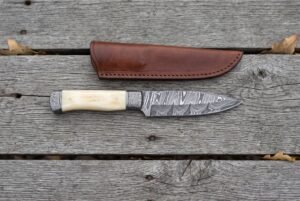 Sandspire Hand Forged Damascus Drop Point Hunting Knife with Camel Bone Handle and Damascus Bolsters & Leather Sheath | Compact Collector Gift | RK-535
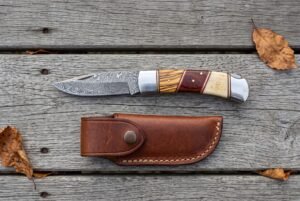 Bonebrass Hand Forged Damascus Folding Pocket Knife with Olive Wood Rosewood and Bone Handle and Brass and Red Fiber Spacers | Everyday Carry Gift | RK-1070-1
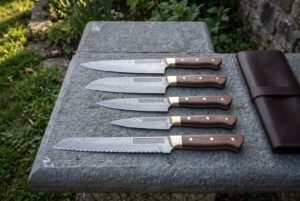 Hearthkeen Hand Forged Damascus Viking Chef Knife Set | 5 Piece Kitchen Roll | 1095 and 15N20 Blades with Walnut Handles and Brass Bolsters | Wedding Gift | RK-1778
8 thoughts on “The Steel Glossary: 1095, 15N20 and What Forge Welding Actually Is”
Comments are closed.