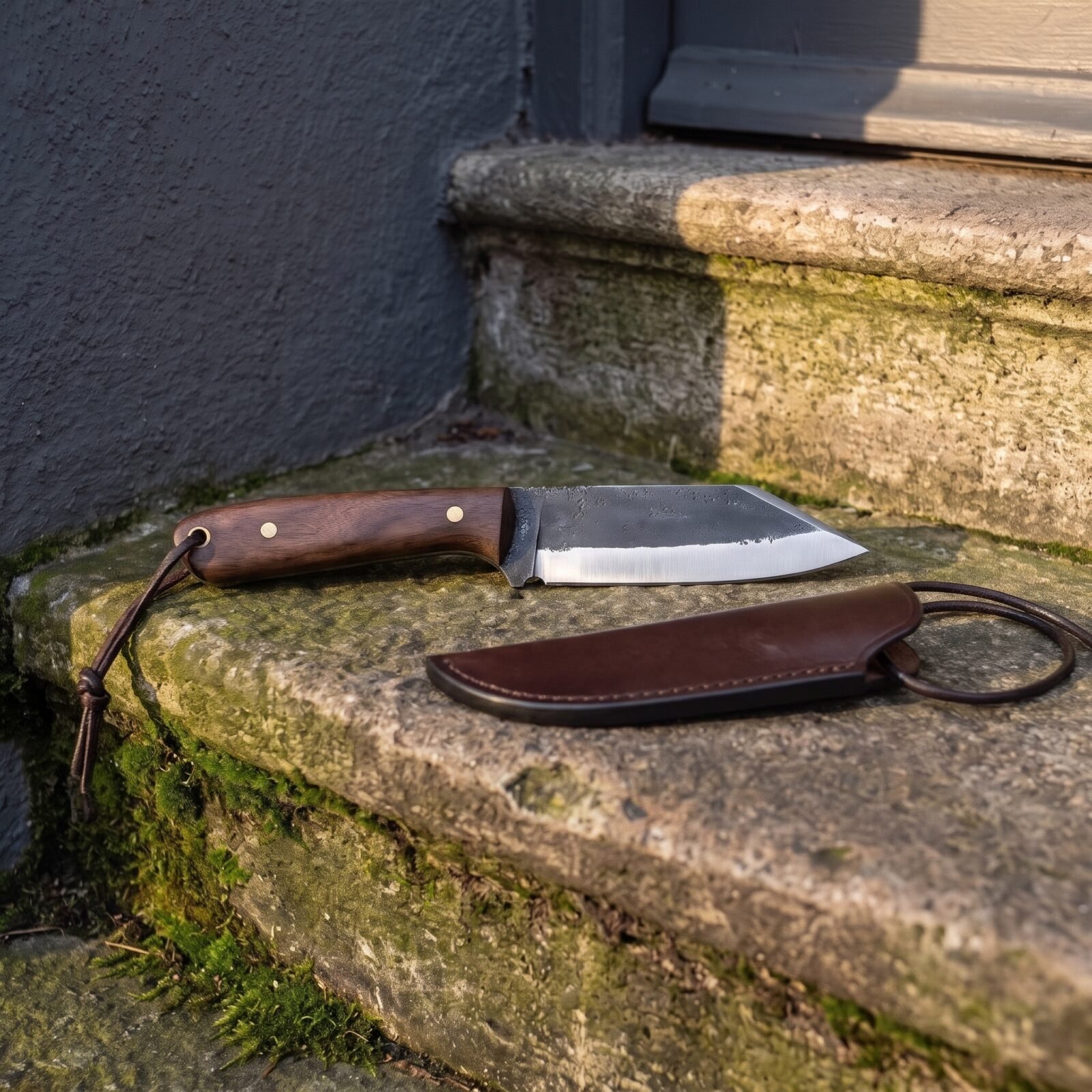
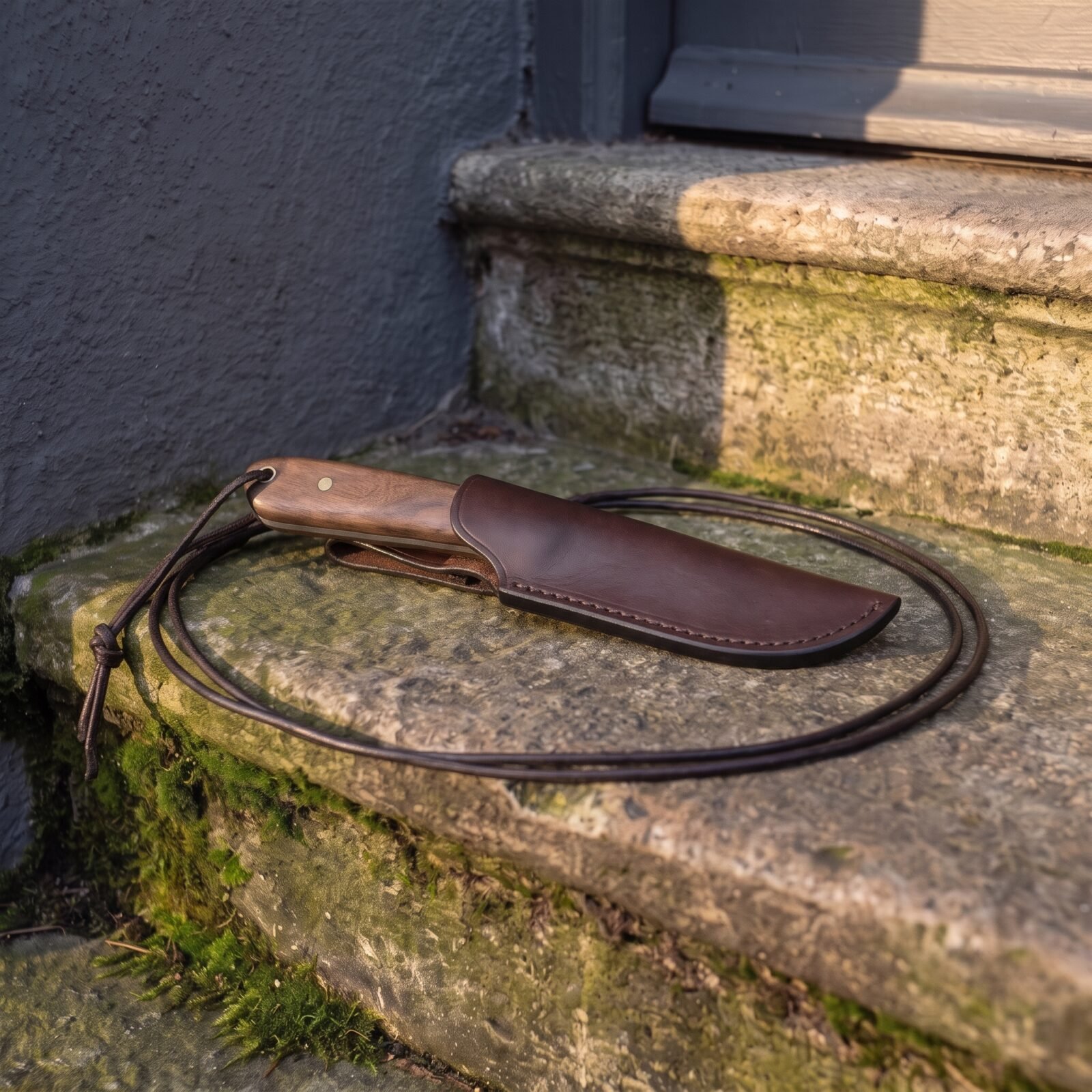
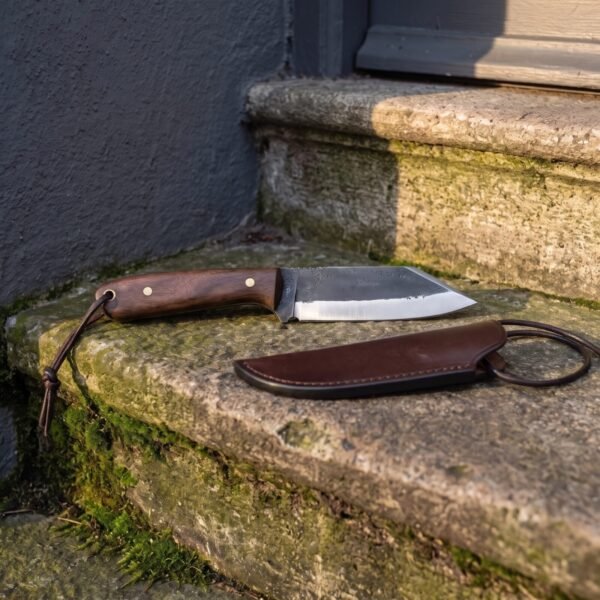
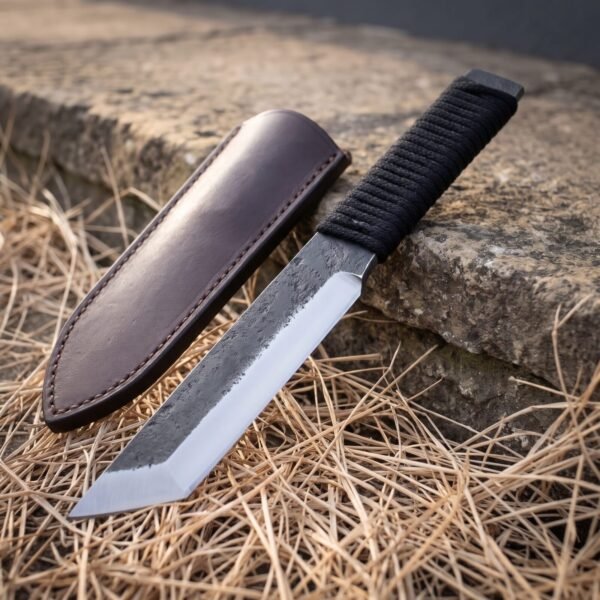
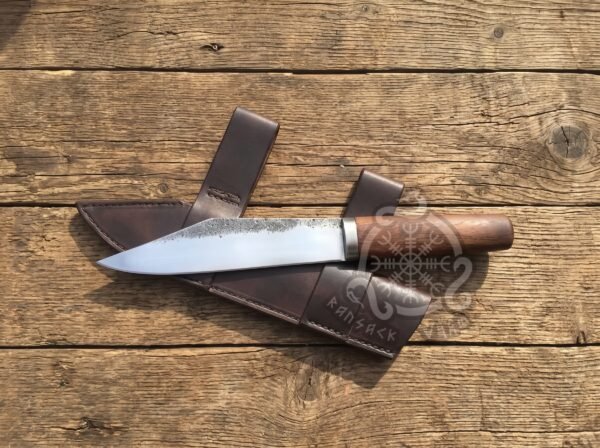
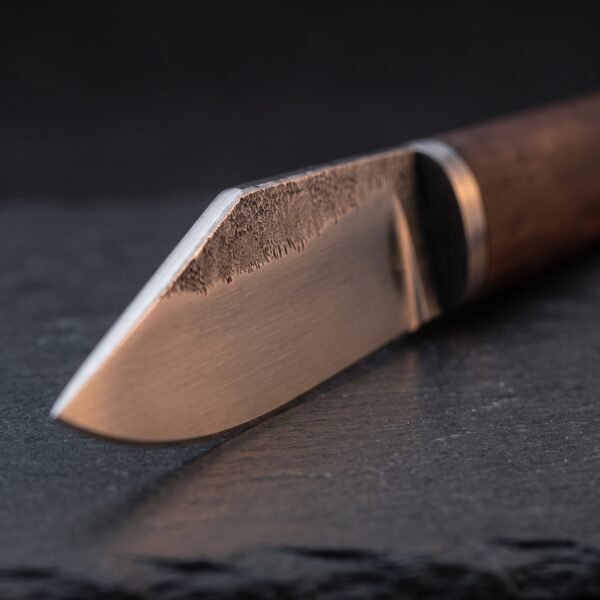
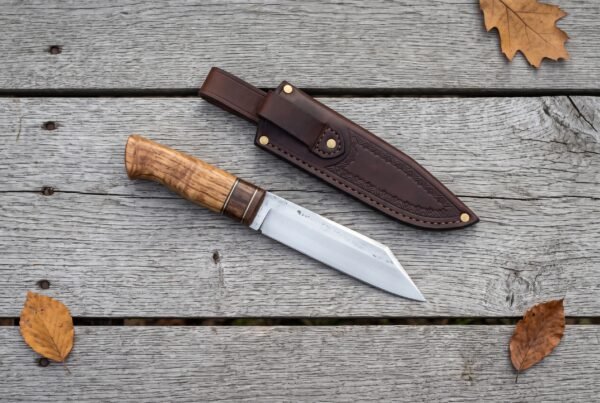
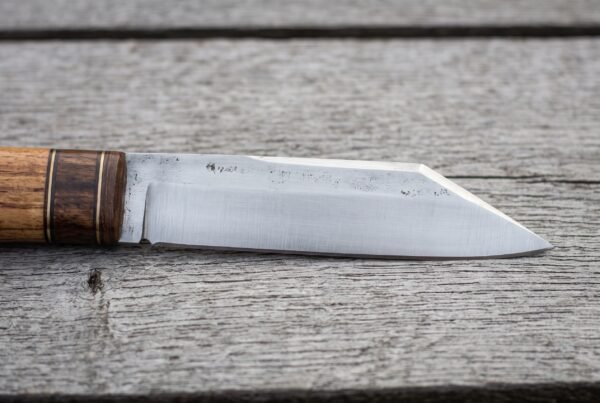
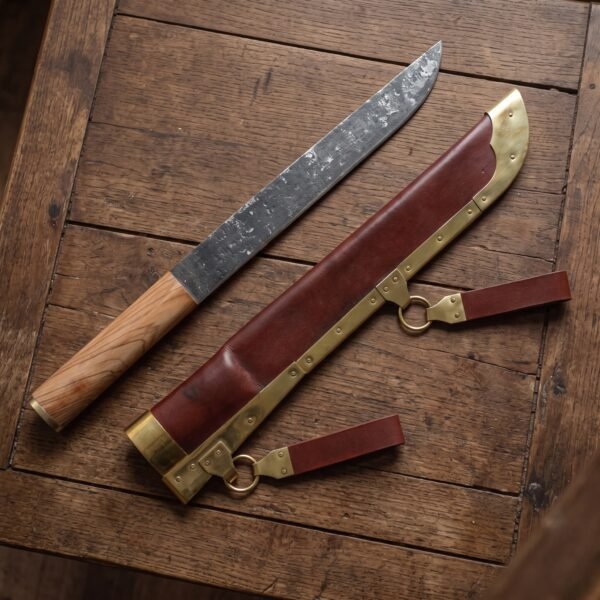
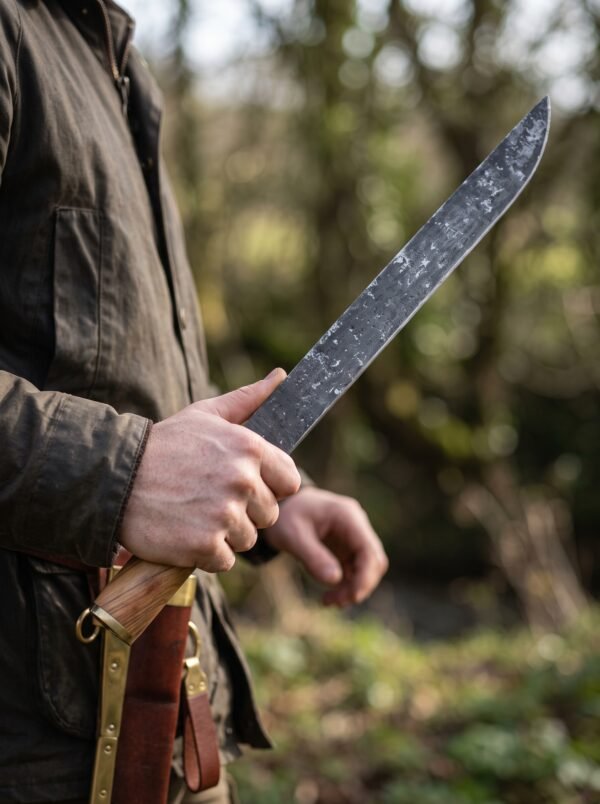
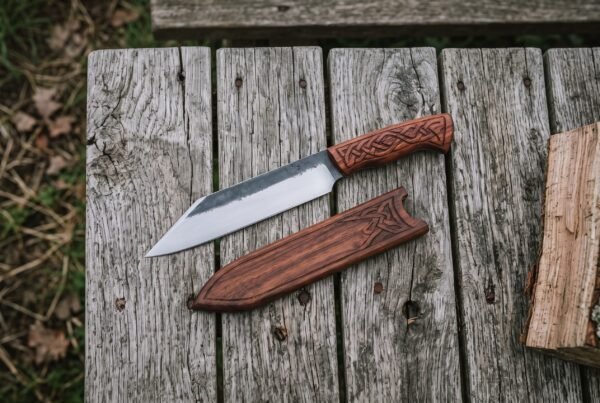
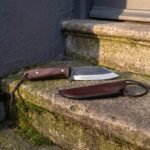
A small hand forged seax made to hang round your neck. It is about six inches overall with a blade of roughly two and three quarter inches, cut in the broken back shape of the Viking age seax: a straight spine that runs level and then breaks downward at an angle to meet the point. The flats keep a dark forged finish and the edge bevel is ground bright, so the line of the edge shows clearly. The handle is dark walnut over a full tang with two brass pins and a lanyard hole at the end. It comes in a fitted brown leather neck sheath with a leather cord.
The blade is 1095 high carbon steel, hardened to 54 to 58 HRC, and it arrives sharp. This is a working knife. It opens parcels, cuts cord, trims a fly line, slices an apple and does all the small jobs that come up in a day, and it does them from a place where you can always find it.
If you want to know where the shape comes from, the history of the Viking seax covers it, and seax vs bowie explains what the broken back does that a clip point does not. The larger seaxes are under Viking seax.
Specifications
| Blade steel | 1095 high carbon steel, hand forged |
|---|
| Hardness | 54 to 58 HRC |
|---|
| Overall length | Approximately 6 inches |
|---|
| Blade length | Approximately 2.75 inches |
|---|
| Blade | Broken back seax profile, dark forged flats, bright ground edge |
|---|
| Handle | Dark walnut scales, two brass pins, full tang, lanyard hole |
|---|
| Sheath | Brown leather neck sheath with leather cord, included |
|---|
| Edge | Sharpened, ready to use |
|---|
| SKU | RK-2386 |
|---|
Why carry a knife round your neck
A neck knife solves a simple problem. Belt knives get in the way when you sit, pocket knives get lost in the bottom of a bag, and both need two hands to open or draw. A small fixed blade on a cord sits flat against your chest under a shirt or over it, it is always in the same place, and you can draw it with one hand.
People who carry them tend to be people who use a knife a lot in small ways: anglers, hunters dressing small game, campers, gardeners, anyone opening boxes all day. Fixed blades are also easier to clean than folders and have nothing to work loose.
The idea of a small knife carried close to the body is not new either. Early medieval people in northern Europe routinely carried a small seax as an everyday tool, and smaller knives were often worn hung from the belt or on a cord. We would not claim that any Viking wore one exactly like this round his neck, but a small seax as a personal everyday knife sits well within the tradition.
The broken back shape on a small blade
The broken back profile has a practical reason behind it, and that reason works at any size. The spine runs straight and thick for most of the blade, then angles down to the point. That puts a strong, fairly acute point in line with your hand, good for piercing and fine work, while the long straight edge below it is easy to sharpen and good for push cuts and slicing.
On a two and three quarter inch blade the effect is a little knife that behaves like a bigger one. The point is controllable for detail work like opening a seam or scoring tape, and the straight edge pulls through cord cleanly. The thick spine also gives you somewhere to put your thumb or a finger for pressure, which on a small handle matters.
The flats are left dark from the forge because that finish resists rust better than bare polished steel and hides the scuffs that an everyday knife collects. The bright edge bevel shows you exactly where the sharp part is.
Handle and sheath
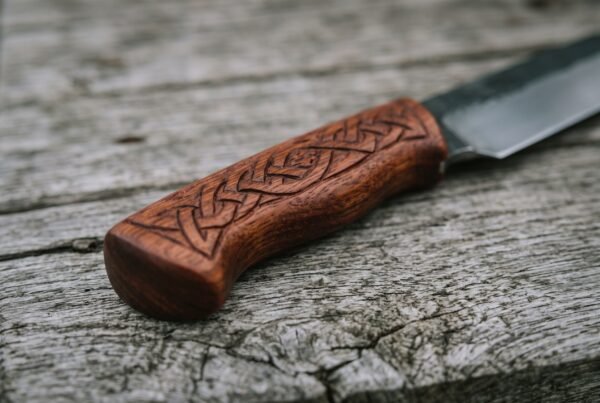
The handle is two slabs of dark walnut pinned through a full tang with brass pins. Full tang means the steel runs the whole length of the handle, so there is no weak joint between blade and handle. The handle is short, which is the nature of a neck knife, so it is shaped to sit in a three finger grip with your thumb on the spine. The lanyard hole at the end takes a short loop of cord if you want a better hold.
The sheath is brown leather, wet formed so the knife clicks in and stays there when it hangs upside down. That retention is the thing that matters most on a neck sheath, and we check every one. A leather cord runs through the sheath so it can be worn round the neck. Swap it for paracord or a ball chain with a breakaway clasp if you prefer. Many people do.
What it is good for
Most of what a neck knife does is boring, and that is the point of it. In a typical week this one might open a dozen boxes, cut the cable ties off a delivery, strip a bit of wire, trim a loose thread, cut twine in the garden, take the label off a new shirt and slice a sandwich in half on a hike. None of that needs a big knife. All of it is easier with a small sharp one that is already on you.
Outdoors it earns its keep in the same way. It will clean a trout, make feather sticks from dry kindling, cut a length of cord for a tarp and open a ration pack with cold fingers. It is not a chopping tool and it is not meant for batoning wood. Use a bigger knife or a hatchet for that and keep this one for the fine work it does well.
Because it hangs where you can see it, people ask about it. A small forged blade with a walnut handle starts more conversations than a pocket knife ever will.
Engraving, runes and your own design
Use the rune converter on this page to turn a name or a short phrase into Elder Futhark and we will cut it into the steel or the leather. Choose your own design in the engraving option above the add to cart button if you would rather have initials or a symbol. Where a piece already carries an engraved design, your chosen engraving replaces it rather than sitting alongside it. With a blade this small, a short line works best: initials or a single word on the flat, or a name on the sheath. More on the engraving page.
Using it safely
This knife arrives sharp. Draw it by pulling straight down out of the sheath with your other hand holding the sheath, not by yanking the cord. Cut away from yourself and keep your fingers behind the edge. Re-sheath it carefully, point first, and listen for the click.
Laws on carrying fixed blades differ from state to state and city to city, and some places restrict neck carry in particular. Check yours before you wear it in public. Knife laws by state is a starting point, though it is not legal advice.
Care
1095 is carbon steel and it will rust if it is put away wet. Worn close to the body it picks up sweat, so wipe the blade dry after use and give it a thin coat of oil now and then. Food safe mineral oil is a good choice if you cut food with it.
Over time the blade will develop a grey patina where it is used. That is normal and it protects the steel. Orange spots are rust and should be rubbed off with a little oil on fine steel wool.
Touch up the edge on a fine whetstone or a ceramic rod when it stops biting. A small blade like this is quick to sharpen. Sharpen a knife with a whetstone walks through it, and the walnut likes a drop of oil once in a while. The knife care guide covers the rest.
Made in the Czech Republic
This knife is made by hand in the Czech Republic. The blade is forged, ground and heat treated in the workshop, the handle is fitted and shaped by hand and the sheath is formed to the knife. Every one is checked for sharpness and sheath retention before it is boxed. It ships from our Chicago, Illinois warehouse. Processing takes one to two weeks, and engraved orders sit at the longer end because the layout is agreed with you first. Shipping inside the United States is free. Returns are accepted for seven days. The lifetime warranty against defects in forging, grind, heat treat and fittings has no end date and needs no receipt.
A note on handmade variation
This knife is made by hand, not machine made or bulk produced, so what arrives will not be a pixel for pixel copy of the photograph. The forged texture on the flats differs on every blade. Walnut grain varies from dark and straight to lighter and figured. The sheath leather shades from tan to chocolate between batches. The size, the steel and the build are the same every time.
Frequently asked questions
Is it sharp?
Yes, it arrives sharpened and ready to use.
Will it fall out of the sheath upside down?
No. The sheath is wet formed to hold the knife by friction, and we check every one hanging upside down before it is packed.
Can I wear it on a belt instead?
It is made for neck carry, but the cord can be tied to a belt loop or a pack strap.
Is it a real seax?
It is a small knife in the seax shape. Historical seaxes ran from small knives like this up to long blades nearly the length of a sword.
Is it a good gift?
It is one of our most practical small gifts, especially with initials on the sheath.
How is it shipped?
Free within the United States from Chicago, Illinois, with tracking sent when it is packed.
What is in the box
- One hand forged 1095 high carbon steel neck seax, approximately 6 inches overall
- Brown leather neck sheath with leather cord
- Engraving where ordered
- Care card for the steel, the walnut and the leather
Explore the range
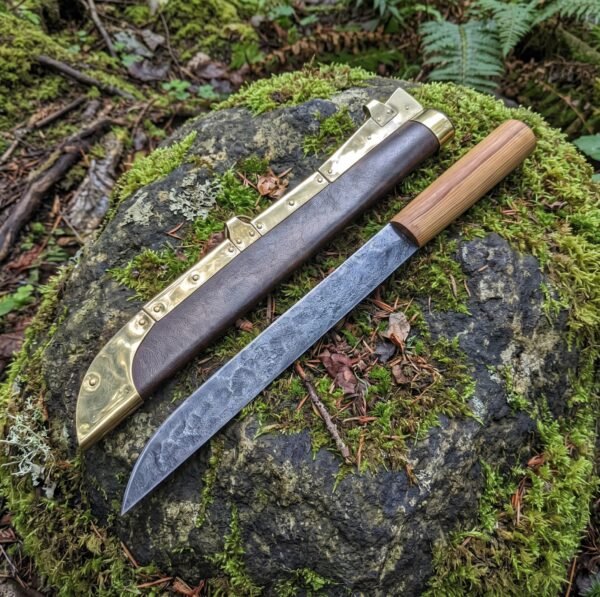
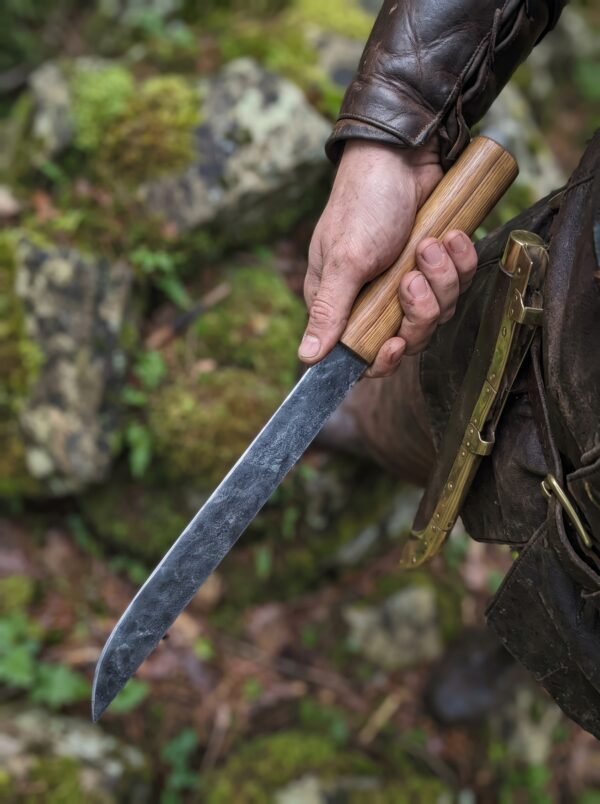
See the rest of the Viking seax range, the wider Viking knives and our custom seax page if you want one made to your own drawing. How to choose a Viking knife helps if you are deciding between sizes.
Close to this one
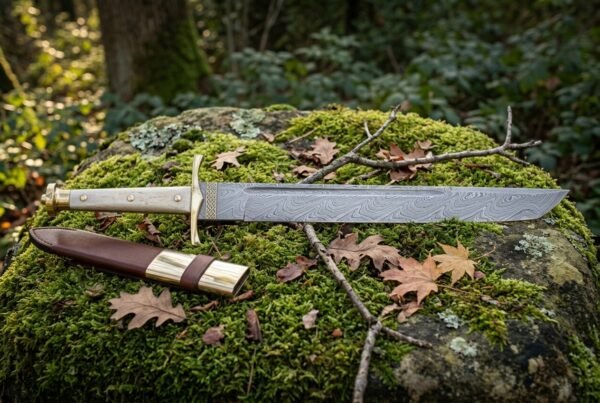
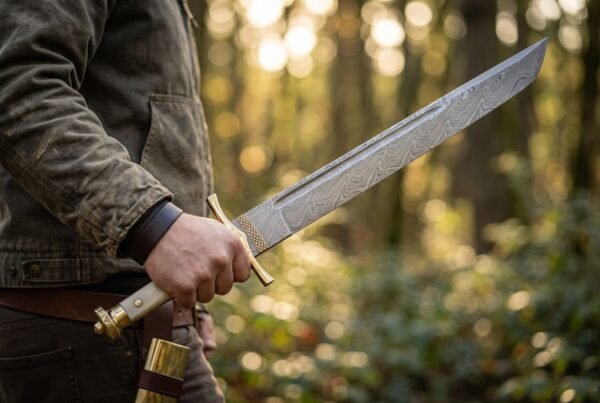
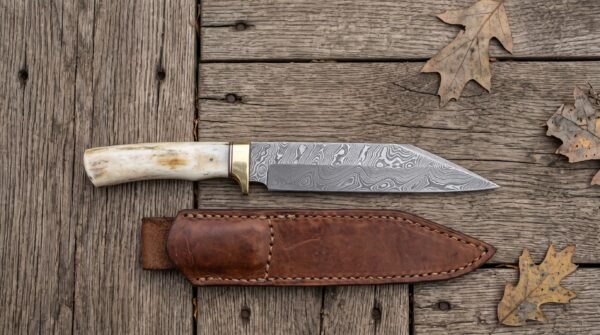
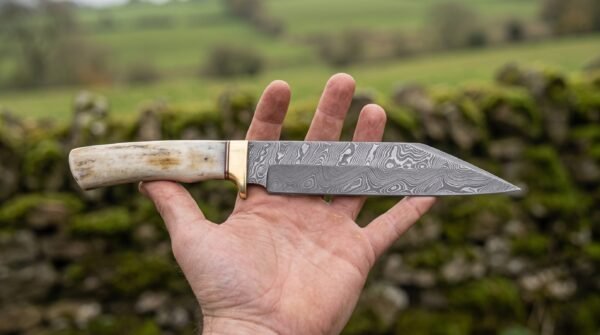
For a full size belt seax in Damascus with a horn handle, see the Hornsax broken back seax. For the long fighting version, there is the Broadsax langseax.
Reviews
There are no reviews yet