
Blog
Battle Axe vs Bearded Axe: Which One Do You Want?

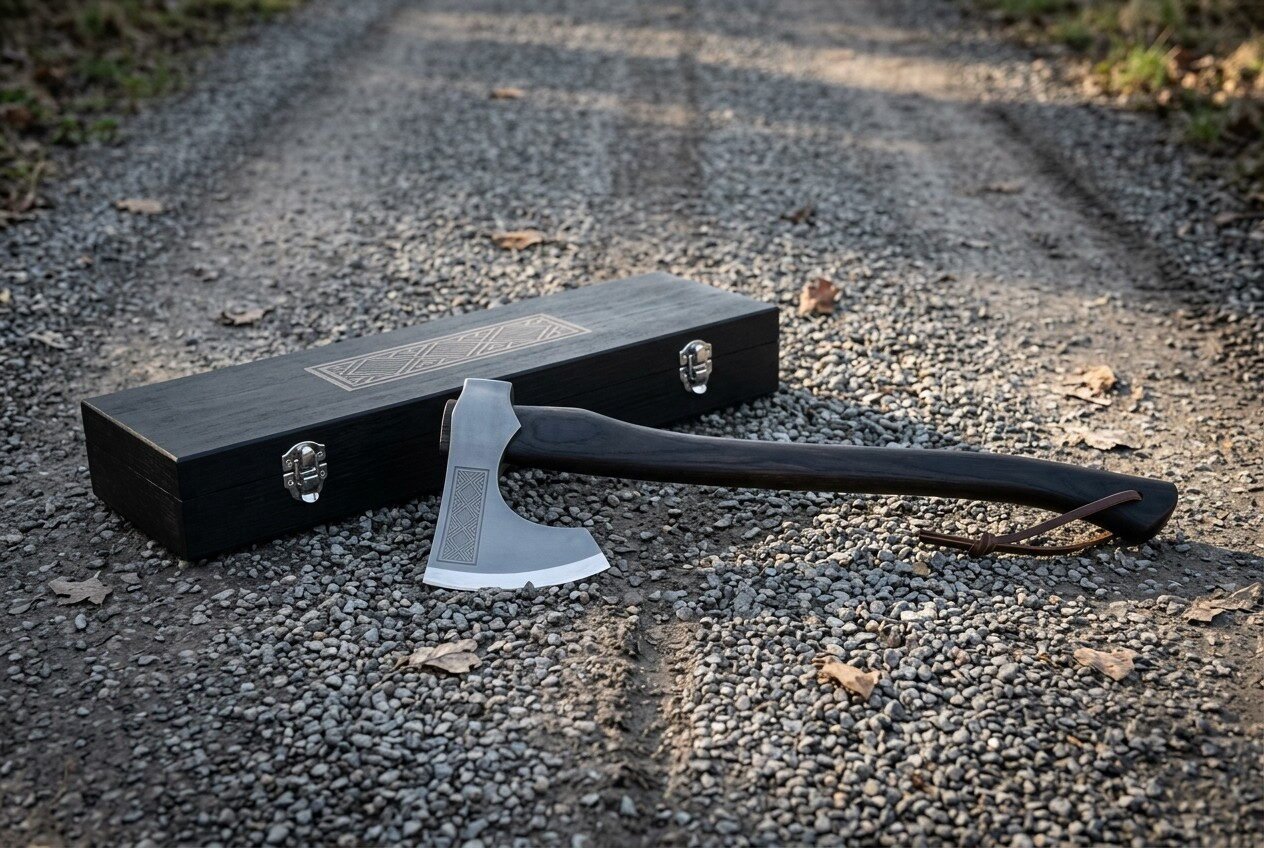
Buy a bearded axe if you want one axe you will actually pick up and use. The beard gives you a long cutting edge on a light head, and the hollow behind it lets you grip right under the steel for close work. Buy a battle axe if you are honest that it is going on a wall, into a reenactment kit or to someone as a gift.
That answer needs a caveat, because the two names do not describe the same kind of thing. A bearded axe is a head shape. A battle axe is a job. Plenty of historical fighting axes were bearded, and plenty of bearded axes spent their whole lives on firewood. When a shop lists both, it is telling you that one group is shaped for cutting control and the other is hafted for reach and impact.
The short comparison
| Bearded axe | Battle axe | |
|---|---|---|
| What the name means | A head shape. The blade hangs below the eye | A role. A head and haft built for fighting rather than firewood |
| Typical haft | Around 15 to 24 inches, one hand | Anywhere from 24 inches to over 30 inches, often two hands |
| Head weight feel | Light for the length of edge you get | Heavier, or lighter but on a long lever |
| Best at | Carving, splitting kindling, camp work, close control | Reach, presence on a wall, drill and reenactment lines |
| Weak at | Reach, and the heel can catch on a bad swing | Fine work, packing, using in a tight space |
| Choke grip behind the edge | Yes, that is the point of the beard | Usually not |
| Who it suits | Campers, carvers, anyone who wants a working axe | Collectors, reenactors, gift buyers |
What a bearded axe is
Look at the head side on. The edge starts high at the toe, sweeps down and back toward the handle, and finishes at a heel that sits below the eye. That drop is the beard, and the gap it leaves between the blade and the haft is where your hand goes when you want control instead of power. Norse smiths used the shape for centuries because it buys edge length without buying head weight.
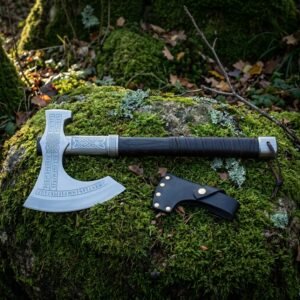 Frostrune Hand Forged High Carbon Steel Norse Runic Bearded War Axe | 24 Inch Overall with 10 Inch Cutting Edge | Norse Battle Collector Gift | RK-1220
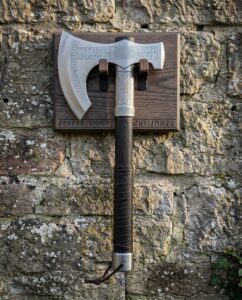 Hallwarden Hand Forged High Carbon Steel Norse Runic Bearded Axe with Rune Carved Wall Mount | Dark Leather Wrapped Ash Haft | Norse Battle Collector Gift | RK-1222
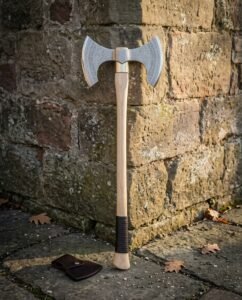 Twinbite Hand Forged High Carbon Steel Double Headed Axe | 28 Inch Overall with 6 Inch Edges | Light Wood Haft and Dark Leather Wrapped Grip | Norse Battle Collector Gift | RK-1215
Steel is expensive to make by hand, so a head that puts steel only where it works costs less to forge and swings lighter. The beard was thrift as much as design. For the longer story of where the shape came from, our guide to what a bearded axe actually is covers that ground properly.
What a bearded axe does well
Control. Slide your hand up into the hollow behind the beard and the axe becomes a very large knife. You can shave a tent peg, point a stake, take bark off a log or trim a shingle without swinging at all. No other axe shape gives you that grip without your knuckles hitting steel.
Bite. The long edge takes a wide slice out of soft wood and the light head means you can keep swinging past the point where a heavier axe would have worn you out. On kindling and small rounds a bearded head is quicker than its weight suggests.
Hooking. The dropped heel catches. Farmers used it to drag brush down and it still works for that. In reenactment the same heel is what hooks a shield rim, which is part of why the shape stayed in use long after it stopped being purely a tool.
What a bearded axe does badly
Reach, mainly. A one handed haft puts you close to whatever you are cutting, and if you want to fell anything thicker than your arm you will be there a while. A bearded head is not a splitting head either. The thin profile that makes it cut well makes it stick in seasoned rounds instead of popping them apart, and levering a stuck thin blade sideways is how beards get chipped.
What a battle axe is
A battle axe is defined by what it was for, not by an outline. The group covers broad crescent heads on long hafts, compact heads with a hammer poll or a spike opposite the bit, and double headed pieces. The common thread is that nothing about the piece is compromised for chores. The bit can be thinner because it never has to survive a knotty log, and the haft can be longer because nobody has to carry it up a hill in a pack.
Our battle axes sit in that group, and the broader Viking axes category mixes both families if you want to see them side by side. For the history of how these grew out of farm tools and ended up in the hands of huscarls, the Viking axe history post is the place to start.
What a battle axe does well
Presence. This is not a soft reason, whatever the purists say. A 32 inch haft with a broad head reads across a room in a way a 16 inch camp axe never will. If the piece is going above a fireplace or onto a stand, the long axe wins on sight alone.
Reach and leverage. Two hands on a long haft move a lot of energy for little effort, which is why the Dane axe pattern outlived the Viking Age in Norman and Byzantine service.
What a battle axe does badly
Everything domestic. It does not pack and it is awkward in a tight camp. You cannot choke up on it, so fine work is out, and a thin fighting bit will wedge in a round and stay wedged.
There is a storage problem too, which nobody mentions until it is leaning in their hallway. A long haft needs somewhere to live, and hung flat it needs two hooks and a clear stretch of wall.
Where the two overlap
A lot of the pieces people call battle axes are bearded. The Norse fighting axe of the ninth and tenth centuries was usually a compact bearded head on a haft of two feet or less, carried by a man who used the same axe for splitting wood on the way. So if you buy a bearded axe you have often bought a battle axe pattern, and the label a shop uses is about intent rather than ancestry.
The useful question is not which name is on the listing. It is how long the haft is and how thick the bit is behind the edge. A short haft with a thickish bit means a tool you can work with. A long haft with a thin bit means a piece built to look and handle like a fighting axe.
Choosing by what you will do with it
Display
Go long and go broad. A Dane style head on a 32 inch or longer haft fills a wall and shows off any etching or engraving on the head, because there is more flat steel to look at. Damascus pattern reads better at distance than a plain head, and a leather edge cover keeps the bit safe and looks right hanging beneath it.
Reenactment
Check your group’s rules before anything else, because most have limits on edge geometry and some ban steel langets or spiked polls. Beyond that, a one handed bearded head with a shield is the standard Viking Age impression and the easiest kit to build around. A long axe is a specialist impression and needs the space to use it.
Camp and bushcraft
Bearded, short haft, and do not go over about two pounds in the head. You want something that rides on a pack, splits kindling, points stakes and does not tire your shoulder in an hour. The choke grip is worth more in camp than in any other setting. Pair it with a fixed blade and you have the whole camp covered.
Around the house
If the real job is feeding a wood burner, buy a proper splitting head for volume and keep the bearded axe for the pleasure of using it.
Gifts
Long axes give better. A big head with engraved knotwork, a leather cover and a wooden case makes an event out of the unboxing, and the recipient needs no axe skill whatsoever to enjoy it. If you know the person actually chops wood, reverse that and get the bearded working axe, because they will notice the difference in the hand.
Steel, and what it actually changes
Every axe head here starts as one of two steels. Plain 1095 is a simple high carbon steel, hardened here to 54 to 58 HRC. It is tough, it forgives a knock, it sharpens on a stone in a few minutes and it is the sensible choice for a head that will meet wood, dirt and the occasional stone. Damascus is 1095 and 15N20 forge welded together and finished at 58 to 60 HRC. Those two steels are near identical in carbon; 15N20 carries nickel, which is what etches bright and gives the pattern. It holds an edge slightly longer and it looks like nothing else.
Neither one is magic. A Damascus axe is a high carbon axe with a pattern on it, priced for the welding and the finishing. Both rust if you leave them wet, and both come back with oil and a stone. If you want the full picture on what pattern welded steel is and is not, read what Damascus steel actually is, and keep the care guide handy for the first month of ownership.
Buy this one if
Buy a bearded axe if you camp, carve, split kindling, want one axe that does most things, want to be able to choke up behind the edge, or want the shape that actually reads as Norse to anyone who knows axes.
Buy a battle axe if the piece is going on a wall or a stand, you want the reach and the presence of a two handed haft, you are building a reenactment impression that calls for a long axe, or you are buying a gift and the moment of opening it matters more than the hours of use after.
Buy both if you already own a working axe. Most people who end up with a wall of axes started with a bearded one, used it, then bought a long axe to look at. That order works better than the reverse.
What we stock
Our bearded axes run mostly one handed with hafts in ash and hardwood, in plain 1095 and in Damascus, with leather edge covers on most heads. The battle axes group holds the longer hafts, the double headed pieces and the war hammers. If you would rather browse by shape than by role, the bearded axe tag pulls every bearded head across both groups into one page. Every piece is handmade in the Czech Republic the old way, then imported, inspected and shipped from Chicago, Illinois, and any engraving is done in the US after arrival. If you are still weighing shapes, the best Viking axes roundup goes through specific patterns.
Whichever way that comparison falls, the practical decisions are the same, and they are set out in our guide to picking an axe. The single most requested head on the site has its own page in the Ragnar Lothbrok axe.
Questions people ask
Is a bearded axe a battle axe?
It can be. Bearded is a head shape and battle axe is a job, so the two overlap constantly. Most Norse fighting axes of the ninth and tenth centuries were bearded heads on short hafts. When a shop separates the two categories it is usually splitting working axes from longer hafted pieces built for reach and display.
Which one is better for splitting firewood?
Neither, honestly. A bearded head is thin behind the edge and will wedge in seasoned rounds, and a fighting bit is thinner still. A bearded axe handles kindling and small green wood fine. For a winter of splitting you want a dedicated splitting head with a fat wedge profile and no romance about it.
How long should the haft be?
For a one handed working axe, 15 to 24 inches covers almost everyone. Shorter gives control for carving, longer gives more bite per swing. Two handed pieces start around 30 inches and run past 40 on the largest Dane patterns. Match it to your reach and to the space you have.
Does Damascus cut better than plain 1095?
Barely, and not in a way you would notice on an axe. Damascus here is 1095 and 15N20 forge welded at 58 to 60 HRC, so it holds an edge slightly longer than plain 1095 at 54 to 58 HRC. Plain 1095 is tougher against knocks and cheaper. You are paying for the pattern and the labour, and that is fine.
Can I throw a bearded axe?
Only if it was sold for throwing. Decorated heads, engraved panels and Damascus pattern all sit on pieces meant to be looked at and used carefully, and repeated impact into a target board loosens heads and chips thin edges. Buy a plain throwing axe for that and let the good one keep its edges.
Where are your axes made?
Ransack Viking is a US company in Chicago, Illinois. Every piece is handmade in the Czech Republic the old way, then imported, inspected and shipped from Chicago. Engraving is done in the US after arrival, so a personalised axe is finished here before it goes out to you.
Things you can actually hold
Closest to this in the shop, the Hammerpoll Viking axe and the Ashwarden Viking battle axe. Alongside them, the Grainwhorl bearded axe and the Gleambeard bearded axe.
Shop the range
Frostrune Hand Forged High Carbon Steel Norse Runic Bearded War Axe | 24 Inch Overall with 10 Inch Cutting Edge | Norse Battle Collector Gift | RK-1220Hallwarden Hand Forged High Carbon Steel Norse Runic Bearded Axe with Rune Carved Wall Mount | Dark Leather Wrapped Ash Haft | Norse Battle Collector Gift | RK-1222Twinbite Hand Forged High Carbon Steel Double Headed Axe | 28 Inch Overall with 6 Inch Edges | Light Wood Haft and Dark Leather Wrapped Grip | Norse Battle Collector Gift | RK-1215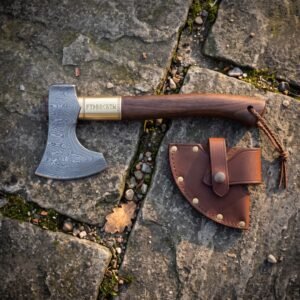 Runehewn Hand Forged 1095 and 15N20 Damascus Viking Bearded Axe | 16 Inch Walnut Haft | Brass Rune Collar and Leather Head Sheath | Norse Reenactment Gift | RK-1500
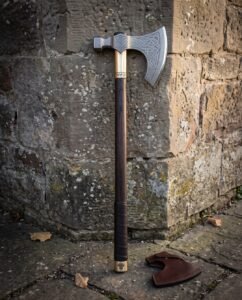 Knotbeard Hand Forged Carbon Steel Long Hafted Viking Bearded Axe | Long Haft Bearded Head | Etched Knotwork Brass Collar and Leather Mask | Norse Gift | RK-1537
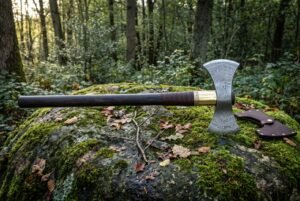 Twinbite Hand Forged Damascus Steel Double Bit Axe | 30 Inch Hardwood Haft | Damascus Head with Rune Engraved Brass Collar and Leather Sheath | Woodland Camp Gift | RK-1576
One thought on “Battle Axe vs Bearded Axe: Which One Do You Want?”
Comments are closed.