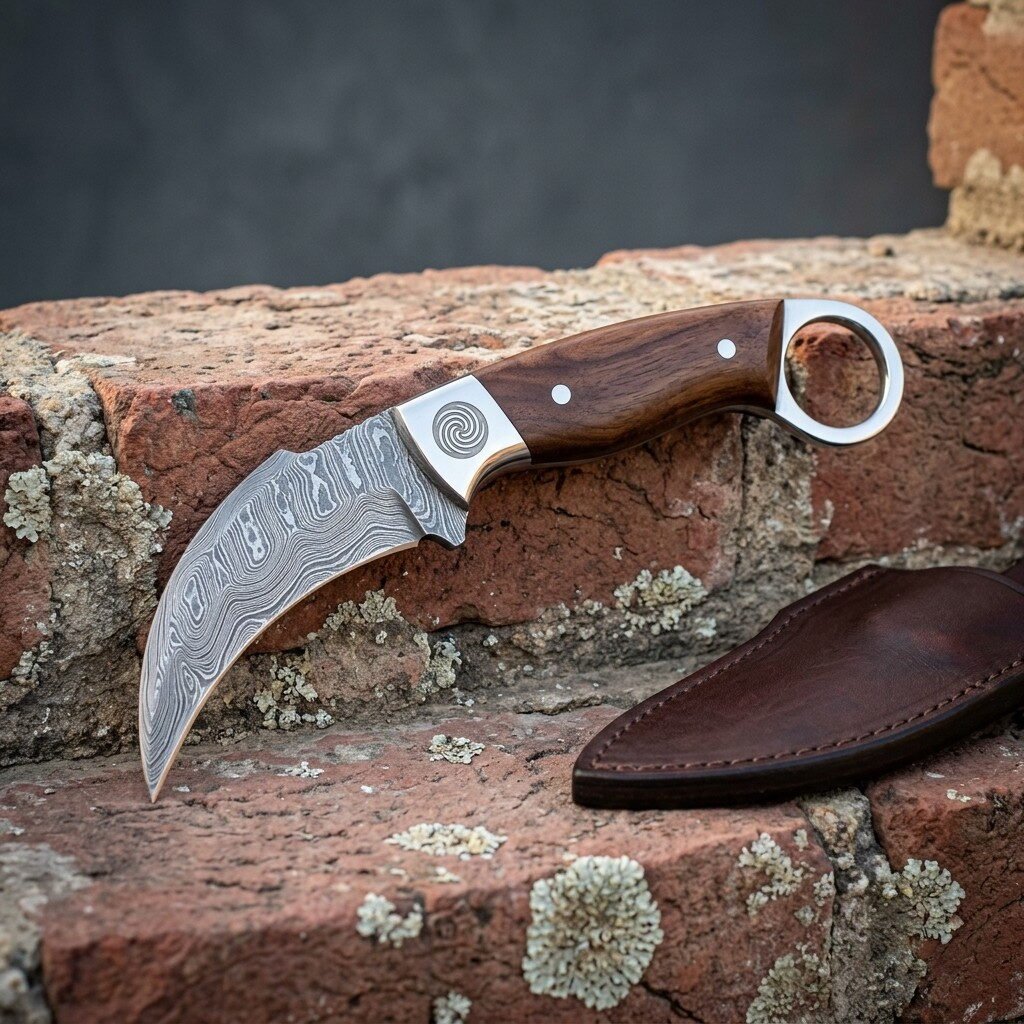
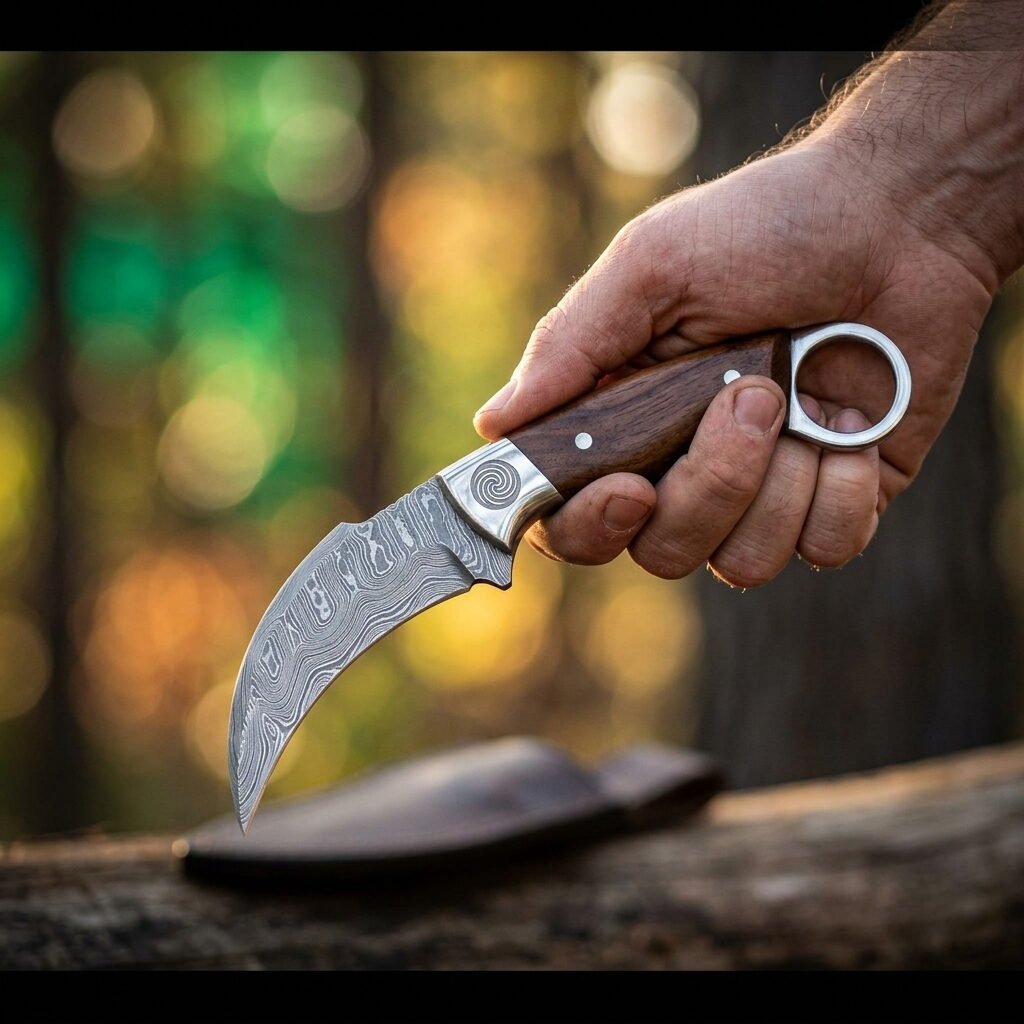
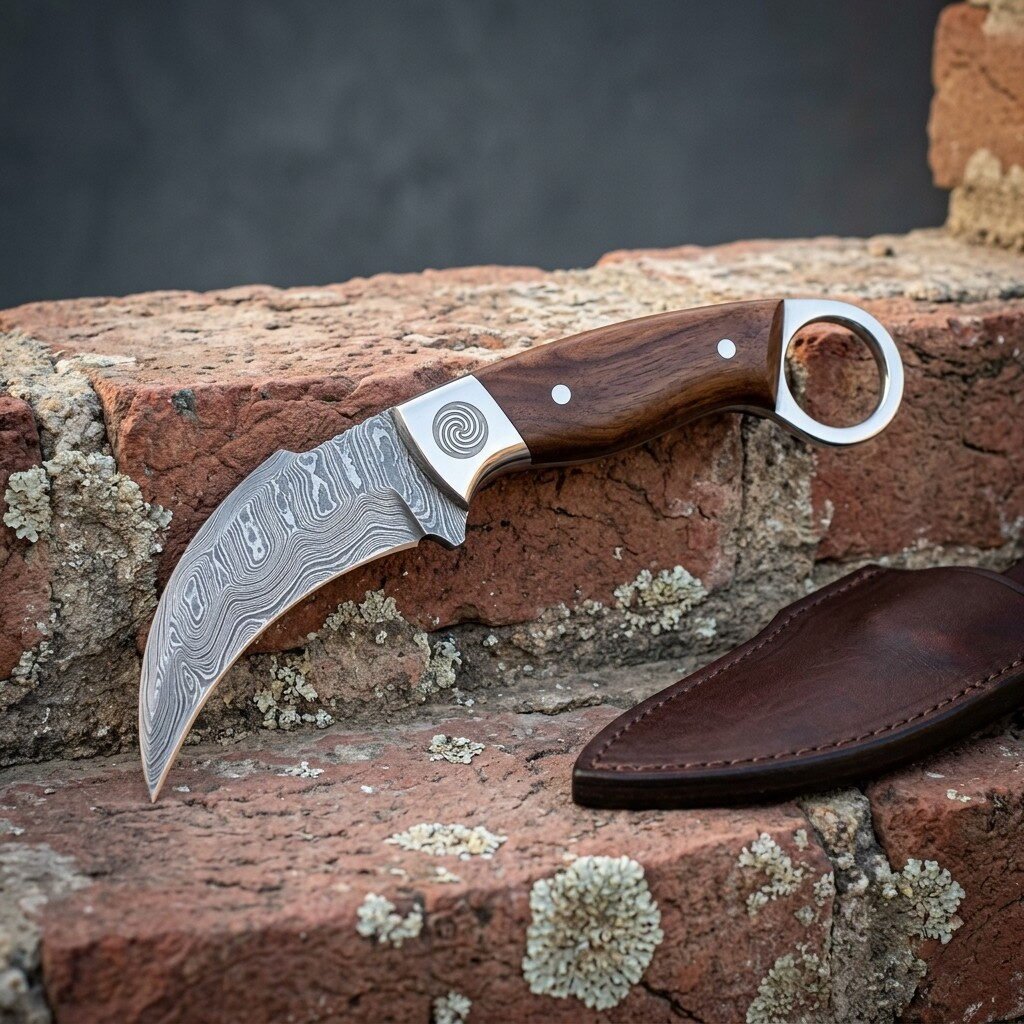
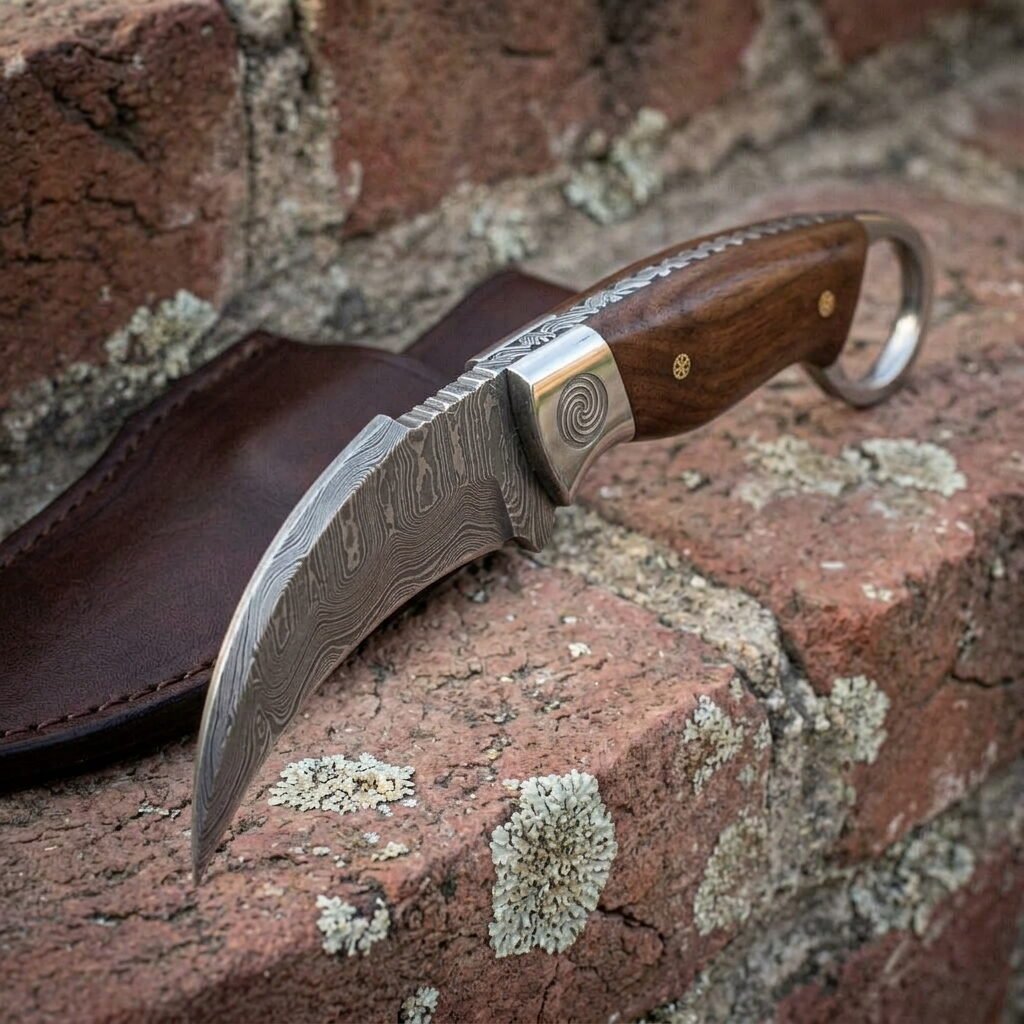
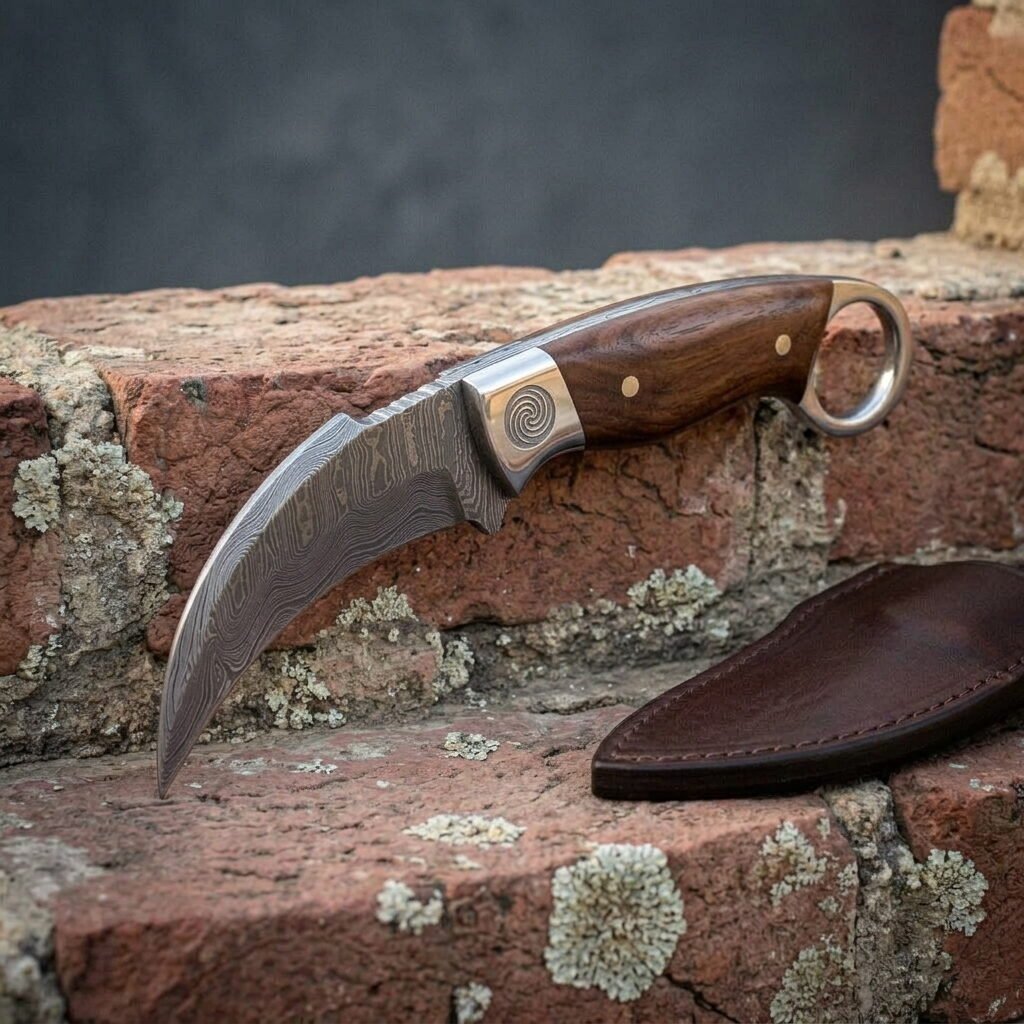
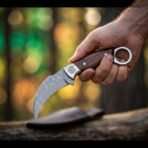
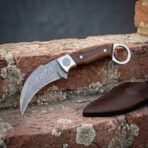
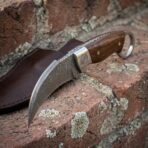
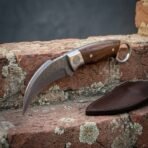
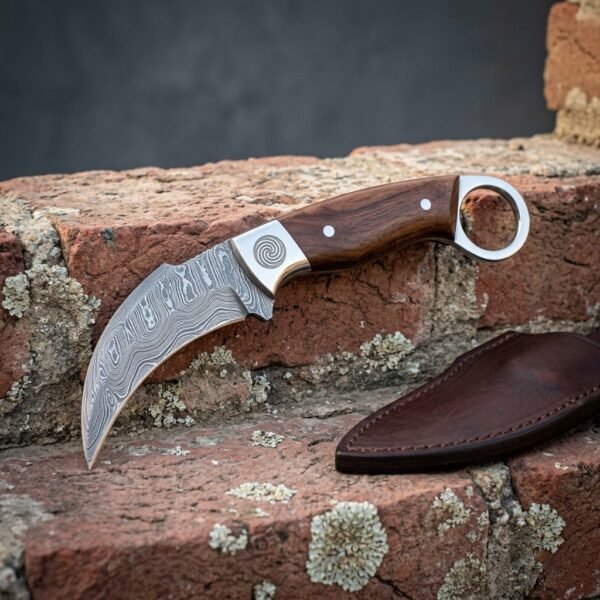
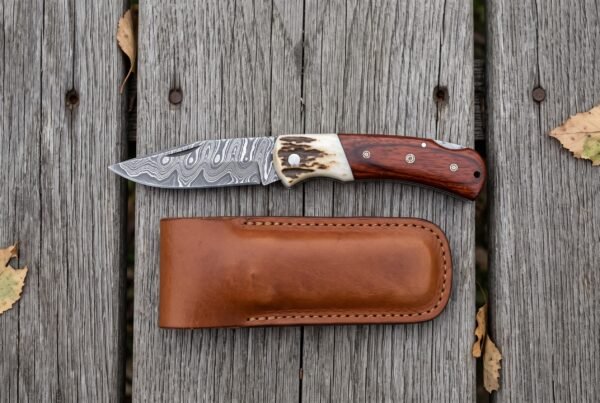
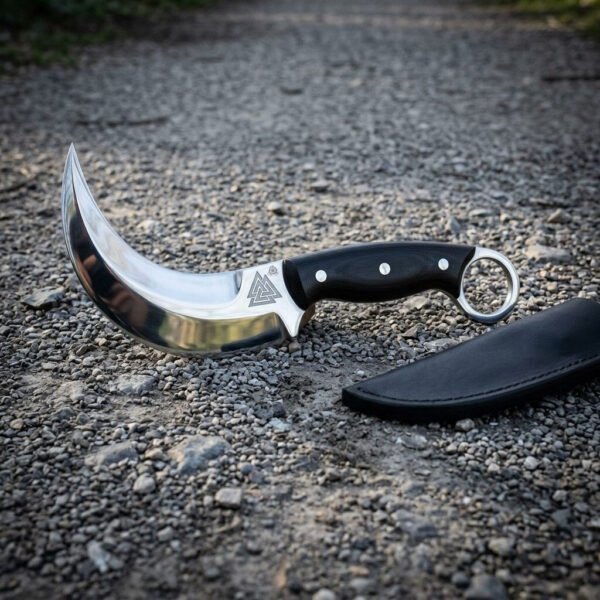
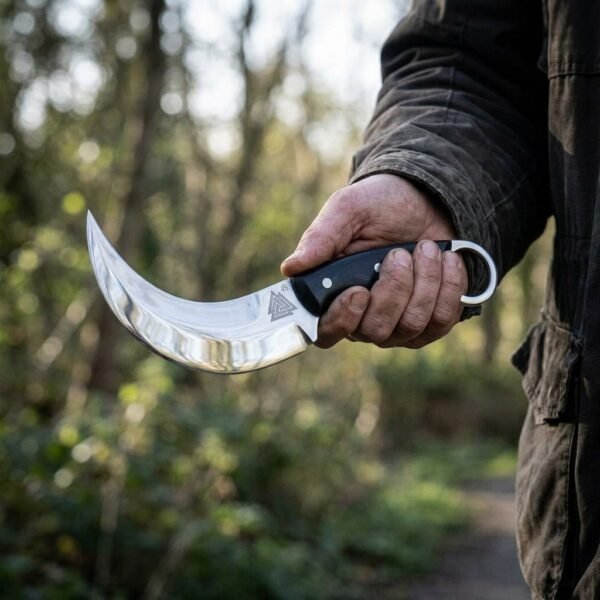
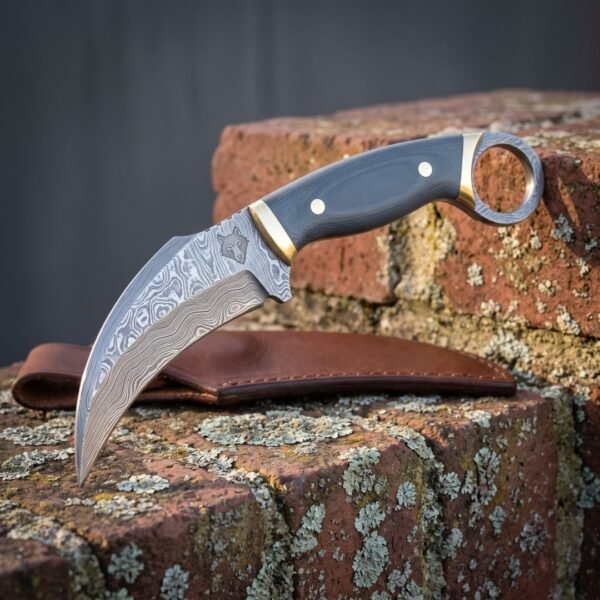
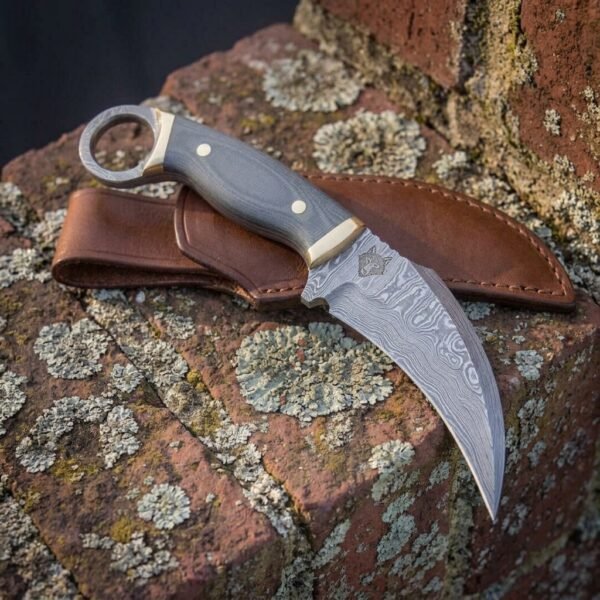
Clawfold is a karambit forged from 1095 and 15N20 Damascus. The blade is a deep hawkbill curve with the pattern running the full length of it in tight rolling waves, the bolster is polished steel engraved with a spiral, the scales are rosewood pinned through with steel, and the butt carries a polished steel finger ring. A brown leather sheath is included. It is a small knife that draws attention out of all proportion to its size, mostly because of the ring.
The karambit came out of the farming villages of the Malay archipelago and it began as an agricultural tool. The curve is a copy of a tiger claw, and the original job was raking through root crops and slicing plant stems close to the ground where a straight blade cannot reach. The ring was there so a working hand could let go of the knife entirely to grab something and still not drop it. Everything else the shape is now known for came later. Clawfold is forged, ground, heat treated, handled and sheathed by hand in the Czech Republic.
The ring on the pommel is not decoration, and what a karambit is for explains the grip it was built around. The pattern is real forge welding rather than a print, and five checks before you buy shows you how to tell. The throwing knives are the other side of the same rack.
Specifications
| Blade material | 1095 and 15N20 Damascus, hardened to 58 to 60 HRC |
|---|
| Overall length | 8 inches |
|---|
| Blade length | 3 and a half inches measured along the curve |
|---|
| Blade profile | Hawkbill curve, single edged on the inside of the curve |
|---|
| Pattern | Rolling wave Damascus, acid etched to bring up the contrast |
|---|
| Handle | Rosewood scales |
|---|
| Pins | Two steel pins through the scales |
|---|
| Bolster | One polished steel bolster engraved with a spiral |
|---|
| Finger ring | Polished steel, integral to the tang |
|---|
| Weight | Approximately 6 oz |
|---|
| Sheath | Dark brown stitched leather sheath |
|---|
| SKU | RK-1902 |
|---|
What the ring is actually for
The ring is the part everyone asks about and the part most often explained wrongly. It is not a spinning handle. Its original and still its best function is retention. Slide the index finger through it and the knife is physically attached to your hand, so you can open a hand fully, carry something, climb, or take a knock without losing the blade. That mattered enormously to someone working in a field. The second function is leverage. With a finger through the ring, the knife pivots around that finger, and a pulling cut generates far more force than the same grip on a straight handle because your whole forearm is behind it rather than just your grip strength. The third is that the ring stops the hand sliding forward onto the edge in a reverse grip, which is the way a karambit is usually held.
1095 and 15N20 Damascus
The pattern is not printed or etched onto a plain blade. Alternating layers of 1095 and 15N20 are forge welded into a billet, drawn out, cut, folded and welded again until the layer count is high, then the finished blade is etched in acid. 1095 has high carbon and darkens in the acid. 15N20 carries about two percent nickel and resists it, staying bright. Every line you can see is the edge of a real layer running through the thickness of the blade, which is why the pattern changes as you sharpen into it rather than wearing off. We temper to 58 to 60 HRC, which is high, because a three and a half inch curved blade is short, well supported along its whole length, and used for pulling cuts rather than prying.
Engraving, runes and your own design
Use the rune converter on this page to turn a name, a date or a short phrase into Elder Futhark and we will cut it into the steel, the leather or the wood. If you would rather have a Viking pattern than a rune line, choose your own design in the engraving option above the add to cart button and tell us where it goes. Where a piece already carries an engraved design, your chosen engraving replaces it rather than sitting alongside it. On Clawfold the engraved surface is the polished bolster where the spiral sits, and it is small, so a short set of initials or a two or three character rune group works far better than a phrase. The sheath face takes a longer line if you need one. See the engraving page.
Handling and grip
A karambit is held in reverse grip most of the time, with the index finger through the ring and the edge facing back toward you, and it cuts on the pull. Held forward, with the ring behind the little finger, it becomes a hooking utility blade for opening boxes, cutting cord and stripping. Either way the ring means the knife cannot be dropped. It is a genuinely sharp tool with an aggressive geometry. Take the sheath off carefully and do not attempt the spinning tricks the internet is full of, because the edge is on the inside of the curve and it is unforgiving of a fumble.
Care
Damascus is high carbon steel and it will rust, and on a Damascus blade rust does something specific. It attacks the dark 1095 layers first and blotches the pattern. Dry the blade after any contact with moisture, wipe off fingerprints, and keep a very light film of oil on it. Do not use an abrasive polish or a scouring pad, because either will cut through the etch and flatten the pattern into grey. If the contrast ever dulls, we can re etch it under the warranty. The rosewood scales want a wipe of oil once or twice a year. Full instructions are in our guide to steel care.
Damascus wants oil more than plain steel does, because the etch that shows the pattern also opens the surface, and caring for a Damascus pattern covers what to use.
Made in the Czech Republic
This piece is made by hand in the Czech Republic, in a workshop that still works the old way. The steel is forged, ground, heat treated and finished by smiths who learned the trade from the people before them, and the wood, horn and leather are cut and fitted by hand rather than pressed out on a line. That is also why no two pieces come out exactly the same.
Ransack Viking is a United States company. We import these pieces ourselves, check every one when it lands and ship from our warehouse in Chicago, Illinois. Engraving is done here in the United States after the piece arrives, so your runes or your own design go on before it leaves for you.
A note on handmade variation
This knife is hand made, not machine made or bulk produced, so what arrives will not be a pixel for pixel copy of the photograph. No two Damascus billets fold the same way, so the wave pattern on your blade is unique and will not match the one shown. Rosewood varies from a light red brown to nearly purple depending on where in the log the scales were cut, and the spiral on the bolster is cut by hand. The dimensions, the steels, the heat treat and the build are the same every time. The character is not.
Frequently asked questions
Is the Damascus real or a pattern applied to the surface?
Real. It is forge welded 1095 and 15N20, and the pattern goes through the full thickness of the blade. Sharpen into it and the pattern continues rather than disappearing.
Which way does a karambit face?
The edge is on the inside of the curve. Held in reverse grip with a finger through the ring, the edge faces back toward you and cuts on the pull.
Is it legal to carry?
Knife carry law varies by state and by city in the United States, and a fixed blade with a ring is treated differently in different places. Check your local law before carrying it.
What size finger does the ring fit?
The ring is sized for an average adult index finger. It is a comfortable fit through most hands and it should not be tight, since the point of it is that the finger moves inside it.
Will the pattern wear off?
No. Repeated hard polishing can dull the etch contrast, which is why we say to avoid abrasives. If it ever fades, send it back and we will re etch it.
Does the sheath cover the ring?
No. The sheath takes the blade and the bolster, and the ring sits proud so the knife can be drawn by hooking a finger into it.
What is in the box
- Clawfold karambit in forge welded 1095 and 15N20 Damascus
- Brown leather sheath
- Care card covering oiling Damascus and keeping the etch bright
- Lifetime warranty against defects in forging, grind, heat treat and fittings
- Forged and finished in the Czech Republic
Explore the range
Browse the other karambit knives, the Viking knives, the Damascus jewellery, and the guides.
Other pieces in this group
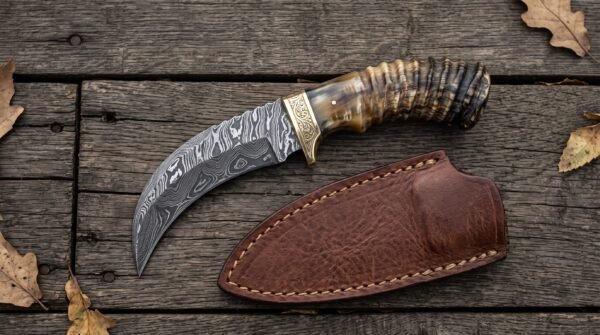
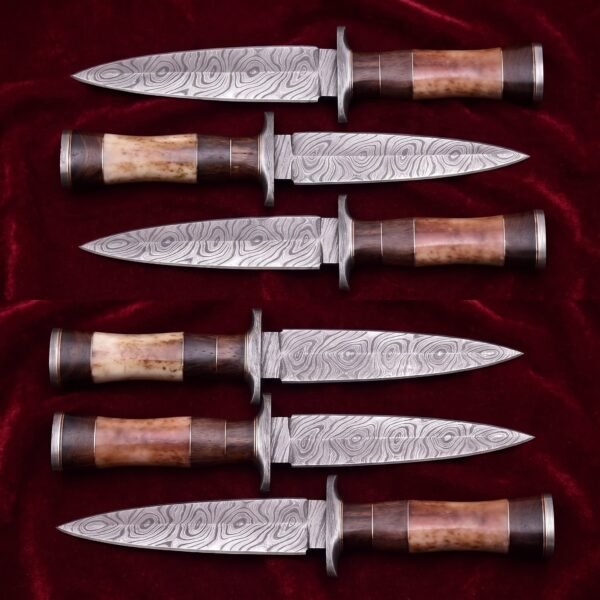
Another in the same line is the Talonvalk karambit knife, 11 inches overall. Next along the rack is the Talonveil karambit knife, 9 inches overall. For a straight comparison, see the Clawshade karambit knife, pattern welded Damascus.
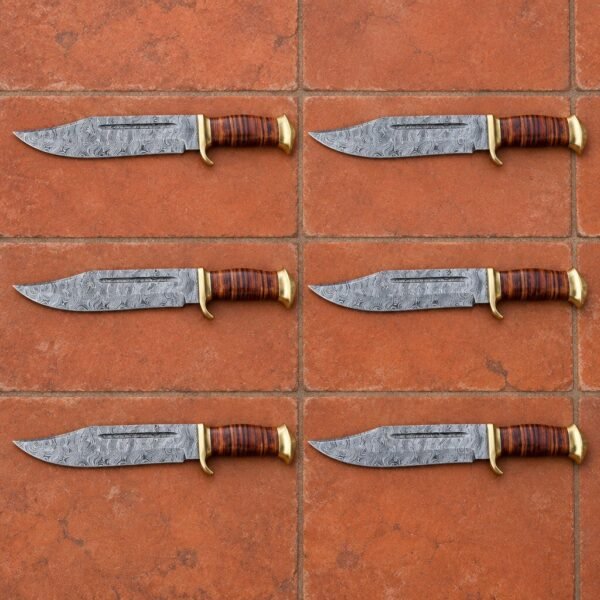
The Ramclaw Damascus skinner knife covers the other half of the same kit. Nothing here exactly right, build one to your own spec on the custom Damascus knife page.


Reviews
There are no reviews yet